Hall Review 2026
Monitors how brands appear in AI-generated search responses. Provides visibility tracking and competitive intelligence across major LLM-powered search platforms.
Key takeaways
- Hall is a GEO/AI search monitoring platform that tracks brand visibility across 8 AI platforms, including DeepSeek -- broader model coverage than many competitors
- Lacks content generation, AI crawler logs, traffic attribution, and Answer Gap Analysis that Promptwatch offers -- Hall is primarily a monitoring dashboard, not an optimization platform
- Free tier available, making it accessible for small teams or those just starting to explore AI visibility
- Paid plans start at $199/month, which is competitive but still monitoring-only
- Best suited for brands and agencies that want a lightweight, affordable entry point into AI search tracking without needing deep optimization workflows
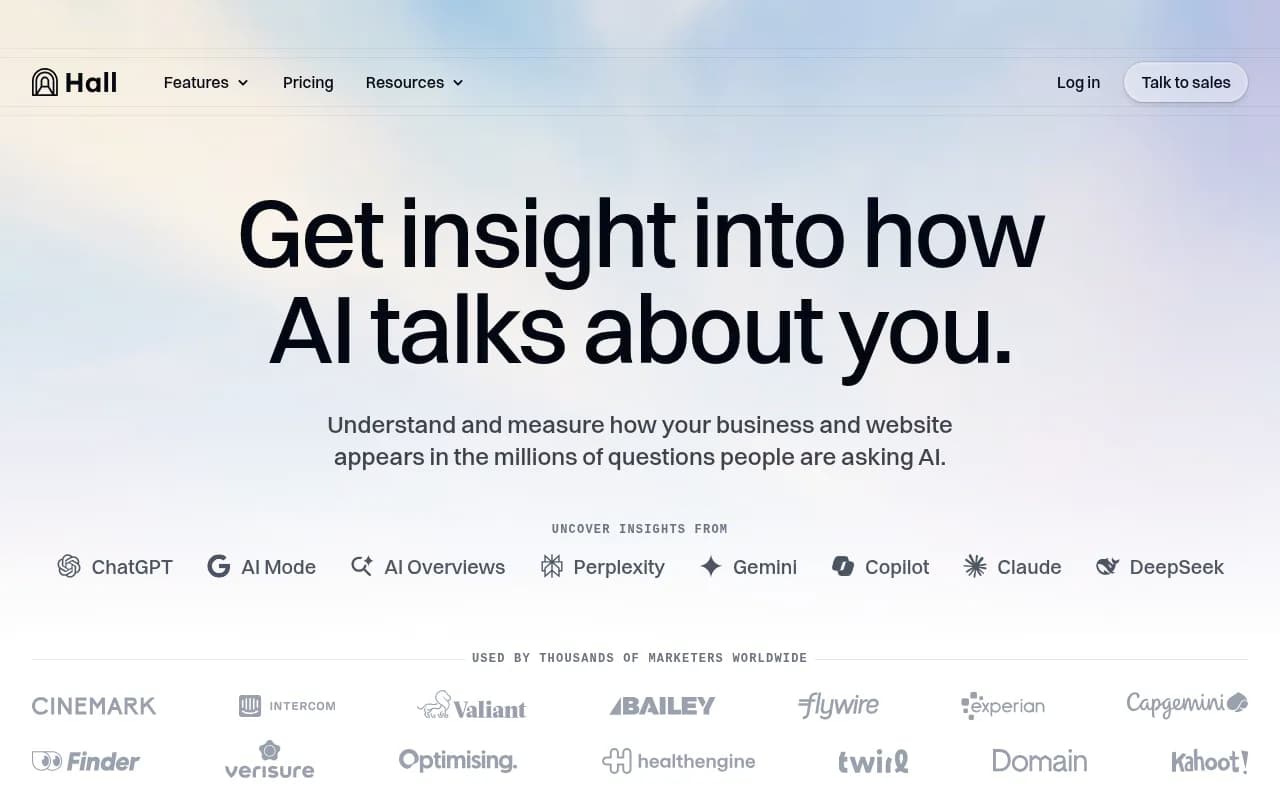
Hall is a GEO (Generative Engine Optimization) monitoring platform designed to help brands understand how they appear in AI-generated search responses. The core premise is straightforward: as more users turn to ChatGPT, Perplexity, Gemini, and similar tools to answer questions, traditional search rankings matter less and AI citation visibility matters more. Hall tracks that visibility, showing you when and how your brand gets mentioned in AI answers across a range of platforms.
The tool targets marketing teams, SEO professionals, and digital agencies that are starting to pay attention to AI search as a channel. It positions itself as accessible -- the free tier is a genuine differentiator in a market where most competitors charge from day one -- and its coverage of 8 AI platforms, including DeepSeek, is broader than several established players. That said, Hall sits firmly in the monitoring camp. It shows you what's happening but doesn't help you change it, which is a meaningful limitation as the GEO space matures.
Hall appears to be a relatively recent entrant to the AI visibility market, launching as the GEO category itself was taking shape in 2024-2025. It has positioned itself around accessibility and breadth of platform coverage, carving out space against both enterprise-focused tools like Profound and lighter-weight trackers like Otterly.AI.
Key features
Multi-platform AI monitoring Hall tracks brand mentions and citations across 8 AI platforms. The list includes the obvious ones -- ChatGPT, Perplexity, Google AI Overviews, Gemini -- but also DeepSeek, which is notable. DeepSeek coverage is something many competitors haven't prioritized, and for brands with international audiences (particularly in markets where DeepSeek has traction), this matters. The monitoring works by running prompts against these platforms and recording how your brand appears in the responses.
Brand visibility tracking The core dashboard shows how often your brand appears in AI-generated answers for tracked prompts. You can see visibility scores over time, which gives you a sense of whether your AI presence is growing or shrinking. This is the fundamental use case: knowing whether AI models are recommending or mentioning your brand when users ask relevant questions.
Competitive intelligence Hall lets you track competitors alongside your own brand, so you can see who's winning visibility for specific prompts. This is useful for understanding the competitive landscape in AI search -- which brands are getting cited, how often, and in what context. The comparison view helps teams prioritize which areas to focus on.
Prompt tracking You set up prompts that represent the kinds of questions your target customers might ask AI tools. Hall then monitors those prompts across its covered platforms and reports back on how your brand appears (or doesn't). The quality of your prompt selection directly affects the usefulness of the data, which is a limitation of any prompt-based monitoring tool.
Free tier Hall offers a genuinely usable free plan, which is uncommon in this space. For small businesses, solo marketers, or teams that want to experiment with AI visibility tracking before committing budget, this is a real advantage. The free tier has limitations on the number of prompts and platforms, but it's enough to get a meaningful read on your AI presence.
Reporting and dashboards Hall provides dashboards that visualize brand visibility over time, competitive comparisons, and prompt-level breakdowns. The reporting is designed to be shareable, which matters for agencies or in-house teams that need to communicate AI visibility metrics to stakeholders who aren't deep in the weeds.
Platform coverage breadth With 8 platforms covered, Hall's breadth is a genuine selling point. Many competitors focus on 4-6 platforms, often skipping newer or less mainstream models. Hall's inclusion of DeepSeek alongside the major players gives it an edge for teams that want comprehensive coverage without stitching together multiple tools.
Who is it for
Hall fits best for small to mid-sized marketing teams and digital agencies that are just beginning to take AI search visibility seriously. Think a 5-20 person marketing team at a SaaS company that's noticed traffic from AI referrals and wants to understand what's driving it, or a boutique SEO agency managing 10-30 client accounts that needs a cost-effective way to report on AI visibility without a massive platform investment.
The free tier makes Hall particularly appealing for freelancers and consultants who want to add AI visibility reporting to their service offering without upfront cost. If you're a solo SEO consultant advising clients on GEO, Hall gives you a starting point that doesn't require selling a $500/month tool to every client.
Where Hall is less suited: brands that need to act on their AI visibility data, not just observe it. If you're running a content team and want to know exactly what to write to improve your AI citations, Hall won't tell you that. It shows you the gap but doesn't help you close it. Similarly, e-commerce brands tracking ChatGPT Shopping recommendations or brands that need AI crawler log data to diagnose indexing issues will find Hall's feature set too thin.
Enterprise teams with complex multi-site, multi-region, multi-language requirements will also likely outgrow Hall quickly. The platform's accessible pricing and straightforward setup suggest it's optimized for simplicity, not for the kind of deep configuration that large organizations need.
Integrations and ecosystem
Hall's integration ecosystem appears limited compared to more established platforms. There's no publicly documented API for custom data pipelines, no native Looker Studio connector, and no mention of integrations with tools like Google Search Console, Slack, or Zapier. For teams that want to pull AI visibility data into their existing reporting stack, this is a gap.
There's no browser extension or mobile app documented. The platform appears to be primarily a web dashboard. Export capabilities for reports likely exist in some form, but the depth of data export options isn't clear from available information.
This is an area where Hall trails more mature platforms significantly. If your team runs reporting through Looker Studio or needs to pipe data into a data warehouse, you'll need workarounds.
Pricing and value
Hall's pricing structure is one of its clearest differentiators:
- Lite (Free): Entry-level access with limited prompts and platform coverage. Enough to get started and understand the product.
- Starter ($199/month): Expanded prompt tracking, more platforms, suitable for small teams or agencies with a handful of clients.
- Business ($599/month): Broader coverage, more prompts, designed for growing teams with multiple brands or clients.
- Enterprise (from $1,499/month): Custom configurations for larger organizations.
The free tier is genuinely useful and rare in this category. The Starter plan at $199/month is competitive -- it's cheaper than Promptwatch's Professional plan at $249/month -- but the comparison isn't apples-to-apples. Hall at $199 gives you monitoring; Promptwatch at $249 gives you monitoring plus content gap analysis, AI content generation, crawler logs, and traffic attribution.
The Business plan at $599/month is in the same range as Promptwatch's Business tier at $579/month, again with the same caveat: Hall is monitoring-only at that price point, while Promptwatch includes the full optimization workflow.
For teams that genuinely only need monitoring and don't plan to use content generation or crawler analytics, Hall's pricing is reasonable. But for teams that want to actually improve their AI visibility (not just track it), the value equation shifts.
Strengths and limitations
What Hall does well:
- The free tier is a real differentiator. In a market where most tools charge from day one, Hall's willingness to let users start for free lowers the barrier meaningfully.
- Eight-platform coverage including DeepSeek is broader than many competitors. For brands that care about comprehensive AI monitoring, this matters.
- The interface appears designed for accessibility -- teams that aren't deeply technical can get up and running without a long onboarding process.
- Competitive intelligence features give teams a baseline understanding of who's winning AI visibility in their category.
Where Hall falls short:
- Monitoring-only. Hall shows you what's happening but provides no tools to change it. There's no Answer Gap Analysis, no content generation, no content briefs, and no optimization workflow. Platforms like Promptwatch go significantly further here.
- No AI crawler logs. Understanding which pages AI crawlers are visiting, how often, and whether they're encountering errors is increasingly important for GEO. Hall doesn't appear to offer this.
- No traffic attribution. Knowing that AI models cite your brand is useful; knowing that those citations drive actual website visits and revenue is more useful. Hall doesn't connect AI visibility to business outcomes.
- No Reddit or YouTube tracking. A meaningful portion of AI citations come from Reddit threads and YouTube content. Hall doesn't appear to surface these sources.
- No prompt volume or difficulty scoring. Without knowing which prompts have high search volume or are realistically winnable, teams are guessing at prioritization.
- No ChatGPT Shopping tracking. For e-commerce brands, this is a significant gap.
- Limited integrations. No API, no Looker Studio connector, no Slack or Zapier integration documented.
Bottom line
Hall is a reasonable starting point for teams that want to dip their toes into AI search monitoring without a major budget commitment. The free tier is genuinely useful, the platform coverage is solid, and the competitive intelligence features give you a basic read on the AI visibility landscape. If your goal is simply to know whether your brand is showing up in AI answers, Hall gets the job done at a fair price.
But if you want to do something about what you find -- identify content gaps, generate articles that target those gaps, track which pages AI crawlers are visiting, or connect AI citations to actual revenue -- Hall isn't built for that. For teams that need the full optimization loop, Promptwatch is the stronger choice: it covers more AI models, includes content generation and gap analysis, provides crawler logs and traffic attribution, and tracks Reddit, YouTube, and ChatGPT Shopping in ways Hall doesn't.
Best use case in one sentence: Hall works well for small marketing teams or agencies that want affordable, multi-platform AI visibility monitoring and don't yet need content optimization or deep analytics.
Frequently asked questions
What is Hall AI?
Does Hall have a free plan?
How much does Hall cost?
Which AI platforms does Hall monitor?
How does Hall compare to Promptwatch?
Who is Hall best suited for?
Similar and alternative tools to Hall