Key takeaways
- Peec AI is a strong monitoring tool with deep prompt-level analytics, but it scores low on actionable recommendations (6/10) and can get expensive as tracking needs grow.
- Radarkit is newer and more focused on helping teams act on what they find, not just observe it.
- Both tools cover the major AI engines (ChatGPT, Perplexity, Google AI Overviews, Claude, Gemini), but differ significantly in how they surface insights and what they expect you to do next.
- For mid-size teams without dedicated GEO specialists, the "what do I do now?" question matters as much as the data itself.
- If you need a full optimization loop (track gaps, generate content, measure results), neither tool fully covers it -- that's where a platform like Promptwatch becomes relevant.
AI search is no longer a niche concern. ChatGPT crossed 900 million weekly active users in February 2026. Google AI Overviews now appear across a wide share of high-intent queries. Perplexity has carved out a real slice of the research and analyst market. For mid-size marketing teams, this creates a practical problem: if a buyer asks ChatGPT which tools to use in your category, and you're not in the answer, you don't exist to that buyer.
That's the gap Peec AI and Radarkit both try to fill. They're dedicated AI visibility trackers -- tools that run prompts on a schedule, parse AI responses, and tell you how often your brand appears, where it sits relative to competitors, and what the sentiment looks like.
But they're not the same tool. This comparison breaks down where each one excels, where each one falls short, and which type of team is likely to get more out of each.
What each tool actually does
Peec AI
Peec AI is built specifically to monitor brand visibility inside large language models. It treats prompts as the core tracking unit: you define the questions your target buyers are asking, and Peec AI runs those prompts across AI engines on a schedule, then measures three things -- visibility (how often you're mentioned), position (where in the response you appear), and sentiment (positive, neutral, or negative framing).

The platform covers ChatGPT, Perplexity, and Google AI Overviews as its primary surfaces, with additional model coverage depending on your plan. Its strength is in prompt-level granularity. You can drill into individual responses, see which sources were cited, and compare your citation share against specific competitors over time.
One review from the AI visibility tracking site aiadvantageagency.com notes that Peec AI is "the strongest AI visibility tracking tool for agencies because it includes unlimited users and free pitch workspaces on every paid plan." That's a meaningful differentiator if you're running client work.
The honest limitation, noted even in Radarkit's own review of Peec AI: the platform shows you what's happening but doesn't always tell you what to do about it. Built-in actionable recommendations score 6/10 in Radarkit's breakdown. That's not a fatal flaw, but it means your team needs to interpret the data and figure out the response strategy independently.
Radarkit
Radarkit positions itself as an AI search and GEO visibility tracker with a stronger emphasis on surfacing next steps alongside the data. It covers similar ground to Peec AI -- prompt tracking, citation analysis, competitor benchmarking -- but the product philosophy leans more toward helping teams act on what they find.
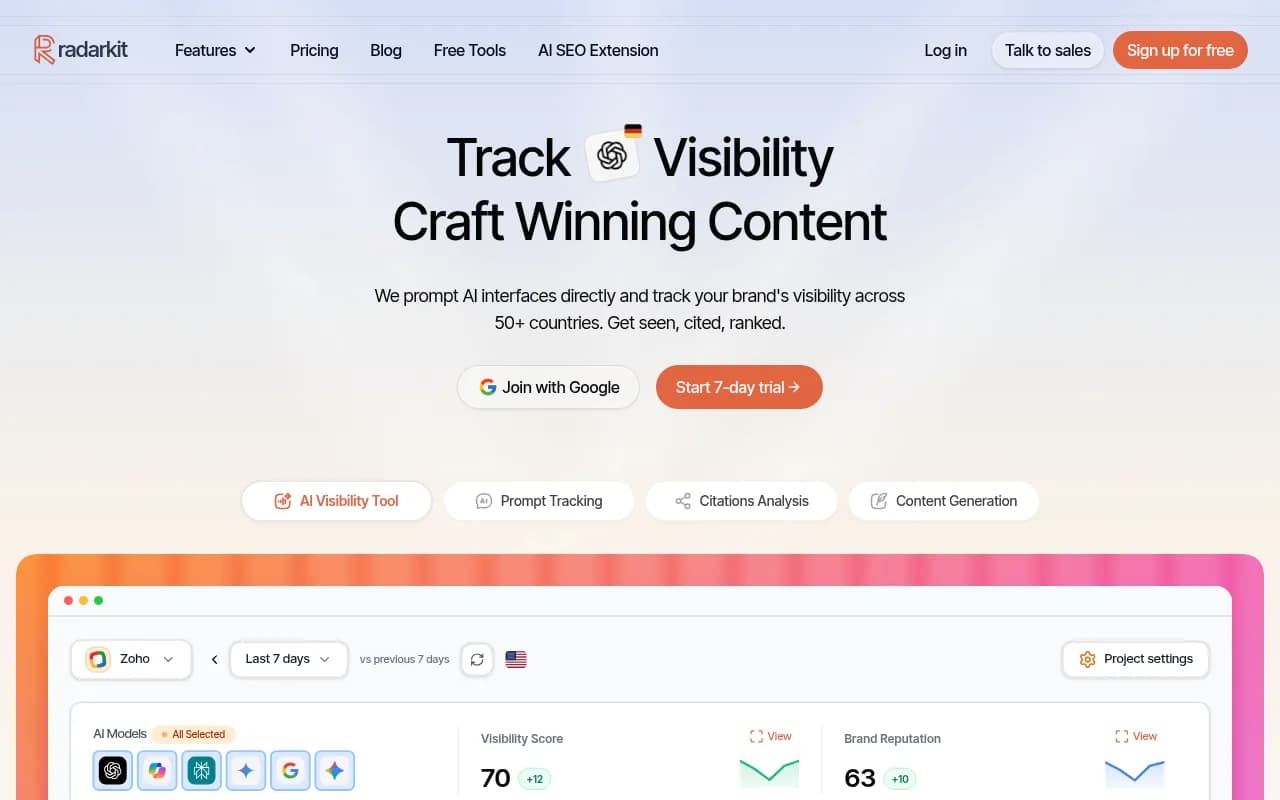
Radarkit's blog content (including their own review of Peec AI) suggests the company is actively targeting teams that feel stuck after seeing their visibility data. That's a real pain point. Knowing you're missing from 70% of relevant AI responses is useful. Knowing which content gaps are causing that, and what to write to fix it, is more useful.
The trade-off is that Radarkit is a younger product. Its data depth and historical tracking breadth are still catching up to Peec AI, which has been in the market longer and has processed more prompt data.
Head-to-head comparison
| Feature | Peec AI | Radarkit |
|---|---|---|
| AI engines covered | ChatGPT, Perplexity, Google AI Overviews, Claude, Gemini | ChatGPT, Perplexity, Google AI Overviews, Claude, Gemini |
| Prompt-level tracking | Yes, strong | Yes |
| Citation analysis | Yes | Yes |
| Competitor benchmarking | Yes (8/10 rating) | Yes |
| Sentiment tracking | Yes | Yes |
| Actionable recommendations | Limited (6/10) | Stronger focus |
| Content gap analysis | Minimal | More developed |
| Unlimited users | Yes (all paid plans) | Plan-dependent |
| Agency pitch workspaces | Yes | Not confirmed |
| Ease of use for beginners | 6/10 | Better onboarding |
| Historical data depth | Strong (older platform) | Still building |
| Pricing transparency | Tiered, can escalate | Competitive |
Where Peec AI wins
If your team is already comfortable with SEO analytics and just needs a dedicated AI visibility layer, Peec AI is a mature, well-rounded tool. The prompt-level data is detailed. The competitor benchmarking is solid. The citation tracking gives you a real picture of which sources AI engines are pulling from when they mention (or skip) your brand.
The unlimited users feature on paid plans is genuinely useful for agencies. Running client visibility reports without worrying about seat counts is a real operational advantage.
Peec AI also scores well on reporting and exports (8/10 in Radarkit's breakdown), which matters if you're presenting AI visibility data to stakeholders who aren't in the platform day-to-day.
The weakness is the "now what?" problem. Peec AI gives you a clear picture of your current state. It doesn't do much to help you change it. For teams with a dedicated SEO strategist who can translate visibility data into content briefs and optimization tasks, that's fine. For teams without that resource, it can feel like a very expensive dashboard.
Where Radarkit wins
Radarkit's core argument is that monitoring without action is incomplete. The platform is built around helping teams close the loop between "we're not visible here" and "here's what we should publish."
For mid-size teams where one person is wearing both the SEO and content strategy hat, that matters. You don't want to spend three hours interpreting a visibility dashboard before you can write a single brief. Radarkit's design philosophy tries to compress that gap.
The onboarding experience is also reportedly smoother for teams that aren't deep SEO practitioners. Peec AI's dashboard can take time to get comfortable with -- Radarkit's approach is more guided.
The honest limitation: Radarkit is newer. If you need two years of historical prompt data or a very mature competitor tracking dataset, Peec AI has the edge simply by virtue of being in the market longer.
The "what do I do next?" problem
This is worth dwelling on because it's the central tension in this comparison -- and in the AI visibility tool category more broadly.
Most AI visibility tools were built to answer "where do we stand?" That's a useful question. But for a mid-size marketing team with limited bandwidth, the more valuable question is "what should we do this week to improve our standing?"
Peec AI scores 6/10 on built-in actionable recommendations. That's not a knock -- it reflects an honest product philosophy that says "we give you the data, you figure out the strategy." For sophisticated teams, that's fine. For everyone else, it creates friction.
Radarkit is trying to solve this, but it's a hard problem. Telling a team "you're missing from 65% of prompts in your category" is easy. Telling them exactly which content to write, in what format, targeting which angle, to move that number -- that requires a much deeper layer of prompt intelligence, content gap analysis, and ideally some content generation capability.
The tools that do this well are typically more comprehensive platforms. Promptwatch, for example, is built around a full optimization loop: find the gaps (Answer Gap Analysis), create content grounded in real prompt data (Content Agents), and track the results as AI engines start citing the new pages. That's a different scope than either Peec AI or Radarkit, but it's worth knowing the category exists if your team needs more than monitoring.

Pricing and scalability
Both tools use tiered pricing models. Peec AI's pricing can escalate as your tracking needs grow -- more prompts, more competitors, more AI engines all push you toward higher tiers. Radarkit's pricing is competitive but less publicly documented.
For mid-size teams, the key question is: what does it cost to track 100-200 prompts across 5 AI engines, with 3-5 competitors, updated weekly? Both tools should be able to quote this, and it's worth getting a direct comparison before committing.
One thing to watch with Peec AI specifically: the unlimited users feature is appealing, but plan limits on prompt volume can become a ceiling faster than expected as your AI visibility program matures. Teams often start with 30-50 prompts and realize within a few months they need 150+.
Who should use which tool
Choose Peec AI if:
- Your team has SEO experience and can interpret visibility data without hand-holding
- You're running an agency and need unlimited users and client pitch workspaces
- You want mature, detailed prompt-level analytics with strong reporting exports
- Historical data depth matters for your benchmarking
Choose Radarkit if:
- Your team is newer to AI visibility and wants more guided next steps
- You want a tool that connects monitoring to action more directly
- You're a mid-size in-house team without a dedicated GEO specialist
- You're evaluating newer tools and want to support a product that's actively building toward the action layer
Consider a broader platform if:
- You need content generation alongside monitoring (not just briefs, but actual drafts grounded in prompt data)
- You want crawler logs showing which AI agents are hitting your site and when
- You need to connect AI visibility to actual traffic and revenue attribution
- You're tracking across 10+ AI engines with multi-language or multi-region requirements
The broader landscape
It's worth noting that Peec AI and Radarkit are two tools in a category that now includes 12+ dedicated platforms, plus AI features added to traditional SEO suites like Semrush and Ahrefs.
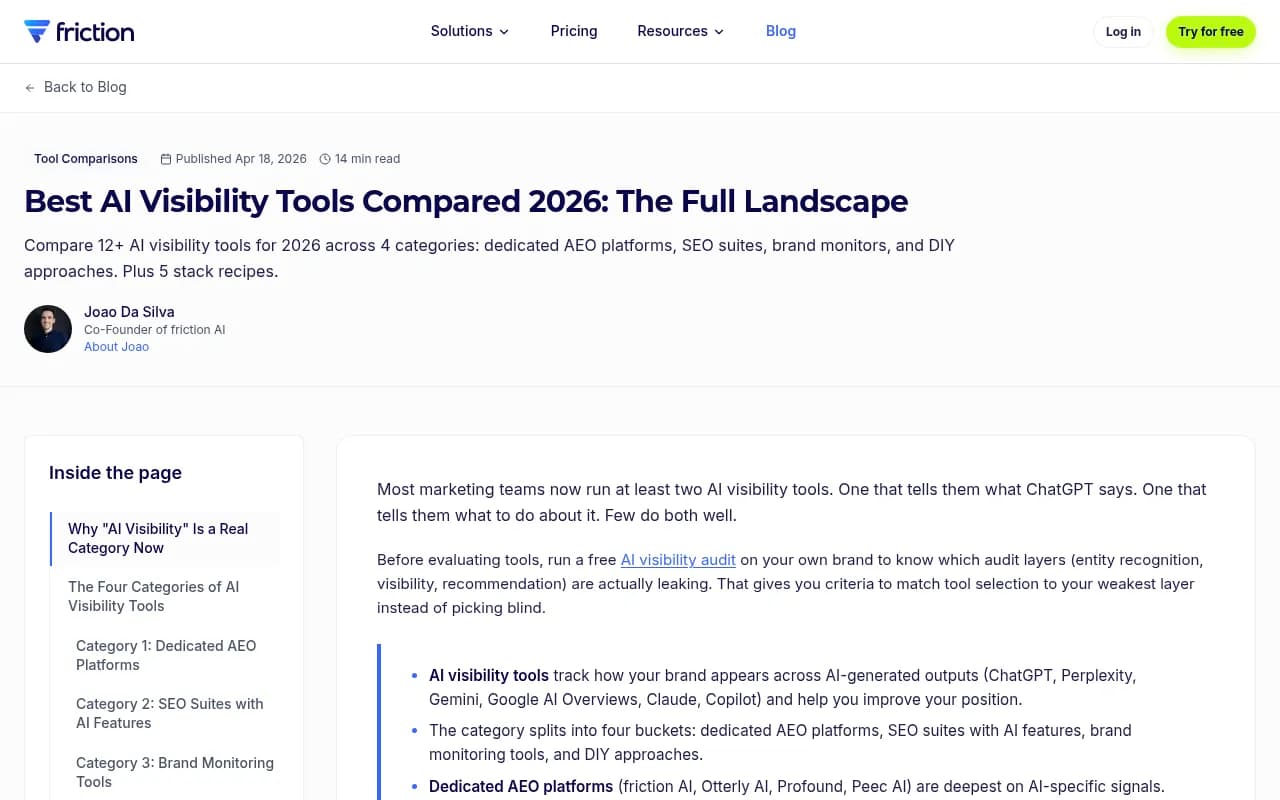
The category splits roughly into monitoring-only tools (show you the data), and optimization platforms (show you the data and help you act on it). Peec AI sits firmly in the monitoring category with strong analytics. Radarkit is trying to bridge toward optimization. Platforms like Promptwatch, Profound, and others are further along the optimization side.

For most mid-size teams, the right answer isn't necessarily the most feature-rich tool -- it's the one your team will actually use consistently. A simpler tool that gets checked weekly beats a comprehensive platform that collects dust after the first month.
Final take
Peec AI is a solid, mature AI visibility tracker. If you have the SEO chops to use the data well, it's one of the better monitoring tools available. The 7.3/10 overall rating from Radarkit's review feels about right -- strong on data, weaker on telling you what to do with it.
Radarkit is a credible alternative, especially for teams that want more guidance baked into the product. It's newer, which means some rough edges, but the product direction is sensible.
Neither tool is a complete solution if your goal is to actually improve your AI visibility, not just measure it. For that, you need something that closes the loop from gap identification to content creation to result tracking. That's a harder problem, and the tools solving it well are worth evaluating separately.
Start with a clear question: do you need to understand your AI visibility, or do you need to improve it? The answer shapes which tool category you should be shopping in.