Key takeaways
- A free manual baseline (about 20 prompts, once a month) is the right first step. It tells you more than most first dashboards will.
- Free methods break down on volume and repeatability. AI answers vary run to run, so one check proves little.
- Paid Perplexity tracking starts around $29 a month and climbs past $300 for enterprise tools. Work out cost per prompt and per engine, not the sticker price.
- Perplexity is the most stable engine to test against: it cites almost exactly 10 sources per answer, so URL-level tracking is worth the effort.
- Most tools track Perplexity as one engine among several. Check which engines are included and which are paid add-ons.
Why Perplexity needs its own tracking
Perplexity does not return a ranked list of ten blue links. It writes an answer and cites a handful of sources. There is no position three. You are cited, mentioned, or absent.
That changes what you measure. You want to know whether your brand is named in the answer (a mention), whether your domain is linked as a source (a citation), and how often both happen across the prompts your buyers actually use.
Sourcing also differs by engine, so a good result on ChatGPT does not carry over. In Promptwatch's social media citations report for Sep 28 to Oct 4, 2026, social platforms made up 2.7% of Perplexity's citations, with LinkedIn and Reddit tied at 0.86% each. ChatGPT got just 0.46% of its citations from social platforms in the same week, and Google AI Overviews got 12.2%. Same prompts, very different source mixes.
Perplexity is also unusually steady. Promptwatch's average sources per response data shows Perplexity citing almost exactly 10 sources per answer, day after day, versus roughly 5 for ChatGPT web-search answers. That makes it a decent test bench: if your pickup changes, your content is a more likely cause than engine noise. With about 10 slots per answer, mid-authority and specialist sites have a realistic shot, which is why tracking at the URL level matters and not only brand mention rate.
The free method: a 20-prompt baseline
I would start here even if you plan to buy a tool. It forces you to read actual answers, which a dashboard percentage hides.
Build the prompt set
Write 20 prompts in four groups of five:
- Category prompts: "best [product type] for [use case]"
- Comparison prompts: "[you] vs [competitor]"
- Brand prompts: "what is [your brand]", "is [your brand] worth it"
- Adverse prompts: "problems with [your brand]", "[your brand] alternatives"
Run them in Perplexity once a month. Add ChatGPT, Gemini and Google AI Overviews if you want a wider view, since the engines disagree a lot.
Log what matters
A spreadsheet is enough. For each run, record:
- Date and exact prompt text
- Whether your brand is mentioned (yes/no)
- Whether your domain is cited, and which URL
- Which competitors appear
- Which domains are cited that are not yours
- Tone of the mention (positive, neutral, negative)
The last two columns are where the value is. The list of cited third-party domains is your outreach and content to-do list.
Run each prompt more than once
SparkToro published research on 28 January 2026 finding that ChatGPT and Google AI returned the same list of brands in fewer than 1 in 100 runs. The study was not Perplexity-specific, but the lesson carries over. Run each prompt three to five times and record a rate, not a single yes or no.
Free vendor tools
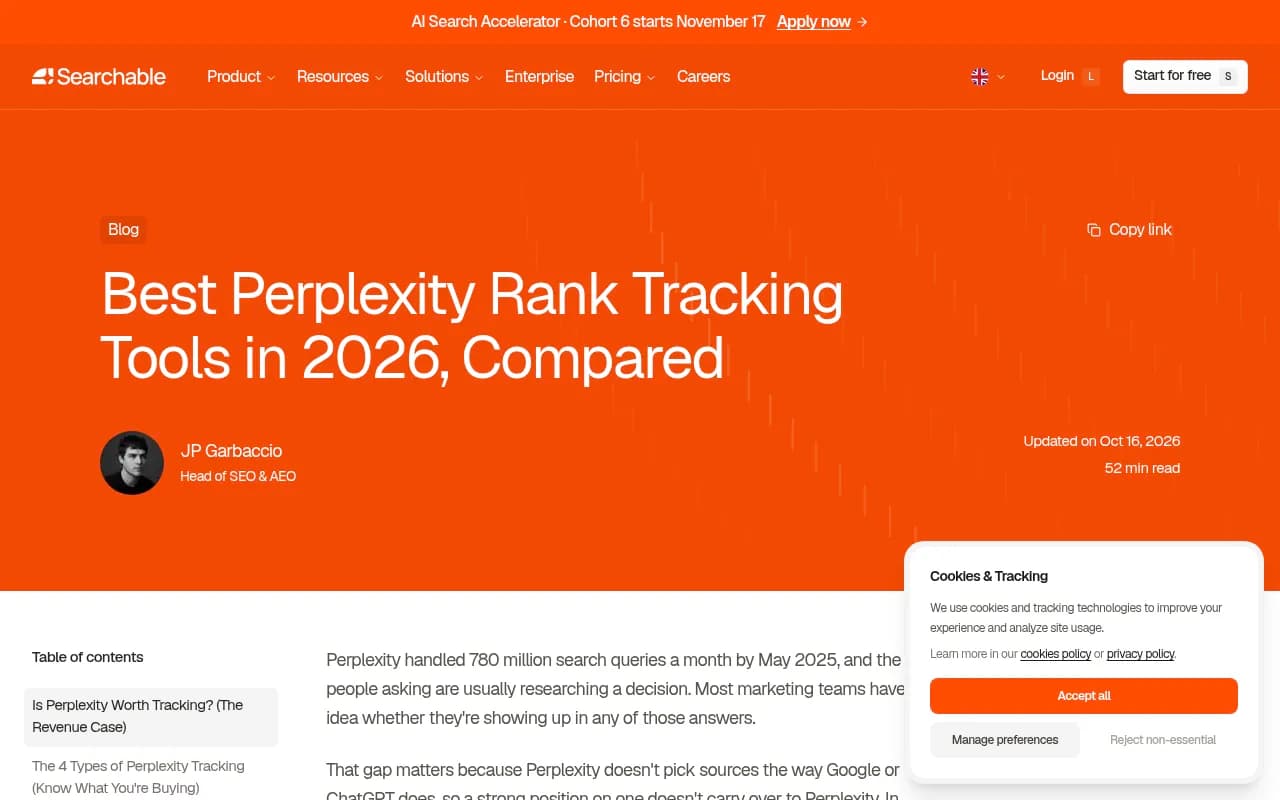
Some vendors give away a one-off scan. Searchable offers a free visibility report, and Promptwatch has a free AI Visibility Report that checks how ChatGPT, Gemini and Perplexity talk about your brand with no login. Treat these as snapshots, not monitoring.
Where free breaks down
A manual process is fine for spot-checks. It fails when:
- You need more than about 30 prompts, or weekly or daily runs
- You want trends, not snapshots
- You track several competitors, countries or languages
- A client or boss wants a report on Monday
- You want to connect citations to traffic and conversions
One other catch: manual Perplexity checks depend on your logged-in state, location and history. Use a private window and note the country you ran from, or your results will not be comparable month to month.
What paid tools add
Paid tools automate the same thing at scale: scheduled runs, many repetitions, stored answers, competitor tracking and reporting. The good ones let you open the underlying answer so you can check the number. A dashboard that only shows a visibility percentage can hide a lot.
The better ones also go beyond monitoring. Crawler logs show whether AI bots can read your site, visitor analytics tie AI referrals to conversions, and content tools help you fix gaps. Most budget trackers stop at the first step.
Entry-level trackers
Prices below come from vendor pages and third-party roundups dated through October 2026 and change often. Confirm on each vendor's site.
Otterly.AI starts at $29 a month for 15 prompts across four engines.

Peec AI starts at $95 a month for 50 prompts on three engines (one source lists EUR 85), with extra engines as paid add-ons and a 7-day trial.

AIclicks lists a Starter plan at $59 a month for 30 prompts on three engines, with GA4, API and MCP from Pro.
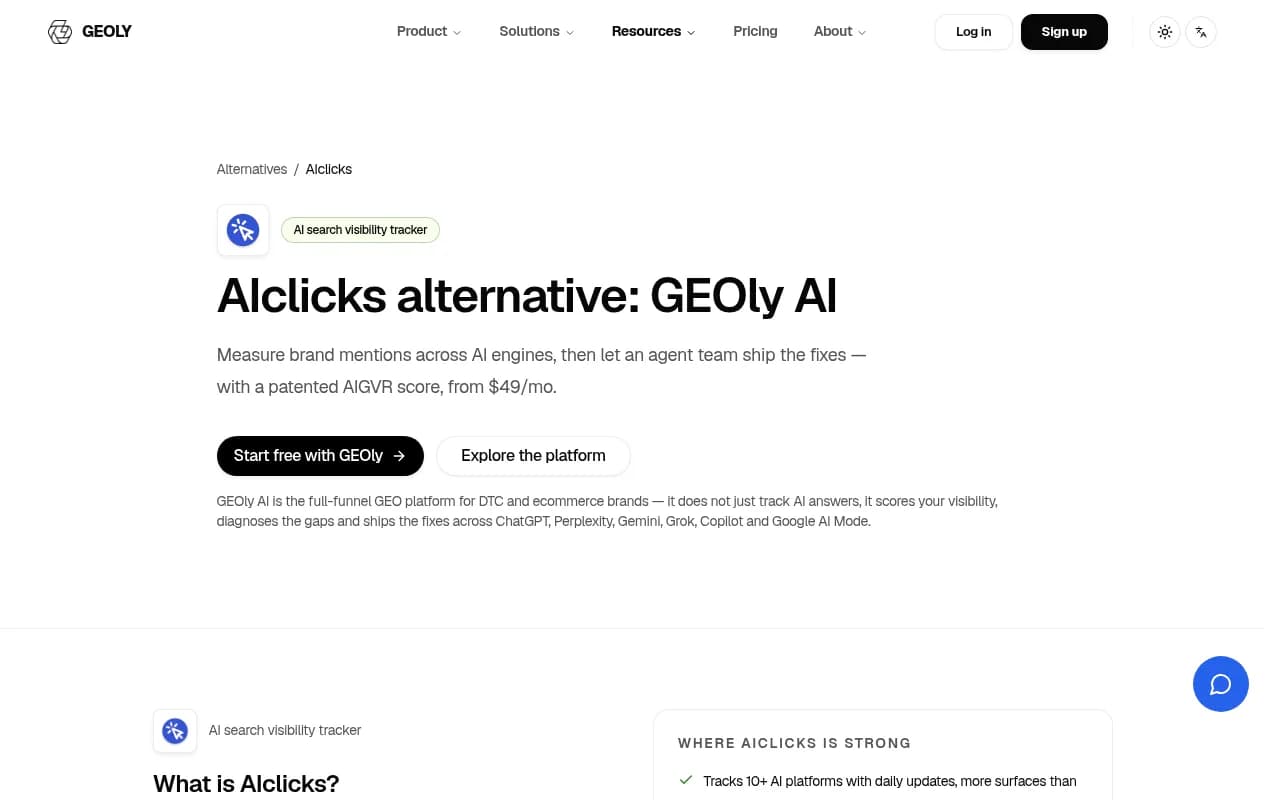
Rankability is aimed at agencies, tracking 11 platforms daily with agency-branded reports from $97 a month, though its tracked-query caps are 100, 300 or 500 by plan.
Keyword.com is credit-based. Chat-app engines cost 0.25 credit a run, while API-model engines including Perplexity Sonar cost 1 credit a run. That matters because Perplexity runs are the expensive ones on that model.
Mid-market and suites
Semrush's AI Toolkit starts at $99 a month standalone for 25 prompts and one domain. Ahrefs Brand Radar starts around $129 a month and overlays backlink data. HubSpot's AEO tools offer a one-time grader and ongoing monitoring from about $50 a month.

Suites are convenient if you already live in them. The trade-off is usually a fixed prompt set and shallower AI-specific data.
Dedicated platforms
LLM Pulse lists a EUR 49 plan with 5 models, 50 prompts and full citation extraction. Searchable starts from $125 a month with a free visibility report. Leapd's Alex starts at $39 a month with a 2-day trial. Profound and Scrunch sit at the enterprise end, from roughly $300 to $399 a month and well into the thousands for full coverage.




For an end-to-end option, Promptwatch monitors the real Perplexity interface rather than only the API, and adds IP-verified AI crawler logs, visitor analytics for AI-referred traffic, and a Content Agent that writes and publishes against your gaps. Paid plans start at $95 a month (Essential, 50 prompts, all models), and a free Explore plan covers ChatGPT only, so Perplexity tracking needs a paid tier. Confirm current terms at promptwatch.com/pricing.

Free vs paid at a glance
| Approach | Cost | Volume | Repeatability | Best for |
|---|---|---|---|---|
| Manual 20-prompt baseline | Free (your time) | About 20 prompts monthly | Low, depends on your session | First look, tiny brands |
| Free vendor visibility report | Free | One-off scan | None, snapshot only | Sanity check before buying |
| Entry tracker (Otterly, AIclicks, Peec) | $29 to $95/mo | 15 to 50 prompts | Scheduled, stored answers | Small teams starting out |
| Suite add-on (Semrush, Ahrefs) | About $99 to $129/mo | 25+ prompts, fixed sets | Scheduled | Teams already in the suite |
| Dedicated GEO platform | $95 to $579/mo and up | 50 to 350+ prompts | Daily, multi-model, multi-country | Teams that want to fix gaps, not only watch them |
| Enterprise tools | $300 to $399/mo and up | Custom | Daily | Large brands, procurement needs |
How to compare prices honestly
Sticker prices mislead. One roundup does the math nicely: a $29 plan with 15 prompts costs roughly $1.93 per prompt, while a EUR 49 plan with 50 prompts works out to about EUR 0.98 per prompt. Do the same with your real numbers.
Before buying, answer these:
- How many prompts do you actually need? Start from your 20-prompt baseline and grow.
- Which engines are included? Perplexity is often bundled, but Google AI Mode, Gemini and Claude are sometimes paid add-ons.
- Is the price per prompt, per engine, per credit or per seat?
- Can you open the underlying answers and cited URLs?
- Does the tool track citations and mentions separately?
- Are there limits on refresh frequency? Some pricing pages do not state one.
- Does the trial need a card? Several 3-day and 7-day trials do.
- Can it connect to analytics, so you can see traffic and conversions, not only mentions?
Treat vendor-published comparisons with care. Several of the roundups behind these prices are written by tool vendors who rank themselves first. They are useful for price points, less so for rankings.
A practical workflow
- Run the free baseline this week. Note your mention rate, your citation rate and the top five domains Perplexity cites instead of you.
- Pick two or three tools with a free trial and load the same 20 prompts into each. Compare whether the numbers can be traced back to real answers.
- Decide on engines. If Perplexity is the only one that matters to you, a cheap tracker may be enough. If your buyers use several assistants, pay for multi-engine coverage.
- Track at the URL level. With roughly 10 sources per Perplexity answer, knowing which of your pages get cited tells you what to update.
- Re-check monthly. Citation behavior shifts quickly, and a result from last quarter may not hold.
If you want to compare more options, the AI rank tracking directory and the GEO software directory list dozens of trackers side by side.
When free is enough, and when it is not
Stay free if you are a small brand with a narrow category, you only care about a few prompts, and you can spare an hour a month. Move to paid when you need daily data, competitor tracking across markets, client reporting, or any link between AI visibility and revenue.
My own view: the biggest mistake is skipping the manual baseline and buying a dashboard first. You end up with charts you cannot interpret. Read twenty real Perplexity answers first, then buy the tool that makes that reading faster and repeatable.
Bottom line
A manual 20-prompt log costs nothing and will tell you where you stand. Once you need volume, history and reporting, pick a paid tracker based on cost per prompt, engine coverage and whether you can inspect the answers behind the numbers. Verify every price on the vendor's own page before you commit.