Key takeaways
- Scrunch's Core plan ($250/mo) covers 4 LLMs and 125 prompts but only ships "basic" content generation and a single page optimization a month; real execution is gated to Enterprise.
- A Scribewise/Scrunch survey of 602 marketing and PR professionals found only 23% are actively refining content to improve AI citation, even though 91% claim to have an AI visibility strategy.
- The platforms worth switching to fall into two camps: dedicated GEO/agentic-content tools (AthenaHQ, Yotpo Discover, Evertune) and content-workflow tools bolting on visibility tracking (AirOps).
- Citation slots are scarce and shifting: ChatGPT cites roughly 5 sources per response versus Google AI Overviews' 10, and how-to and documentation content is growing fastest while product/landing pages lose share.
- Agentic content generation carries real risk (hallucination, voice drift, review bottlenecks), so the right tool pairs automation with a human review layer, not a fire-and-forget pipeline.
Why Scrunch alone isn't enough anymore
Scrunch built its reputation as an AXP, an "Agent Experience Platform," tracking how brands show up across ChatGPT, Perplexity, Google AI Overviews, and Copilot. That part works. The Core plan, at $250 a month, gives you 125 prompts, 5,000 monthly responses, and five competitor slots. It's a solid dashboard.
The problem shows up the moment you try to act on what the dashboard tells you. Core includes "basic" content generation and exactly one page optimization per month. If your audit turns up twenty pages with citation gaps, you're optimizing one and staring at the other nineteen until next month, or until you upgrade to Enterprise and its custom pricing. One reviewer at geotoolbox.ai summed it up as "strong diagnosis; thin on execution," which is a fair read of a lot of tools in this category, not just Scrunch.
That gap between diagnosis and execution is exactly what the 2026 Scribewise/Scrunch survey of 602 marketing and PR professionals captured. Ninety-one percent of respondents said they have a documented AI search strategy. Only 23% said they're actually focused on refining existing content to improve AI citation, and just 33% analyze AI bot traffic at all. Scrunch's own Head of Marketing put it plainly in the release: "Visibility into AI-generated answers is foundational, but it's only the first step... turning that data into prescriptive action is how brands become the answer in AI search." I'd go further: most teams don't lack visibility data anymore. They lack the staff-hours to turn that data into fifty rewritten pages before the next model update makes the data stale.
That's the gap agentic content platforms are trying to close. Instead of handing you a spreadsheet of gaps, they assign an agent to go write the page, update the schema, or draft the comparison content, and in some cases publish it straight to your CMS.
What "agentic content generation" actually means here
Worth being precise about this, because the term gets used loosely. In this category it means a system that:
- Identifies a specific visibility gap (a prompt where a competitor gets cited and you don't, a page AI crawlers hit and bounce from, a topic with no coverage)
- Generates a draft, brief, or full article addressing that gap, grounded in your existing content and brand voice
- Either queues it for human review or pushes it directly into your CMS
- Re-checks citation performance after publishing to confirm the fix worked
That loop, gap to draft to publish to re-check, is what separates an agentic platform from a tracker with a "generate content" button bolted on.
The content that's actually worth fixing first
Before picking a tool, it helps to know what AI engines are rewarding right now, because agentic platforms will happily generate the wrong thing at scale if you let them. Promptwatch's data on ChatGPT citation types shows product pages holding about 25-30% share through August 2026, but that share is shrinking: how-to content more than doubled from 4.3% to 9.1% of citations over the month, and documentation nearly doubled too, from 3.3% to 8.2%. Social posts, meanwhile, collapsed from 4.4% to under 1% after August 14, the same week Reddit's citation share in ChatGPT fell from 3.8% to 0.5% (see Promptwatch's data on Reddit citations dropping in ChatGPT and the ChatGPT citation types breakdown).
There's also a domain-authority angle that changes who can realistically win. Mid-authority domains, DR 46-75, took nearly half of ChatGPT's citations in August 2026, while the very biggest sites (DR 91-100) saw their share shrink from roughly 7% to 3% over the same period, per Promptwatch's citation-share-by-domain-rank data. If you're a mid-market brand worried that agentic content can't compete with Wikipedia and Forbes, this is the number that says otherwise.
And there's a hard ceiling to keep in mind: Promptwatch's average-sources-per-response data shows ChatGPT cites roughly 5 sources per web-search response, half of what a traditional Google results page shows, while Google AI Overviews and Perplexity each cite closer to 10. Fewer slots means every piece of content an agent generates needs to be competitive, not just present.
The alternatives that actually execute
AthenaHQ
AthenaHQ is the closest thing to an apples-to-apples Scrunch replacement, and it's the one independent reviewers keep pointing to as the "enterprise-depth alternative at a self-serve price." Starter runs about $270-295/month billed annually (3,600 monthly credits), Growth is $545/month, and Enterprise starts around $2,000+.

What matters here is the "content optimization agent" bundled into the Starter tier alongside on-page and off-page actions, plus its proprietary Athena Citation Engine (ACE), which analyzes citation-probability patterns to predict what content is likely to get picked up before you publish it. In AthenaHQ's own comparison against Profound, Starter at $295/month includes unlimited seats and 11 tracked AI models, versus Profound Growth at $399/month with 3 seats and 3 engines. Vendor case studies claim gains like a 40% increase in brand mention rate and a 5x increase in AI content citations; treat those as vendor-supplied, but the Action Center approach (one reviewer, a financial-services buyer who'd been paying nearly $6,000/month elsewhere, said it's what finally made the data usable for non-analysts) is a real differentiator worth testing during a trial.
Yotpo Discover
If you're in ecommerce, Yotpo Discover takes a different, and honestly more defensible, approach to the hallucination problem baked into agentic content. It runs three named agents: an Onsite Agent that finds and fixes on-site optimization issues, a Content Agent that drafts AI-visibility content, and an Activation Agent that engages real reviewers and loyalty members across Reddit, marketplaces, and publisher sites to strengthen authentic signal rather than manufacture more synthetic copy.
Yotpo Discover
That third agent matters. Instead of just generating more pages, it's trying to get genuine human-written mentions into the places AI already trusts, which sidesteps a lot of the brand-voice-drift risk that comes with pure AI-generated content at scale. Yotpo reports a 16% increase in #1 product placements in AI answers and a 20% lift in awareness-stage visibility across its 30,000+ commerce brand base. Pricing is enterprise custom, no public self-serve tier, so budget for a sales conversation.
AirOps
AirOps isn't really a Scrunch competitor in the monitoring sense; it's a content-workflow platform that added visibility insights on top. Solo is $200/month (ChatGPT-only visibility, 100 tracked prompts, 20,000 tasks), and Pro jumps to $2,000/month for multi-engine tracking across ChatGPT, Google, and Perplexity plus 75,000 tasks.
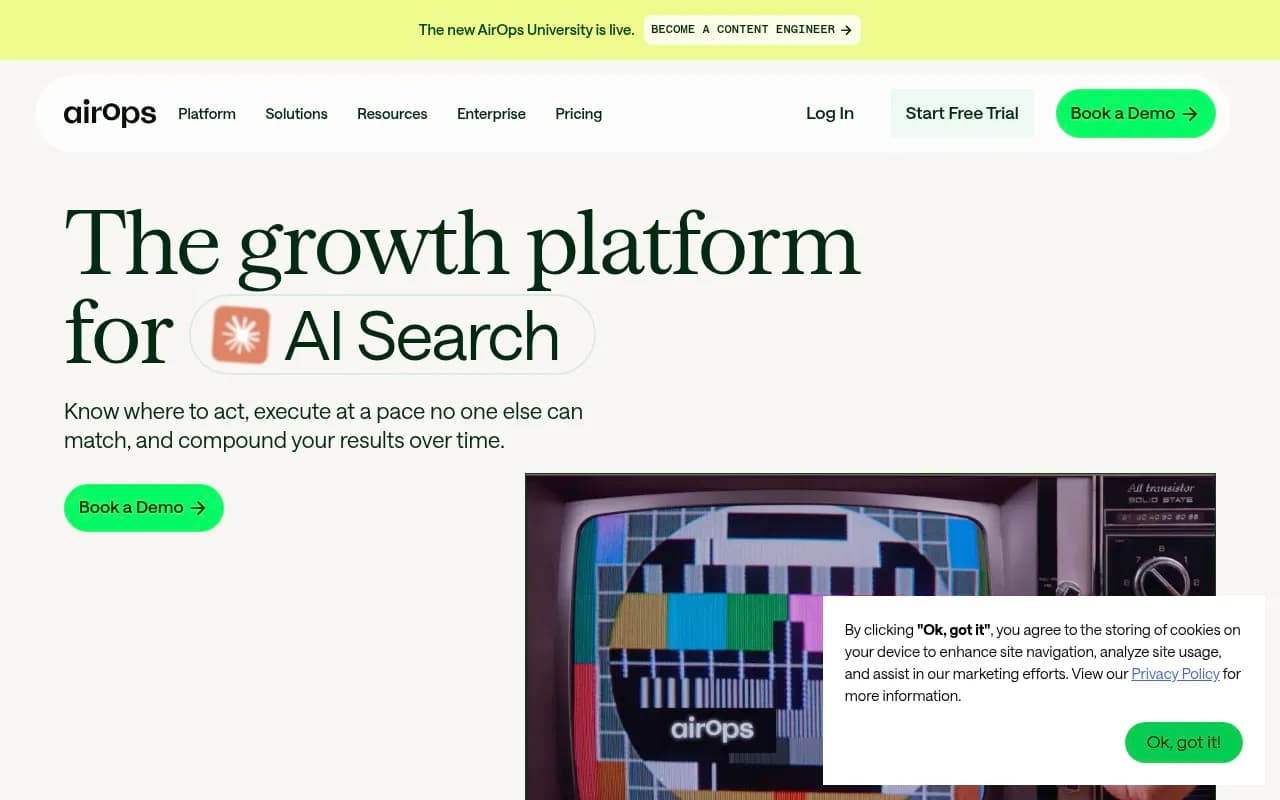
The "Grids" feature lets you run bulk AI workflows across hundreds of pages spreadsheet-style, and "Power Agents" are pre-built templates for competitor analysis and content-gap identification. G2 rates it 4.6/5 across 111+ reviews, with customers like Webflow, Ramp, and Carta, but nearly half of reviewers cite a two-to-three-week learning curve, and about a fifth flag the price-to-ROI ratio even in positive reviews. An independent take worth remembering before you buy: AirOps "will accelerate production, but it will not improve what is being produced." It's a strong pick if you already have a proven content strategy and just need to scale output; a weak pick if you're hoping the tool will figure out strategy for you.
Evertune
Evertune sells itself as a strategic research and activation system rather than a monitoring dashboard, and it prices accordingly: Pro starts at $800/month with 100,000 prompts and up to 11 tracked models, and there's no self-serve tier below that. It's a demo-led sale, not a signup-and-go product.

The core pitch is "Data-Driven Optimization Recommendations," specific content and messaging changes prioritized by impact potential, rather than a generic gap list. It also samples each prompt up to 100 times per model for statistical reliability, which matters if you've ever been burned by a tracker that reports wildly different results between two runs of the same query. This is a fit for enterprise teams with budget to match, not a first tool for a lean marketing team.
Profound
Worth mentioning because it's the platform most often name-checked alongside Scrunch, but be careful about what you're actually buying at each tier. Starter is $99/month and covers ChatGPT only, with no API access and no real content execution. Growth at $399/month adds Perplexity and Google AI Overviews plus "Profound Agents" on a credit system (400 credits included). Meaningful agentic functionality is effectively gated behind Growth or Enterprise.

Profound's Agent Analytics module, which tracks how AI crawlers actually behave once they land on your site, is genuinely useful and complements a content-generation agent rather than replacing one. Just don't expect the $99 tier to fix anything; it's monitoring, full stop.
Comparison table
| Platform | Starting price | LLM coverage | Content execution | Best for |
|---|---|---|---|---|
| Scrunch | $250/mo | 4 engines (9 on Enterprise) | Basic; 1 page opt/mo on Core | Teams that mainly want tracking with light optimization |
| AthenaHQ | ~$270-295/mo | 11 models | Content optimization agent + Action Center at Starter tier | Best all-round replacement, closest to full execution |
| Yotpo Discover | Custom/enterprise | Ecommerce-focused | 3-agent system incl. onsite fixes + authentic UGC activation | Ecommerce and DTC brands |
| AirOps | $200/mo (Pro $2,000) | ChatGPT only on Solo; multi-engine on Pro | Bulk workflow "Grids" and Power Agents | Teams with an existing content strategy needing scale |
| Evertune | $800/mo | Up to 11 models | Prescriptive, impact-ranked content recommendations | Enterprise with budget for a demo-led platform |
| Profound | $99/mo (Growth $399) | 3 engines on Growth, up to 10 on Enterprise | Credit-based "Profound Agents"; gated above Starter | Teams that already know Agent Analytics is what they want |
Where Promptwatch fits in this picture
Most of the tools above split into two buckets: trackers that added a content button, or content tools that added a tracking tab. Promptwatch was built to close that loop end to end rather than bolt one side onto the other.

The pieces that matter for the "fix, don't just report" argument: AI crawler logs (Agent Analytics) show exactly which pages ChatGPTBot, ClaudeBot, PerplexityBot, and 400+ other crawlers actually read and where they hit errors, so you know why a gap exists before you write anything. Content gap analysis scores your existing pages against what AI is actually citing and generates briefs with brand instructions, competitor context, and internal linking built in. Content Agents then plan, write, and publish GEO-optimized content directly to Webflow, Framer, or WordPress, either through a review inbox or fully automated, and Unified Actions turns all of this into a prioritized to-do list rather than a raw data dump. Crisp, one of Promptwatch's customers, used this setup to scale to 5-10 published articles a day and saw 2x higher conversion rates from AI traffic than from traditional channels.
It also covers ground the platforms above don't: dedicated Reddit and YouTube citation tracking, ChatGPT Shopping and Ads Radar to see which competitors are bidding on your prompts, and prompt-level search volume and difficulty scoring so you're not guessing which gaps are worth an agent's time. At 1,840+ customers and a 4.7/5 rating on G2, it's priced competitively too: Essential starts at $95/month, well under most of the platforms compared here, with Professional at $245/month adding automated content generation and shopping insights.
What to watch out for with agentic content generation
This category has a real failure mode, and it's worth naming before you turn on full automation. Adobe's 2026 framework on agentic content risk puts it bluntly: in a multi-agent pipeline, "if one hallucinated claim doesn't get reviewed, it gets acted on, passed to the next agent, and embedded in every deliverable that follows." A single wrong fact doesn't just sit on one page, it propagates.
Lyzr's 2026 roadblocks list for enterprise AI content generation adds a few more worth keeping in mind: brand voice drift as generation speed outpaces human oversight, review capacity becoming the actual bottleneck ("human review scales linearly while generation scales far faster"), and difficulty attributing content velocity to real ROI. And the same Scribewise/Scrunch survey cited earlier found 56% of marketers worry about brand misrepresentation in AI-generated results, with half having actually witnessed it in the past year.
The fix isn't avoiding automation, it's structuring it. Keep a centralized, frequently-updated knowledge base as your source of truth so agents aren't working from stale product messaging. Start with a review inbox rather than full auto-publish until you trust the outputs. And measure citation performance after publishing, not just before, so you catch content that got published but didn't actually move the needle.
If you want to compare more options beyond the six covered here, the GEO software directory at bestgeosoftware.com and the agentic SEO tools listed at agenticseotools.com are both good places to keep browsing before you commit.