Key takeaways
- Slate is the only one of the three with fully public pricing for agencies: $2,000/month for the Agency plan, with multiple client workspaces and a GTM Engineer.
- Scrunch is the middle option. Core starts at $250/month, agency plans start at $500/month (per Scrunch's own post), and it was acquired by Sitecore on June 3, 2026.
- Bluefish is built for the Fortune 500. There is no public pricing, no self-serve trial, and third-party estimates put contracts at $150K to $500K+ per year.
- These three are not like-for-like. Slate bills in credits and answers, Scrunch in prompts, Bluefish by contract. Compare cost per tracked answer, not sticker price.
- Nearly every roundup of these tools is written by a competitor, so treat rankings with suspicion and run a trial before signing.
Why this comparison is awkward
I'll be upfront: these three tools are not direct substitutes. They overlap on AI visibility tracking, but they come from different places. Slate pitches itself as an AI-search-first content operations platform. Scrunch started as monitoring and moved toward serving AI-ready pages to agents. Bluefish sells an "Agentic Marketing Platform" to large brands with procurement teams.
That means the useful question is not "which is best" but "which one matches the work my team cannot already do." An agency running 15 client accounts has a different problem than a Fortune 500 brand manager worried about how ChatGPT describes a product line.
A second caveat. Most of the comparison content you will find online is vendor-authored. Scrunch publishes a "best tools" list where Scrunch comes first. Meikai publishes an enterprise buyer's guide where Meikai comes first. Bluefish's pricing details mostly come from a competitor's review. I've flagged vendor claims below where it matters.
The three platforms at a glance
| Slate | Scrunch | Bluefish | |
|---|---|---|---|
| Positioning | AI-search-first content operations, credit-based | Monitoring plus Agent Experience Platform | Agentic Marketing Platform for enterprise |
| Entry price | $499/mo (Growth) | $250/mo (Core) | Quote only |
| Agency plan | $2,000/mo, multiple client workspaces | $500/mo (Agency Core, vendor-published) | Not a published tier |
| Pricing model | Credits and AI answers | Prompts | Annual contract |
| Platforms tracked | ChatGPT, Perplexity, AI Overviews, AI Mode on all plans; Claude and Gemini as add-on | 4 on Core; 9 on Enterprise | ChatGPT, Google AI, Claude, Perplexity, Amazon Rufus |
| Free trial | Self-serve onboarding on Growth | 7-day trial | None; demo request only |
| Ownership | Independent (funding not found) | Sitecore (June 2026) | Independent, $68M raised |
Slate: public pricing and agent execution

Slate is the newest of the three and the one I know least from independent sources. I found no third-party reviews, customer logos, or published SOC 2 or SSO details. That does not mean they do not exist. It means you should ask for them before putting Slate on an enterprise shortlist.
What Slate does publish is pricing, and it is unusually clear:
| Plan | Price/mo | Credits | AI answers tracked/mo | Pages monitored |
|---|---|---|---|---|
| Growth | $499 | 15,000 | 10,000 | 1,000 |
| Scale | $999 | 50,000 | 20,000 | 5,000 |
| Agency | $2,000 | 100,000 | 50,000 | 10,000 |
| Enterprise | Custom | Custom | Custom | Custom |
Annual billing saves 20%. The Agency plan adds multiple client workspaces, 1:1 expert onboarding, and a GTM Engineer with priority Slack support.
How the credit model works
This is the part to understand before buying. An "AI answer" is one response from one platform, for one prompt, in one location. So 333 prompts run daily on a single platform use about 10,000 answers a month, which is the entire Growth allowance. Run the same prompts weekly and you use roughly 1,450.
Credits are a separate pool. They pay for agent work such as Cowork tasks and workflow runs, while tracking and page monitoring draw from their own allowances. Slate alerts at 90% usage and at zero, and workflows pause at zero and resume from the step that stopped once you add credits. Credit packs come in 5,000, 50,000 and 100,000.
All workspaces in one org share a single allowance unless an admin sets per-workspace limits. For agencies that is a real consideration. One noisy client account can drain the pool.
Coverage and gaps
Every plan tracks ChatGPT, Perplexity, Google AI Overviews and Google AI Mode. Claude and Gemini live in a separate answer pool sold in packs of 1,000. Only Enterprise includes all six. If your clients care about Gemini, budget for the add-on.
One inconsistency worth knowing: Slate's own blog lists the product at $199/month, while the pricing page shows $499 as the entry price. The blog is probably stale. Trust the pricing page, and confirm on a call.
Scrunch: monitoring that moved toward action

Scrunch was acquired by Sitecore, announced June 3, 2026, reportedly for about $225M. Scrunch says it will continue as a standalone platform and speed up its roadmap. Its stated thesis is that "the future isn't visibility. It's action." Details on Sitecore integration are still thin, so ask about the roadmap if you are signing a multi-year deal.
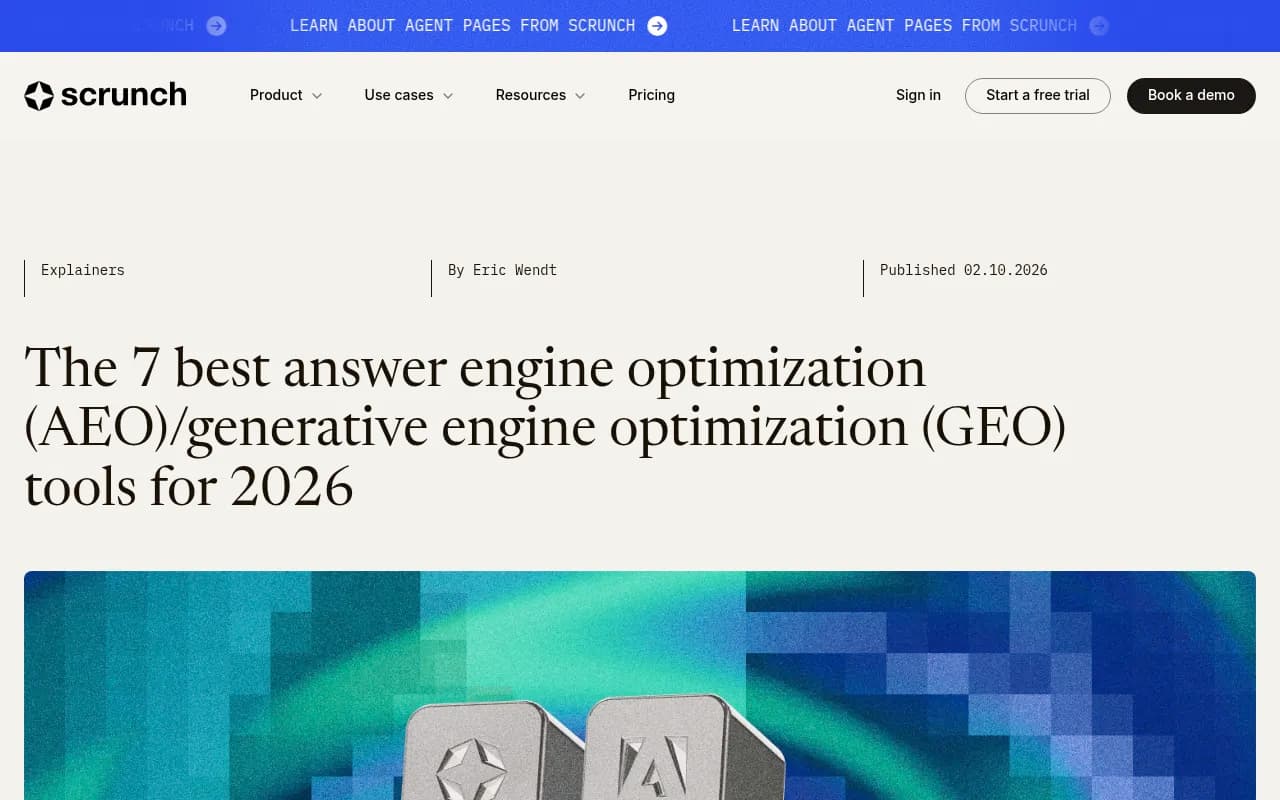
The screenshot above is Scrunch's own listicle. Useful for its feature matrix, but remember who wrote it.
Product structure
- Agent Experience: Agent Pages (an optimized experience served to AI agents), Agent Traffic, and Site Optimization.
- Monitoring and Insights: Monitoring and Citations, Insights, Shopping, and AI Search Trends.
- Separate Enterprise and Agencies use-case pages.
Agent Pages are the distinctive piece. Instead of only telling you how AI describes your brand, Scrunch can serve a version of your site tuned for AI crawlers. Neither Slate nor Bluefish is marked as offering that, at least according to Scrunch's own comparison, which is a competitor's claim.
Pricing
Straight North reports Core at $250/month for 125 prompts across ChatGPT, Perplexity, Google AI Overviews and Copilot, with five seats. Enterprise adds Gemini, Claude, Google AI Mode, Meta AI and Grok, plus API access and SSO. Scrunch's own post lists Agency Core at $500/month, with Enterprise and Agency Enterprise as custom. I did not verify scrunch.com/pricing directly, so check it before quoting.
Some older roundups say Scrunch has no public pricing. That is out of date.
Enterprise credentials
NoGood reports a completed SOC 2 Type II audit, role-based access controls, and multi-brand, multi-domain, multi-region support. Data refreshes about every three days as standard, which is slower than daily-refresh tools. Customers Scrunch names include Akamai, Lenovo, ADP, Publicis and Seer Interactive, and it claims 500-plus brands and agencies.
On ratings: Scrunch cites 4.6/5 on G2 for itself, while one non-competitive third-party review landed at 3.9/5. Both numbers are worth holding in your head.
Bluefish: enterprise, contract-first

Bluefish is the heavyweight here. It announced a $43M Series B on April 14, 2026, co-led by Threshold Ventures and NEA, bringing total funding to $68M. Investors include Amex Ventures, TIAA Ventures, Salesforce Ventures and Bloomberg Beta. It claims roughly 10% of the Fortune 500 as customers, with named logos including Adidas, American Express, Hearst, LVMH and Ulta Beauty.
It calls itself an Agentic Marketing Platform, combining AI Monitoring, Activation and Measurement for Search, Content, PR/Comms, Commerce and Paid Media teams. Agentic Campaigns launched June 18, 2026. Platform coverage includes ChatGPT, Google AI, Claude, Perplexity and Amazon Rufus. The Rufus coverage matters if you sell physical products.
The company claims "double and triple-digit performance gains" for Fortune 500 brands. That is a vendor claim with no independent verification that I found.
Pricing and access
Bluefish publishes no pricing. A competitor's review (Meev) verified on July 19, 2026 that its /pricing page returns a 404, with no trial or self-serve signup and every call to action routing to a demo request. Third-party estimates from OpenLens put contracts at $150K to $500K+ a year, plus $15K to $100K for implementation, with 4 to 6 weeks of onboarding. These are estimates, not vendor numbers. But if the real figure is even half of that, Bluefish is not an agency tool.
Where it fits
Reviewers describe Bluefish as strong on brand protection: sentiment, safety, accuracy, and crisis detection. If your concern is how AI represents a regulated or high-profile brand, that defensive angle is the draw. If your concern is shipping content next week, it is a heavier lift.
Agency fit: who handles multiple clients best?
| Need | Slate | Scrunch | Bluefish |
|---|---|---|---|
| Multiple client workspaces | Yes, Agency plan | Yes, agency tiers | Enterprise accounts, not agency-oriented |
| Predictable monthly cost | Yes, published | Yes, published | No |
| Self-serve start | Growth plan | 7-day trial | No |
| Dedicated support | GTM Engineer, priority Slack | Custom | Enterprise onboarding |
| Technical AI-crawler analytics | Page monitoring | Agent Traffic included on Core | Enterprise diagnostics |
For agencies, Slate and Scrunch are the realistic options. Scrunch is cheaper to enter. Slate costs more but bundles execution through agents and credits. If your team writes and ships content itself, Scrunch's price is easier to justify. If you want the platform doing some of the work, Slate's credit model makes more sense, provided you watch usage.
Enterprise fit: who clears procurement?
Bluefish and Scrunch have the stronger enterprise story on paper. Scrunch has the SOC 2 Type II audit. Bluefish has SOC 2-aligned controls, though NoGood notes it is not officially certified, plus a Fortune 500 customer base and investor list that reads like a security reviewer's comfort blanket. Slate offers an Enterprise tier with custom workspaces and all six platforms, but I could not verify certifications. Ask for the security documentation on the first call.
What these platforms actually measure
Whatever you pick, the underlying data behaves the same way, and it helps to know what you are paying to track. Promptwatch Data's sources-per-response report shows ChatGPT citing about 5 sources per web-search answer, while Google AI Overviews cites about 10 and Perplexity almost exactly 10 every day. A single tracked prompt therefore returns very different citation counts by platform.
Query fanouts matter too. In Promptwatch's ChatGPT fanout data, average fanouts per response fell from 2.15 in early December to about 1.84 by early March 2026, and average query length dropped from roughly 117 characters to about 53 from April. Short, focused headings that read like search queries are the practical takeaway. And if a platform lets you inspect fanouts, use it.
Also check which content types get cited. Promptwatch's content type data found product pages the most cited type in ChatGPT at 22.4% of citations between Sep 28 and Oct 4, 2026.
Alternatives worth a look
If none of the three fits, a few other tools cover similar ground. For a platform that goes past monitoring into execution, Promptwatch tracks the real UIs of ChatGPT, AI Overviews, Gemini and Perplexity, shows IP-verified AI crawler logs, and has a Content Agent that writes and publishes to Webflow, Framer or WordPress. Plans start at $95/month and agency tiers at $199/month, so it undercuts all three on entry cost. Confirm current numbers at promptwatch.com/pricing.

Other options:


Adobe LLM Optimizer
Profound is the common enterprise pick with daily refreshes and prompt volume data. AthenaHQ combines monitoring and content agents. Adobe LLM Optimizer makes sense if you already live in Experience Cloud. For a broader view, the GEO software directory lists dozens more.
The Meikai guide above is useful for its evaluation criteria (prompt modeling, multi-model measurement, managed execution). Like every roundup here, it ranks its own product first.
How to choose
- Pick Slate if you are an agency or in-house team that wants tracking and agent-driven execution under one bill, and you are comfortable with credit accounting.
- Pick Scrunch if you want published pricing, SOC 2 Type II, AI-crawler analytics, and the option to serve AI-ready pages. Watch the Sitecore roadmap.
- Pick Bluefish if you are a large brand with a six-figure budget, a procurement process, and a brand-protection or commerce focus.
- Skip all three if you need a cheap tracker. Tools like Peec AI or Otterly.AI start far lower.
Questions to ask on every demo
- How is an answer or prompt counted, and what happens at the limit?
- Which AI platforms are on my plan, and which cost extra?
- Does data come from real interfaces or APIs? The two can differ.
- How often does data refresh? Scrunch is about every three days. Others are daily.
- What security documents can you send today?
- Who owns the company in 18 months?
The last one is not paranoid. Scrunch changed owners this year, and XFunnel was absorbed by HubSpot in 2025. Ask for the roadmap commitment in writing.
If you would rather hand the selection and rollout to specialists, 1001 SEO Media runs GEO programs for brands and agencies. Either way, run a two-week trial on your own prompts before committing, and compare cost per tracked answer rather than sticker price.