Key takeaways
- At scale, the bottleneck is plan limits (documents, articles, Drafts), not seats. Check those before you look at the headline price.
- Frase Scale ($239/mo yearly) is the only one of the four that fits roughly 100 articles a month on one plan. Clearscope is better for polishing existing content than for bulk drafting.
- NeuronWriter is the cheapest way to get Surfer-style scoring, but documents are capped (25 to 150 per month) and its AI writer is not calibrated to its own scorer.
- All four now sell AI visibility tracking. It is gated by tier, so confirm which models you actually get.
- Content scores optimize for Google-style coverage. ChatGPT cites product pages, landing pages and listicles, so match briefs to content type, not just to a score.
What "scaled content team" changes
A freelancer optimizing four posts a month can pick any of these tools and be fine. A team shipping 40 to 100 pieces a month, with in-house editors, freelancers and an agency or two, hits different walls. Seats get expensive. Document caps run out on the 20th. Scores start driving the writing instead of the other way around.
So I looked at these four through that lens: how limits work, what it costs to stay inside them, and what the workflow does to writers.
One caveat on sources. Much of the comparison content out there is stale or vendor-written. The NeuronWriter "best overall value" post is authored by NeuronWriter and still quotes a $19 Bronze price. The widely linked Growth Marketing Pro comparison describes a Clearscope and Frase from around 2021. I leaned on current vendor pricing pages instead, and where sources disagree (mostly Surfer), I say so.
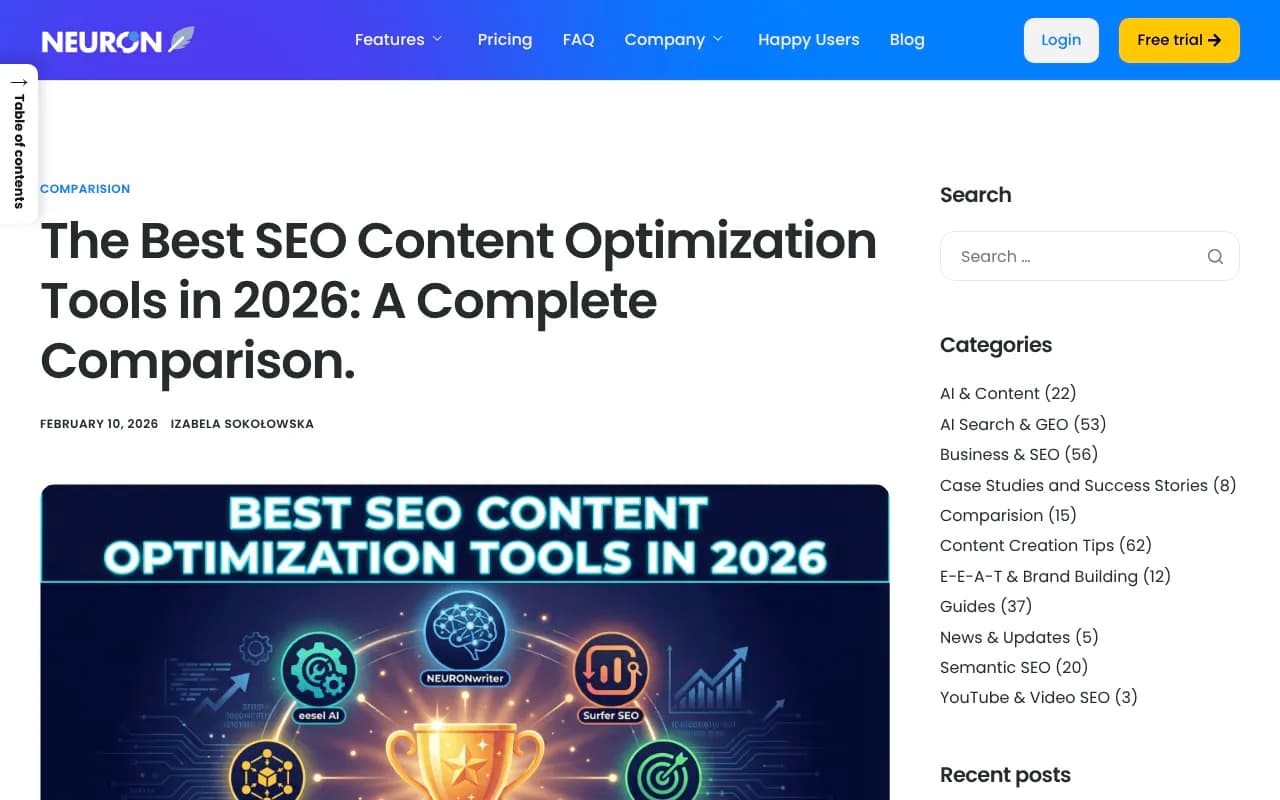
The four tools at a glance
| Tool | Entry price (yearly billing) | Scaling limit that matters | Seats | Best for |
|---|---|---|---|---|
| Surfer SEO | Standard around $99/mo (third-party, verify) | 360 documents/mo on Standard | 3 on Standard, 5 on Pro | Writer-friendly editor, on-page audits |
| Frase | Starter $39/mo, Professional $103, Scale $239 | 10, 40 or 100 articles/mo | 1, 3 or 5 | Brief-to-publish pipelines |
| Clearscope | Essentials $129/mo, Business $399 | 50 or 300 pages; 20 Drafts/mo | Unlimited | Editorial quality control |
| NeuronWriter | Bronze $23/mo up to Diamond $117 | 25 to 150 documents/mo | Unlimited from Gold ($69) | Budget-driven teams |
Surfer SEO

Surfer is the most complete pure optimizer of the four. The editor gives real-time feedback, the SERP analysis is deep, and the audit tools work well for refreshing older posts. Writers like it because the score moves as they type.
The pricing picture is the messy part. Surfer's official pricing page currently shows AI Search Analytics at $82/mo billed yearly (50 AI prompts across ChatGPT, Perplexity, AI Overviews and Gemini) and Standard at $99/mo billed yearly. Third-party summaries list Discovery at $49, Pro at $182, Peace of Mind at $299 and Enterprise from $999, with Standard at $119/mo billed monthly and Pro at $219. One source lists much higher legacy numbers, which look like pre-rebrand pricing. I wouldn't trust any of these over the live page at surferseo.com/pricing, and one report says Surfer has raised prices twice since 2023.
What matters for scale: Standard and Pro reportedly both include 360 documents a month, so the Pro premium buys features (daily prompt refresh, five brand workspaces, one-click internal links, a coverage gap report, cannibalization report) and seats, not volume. If you run multiple brands or client accounts, that is the reason to upgrade. If you just need more documents, it isn't.
The real-world complaint is score chasing. In one hands-on comparison, Surfer suggested 87 terms to reach a score of 80+ on a 2,000-word B2B article, where Clearscope suggested 34 for an A+. Whatever your exact numbers, the lesson is that junior writers and freelancers will stuff terms to turn the meter green unless an editor stops them.
Frase
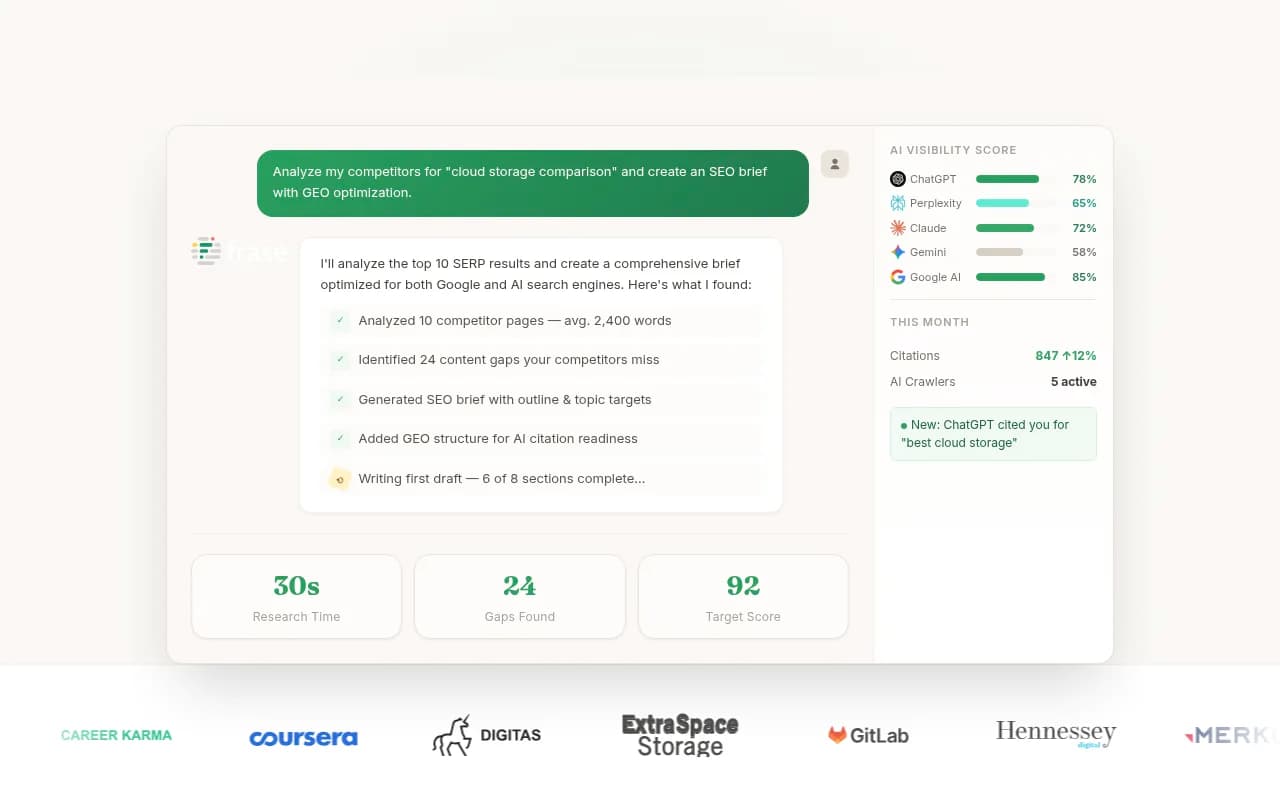
Frase has changed a lot. It now calls itself a content operating system for AI search, and the current product is closer to a publish-and-monitor pipeline than the brief generator older reviews describe.
Current plans from the vendor page:
- Starter: $39/mo yearly ($49 monthly), 1 seat, 1 site, 10 articles and 50 audit pages a month.
- Professional: $103/mo yearly ($129 monthly), 3 seats, 5 sites, 40 articles, 250 audit pages, content calendar and internal linking suggestions. Extra seats are $29/mo.
- Scale: $239/mo yearly ($299 monthly), 5 seats, up to 10 domains, 100 articles, 1,000 audit pages, exportable client reports.
- Enterprise: custom, with SSO, white-label reports and a branded client portal.
It publishes straight to WordPress, Webflow, Sanity or Wix, and Content Guard watches pages for Google decay (10, 75 or 300 pages depending on tier). An MCP server and CLI come on every plan. That is a real advantage if your team already runs content through automation.
The tradeoffs: seats are capped, and the content score is less granular than Surfer's, based on topic coverage rather than term-frequency density. For teams that care about comprehensive coverage more than hitting a number, I think that is a fair trade. For teams that want strict, auditable scoring thresholds across many freelancers, it is a weakness. Reviewers also put its editor a notch below Clearscope for polish.
If your honest bottleneck is the stretch between keyword assignment and first draft, Frase is the one that attacks it directly. A Reddit thread in r/SEO makes the same point: Surfer gets expensive, and people like Frase for research, briefs handed to writers, and refreshing existing content.
Clearscope

Clearscope does one thing and stays in its lane. The report is cleaner and surfaces fewer terms, which tends to produce more natural prose. It is the tool editors tend to trust.
Pricing from the vendor page:
- Essentials: $129/mo. 50 tracked queries, 50 pages, 20 monthly Discoveries, 20 monthly Drafts.
- Business: $399/mo. 300 tracked queries, 300 pages, 50 Discoveries, 20 Drafts, a dedicated account manager.
- Enterprise: custom, with SSO and crawler whitelisting.
Unlimited users and projects are on every plan, which is the standout for large freelancer rosters. Nobody counts seats. The limits are on pages and Drafts instead. Add-on blocks of pages cost $25/mo (Essentials) or $15/mo (Business); Draft add-ons exist too, but check the block sizes on the pricing page before budgeting, since the scraped details were unclear.
Every plan includes query tracking across ChatGPT and Gemini, brand visibility tracking, and query fan-out awareness (the web searches AI platforms trigger). That is a thoughtful addition rather than a bolted-on dashboard.
Where it struggles at scale: 20 Drafts a month is not a volume number. Clearscope suits a team publishing fewer, higher-stakes articles and refreshing a large existing library, not one that wants a bulk drafting engine. Business at $399 buys breadth of tracked pages, not drafting capacity.
NeuronWriter
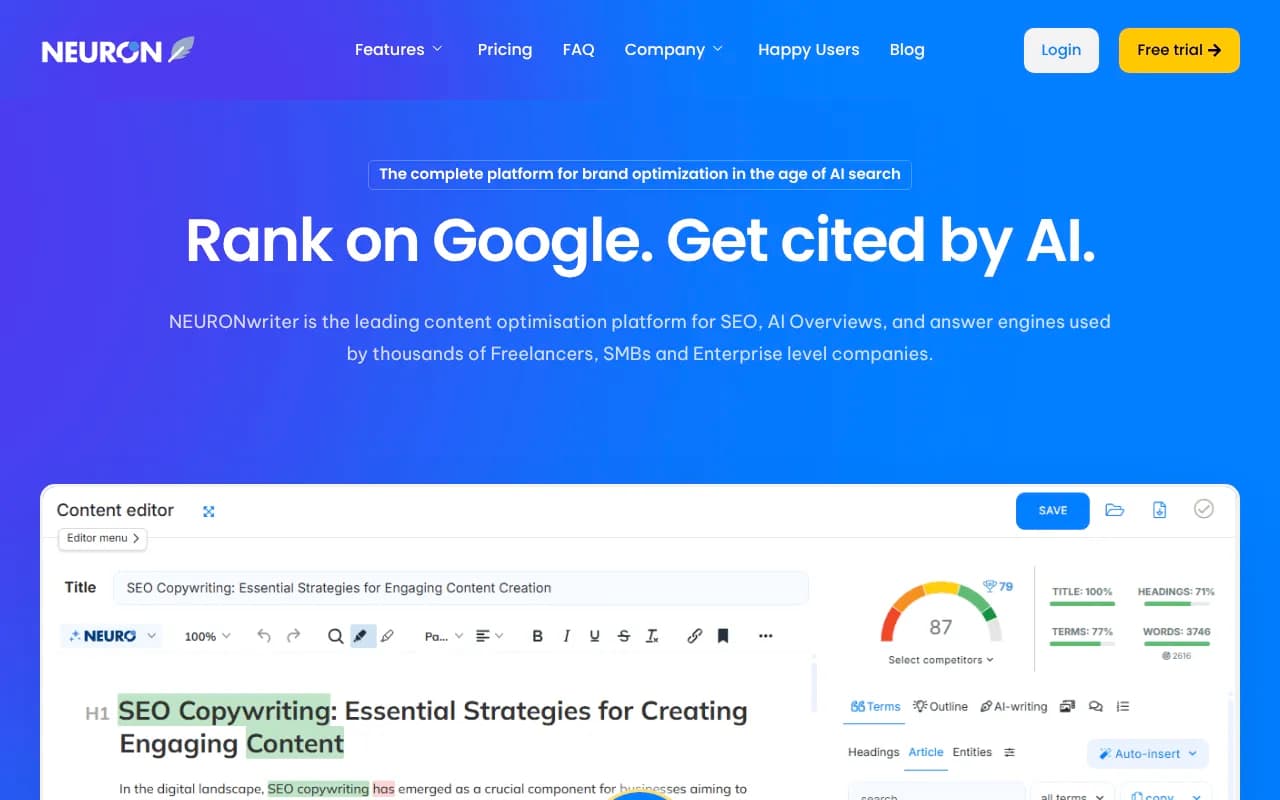
NeuronWriter is the budget option, and the price gap is real. Current monthly prices on yearly billing:
- Bronze $23: 2 projects, 25 documents, 5 AI-monitored questions.
- Silver $45: 5 projects, 50 documents.
- Gold $69 (most popular): 10 projects, 75 documents, unlimited team members, Content Designer, GSC, WordPress and Shopify integrations, your own OpenAI key, API/MCP.
- Platinum $93: 25 projects, 100 documents.
- Diamond $117: 50 projects, 150 documents.
An AI Monitoring add-on starts at $9/mo and covers Google, AI Overviews, AI Mode, ChatGPT and Perplexity.
Two things to flag. First, NeuronWriter's own comparison post talks up unlimited article creation, but the pricing page caps documents at 25 to 150 per month. Trust the pricing page. Second, Bronze and Silver have read-only sharing, so unlimited collaborators really begin at Gold.
The biggest quality warning comes from a hands-on test: NeuronWriter's AI writer produced a 1,500-word article using the target keyword 36 times, while its own scorer recommended 5 to 10 uses, and it still scored 87/100. The writer and the scorer are not calibrated to each other. If you use it for scoring human-written drafts, that doesn't matter much. If you lean on AI first drafts and trust the number, you will publish over-optimized copy.
It also handles European languages reasonably well, per one comparison, while Frase and Clearscope are English-dominant. For multilingual teams, that matters.
Cost at scale: three realistic scenarios
These are rough calculations from the plan limits above, not benchmarks.
| Scenario | Best fit | Why |
|---|---|---|
| 100 new articles/month, small core team | Frase Scale ($239/mo) | 100 articles and 5 seats on one plan, with CMS publishing |
| 20 to 30 flagship articles plus a big refresh library, 20+ freelancers | Clearscope Essentials or Business | Unlimited users, editorial-grade grading |
| 50 to 75 optimized documents, many contributors, tight budget | NeuronWriter Gold ($69/mo) | Unlimited members and 75 documents |
| Multiple brands or clients, heavy on-page audits | Surfer Pro | Brand workspaces, cannibalization report, internal links |
The important point: seat-based pricing punishes you when freelancers rotate, and document caps punish you when volume spikes. Map your actual monthly volume and contributor count before comparing sticker prices.
AI visibility is now in every tool, with caveats
All four now sell some form of AI tracking:
- Surfer: AI Search Analytics as a separate product.
- Clearscope: query tracking across ChatGPT and Gemini, plus fan-out awareness.
- Frase: GEO scores, AI Visibility and AI crawler monitoring.
- NeuronWriter: AI-monitored questions plus the add-on.
Coverage is gated by tier. On Frase, Starter covers ChatGPT and Google AI, Professional adds Perplexity, and Scale adds Claude and Gemini. NeuronWriter needs the paid add-on for broader coverage. Check the model list on the tier you would actually buy.
This matters because content scores and AI citations are not the same game. Promptwatch Data's report on which content types ChatGPT cites (Sep 28 to Oct 4, 2026) found product pages at 22.4% of citations, landing pages at 16.8%, listicles at 13.6%, how-tos at 8.7% and comparisons at 5.9%. You can read the full breakdown in Promptwatch's ChatGPT citation share by content type report. For commercial prompts, product pages rise to 26.0% and landing pages to 20.6%.
The practical read for a scaled program: a green score on a 2,000-word blog post does not make it the kind of page ChatGPT cites. Build briefs by content type and prompt intent, not just by keyword. Also plan for decay. In Promptwatch's content half-life report, news pages lost half their citations in about five weeks, while landing pages and docs held up for months, so evergreen and reference formats deserve more of your volume than news-style posts.
I could not find independent head-to-head data showing that higher scores from any of these four tools correlate with better rankings or AI citations. Treat the scores as a quality guardrail, not a prediction.
When you need a dedicated AI visibility layer
The in-tool trackers are fine for a pulse check. If AI search is becoming a real channel, you will want to see which pages get cited, whether AI crawlers can read your site, and what traffic it drives. A platform like Promptwatch covers that side, and it pairs naturally with whichever optimizer you pick.

For a broader look at options, the GEO software directory at bestgeosoftware.com lists the category.
Process rules that keep scores from ruining content
- Set a score floor, not a target. "Above 70, then edit for readers" beats "get to 100."
- Have one editor own the final read. Scores can't catch a paragraph that says nothing.
- Write briefs by content type. A comparison page and a how-to need different structures, whatever the tool says.
- Don't let AI drafts through unreviewed. NeuronWriter's keyword stuffing is the extreme case, but every tool's AI writer needs a human pass.
- Track refresh work separately from net-new volume. Clearscope and Frase's decay monitoring both make this easier.
- Audit plan limits quarterly. Surfer raised prices more than once, and Frase's plans have moved since older reviews.
Which one should you pick?
- Pick Frase if your constraint is moving from keyword to published draft quickly, and you want CMS publishing and decay monitoring in one place.
- Pick Clearscope if editorial quality and unlimited contributors matter more than raw volume, and you can afford the entry price.
- Pick NeuronWriter if budget is the deciding factor and your writers produce the first drafts. Use its score, not its AI writer, as the guide.
- Pick Surfer if writers will live in the editor all day and you need audits, internal linking and multi-brand workspaces. Verify pricing on the live page first.
If you are still undecided, run the same two articles through two tools on a trial. Frase and NeuronWriter offer 7-day trials, Clearscope offers 14 days. Compare the term lists, how editors react to the output, and how fast you hit a plan limit. That test will tell you more than any comparison table, including this one.
For wider alternatives, see the software directory at surferstack.com.