Key takeaways
- Scrunch was acquired by Sitecore in June 2026 for a reported $225 million, and it's now positioned as the AI-search layer of an enterprise DXP, not an independent visibility startup
- Scrunch's own pricing page still lists content generation as limited (one page optimization a month on Core) or, on competitor comparison pages, flagged outright as "coming soon"
- Migrating means exporting prompts, personas, tags, and competitors from Scrunch's Configure > Exports panel, then rebuilding that structure inside a platform that can also draft and publish
- ChatGPT only shows about 5 citation slots per response, according to Promptwatch's data, so the content you generate after migrating needs to be narrow and specific, not broadly "relevant"
- Platforms like Promptwatch close the loop between visibility data and actual published pages, with content agents that plan, write, and push to your CMS instead of leaving you a to-do list
Why people are leaving Scrunch in 2026
I want to be fair to Scrunch here, because its monitoring is genuinely good. Persona segmentation, funnel-stage tagging, prompt-variant tracking across four models on the Core plan, it's a granular tool. If your problem is "I don't know how my brand shows up across ChatGPT and Perplexity," Scrunch answers that question well.
The problem is what happens after you get the answer.
On June 3, 2026, Bloomberg reported that Sitecore acquired Scrunch for roughly $225 million. Sitecore's CEO and Scrunch's CEO both framed the deal around getting brands to "act" on AI-search data inside an existing content stack, Sitecore's. That's a tell. If Scrunch's own leadership needed to bolt the platform onto an enterprise CMS to make the data actionable, the data on its own wasn't closing the loop.
Check Scrunch's pricing page and you'll see it in black and white: Core gets "1 page optimization/month." Enterprise gets "Content Generation: Advanced," whatever that means at custom-quote pricing. Profound's own comparison page, published in May 2026, went further and listed Scrunch's content generation feature as literally "coming soon." A tool that's been live since March 2025 still doesn't have a repeatable, in-platform way to turn a visibility gap into a published article.
So you end up running two separate subscriptions: Scrunch to tell you where you're invisible, and a second tool, or a freelancer, or your own content team scrambling, to actually fix it. That's slower, more expensive, and harder to attribute results back to. If you're going to migrate anyway, this is the year to consolidate into one platform that does both.
What you're actually migrating
A Scrunch account isn't just a dashboard. Underneath it you've built up:
- A prompt library (branded and non-branded prompts you've been tracking, often with stage and topic tags)
- Persona definitions, including geolocation and descriptions
- Competitor lists tied to those prompts
- Historical citation and sentiment data you'll want for before/after comparisons
- Site audit history and any AXP edge-rendering configuration if you're on Enterprise
Scrunch's help center confirms you can export most of this. Configure > Exports gives you metadata-only CSVs for prompts (text, stage, persona, topics, tags, branded status, platforms, creation date) and personas (definitions, geolocation, descriptions). The Explorer tab lets you build a custom metric breakdown and export it to CSV or Excel, though it's capped at 8 queries per export and runs asynchronously. There's also a citation domain/URL breakdown export if you want to preserve which sources were winning citations before you left.
What you can't export cleanly: the raw historical AI responses themselves, and anything tied to AXP's edge-serving rules if you used that. Print-to-PDF only gives you a visual snapshot of the home dashboard, not structured data, so don't rely on it for anything beyond a sanity check.
Interestingly, Scrunch has published its own MCP-based "switch from another tool" workflow for people migrating into Scrunch, where an AI agent reads a competitor's exported settings and recreates brands, personas, and prompts automatically. There's no equivalent reverse tool yet for migrating out, which means most of the rebuild on the new side is manual CSV re-entry. Budget time for this; it's the part everyone underestimates.
Step 1: export everything before you cancel
Don't cancel your Scrunch subscription the day you sign up elsewhere. Pull every export type first:
- Configure > Exports: prompts CSV and personas CSV
- Explorer: build and export your key metric breakdowns (mention rate, citation rate, sentiment trend) grouped by platform and by month, repeating for each of the 8-query caps you need
- Citation domain/URL breakdown export, so you have a baseline of who was winning citations in your category before you switched tools
- Site audit history, if you're on a plan with multiple audits
Keep raw exports in a shared drive, not just in whatever new tool you pick. Six months from now you'll want to show stakeholders the before-and-after, and re-exporting from a canceled account is harder than it should be.
Step 2: rebuild your prompt library, but prune it first
Here's where most migrations go wrong. People dump their entire Scrunch prompt CSV into the new tool and expect equivalent results. Don't do that. Use the move as an excuse to cut dead weight.
Look at which prompts in your Scrunch export actually generated citations versus which ones sat at zero for six months. If a quarter of your 125 tracked prompts never surfaced your brand, they were probably too broad or aimed at the wrong intent. Promptwatch's research on average sources per response is useful context here: ChatGPT only cites about 5 sources per web-search response, Google AI Overviews cites roughly 10, and Perplexity is stable at almost exactly 10. With only 5 slots on ChatGPT, a prompt that's "pretty relevant" to your brand simply won't make the cut. Narrow, specific prompts beat broad ones.
When you rebuild the library in your new platform, tag prompts by funnel stage and persona the same way you had them in Scrunch, that consistency is what makes before/after comparisons meaningful.
Step 3: pick the platform that closes the loop
This is the actual decision. You're not choosing between "tracker A vs tracker B" anymore, you're choosing which platform turns a visibility gap into a published, cited page without three handoffs between teams.
| Platform | Starting price | Content generation | Notable gap vs Scrunch |
|---|---|---|---|
| Scrunch (Core) | $250/mo | 1 page optimization/month | Content gen flagged "coming soon" on competitor pages |
| Promptwatch | $95/mo (Essential) | Content Agents draft and publish to Webflow, Framer, WordPress on a schedule | Adds crawler logs, Reddit/YouTube citation tracking, Unified Actions |
| Profound | Custom quote only | Profound Agents, brief-to-draft, no self-serve tier | No free trial beyond 7 days; enterprise-only |
| AirOps | Free Solo tier / custom Pro | Quill agent for production, 35,000 free tasks/mo | Steeper setup, more configuration required |
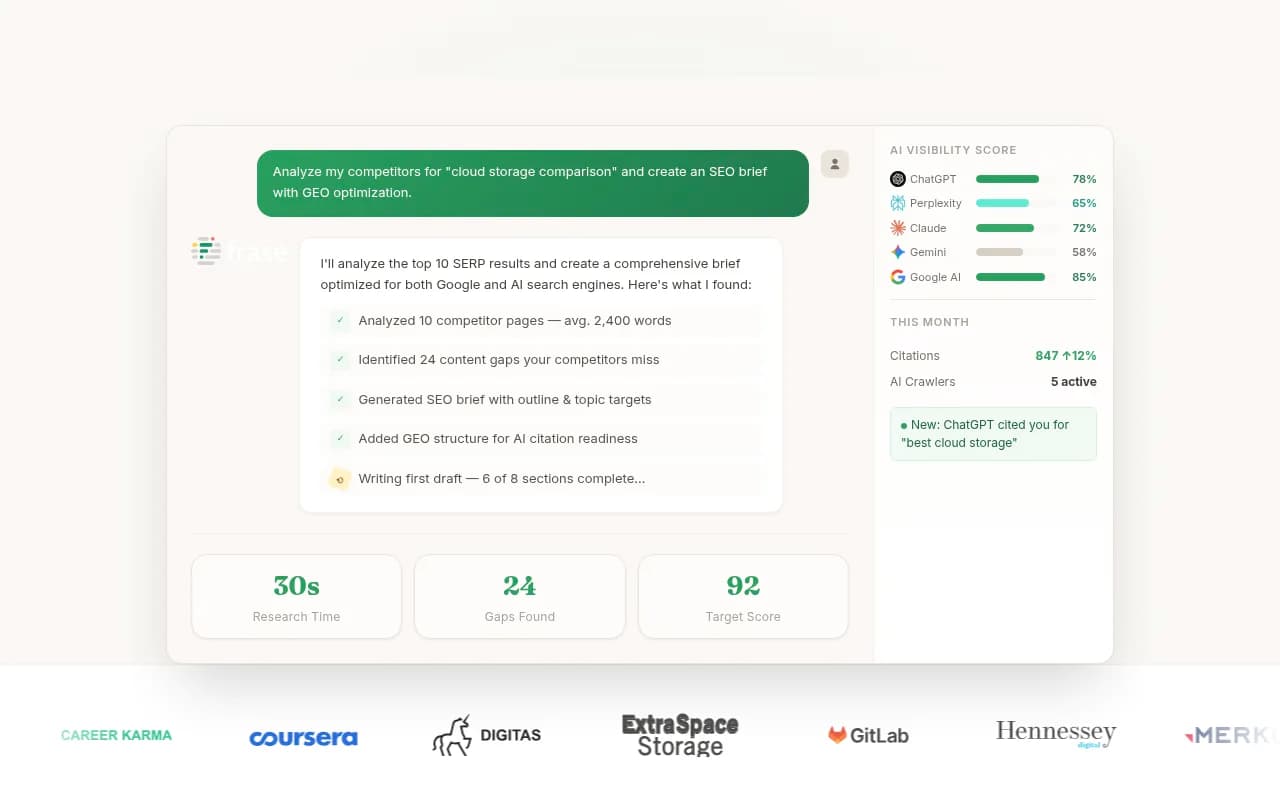
| Frase | $39/mo (Starter) | 10 articles/mo, publishes to WordPress/Webflow/Sanity | Tracks fewer AI engines on lower tiers |
| Writesonic GEO | $79/mo | AI articles bundled with tracking | Only 3 engines tracked on entry plan |
Pricing on this category shifts fast, Scrunch itself quietly retired an entire Starter/Growth ladder earlier in 2026, so verify current numbers on each vendor's site before you commit.
A few honest notes on each option. Profound has real depth, including 1.3 billion+ real user prompts from actual answer-engine conversations and an accuracy-alert system Scrunch doesn't have, but it sells no self-serve tier, you're negotiating an enterprise quote from day one. AirOps and Frase both genuinely combine tracking and writing, but AirOps' own comparison materials admit a steeper learning curve, and Frase's AI-visibility tracking only covers ChatGPT and Google AI on its cheapest plan.
Promptwatch is what 1001 SEO Media runs internally for this exact reason, it's built around the idea that monitoring alone doesn't move the needle. Its Content Agents plan, write, and publish GEO-optimized pages directly into your CMS on a schedule, with a review inbox if you want a human in the loop or fully automated if you don't. Underneath that sits the same kind of monitoring Scrunch offers (prompt tracking across ChatGPT, Gemini, Claude, Perplexity, Grok, Copilot, Google AI Overviews and AI Mode, and more), plus things Scrunch doesn't do at all: AI crawler logs showing exactly when ChatGPTBot or ClaudeBot hit your pages, dedicated Reddit and YouTube citation reports, and Unified Actions, a prioritized to-do list generated from your own visibility and crawler data.

If you're still shopping broadly, Profound and AirOps are worth a look for enterprise budgets, and the wider directory at bestgeosoftware.com covers the smaller, cheaper trackers like Otterly.AI and Peec AI if content generation isn't your priority right now.

Step 4: match your content templates to what's actually getting cited
Don't just start generating generic "listicle" content because that's what the last tool defaulted to. Promptwatch's ChatGPT citation types data for August 2026 shows product pages leading at roughly 28.7% of citations on average, but how-to content more than doubled over the month, from about 4.3% in the first week to 9.1% in the final nine days, while social posts collapsed from 4.4% to under 1% right after Reddit's citation share fell off a cliff on August 14. Promptwatch's own read on that data is blunt: put how-to guides back on the roadmap, and don't count on social posts carrying citation weight anymore.
That same collapse in Reddit citations is documented in Promptwatch's Reddit citation data, showing reddit.com's share of ChatGPT Search citations dropping from roughly 4% to 0.5% on that same date. If your migration plan assumed Reddit seeding would keep paying off the way it did in Scrunch's old playbook, rebuild that assumption.
One more thing worth checking before you pick a target domain rank obsessively: Promptwatch's citation-share-by-domain-rank data found mid-authority domains (DR 46-75) taking almost half of all ChatGPT citations in August 2026, while the very biggest domains (DR 91-100) fell to around 3% by month's end. You don't need a legacy media domain to get cited. You need tightly focused, specific pages.
Step 5: run both tools in parallel for one billing cycle
This is the step people skip to save money, and it's the wrong place to cut corners. Run Scrunch and your new platform side by side for at least one full billing cycle before canceling. Compare:
- Citation rate for the same set of core prompts across both tools
- Whether sentiment scoring tracks directionally the same way
- How the new tool's crawler or audit data lines up with anything you can independently verify (server logs, Search Console)
If the new platform's numbers look wildly different from Scrunch's on the exact same prompts, don't panic immediately, different tools scrape from real UIs vs APIs and can legitimately diverge. But get a second data point before trusting the new baseline for reporting to stakeholders.
Step 6: build a cadence, not a one-time push
The entire point of leaving a monitoring-only tool is that you stop treating content as a quarterly scramble. Once your prompt library and personas are rebuilt, set a realistic publishing cadence, most teams starting out do a handful of pages a week rather than a daily flood, and scale up once you can see which templates actually earn citations.
Crisp, a Promptwatch customer, scaled to 5-10 articles a day and saw 2x higher conversion rates from AI-driven traffic versus traditional channels once the content loop was automated end to end. That's an extreme pace, most teams don't need it, but it shows what's possible once the bottleneck between "we found a gap" and "we published something for it" disappears.
A quick sanity check before you commit
Before you sign an annual contract with anyone, ask three concrete questions instead of reading another feature list:
- Can this platform publish directly to my CMS, or does it hand me a Google Doc I still have to format and upload myself?
- Does it track the specific AI engines my customers actually use, not just ChatGPT and one or two others?
- If I ask it "why didn't we get cited for this prompt last week," does it have crawler-level data to answer that, or just a mention-rate number?
Scrunch answers question 3 reasonably well and question 2 decently on Enterprise. It doesn't answer question 1 yet, that's the gap you're migrating to close.
If you want a broader look at where the whole category stands right now, the rankings at aisearchtoolrank.com are a reasonable second opinion before you sign anything longer than a monthly plan.