Key takeaways
- Pages that go more than three months without a substantive update are over 3× more likely to lose AI citations, according to AirOps' analysis of thousands of cited pages.
- Different engines have different freshness appetites: ChatGPT and Perplexity reward recency aggressively, while Google AI Overviews and AI Mode behave closer to classic organic search. A quarterly cadence works across the board; monthly is safer for commercial pages in fast-moving industries.
- A real refresh means at least ~20% substantive revision. Changing the date and republishing does nothing, and mismatched freshness signals can get discounted site-wide.
- Product and commercial pages are the fastest-growing citation format on both ChatGPT and Google AI Overviews, so refresh cycles should prioritize specs, pricing, and availability, not just blog posts.
- Before assuming a citation drop is your fault, check it against known platform shifts. ChatGPT's average citations per response fell roughly 27% after the GPT-5.3 rollout in March 2026, across every model, with no recovery.
Why this playbook exists now
Google I/O 2026 changed the stakes. AI Mode crossed one billion monthly users, information agents are launching this summer, and Google described its new AI-powered search box as the biggest upgrade to Search in over 25 years. Meanwhile, Ahrefs benchmarks put the position #1 organic CTR drop at 34.5% when an AI Overview appears on the SERP, and only 17–54% of AI Overview citations now come from top-10 organic results, down from 76% in mid-2025.

The practical consequence: ranking well no longer guarantees you appear in the AI answer. What determines whether you show up is whether AI systems consider your page a current, credible source when they build a response. And "current" is something you control through your refresh cadence.
This guide is about that cadence. Not vague "keep content fresh" advice, but specific numbers: how often each page type needs updating, per engine, and what actually counts as an update.
What the data says about freshness and citations
The research here is surprisingly consistent across independent sources:
- AirOps' 2026 State of AI Search report found that pages not updated quarterly are 3× more likely to lose citations, and that over 70% of all pages cited by AI have been updated within the past 12 months. More than half were refreshed within six months.
- Amsive's research suggests roughly 50% of AI citations come from content less than 13 weeks (~90 days) old, which some practitioners now call the "effective citation lifespan."
- Ahrefs' analysis of 17 million AI citations found AI-cited content is 25.7% fresher on average than traditionally-ranked organic content, with recently updated pages averaging 6 citations versus 3.6 for outdated pages.
- ChatGPT shows the strongest recency bias of any engine: 76.4% of its most-cited pages were updated within the last 30 days, per Demand Local's April 2026 brief.

There's an important counter-example, though, and I'd be dishonest to skip it. Wikipedia is among the most-cited domains on every AI platform despite many pages going years without a major rewrite. Dense, well-sourced, structurally clean content can outperform a freshly-dated but thin page. Freshness doesn't override quality. It's a tiebreaker and a decay accelerant, not a substitute for substance.
Each engine has a different freshness appetite
This is where most refresh advice falls apart. "Update quarterly" is a fine default, but it hides big per-engine differences:
| Engine | Freshness behavior | Practical cadence |
|---|---|---|
| ChatGPT Search | Strongest recency bias; 76.4% of top-cited pages updated within 30 days; 6–12 week lag between update and citation pickup | Monthly for priority pages |
| Perplexity | Real-time retrieval; ~50% of citations from current-year content | Monthly baseline if you care about Perplexity |
| Google AI Overviews | Weakest freshness bias, closest to classic organic age profiles | Quarterly is usually sufficient |
| Google AI Mode | Behaves like AI Overviews on freshness but with more diverse link selection via query fan-out | Quarterly, with structure and crawlability prioritized |
One more thing worth knowing: the citation pie is smaller than you think. Promptwatch's data on average sources per response shows ChatGPT typically cites around 5 sources per response, while Google AI Overviews cites about 10 and Perplexity sits at almost exactly 10, day after day. Every slot on ChatGPT is contested roughly twice as hard as on Google's surfaces. A stale page doesn't just underperform there; it gets replaced.
The refresh cadence playbook
Here's the schedule I'd defend to a client, synthesized from the AirOps cadence research, StackMatix's analysis of 35M+ AI Overviews, and the per-platform data above:
| Page type | AI visibility cadence | What to update |
|---|---|---|
| High-value landing and product pages | Every 30 days | Pricing, specs, availability, comparison tables, FAQs, schema |
| Commercial and service pages | Every 90 days | Case studies, proof points, feature lists, dateModified |
| Thought leadership posts | Every 45–60 days | Stats, examples, new sections answering follow-up questions |
| Listicles and comparison pages | Every 60–90 days | Rankings, screenshots, pricing, "last updated" verification |
| Research and data reports | Every 90 days | New data cuts, methodology notes, updated figures |
| Evergreen guides and tutorials | Every 6 months | Examples, screenshots, broken links, tool names |
| News and current events | Hours to days | Continuous; these decay fastest |
| Historical and reference | Leave alone | Age signals quality here; forced updates look manipulative |
Two adjustments to this table:
Fast-moving industries compress everything. If you're in AI, fintech, or SaaS, anything past 60 days is at risk regardless of page type. The half-life of accuracy in those categories is brutal.
Prioritize commercial pages over editorial. This is the counterintuitive one. Promptwatch's July 2026 citation type data shows product pages hit 32.8% of all ChatGPT Search citations in July, nearly double their March share, and on Google AI Overviews, product pages overtook listicles as the most-cited format in late July for the first time (17.9% vs 16.2% daily share by month end). Listicles, meanwhile, fell from ~26% of AI Overviews citations in Q1 to 18%. Most teams pour their refresh energy into blog posts while their product pages, the fastest-growing citation format on both surfaces, sit untouched for a year. Flip that.
What actually counts as a refresh
This is where most refresh programs fail. Research on freshness thresholds suggests you need at least 20% substantive content revision to produce any freshness benefit. Cosmetic date changes without real edits are detectable, and Google has explicitly discouraged them. John Mueller has warned against superficial date bumps for years, and AI engines evaluate the content delta, not just the lastmod field.
A defensible refresh includes most of the following:
- Updated statistics with current sources
- At least one new section addressing questions the page didn't previously answer
- Revised examples, screenshots, or product information
- Fixed internal links and refreshed external citations
- An honest "last updated" timestamp
The technical signals matter too, and they need to agree with each other:
dateModifiedin your Article schema should advance only when the content genuinely changed. IfdateModifiedmoves but a diff shows near-zero change, the mismatch is detectable and freshness signals can get discounted site-wide, not just on one URL.- XML sitemap
<lastmod>should match the realdateModified. Google uses<lastmod>for crawl prioritization only if it's consistently accurate. Sitemaps that regenerate nightly and mark every page as modified yesterday get their dates disregarded entirely. - A visible on-page "Updated" element helps. AirOps found pages with a visible timestamp earned 1.8× more citations than those without.
- Keep a per-page changelog. Demand Local recommends a documented "what changed" log per refresh, visible to both clients and crawlers. It's also your defense when someone asks why you touched a page.
Before you panic: platform shifts vs. content decay
Here's a mistake I've watched smart teams make. Citations drop, everyone assumes the content went stale, the team burns a sprint rewriting pages, and the numbers don't recover. Because the problem was never the content.
Around the GPT-5.3 rollout on March 4, 2026, average citations per ChatGPT response dropped from roughly 6.4 to 4.7–4.9 by late March, a ~27% reduction, hitting all models simultaneously within a day. A month later there was no recovery. Every brand monitoring ChatGPT saw a citation decline that had nothing to do with their pages.
The lesson: before diagnosing a freshness problem, check the date of the drop against known model rollouts and platform changes. Continuous monitoring across engines is the only reliable way to separate "we lost visibility" from "the platform is citing fewer sources across the board." Tools like Promptwatch handle this well, because they track citation trends per engine over time and include AI crawler logs that show whether bots are even visiting your refreshed pages.
Retrieval mechanics also change abruptly in ways that affect your refresh ROI. On August 8, 2026, ChatGPT Search started using the site: operator at scale, jumping from ~0.4% to ~17% of fanout queries overnight, with searches per response nearly doubling. Site-level technical health suddenly mattered more for inclusion in fanouts. If your refreshes aren't getting picked up, the bottleneck might be crawlability, not content.
Make sure AI crawlers can actually see your refreshes
Refreshing a page nobody recrawls is wasted effort. Log studies show training crawlers like GPTBot and ClaudeBot revisit frequently-updated, high-authority pages daily while static pages get crawled far less often. Update frequency itself drives recrawl frequency, which creates a compounding advantage for teams that refresh on schedule.
Three crawler checks worth running monthly:
- Verify Anthropic's crawlers aren't blocked. Claude's citation crawler grew from roughly 30 visits a day in mid-December 2025 to several thousand per day by mid-April 2026, a 100× increase in four months, per Promptwatch's crawler visit data. That's a fast-growing citation channel, and a lot of robots.txt files and WAF rules written in 2024 still block it.
- Check for Meta-WebIndexer. Its share of tracked AI crawler requests jumped from ~2% to nearly 38% between mid-July and August 9, 2026. If Meta is building a search index, you want to be in it, and you want to confirm your CDN isn't blocking the crawler.
- Watch crawl-to-citation paths. Knowing GPTBot read your refreshed page but didn't cite it tells you something different than knowing GPTBot never came back. Most monitoring tools don't offer this; crawler log analysis is the differentiator.
Tools for running this playbook
You can run a refresh program with a spreadsheet and server logs, but the monitoring layer is where most teams need help. You need to know which pages are cited, which lost citations, and whether the cause is your content or the platform. A few options depending on budget and whether you want monitoring only or monitoring plus execution:
| Tool | Entry price | What it does | Best for |
|---|---|---|---|
| Promptwatch | $95/mo (free tier available) | Full stack: citation tracking, crawler logs, visitor analytics, content gap analysis, automated content agents with CMS publishing | Teams that want to close the loop from insight to fix |
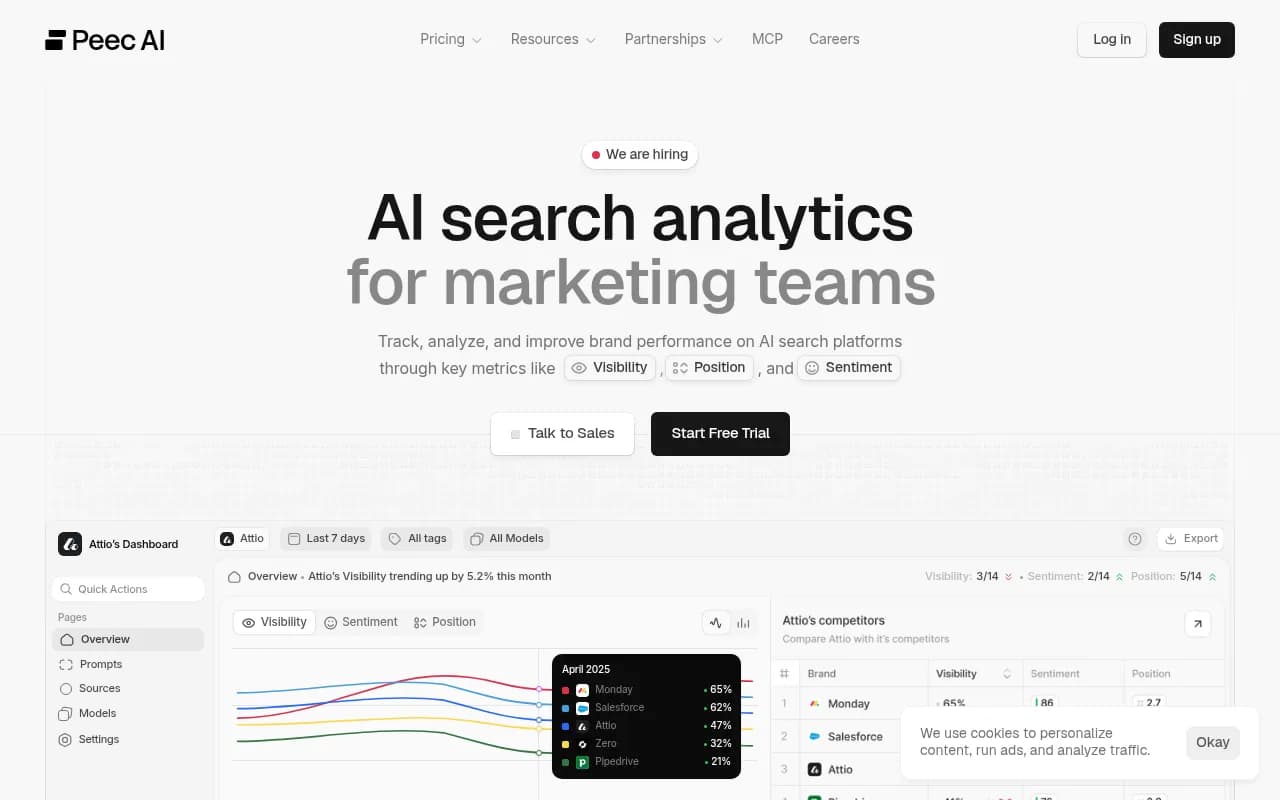
| Peec AI | ~$80/mo | Prompt tracking across engines, unlimited seats on Starter | Budget-conscious monitoring |
| Otterly.AI | $29/mo | Basic brand visibility monitoring, 4 engines | Cheapest credible entry point |
| AthenaHQ | Free tier, ~$95–295/mo | Monitoring plus an action center with predictive citation modeling | Small teams wanting some action layer |
| Scrunch AI | ~$250/mo | 7 engines ungated, plus action layer | Brands needing wide engine coverage |
| Profound | $99/mo starter, enterprise custom | Enterprise monitoring and agent remediation | Large orgs with compliance needs |
The honest framing: monitoring-only tools are cheaper but stop at telling you there's a problem. Action-layer tools cost more but can trigger updates directly. If your bottleneck is knowing what to refresh, monitoring suffices. If your bottleneck is actually shipping the refreshes, you want the latter. For a deeper comparison of this category, the GEO software directory at bestgeosoftware.com covers the full landscape.
A 90-day operating rhythm
Here's how to turn all of this into a repeatable process:
Days 1–14: audit and baseline. Pull your cited pages from the last 90 days. Sort by last substantive update. Anything over 90 days old that's earning citations goes on the priority list. Verify your robots.txt and CDN rules aren't blocking GPTBot, ClaudeBot, PerplexityBot, or Meta-WebIndexer. Fix your dateModified and sitemap <lastmod> hygiene.
Days 15–45: first refresh wave. Hit product and commercial pages first, given their growing citation share. Each refresh: 20%+ substantive change, updated stats, new sections, honest timestamp, changelog entry. Resubmit updated sitemaps.
Days 46–75: measure and adjust. Compare citation trends before and after each refresh, per engine. Remember ChatGPT's 6–12 week pickup lag, so don't judge a refresh after ten days. Check crawler logs to confirm bots returned.
Days 76–90: systematize. Set update SLAs per page type using the cadence table above. Assign owners. Put the calendar in writing, because a cadence nobody owns is a cadence that doesn't happen.
Common mistakes to avoid
- Date-stuffing without substance. Engines evaluate content delta. Fake freshness signals can get discounted site-wide.
- Refreshing everything equally. Your product pages likely deserve monthly attention; your evergreen guides don't. Allocate by citation value, not by page count.
- Judging refreshes too fast. ChatGPT's citation pickup lag runs 6–12 weeks. Killing a refresh program at week three means you never see the payoff.
- Ignoring platform volatility. A citation drop that starts on a known rollout date is probably not your fault. Diagnose before you rewrite.
- Forgetting the offsite half. AirOps found 85% of brand mentions originate on third-party pages, and only 30% of brands stay visible from one answer to the next. Refreshing your own pages is necessary but not sufficient; mentions and citations together create stability.
The bottom line
The numbers point one direction: quarterly refreshes as the floor for anything you want cited, monthly for commercial pages, and at least 20% real change every time. Teams that operationalize this, with owners, SLAs, and per-engine monitoring, are the ones still showing up in AI Mode answers when their competitors' pages quietly age out of the citation pool. A page can rank steadily in classic Google and still fall out of ChatGPT's citation pool within a single quarter. The refresh cadence you set this month is what decides which side of that you're on.