Key takeaways
- AI slop isn't defined by "AI wrote it" — Merriam-Webster's 2025 word of the year defines slop as low-quality content produced in quantity by AI, and Google's own spam policy targets scaled, low-effort output regardless of who or what made it.
- Fact-checking is the single biggest time sink in review, and for good reason: hallucination-style citation errors run from 37% (Perplexity, the best performer tested) to 94% (Grok-3) in one Columbia Journalism Review test of AI search tools.
- Ahrefs' 331k-page study found almost no correlation (0.011) between percentage of AI content and ranking position — the real signal is thinness and repetition, not authorship.
- AI detectors (GPTZero, Originality.ai, Pangram) disagree with each other constantly and carry 7-10%+ false-positive rates, so they belong in your process as a flag, not a verdict.
- If part of your goal is getting cited by ChatGPT or AI Overviews, thin listicles and generic product pages are losing citation share to how-tos and documentation, according to Promptwatch's citation-type tracking — a quality bar AI search is now enforcing on its own.
Why a checklist, not a vibe check
Most teams don't have an AI slop problem because their writers are lazy. They have one because nobody built a gate between "draft finished" and "published." Shreya Sharma put it well in a LinkedIn post that's been making the rounds in content marketing circles: most AI content doesn't fail because AI wrote it, it fails because nobody checked it against anything before hitting publish.
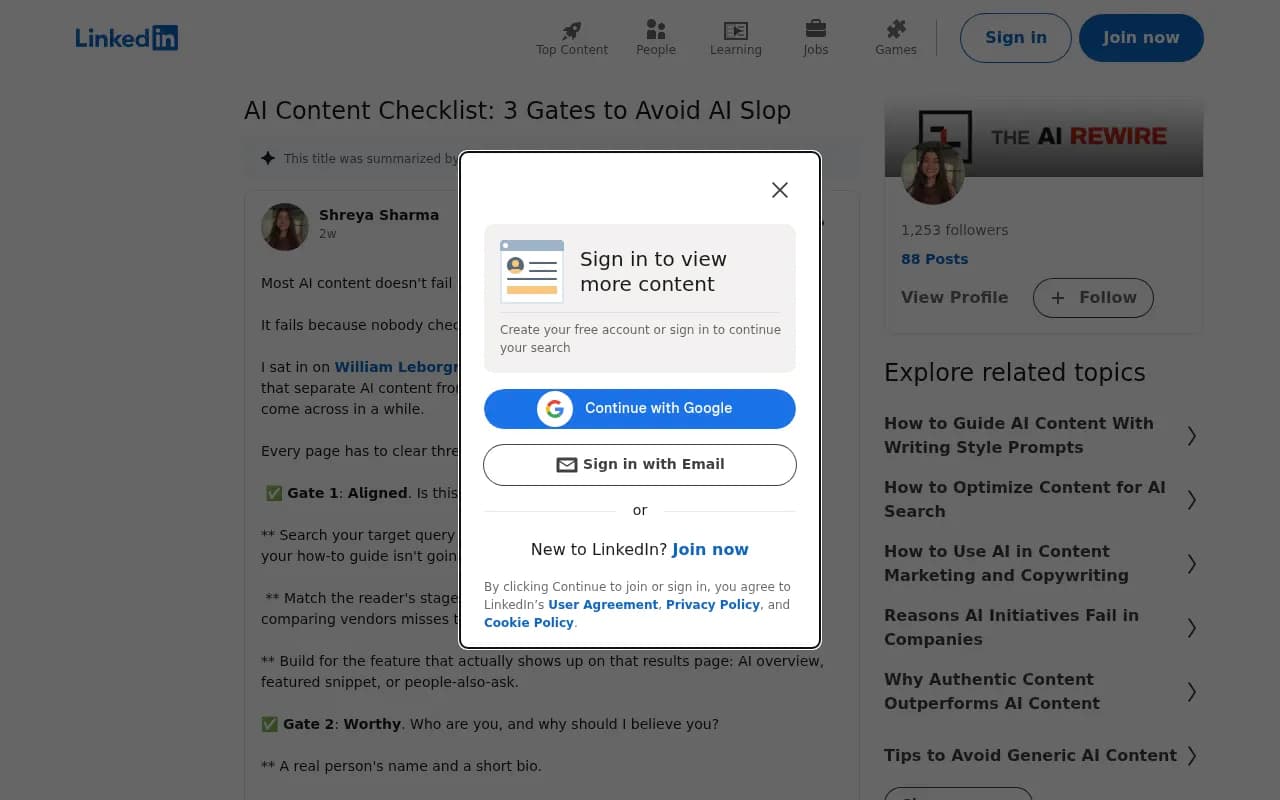
That's the whole problem in one sentence. AI models don't produce slop on their own — they produce raw material. Slop happens at the review stage, when raw material gets published without anyone checking it against a fact, a customer, a competitor's page, or even a simple read-aloud test. So this isn't a list of AI ethics platitudes. It's a checklist you can actually run before you hit publish, twelve checks deep, roughly in the order you should do them.
The order matters
Before the checklist itself, one structural note worth stealing from how Glean frames AI content review: check factual accuracy and sourcing first, then tone and brand alignment, then structure and flow last. Polishing prose before you've verified the claims inside it is backwards — you'll spend twenty minutes making a false statistic sound more confident.
The 12 checks
1. Fact-check every claim, one by one
Treat every statistic, date, name, and "studies show" in the draft as unverified until you've checked it against a primary source. On a typical 1,500-word AI-assisted article, budget 20-30 minutes specifically for this — verifying stats, confirming quotes are real, checking that cited studies say what the draft claims they say. This is the step people skip when they're behind deadline, and it's the step that actually matters.
Hallucination rates are why this can't be optional. Stanford HAI's 2026 AI Index put hallucination rates across 26 leading models anywhere from 22% to 94%, depending heavily on the benchmark. More relevant to publishing: a Columbia Journalism Review test of AI search tools found citation-hallucination rates of 37% for Perplexity's Sonar Pro (the best of the group), climbing to 67% for ChatGPT, 76% for Gemini, and 94% for Grok-3. Even the best tool got it wrong more than a third of the time. If your AI draft cites a source, go find the source.
2. Verify every link actually resolves to what it claims
A small, mechanical check that catches an embarrassing amount of slop: click every outbound link. AI models cite URLs that don't exist, link to the wrong page on a real domain, or paraphrase a source so loosely the link no longer supports the claim next to it. This takes five minutes and catches things fact-checking by memory won't.
3. Run the shuffle test on structure
Randomly reorder the H2 sections in your draft. If the piece still basically makes sense in the new order, your sections aren't actually connected to each other, they're just adjacent. That's a structural tell of AI slop: paragraphs that could be swapped with paragraphs from a competitor's article on the same topic because nothing in them depends on what came before. Rework until the order matters.
A related version: write one sentence per section summarizing what it covers. If two sentences are basically duplicates, you've got a redundant section — AI models love restating the same point under a different H2.
4. Read it out loud
This sounds almost too simple to be a real editing technique, but it's one of the most reliable ways to catch phrases that don't sound like your company. If you stumble over a sentence, or a paragraph sounds like it was written by someone who's never talked to your customers, it probably was. Maintouch's guidance on this is blunt: read the content out loud specifically to catch phrasing that doesn't match your brand voice, separate from checking whether the facts are right.
5. Check for AI's tell-tale sentence rhythm
AI-generated prose tends to flatten out: long runs of 15-20 word sentences, heavy use of semicolons and parentheticals, and a habit of starting sentences with "This." Running a draft through Hemingway Editor isn't about chasing a readability score, it's about visually spotting where the rhythm goes dead flat for three or four paragraphs in a row. Break it up. Short sentence. Then a longer one that actually goes somewhere.
6. Cut the generic filler vocabulary
Every AI model has a house style, and it leaks through in specific words and constructions: "in addition," "it's worth considering," "it's important to note," "not only X but also Y." None of these are wrong exactly, they're just empty calories that signal "nobody edited this." Strip them and see if the sentence loses anything. It usually doesn't.
7. Add first-party detail the model couldn't have known
This is the single biggest lever for turning AI-assisted content into something that isn't slop. AI models have no access to your actual customer calls, your product usage data, or the specific objection your sales team hears every week. Insert it. A concrete product detail, a real customer quote, an actual number from your own analytics. Content built on first-party data reportedly correlates with a 2.9x revenue increase over content relying on third-party sources, per data cited in Maintouch's review of the problem — whether or not you trust that exact multiple, the underlying logic holds: information nobody else has is the one thing a generic AI draft structurally cannot contain.
8. Ask if this could be about any company in the industry
A gut check, not a tool: could you swap your company's name for a competitor's in this draft and have it still read fine? If yes, it's slop, no matter how it was written. The fix connects back to check 7 — specificity, named tools, real examples, not "many businesses find that..."
9. Run a technical pre-flight before it goes live
Separate from the writing quality, check the boilerplate stuff that still kills otherwise-good content: does the title actually match what someone searching for it wants to find, is the key information sitting in crawlable text rather than buried in an image or a script-rendered widget, are headings structured logically rather than just decorative. This is the kind of thing tools like Clearscope or Surfer SEO are built to flag automatically against what's already ranking.

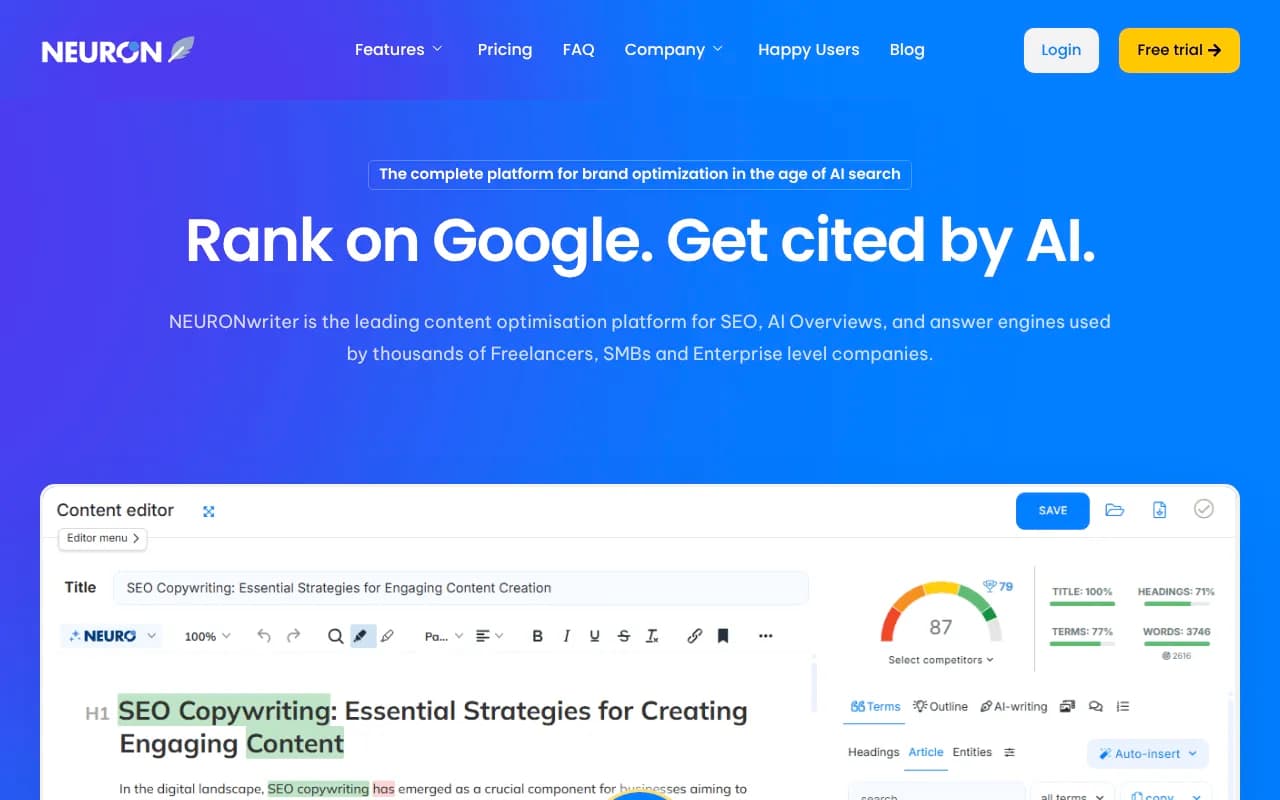
If you're running content at volume, a platform like MarketMuse or NeuronWriter can layer this technical and topical check into the writing process itself rather than leaving it for a final pass.
10. Run it through an AI detector, but don't treat the score as a verdict
Detectors are useful as a second opinion, not a gate. GPTZero, Originality.ai, and Pangram all disagree with each other on the same document regularly, and independent testing has put false-positive rates at roughly 7% for Originality.ai and over 10% for GPTZero in one comparison. Use one as a flag that a section reads too close to raw output, then go fix it by hand with checks 4 through 8. Don't kill or publish a piece purely because a detector returned a percentage.
| Detector | Starting price | Claimed strength | Worth knowing |
|---|---|---|---|
| GPTZero | $12.99/mo for 150k words | High accuracy on pure AI text in own testing | ~78% AI-text catch rate in independent tests |
| Originality.ai | $14.95/mo for 200k words | Lower false-positive rate (7.2% in one cited study) | Built-in plagiarism check too |
| Pangram Labs | $15/mo for 600 scans | Frequently cited as most accurate in third-party tests | Credits scale with document length |
| Copyleaks | $9.99/mo for 25k words | Budget option, 2 seats included | Weaker on longer-form nuance |
11. Check whether Google would even want to rank this
Google has been explicit since 2023 that AI authorship isn't the penalty trigger — manipulative intent and low value are. Its spam policy specifically names "scaled content abuse": automated tools used to produce many pages that add little to no value compared to what already exists on the same topic. Ahrefs' 331k-page analysis backs this up empirically: pages under 50% AI content account for 82.2% of top-3 rankings, but the correlation between AI-content percentage and ranking position across a larger 600k-page sample was just 0.011 — essentially nothing. The lesson isn't "avoid AI," it's "avoid thin." Ask honestly: does this page add something the top five results for this topic don't already say?
12. Check whether this is the kind of content AI search actually cites
If part of the goal is showing up when someone asks ChatGPT or Google's AI Overviews about your topic, it's worth knowing what those systems are actually rewarding right now. Promptwatch's citation-type tracking for August 2026 found social posts collapsed from 4.4% to under 1% of ChatGPT citations after mid-August, while how-tos more than doubled from 4.3% to 9.1% over the same period and documentation rose from 3.3% to 8.2%. Generic listicles and thin product pages are losing ground to substantive, specific content — which is a fairly direct confirmation that the slop problem and the AI-citation problem are the same problem.
A separate Promptwatch data cut on domain authority found something reassuring for smaller sites: mid-authority domains (DR 46-75) account for nearly half of all ChatGPT citations, while top-tier DR 91-100 domains shrank from about 7% of citations to roughly 3% over the course of August. You don't need a massive domain to get cited. You need content that clears the bar the other eleven checks on this list are designed to enforce.
If you want an ongoing view of whether your content is actually clearing that bar in AI search, rather than checking once and hoping, Promptwatch tracks citations, crawler activity, and content gaps across ChatGPT, Gemini, Claude, Perplexity, and AI Overviews, and flags which of your pages are losing ground before traffic drops make it obvious.

Putting the 12 checks into a workflow
Doing all twelve on every single blog post isn't realistic for most teams. Here's a rough tiering that keeps the important stuff mandatory without turning publishing into a week-long process.
| Priority | Checks | When to skip |
|---|---|---|
| Never skip | Fact-check claims (1), verify links (2), "any company" test (8) | Never |
| High-stakes content only | Voice read-aloud (4), first-party data insertion (7), shuffle test (3) | Fine to lighten on internal or low-traffic pages |
| Nice-to-have, automate where possible | Detector pass (10), readability rhythm (5), filler vocabulary (6) | Batch these with a tool rather than doing manually every time |
| Ongoing, not per-article | Technical pre-flight (9), Google spam-policy sanity check (11), AI citation check (12) | Run periodically across the whole site, not per post |
A word on cost
All of this takes time, and that's sort of the point. A piece worth your reputation is a piece worth thirty minutes of fact-checking and a read-aloud pass. If a checklist this long feels expensive, that's roughly the argument made in a widely shared 2026 piece on AI slop eating the internet: don't publish anything you wouldn't bet your reputation on, add sources, add constraints, add review — and if that sounds like a lot of overhead, that's the point. The alternative, judging by IAS's ad-inventory data showing non-AI-slop inventory delivers a 49% higher success rate and 24% lower cost per conversion, is that low-effort content doesn't just fail to rank, it actively performs worse wherever it lands.
If you're building or refining a content workflow around this, the directory of AI search visibility and GEO tools at bestgeosoftware.com is a reasonable place to compare platforms that fold citation tracking and content quality checks into one pipeline rather than juggling five separate tabs.