Key takeaways
- There is no agreed definition of an AI visibility score, no published benchmark, and no two vendors calculate it the same way. A 31 in one tool and a 68 in another can both be correct.
- Scores diverge for five reasons: prompt sets, engines counted, time windows, scoring scales, and the fact that AI answers are not deterministic.
- Trust the tool whose methodology you can inspect, whose prompts you control, and whose data comes from the real interfaces people use. Treat the score as a trend line, not a grade.
- Never compare a number from one tool against a number from another, or against a vendor's quoted "industry average."
- Pick a tool by what it helps you do after the score: trace sources, fix gaps, and measure traffic.
The problem: eight dashboards, eight verdicts
A thread on r/GEO_optimization caught my eye recently. A content and SEO person with five-plus years in B2B and B2C SaaS said they had tried 20+ AI visibility tools on their own brand in two weeks. Every tool gave a different answer. That matches what most teams discover the first time they buy a second platform. You scan the same company, in the same week, and the numbers don't line up.
The instinct is to assume somebody is wrong. Usually nobody is. One analysis from ContextBolt puts it bluntly: you can score 31 in one tool and 68 in another on the same Tuesday, and neither number is wrong. A LinkedIn piece on the same topic splits the disagreement into noise and genuine methodology differences, which is the right frame. Some of the gap is randomness. Some of it is design choices baked into each product.
This guide walks through where each gap comes from, so you can decide which tool to believe and, more importantly, what to do with the number once you have it.
What an AI visibility score actually measures
Strip the branding away and almost every score is built from the same two ingredients. The first is volume: how many AI answers, out of the set the tool looked at, named your brand. The second is spread: how many different engines those mentions came from. Being named by one assistant is fragile. Being named by several is a position.
Some vendors layer on sentiment, position within the answer, or whether you were cited as a source and not just named. Those refinements move the number a few points. None of them fix the real issue, which is the denominator. A score is mentions divided by a set of questions somebody chose. Change the questions and the score changes, with nothing different about your brand.
That is why a vendor telling you "the average in your industry is 34" is describing its own customer base, set up its own way. It is not describing an industry.
Why eight tools give you eight numbers
Here is the practical breakdown of what differs between platforms.
| What differs | What it does to your score |
|---|---|
| Question set | Broad category prompts dilute you. Narrow buyer prompts concentrate you. Same brand, different number. |
| Engines counted | A tool tracking only ChatGPT and one tracking six engines measure different populations. |
| Time window | Twelve months of history versus a current-state index gives different totals. |
| Scale and formula | Linear scales spread the top out. Log scales spread the bottom out, so small brands see more movement. |
| Data collection method | API calls and real user interfaces can return different answers and citations. |
| Run frequency | A single daily run and several runs a day produce different samples of a noisy signal. |
Semrush's own guide to measuring AI share of voice walks through the first three of these and reaches the same conclusion: the prompt set decides the number.
The prompt set is the biggest lever
If tool A tracks 50 category prompts like "best CRM software" and tool B tracks 50 prompts like "best CRM for a 10-person agency," you are comparing two different markets. Your brand might dominate the narrow one and barely register in the broad one. Both tools would be telling the truth.
The fix is boring and effective. Use the same prompts in every tool you test, or better, use a tool that lets you define them and doesn't hide the list.
Engines are not interchangeable
Engines expose different numbers of citation slots. According to Promptwatch Data's average sources per response report, ChatGPT cites about 5 sources per web-search answer, while Google AI Overviews and Perplexity cite roughly 10. Copilot swung from under 2 to nearly 17 sources per response within a few weeks before settling at the low end. A tool that weights every citation equally across engines will score you differently from one that doesn't, even if both count the same engines.
The engine itself keeps moving
Tools that track at different times capture different behavior. Promptwatch's ChatGPT query fanouts data shows the average number of fan-out searches per response sliding from about 2.15 in early December to about 1.84 by early March, with average query length falling from roughly 117 characters to the high 80s. After a data gap, fanouts returned in April at exactly 1.0 per response and about 53 characters. If retrieval behavior shifts in steps like that, the same prompt set will score differently month to month, and tools that don't track fanouts at all won't see why.
It gets stranger in August. According to Promptwatch's site: operator report, ChatGPT started using the site: operator at scale on August 8, 2026, jumping from roughly 0.4% to about 17% of all fan-out queries overnight, and searches per response nearly doubled. Any score that spans that date is measuring two different ChatGPTs.
The noise problem: AI answers are not deterministic
There is a fifth reason underneath all the others, and it should make you cautious about any single reading. SparkToro's research on AI recommendation consistency found that there is less than a 1 in 100 chance that ChatGPT or Google's AI, asked 100 times, will give you the same list of brands in any two responses. Claude is slightly more likely to repeat itself, but even less likely to do so in the same order.
Run the same question twenty times and you get a distribution, not a value. A tool that shows you a score to one decimal place is showing you precision it doesn't have. This is also why run frequency matters. A tool sampling each prompt once a day is giving you a thinner slice of that distribution than one that can run a prompt every few hours.
Search Engine Land's write-up on which AI share of voice metrics matter lands in the same place from the agency side: the composite score is the least actionable thing on the screen.
Trust test: seven questions to ask any tool
You can't pick a winner by comparing scores. You can pick one by comparing methodology. Ask these:
- Can I see and edit the full prompt list behind the score?
- Does it collect from the real interfaces of ChatGPT, Gemini, AI Overviews and others, or only from APIs? User-facing answers and citations can differ from API output.
- Which engines count, and are they weighted?
- How often does each prompt run, and can I raise that for a launch?
- Does it separate mentions from citations, and show position and sentiment independently?
- Can I click from the number to the actual answers and sources?
- Does it connect to what happens on my own site: AI crawler visits and AI-referred traffic?
A tool that answers "yes" to most of those lets you audit its own number. A tool that hides the denominator asks you to take the score on faith.
A test you can run this week
If you already have two or three platforms, here is a cheap way to find out which deserves trust.
- Export or write down 25 to 50 prompts that real buyers would use, including a few with competitor names and a few with your brand name.
- Load the identical list into each tool. Where a tool won't allow that, note it. That is data too.
- Run for at least two weeks before reading anything.
- Compare rank order of competitors, not raw scores. If three tools agree that you trail the same two competitors, that is a signal. If they disagree on who leads, look at the engines and prompt mix.
- Spot-check 10 responses by hand in the actual ChatGPT or Google interface. See whether the tool's recorded answer resembles what you see.
- Check whether movement lines up with something real: a new article, a lost listing, a model update.
The agreement that matters is directional. If every tool shows you rising over six weeks, believe it. If one says up 12 points and another says down 5, find the cause before reporting either.
Eight tools, compared by what they measure
What follows is a practical read on eight platforms people commonly run side by side. I'm describing positioning, not ranking accuracy, because no one can honestly rank accuracy when there is no ground truth.
| Tool | Strength | Watch for |
|---|---|---|
| Promptwatch | Real-UI collection, citations, crawler logs, traffic, and content fixes in one loop | Content Agent and faster tracking start on Business |
| Profound | Enterprise reporting and wide engine coverage | Custom pricing, built for larger orgs |
| Semrush AI Visibility Toolkit | Fits teams already living in Semrush | Prompt sets are less transparent than dedicated trackers |
| Ahrefs Brand Radar | Strong index of mentions alongside Ahrefs data | Index-style view, not a controlled prompt panel |
| Peec AI | Simple prompt tracking at a lower price | Monitoring-focused |
| Otterly.AI | Affordable brand monitoring | Basic tracking, limited downstream measurement |
| Scrunch AI | Monitoring for brands and agencies | Monitoring-led |
| AthenaHQ | Visibility monitoring with a clean interface | Lighter on content execution |
Promptwatch
Promptwatch is the one I'd point a skeptical reader to first, mostly because it lets you check its own work. It collects answers from the real interfaces of ChatGPT, Google AI Overviews, Google AI Mode, Gemini, Perplexity, Copilot and others, in each country and language. Its Visibility Score is documented: each response is scored on placement, share of attention and depth, then averaged, and responses that don't mention your brand count as zero. That means the denominator is visible instead of buried. It also reads your site's AI crawler logs and AI-referred visitors, so a low score can be traced to either an access problem or a content problem. Prompts run daily on every plan, and Business and Agency Scale can run every 12, 6 or 1 hours, which helps with the noise issue above.

Plans run from Essential at $95/mo to Business at $579/mo, with a 7-day free trial; confirm current pricing at promptwatch.com/pricing. If you want a sanity check before paying anything, the free AI visibility report scans how ChatGPT, Gemini and Perplexity talk about you.
Profound
Profound is an enterprise platform with deep reporting and wide engine coverage. Its own buyer's guide leads with itself, which is worth remembering when reading vendor-authored comparisons, mine included. It suits large organizations that want depth and can pay custom enterprise rates. See the Promptwatch vs Profound comparison for the trade-offs.

Semrush AI Visibility Toolkit
The Semrush toolkit reports citation frequency, sentiment and share of voice. A reviewer testing it on a personal site was careful to note that the score reflects Semrush's tracking methodology and available data, and is not an official ranking from any AI platform. That caveat applies to every tool on this list. If your team already works in Semrush, the convenience is real.
Ahrefs Brand Radar
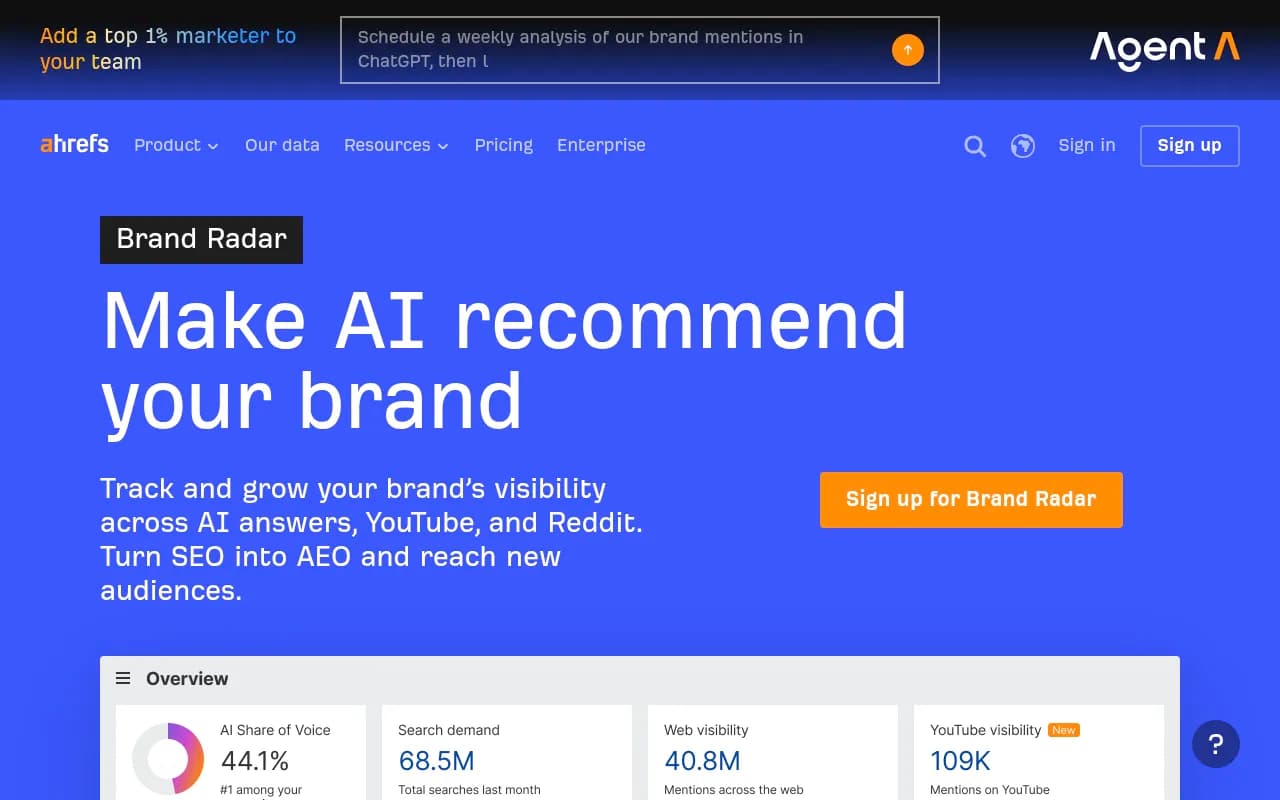
Brand Radar is closer to an index of mentions than a controlled prompt panel, so its numbers will naturally differ from tools running a fixed prompt list. Neither design is wrong. They answer different questions.
Peec AI, Otterly.AI, Scrunch AI and AthenaHQ
These four are mostly monitoring-led. They are good at answering whether your brand got mentioned and by whom, usually at friendlier prices. Where they thin out is the second half of the job: crawler visibility, AI traffic attribution, and content production grounded in what AI already cites.


If you want to browse beyond these eight, the GEO software directory at bestgeosoftware.com lists a much longer field.
What to watch instead of the headline score
A composite score averages very different problems into one digit. Read the components separately and you can tell what kind of problem you have.
| Symptom | Likely cause | First thing to check |
|---|---|---|
| Low share of voice | Coverage problem: AI doesn't associate you with the topic | Content gaps against tracked prompts |
| Mentioned late in answers | Prominence problem | Position and which competitors outrank you |
| Mentioned, but rarely cited | Content or crawlability problem | Crawler logs and which of your pages get cited |
| Weak sentiment | Reputation problem | The specific claims AI makes about you |
| Good visibility, no clicks | Attribution or intent problem | AI-referred traffic and conversions |
Citations and mentions are not the same thing, either. Promptwatch's academy explains the distinction in citations vs mentions, and it is worth reading before you build a report on either.
Source behavior also changes quickly, which is one more reason to track components. According to Promptwatch Data's Reddit citations report, reddit.com's share of ChatGPT citations fell from about 4% to 0.5% on August 14, 2026, while AI Overviews and AI Mode declined more gradually. And per the social media citations report, between Sep 28 and Oct 4, 2026, ChatGPT drew 0.46% of its citations from social platforms while Google AI Overviews drew 12.2%. A tool that blends engines will hide that split inside one number.
Which to trust
My honest answer: none of them as a standalone grade, and the ones that let you audit the number more than the ones that don't.
Practically, that comes out as a short set of rules.
- Pick one primary tool and stick with it for at least a quarter. Consistency matters more than which brand you chose, because a trend only means something inside one methodology.
- Use a second tool as a cross-check on direction, not on level.
- Prefer collection from real interfaces, a visible prompt list, and documented formulas.
- Prefer tools that connect the score to your own site data. A visibility number with no link to crawls, citations or traffic is a vanity metric.
- Choose for what happens next. A dashboard that reports a score and leaves the work to you is the weaker buy. An end-to-end platform that shows the gap, drafts the content, publishes it, and checks whether it got crawled and cited closes the loop.
For teams that want that loop, Promptwatch's Action Board, Content Agent and CMS publishing to WordPress, Webflow and Framer are built for exactly this. If you are mapping a first 90 days, the 90-day GEO program is a reasonable template.
And if you just want a second opinion on your setup, 1001 SEO Media runs GEO and AI visibility work for brands, and can help you choose prompts and engines before you spend on tooling.
Reporting the number without lying
When the score goes into a slide, a few habits keep you honest.
- Always state the prompt count, engines, country and date range next to the number.
- Report competitors from the same run, never against a different tool or a different month's methodology.
- Show a range or a trend, not a single point. One reading from a noisy system is an anecdote.
- Hold the prompt list fixed for a quarter. When you change it, mark the break on the chart.
- Pair the score with something that happened on your site: pages crawled, pages cited, visits from AI, conversions.
The last one is the real test. Crisp, for example, saw 2x higher conversion rates from AI traffic than from traditional channels, per its Promptwatch case study. That is a result you can defend in a meeting. A score of 68 is not.
The short version
Eight tools will give you eight scores because they are measuring eight slightly different things on a system that changes its answer every time you ask. Decide what you are trying to move, fix your prompts, hold your methodology steady, and judge tools by how transparent their number is and how much they help you act on it. The score is the headline. The questions, answers, sources and crawl data underneath are the work.