Key takeaways
- A mention (your brand named in an answer) and a citation (a source link in the answer) are different events. Log them separately or your numbers will mislead you.
- One vendor study (Am I Cited, which sells a related tool) claims 85% of brands mentioned in ChatGPT have no citation link. Treat it as a directional claim, not independent research.
- Measure in layers: earned coverage, answer presence, answer accuracy, and business response. Don't collapse them into one "AI visibility" score.
- Unlinked mentions leave no referrer, so you need proxies: branded search, direct traffic, GA4 AI referral filters, and a fixed prompt set run on a schedule.
- Correlation is not causation. A mention on a trade site does not prove it caused an answer appearance.
Why unlinked mentions are hard to measure
A user asks ChatGPT for the best tool in your category. Your brand is named in the third sentence. No link, no click, no referrer, no UTM tag. Analytics shows nothing. Yet that person may well open a new tab and type your name into Google an hour later.
This is the core problem. Traditional SEO gave you rankings, impressions and clicks. The answer layer gives you none of those by default, so you have to build the measurement yourself.
And there's a trap on the other side. Plenty of vendor content says "unlinked mentions are worth more than backlinks, so go get mentions." That might be partly true, but it's often stated with more confidence than the evidence supports. I'd rather give you a measurement approach that holds up when your CFO asks what it proves.
What the evidence says (and doesn't)
Two numbers circulate constantly in this topic:
- Am I Cited, a vendor that sells AI citation tracking, says 85% of brands mentioned in ChatGPT have no citation link. In a separate post it says it analyzed 107,432 brand mentions across ChatGPT, Google AI Mode, AI Overviews, Gemini and Perplexity and found 56.5% carried no citation link. Those two figures don't match, which is a good reason to treat both as rough.
- The same vendor cites an Ahrefs study of 75,000 brands, reporting a 0.664 correlation between web mentions and AI Overview visibility versus 0.218 for backlinks. I haven't verified that against Ahrefs directly, so check the primary source before quoting it in a client deck.
Even if both hold up, correlation tells you that brands mentioned widely also tend to appear in answers. It doesn't tell you that any single placement caused any single appearance. Brands with lots of web mentions are usually bigger, older and better known, which would produce the same pattern on its own.
What first-party data does show is that answers are built from many sources. In Promptwatch's data for Sep 28 to Oct 4, 2026, 47.6% of ChatGPT responses cited 10 or more unique domains, and only 6% cited three or fewer. For brand-specific prompts the picture is tighter: five domains was the most common count. An earlier Promptwatch sources-per-response report put ChatGPT at about 5 sources per web-search answer, Google AI Overviews at about 10 and Perplexity at almost exactly 10. The two ChatGPT figures differ in date and method, so don't read them side by side as a contradiction. The practical point is the same: your brand competes inside a crowded source list, and third-party pages shape how you're described.
Mention, citation, appearance: define your units
Before you count anything, pin down what you're counting. The most useful framing comes from Percepture's write-up on this topic: keep three records distinct.
| Record | What it is | Example |
|---|---|---|
| Earned mention | A published page names your brand, with or without a link | A trade article lists you in a comparison |
| Answer appearance | An AI response names your brand | ChatGPT recommends you for a category prompt |
| Citation | The answer points to a source URL | The answer links to that trade article |
Note that a citation to a trade publication is not a citation to your own site, even if the article names you. If the answer cites the comparison page, log the answer appearance and the cited page as two rows. Don't call it one win.
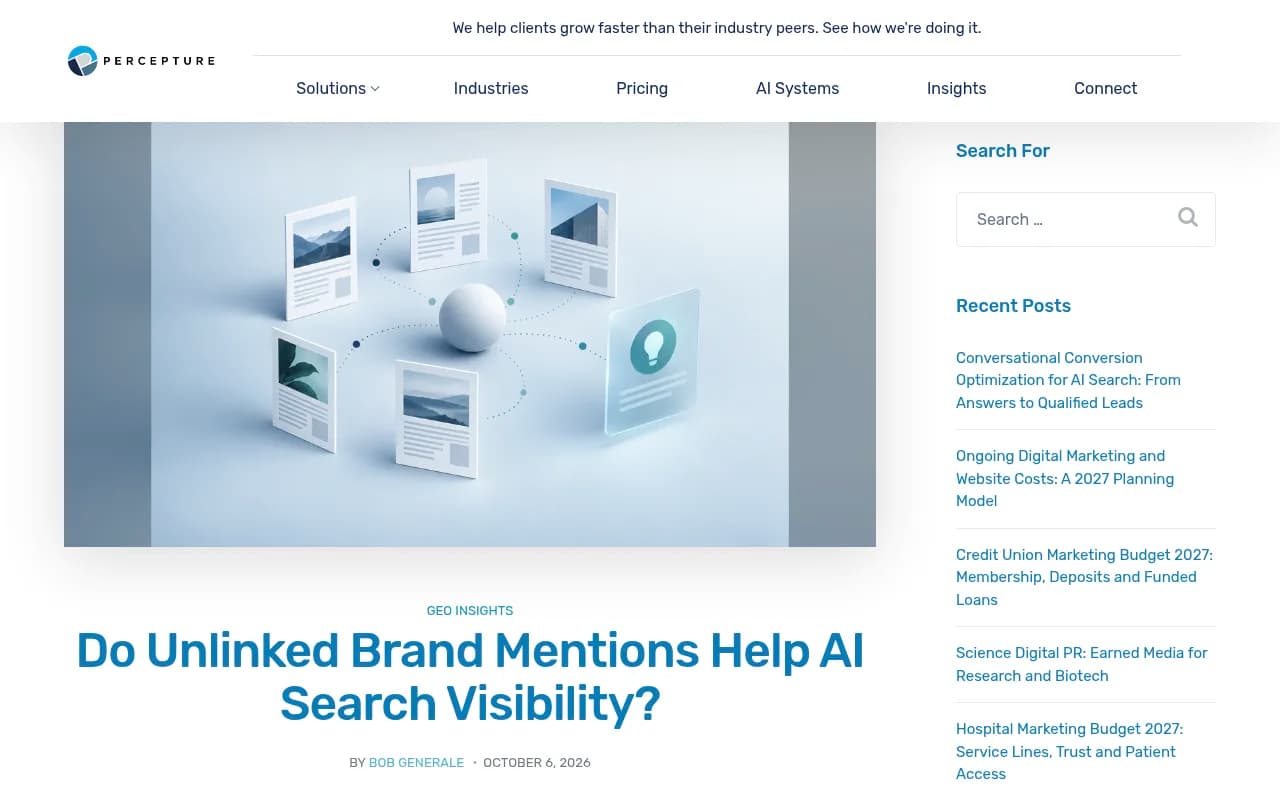
When you read any vendor report, ask what the word "mentions" means in it. Published coverage, brand appearances in answers and citations are all called "mentions" somewhere, and the trend lines mean very different things.
A layered measurement plan
Use separate measures for work done, answers observed and business response. One blended score hides which layer is broken.
| Layer | What to record | What it can't prove alone |
|---|---|---|
| Earned coverage | Distinct pages with accurate, relevant mentions; linked and unlinked logged separately | That an AI answer used the page |
| Answer presence | Eligible responses naming the correct brand, divided by all eligible responses in a fixed prompt set | That a specific placement caused it |
| Answer accuracy | Whether the answer gets your company, service, location and limits right | Commercial value from name recognition |
| Business response | Referrals, branded search, qualified inquiries, self-reported discovery | Revenue caused by an unlinked mention |
Two rules keep this honest. First, define an "eligible response" before you calculate presence, and keep failed runs in a separate log. Second, if an answer describes a different company with the same name, exclude it from presence and flag the identity error.
Reading the metrics together
Once you have data, the combination tells you where the problem is:
- Low presence across many prompts: a coverage problem. Not enough trusted pages name you.
- Present but late or buried in the answer: a prominence problem.
- Mentioned often but never cited to your own domain: a content or crawlability problem on your site.
- Mentioned with weak or wrong descriptions: a reputation or accuracy problem, usually traceable to the third-party sources the model leans on.
Step 1: build a fixed prompt set
Pick 30 to 100 prompts that reflect how buyers actually ask. Split them into three kinds:
- Organic category prompts with no brand named ("best invoicing software for freelancers").
- Competitor comparison prompts ("X vs Y").
- Brand-specific prompts ("is [your brand] any good?").
The split matters. Promptwatch's unique-domains data shows organic prompts pull in far more sources than brand-specific ones, so your presence rate on each type means something different. A single prompt tells you almost nothing, since answers vary run to run. Measure across many.
Keep the set fixed. If you keep swapping prompts, you can't tell whether a change came from your work or from your test.
Step 2: log answers on a schedule
The manual version, as Duane Forrester described it, is simple and works as a baseline. Run the same prompts across ChatGPT, Perplexity, Gemini and Copilot, and record:
- Date
- Assistant
- Prompt
- Brand mentioned (yes/no) and position in the answer
- Citation found (yes/no) and URL cited
- Competitors named in the same answer
- Notes on phrasing and sentiment
Screenshots help. Then repeat weekly or monthly. You can automate capture with n8n or Zapier pushing outputs into a Google Sheet, though it's fiddlier than it sounds.
Manual logging gets painful past a few dozen prompts. That's when a tracker earns its keep.
Step 3: use a tracker that records real answers
The tools below all attempt some version of mention and citation monitoring. They differ in how they collect data (APIs versus real user interfaces), how much they do beyond monitoring, and what they cost, so verify current pricing and coverage on each vendor's site.
Promptwatch is the one I'd start with if you want more than a mention counter. It tracks the real interfaces of ChatGPT, Google AI Overviews, AI Mode, Gemini, Perplexity and others, reports Visibility Score, Share of Voice, position and sentiment, and logs which AI crawlers hit your pages. That last part helps with the "mentioned but never cited to us" problem, since you can see whether crawlers reach your content at all. It also ties AI-referred visits back to your site and turns gaps into content tasks.

Other options worth a look:
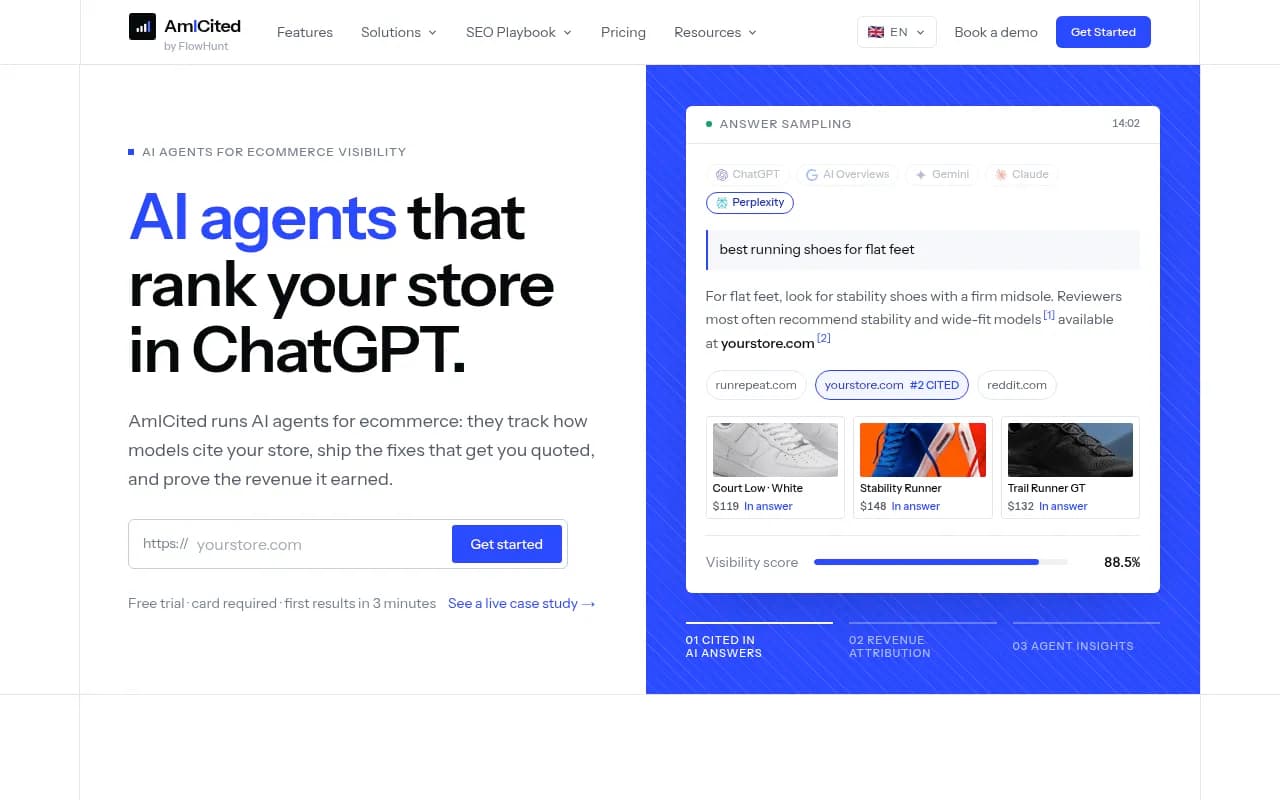
Am I Cited is the vendor behind the 85% claim, and it focuses on mention rate, citation rate and sentiment.

Ahrefs Brand Radar is a natural fit if your team already lives in Ahrefs and wants brand appearances next to backlink data.

Otterly.AI is an affordable prompt-level monitor for smaller budgets.

Peec AI covers visibility tracking with suggestions.

Profound targets enterprise teams with deeper analytics.
| Tool | Best for | Goes beyond monitoring? |
|---|---|---|
| Promptwatch | End-to-end tracking, crawler logs, AI traffic, content fixes | Yes, via Content Agent and Action Board |
| Am I Cited | Mention and citation rate tracking | Limited |
| Ahrefs Brand Radar | Teams already on Ahrefs | Limited |
| Otterly.AI | Budget-conscious prompt monitoring | No |
| Peec AI | Lightweight visibility tracking | Limited |
| Profound | Enterprise analytics | Mostly monitoring |
For a wider view, the directories at bestgeosoftware.com and ai-rank-tools.com list many more trackers by category.
Step 4: capture the proxy signals
Unlinked mentions produce downstream behavior that you can see. None of these prove causation, but together they paint a picture.
Branded search
Watch branded query impressions and clicks in Search Console and Google Trends. People who see your name in an answer often search it later. A rise in branded search that tracks a rise in answer presence is a meaningful pattern, particularly if you repeat it across periods.
Direct traffic
In GA4, look at direct traffic to pages assistants commonly cite. Free-tier AI users often arrive without referrer data, so spikes on specific landing pages can be hidden AI visits. Treat that as a hint, not a classification. Don't auto-assign unattributed traffic to AI.
Identifiable AI referrals
Build a custom channel group or exploration in GA4 using a regex that matches chatgpt.com, perplexity.ai, claude.ai, gemini.google.com, copilot.microsoft.com and similar referrers. Add "landing page + query string" as a dimension to see which pages get the visits. Where you control link placement, use UTM parameters too.
^https:\/\/(www\.meta\.ai|www\.perplexity\.ai|chat\.openai\.com|claude\.ai|gemini\.google\.com|chatgpt\.com|copilot\.microsoft\.com)(\/.*)?$
Keep customer-reported discovery ("how did you hear about us?") in a separate column from measured referrals. Both are useful. Mixing them isn't.
Copy-paste traces
Support tickets, forum posts and sales calls sometimes contain phrasing lifted from an assistant's description of you. It's anecdotal, but it's a quick check on accuracy.
Step 5: work out which sources shape your mentions
Once you know you're being named, the next question is why, and which pages the model drew on. Three habits help:
- Look at which domains are cited in answers where you appear, and where you don't. Review sites, listicles and forums often matter more than your own pages for brand and comparison prompts.
- Check who is cited alongside you. Competitors in the same answers show you the category's source ecosystem.
- Watch for content type. In Promptwatch's data for Sep 28 to Oct 4, 2026, product pages were the most cited type in ChatGPT at 22.4% of citations, followed by landing pages and listicles. Where your category sits on that spectrum shapes where a mention is likely to come from.
Source types also vary by assistant. Per Promptwatch's social media citation data for the same week, ChatGPT drew just 0.46% of its citations from social platforms, while Google AI Overviews drew 12.2%. And reddit.com's share of ChatGPT citations fell from roughly 4% to 0.5% on August 14, 2026. If your mention strategy leaned on Reddit threads, check whether it still works on the assistant you care about.
Sources also age. Promptwatch's content half-life report, tracking pages ChatGPT cited on July 6, 2026, found news lost half its cited pages within 36 days, while landing pages and docs stayed cited longest. A trade-press mention can fade faster than a durable reference page.
Should you ask for the link?
Sometimes. Ask when a link helps the reader reach something relevant, like a service page or supporting document. Don't ask just to move a placement from one reporting bucket to another.
Accuracy comes first. If the article gets your service wrong or confuses you with another company, fixing the passage matters more than getting a link to it. And if you add a link later, don't count the reclassification as a visibility gain. Nothing about the answer layer changed.
For finding unlinked mentions in the first place, standard media monitoring and brand-mention tools work. Outreach tools such as Respona can help once you have a list.
Earning more mentions that count
The general pattern across sources: models favor brands that show up consistently in many trusted places, and self-published content alone rarely gets a brand into answers. That points to a few approaches:
- Be described clearly and consistently. Use full, specific descriptions of what you do wherever you publish, so there's less ambiguity to resolve.
- Get into third-party comparisons, listicles and review platforms like G2 and Capterra, which come up repeatedly in brand and comparison answers.
- Publish original data that others reference.
- Give expert commentary to publications your buyers read.
- Take part honestly in communities where your customers ask questions.
None of that is new. What's new is measuring it by answer presence instead of link count.
What to reject in a vendor proposal
If an agency or tool promises that a certain number of unlinked mentions will produce a specified AI inclusion or ranking, walk away. Nobody controls that. Ask instead for the prompt set, baseline procedure, coverage criteria, reporting method and attribution rules, plus dated answer records behind every chart. If you're comparing providers, put those reporting terms in writing before you compare prices.
A simple starting checklist
- Write your three-part definition: earned mention, answer appearance, citation.
- Build a fixed prompt set of 30 to 100 prompts across organic, comparison and brand types.
- Capture a baseline across at least ChatGPT, Gemini, Perplexity and Google AI Overviews.
- Set up the GA4 AI referral view and a branded-search report.
- Rerun on a fixed schedule and review the layers separately.
- Fix inaccuracies first, then pursue coverage gaps.
Unlinked mentions are real visibility, but you can only claim what you can observe. Record the answer, record the source, and keep the claims about cause modest until you've got repeated data behind them.