Key takeaways
- Answer Gap Analysis finds the specific prompts and questions where AI models (ChatGPT, Perplexity, Google AI Overviews) cite your competitors but not you -- these are your highest-priority content opportunities.
- Traditional keyword gap analysis tells you what you're missing in Google's index. Answer Gap Analysis tells you what you're missing in AI responses -- a fundamentally different problem requiring a different approach.
- According to Ahrefs (December 2025 data), AI Overviews reduce clicks on the #1 organic result by 58%, which means being cited in AI responses is now as important as ranking.
- Closing answer gaps requires creating content with genuine "information gain" -- unique data, perspectives, or structured answers that AI models can't find elsewhere.
- Tools like Promptwatch automate this process end-to-end: finding the gaps, generating content to fill them, and tracking whether AI models start citing you.
The problem with traditional gap analysis in 2026
Most SEO teams still run content gap analysis the same way they did in 2021. Pull up Ahrefs or Semrush, compare your domain against two or three competitors, export the keywords they rank for that you don't, and build a content calendar around the list.
That process isn't useless. But it's increasingly incomplete.
Here's why: AI search engines don't rank pages the way Google's traditional index does. When ChatGPT answers a question about "best CRM for small businesses," it isn't pulling the page with the most backlinks or the highest domain authority. It's pulling the source that most completely and clearly answers the question -- the one that covers the right entities, provides structured context, and demonstrates genuine expertise on the topic.
If your competitor's page includes a comparison table, specific pricing data, and a clear recommendation, and yours is a 2,000-word essay that buries the answer in paragraph seven, the AI cites them. You get nothing. No click, no mention, no visibility.
Ahrefs published data in late 2025 showing that AI Overviews reduce clicks on the #1 organic result by 58%. That number should reframe how you think about content strategy. Ranking first doesn't protect you anymore if an AI Overview answers the question before the user ever reaches your result.
This is the gap that Answer Gap Analysis is designed to find.
What is Answer Gap Analysis?
Answer Gap Analysis is the process of identifying specific questions, prompts, or topics where AI models give your competitors credit but not you.
It's different from traditional keyword gap analysis in a few important ways:
- Traditional gap analysis compares keyword rankings. Answer Gap Analysis compares AI citations.
- Traditional gap analysis is based on historical search volume data. Answer Gap Analysis is based on real AI model outputs -- what the models actually say when users ask questions.
- Traditional gap analysis tells you "your competitor ranks for this keyword." Answer Gap Analysis tells you "when someone asks this question, the AI recommends your competitor and ignores you."
The output of a good Answer Gap Analysis isn't a list of keywords. It's a list of specific prompts where you're invisible, along with the content your competitors have that you don't -- the exact information gap causing the AI to look elsewhere.
That's a much more actionable starting point for content creation.
Why AI models cite some sources and not others
To understand why Answer Gap Analysis matters, you need a rough model of how AI search engines decide what to cite.
AI models are trained to give accurate, helpful answers. When they generate a response, they look for sources that:
- Directly answer the specific question being asked
- Provide structured, scannable information (definitions, comparisons, step-by-step processes)
- Cover the relevant entities and relationships around the topic
- Demonstrate expertise through specificity -- real data, named examples, concrete recommendations
Forrester's 2026 research found that content providing unique "information gain" ranks three times higher in AI responses than content that rehashes existing consensus. "Information gain" means something the AI can't easily synthesize from the general web -- your own data, a proprietary perspective, a structured comparison no one else has published.
Generic content doesn't get cited. Content that adds something new does.
This is why closing answer gaps isn't just about writing more content. It's about writing content that AI models actually need -- content that fills a specific informational hole they're currently filling with your competitor's page instead of yours.
The four types of gaps that matter in 2026
Modern content gap analysis has expanded well beyond keywords. There are four distinct gap types worth tracking:
Keyword and topic gaps are the traditional kind -- topics your competitors cover that you don't. Still relevant, still worth finding, just no longer the whole picture.
Semantic gaps occur when you cover a topic but miss the related entities, subtopics, and questions that AI models expect to see alongside it. You might have a page about "email marketing," but if it doesn't address deliverability, list segmentation, and A/B testing in a structured way, AI models may not consider it a complete source.
Format gaps happen when your content covers the right information but presents it in a way AI models struggle to extract. A 3,000-word narrative essay and a structured FAQ with clear H2 headings both "cover" a topic, but the FAQ is far more likely to get cited because the answer is immediately findable.
Answer gaps (the focus here) are the most specific: these are the exact prompts and questions where AI models are actively citing someone else instead of you. They're not theoretical -- they're happening right now, in real user sessions, and they're costing you visibility.
How to run an Answer Gap Analysis
Step 1: Define your prompt universe
Start by building a list of the questions your target audience actually asks AI models. This is different from a keyword list. You're looking for natural-language questions, not search queries.
Sources for this:
- Customer support logs (what questions do people actually ask your team?)
- Reddit threads in your niche
- Perplexity's "related questions" suggestions
- ChatGPT's follow-up question suggestions
- Your own sales team's FAQ list
An estimated 15% of daily searches in 2026 are brand-new queries with no historical search volume data. Chasing monthly search volume from Google Keyword Planner means missing a significant portion of the real question universe. Cast a wider net.
Step 2: Run those prompts through AI models and record who gets cited
For each prompt, run it through ChatGPT, Perplexity, Google AI Overviews, and any other models relevant to your audience. Record:
- Which sources get cited
- Whether your domain appears at all
- Which competitors appear most frequently
- What specific content the AI is pulling from
This is tedious to do manually at scale. Tools designed for AI visibility monitoring automate this process -- running hundreds of prompts, recording citations, and surfacing the gaps automatically.
Promptwatch does this specifically: it tracks prompt-level citations across 10 AI models, then surfaces the prompts where competitors are visible and you're not.
Step 3: Analyze what your competitors have that you don't
For each gap prompt, visit the pages your competitors are getting cited for. Ask: what does this page have that mine doesn't?
Common answers:
- A direct, concise answer in the first paragraph
- A comparison table or structured data
- Specific statistics or original research
- A clear recommendation or verdict
- Coverage of related subtopics and entities
This analysis tells you exactly what to write -- not just "cover this topic" but "cover this topic with this specific structure and these specific information elements."
Step 4: Create content that fills the gap
This is where most gap analysis guides stop -- they tell you to "create content" without being specific about what that means for AI search.
Content that gets cited by AI models tends to share a few characteristics:
- It answers the question directly and early (the "golden answer" format: a clear 40-word answer immediately after the relevant heading)
- It's structured with clear H2 and H3 headings that match the question being asked
- It includes specific data, named examples, and concrete recommendations
- It covers the topic completely enough that the AI doesn't need to supplement it with another source
Generic, consensus-rehashing content doesn't get cited. If your page says the same thing as the top 10 results already say, the AI has no reason to prefer you.
Step 5: Track whether the gaps close
After publishing, monitor whether AI models start citing your new content. This is where most teams drop the ball -- they publish and move on without ever confirming whether the content actually changed their AI visibility.
Page-level citation tracking shows you exactly which pages are being cited, by which models, and how often. If a page you published to close a gap isn't getting cited after 4-6 weeks, something is wrong -- either the content isn't structured correctly, the AI crawler hasn't indexed it yet, or the gap requires a different approach.
Answer Gap Analysis vs. traditional keyword gap analysis
Here's a direct comparison of the two approaches:
| Dimension | Traditional keyword gap analysis | Answer gap analysis |
|---|---|---|
| What it measures | Keyword rankings in Google | AI citations across LLMs |
| Data source | Historical search volume databases | Real AI model outputs |
| Output | List of missing keywords | List of prompts where competitors are cited, you're not |
| Content guidance | "Write about this topic" | "Write this specific answer in this specific format" |
| Relevance to AI search | Low | High |
| Tools | Ahrefs, Semrush | Promptwatch, Profound, AthenaHQ |
| Actionability | Medium (requires interpretation) | High (gaps are specific and concrete) |
The two approaches aren't mutually exclusive. Traditional keyword gap analysis still helps you find topic coverage gaps. Answer Gap Analysis tells you whether you're actually winning in the AI responses that now intercept a large share of search traffic before it reaches organic results.
Tools that support Answer Gap Analysis
Several platforms have built Answer Gap Analysis into their core workflow. Here's a look at the main options:
Promptwatch is the most complete implementation. It tracks prompt-level citations across ChatGPT, Perplexity, Google AI Overviews, Claude, Gemini, and more, then surfaces specific prompts where competitors appear and you don't. The content generation layer means you can go from gap identification to published content without leaving the platform. It also includes AI crawler logs, which show you whether AI crawlers are actually reading your new pages -- useful for diagnosing why a gap isn't closing.
Profound covers enterprise-level AI visibility monitoring with strong analytics. Good for large teams that need detailed reporting.
AthenaHQ focuses on monitoring and surfacing visibility data. Solid for tracking, though it doesn't extend into content generation.
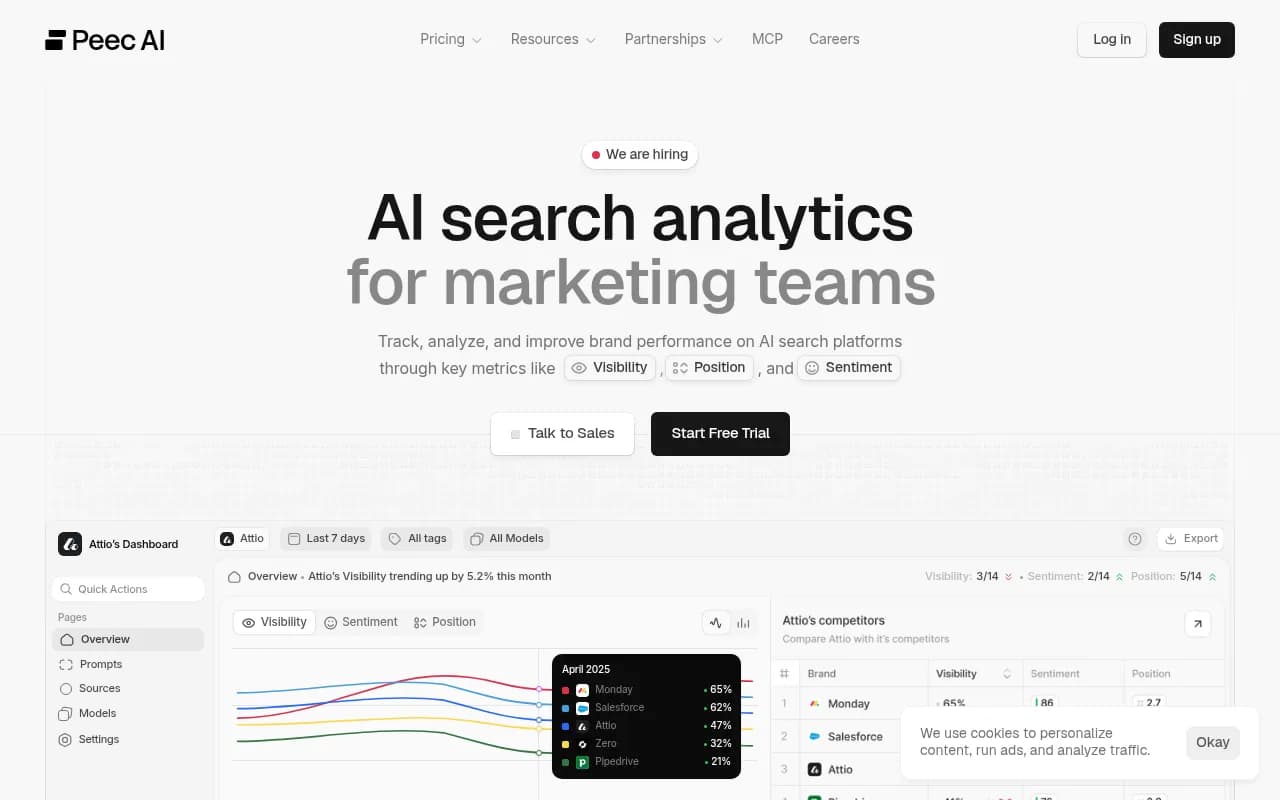
Peec AI offers AI visibility tracking with suggestions for improvement. More accessible price point for smaller teams.
For traditional keyword gap analysis that feeds into an Answer Gap workflow, Ahrefs and Semrush remain the standard starting points -- just don't mistake keyword gap data for answer gap data.
For content optimization once you've identified the gaps, Surfer SEO and Clearscope help you structure content to match what AI models expect to see.
Common mistakes teams make with Answer Gap Analysis
Treating it as a one-time audit. AI model behavior changes as models are updated and as the web changes. A gap you closed three months ago might reopen. Answer Gap Analysis works best as an ongoing process, not a quarterly project.
Focusing only on branded prompts. Your brand name is one prompt type. But most AI search happens on unbranded category and comparison queries -- "best [category] tool," "how to [solve problem]," "[your category] vs [competitor]." These are often where the biggest gaps live.
Publishing content without checking structure. You can write a great page that covers all the right information and still not get cited because the answer is buried. AI models favor content where the answer is immediately findable -- clear headings, direct opening sentences, structured data where relevant.
Ignoring offsite gaps. AI models don't only cite your website. They cite Reddit threads, YouTube videos, third-party review sites, and industry publications. If your competitors are winning citations through their presence on those channels and you're not, that's an answer gap too -- just one you close through PR and community participation rather than on-page content.
Not tracking results. Publishing content to close a gap and then never checking whether the gap actually closed is a waste of effort. Page-level citation tracking is the feedback loop that makes the whole process work.
What "information gain" actually means in practice
The phrase "information gain" gets used a lot in 2026 AI SEO discussions, but it's worth being concrete about what it means.
Information gain is anything your content provides that AI models can't easily synthesize from the general web. Examples:
- Original survey data or research ("We surveyed 500 marketers and found...")
- A proprietary framework or methodology with a specific name
- A comparison table that doesn't exist anywhere else in that exact form
- A specific recommendation with a clear rationale ("We recommend X over Y because of Z")
- A case study with real numbers from a real client
Generic content -- "here are five tips for email marketing," followed by tips that appear on every other email marketing page -- has near-zero information gain. AI models already know those tips. They don't need to cite you for them.
The practical implication: when you're creating content to close an answer gap, ask yourself what you're adding that isn't already out there. If the honest answer is "nothing," the content probably won't close the gap.
Putting it together: the Answer Gap Analysis workflow
A practical workflow for a marketing team running this process:
- Build a prompt list from customer support logs, Reddit, and competitor research (monthly)
- Run prompts through AI models and record citation data -- or use a monitoring tool to automate this
- Identify the highest-priority gaps: prompts with meaningful search/query volume where competitors appear and you don't
- Analyze competitor pages to understand what information they have that you're missing
- Create content with direct answers, clear structure, and genuine information gain
- Monitor citation data for 4-6 weeks post-publish
- Iterate based on what's working and what isn't
The cycle from gap identification to citation takes time -- AI crawlers need to find and index new content before models start citing it. Crawler log data can show you where that process is breaking down if citations aren't materializing.
This is the core loop that separates teams who are actively growing their AI visibility from teams who are watching competitors get cited and wondering why.