Keyword Grid Review 2026
Semantic keyword analysis and SEO optimization tooling that supports broader AI search visibility efforts.
Key takeaways
- Keyword Grid analyzes your pages the way search engines do, using embedding models rather than the keyword-density guesswork most on-page tools rely on. The semantic analysis is genuinely different from competitors like Frase or Surfer.
- Pricing starts at $78/month for 200 credits (40 reports, at 5 credits per report), with no free trial. There's a 7-day money-back guarantee, but credits don't roll over month to month.
- It's a content optimization tool only. It has no AI visibility monitoring: no prompt tracking, no citation analytics, no AI crawler logs, and no traffic attribution from AI platforms, which Promptwatch provides end to end.
- The product launched publicly in November 2025 and is a solo-founder operation. There are no independent reviews on G2, Trustpilot, or Capterra yet, so you're buying on the founder's reputation and the 7-day refund window.
- Best suited for SEO practitioners and content teams who want deep semantic on-page analysis and are willing to pair it with a separate monitoring tool.
What Keyword Grid actually does
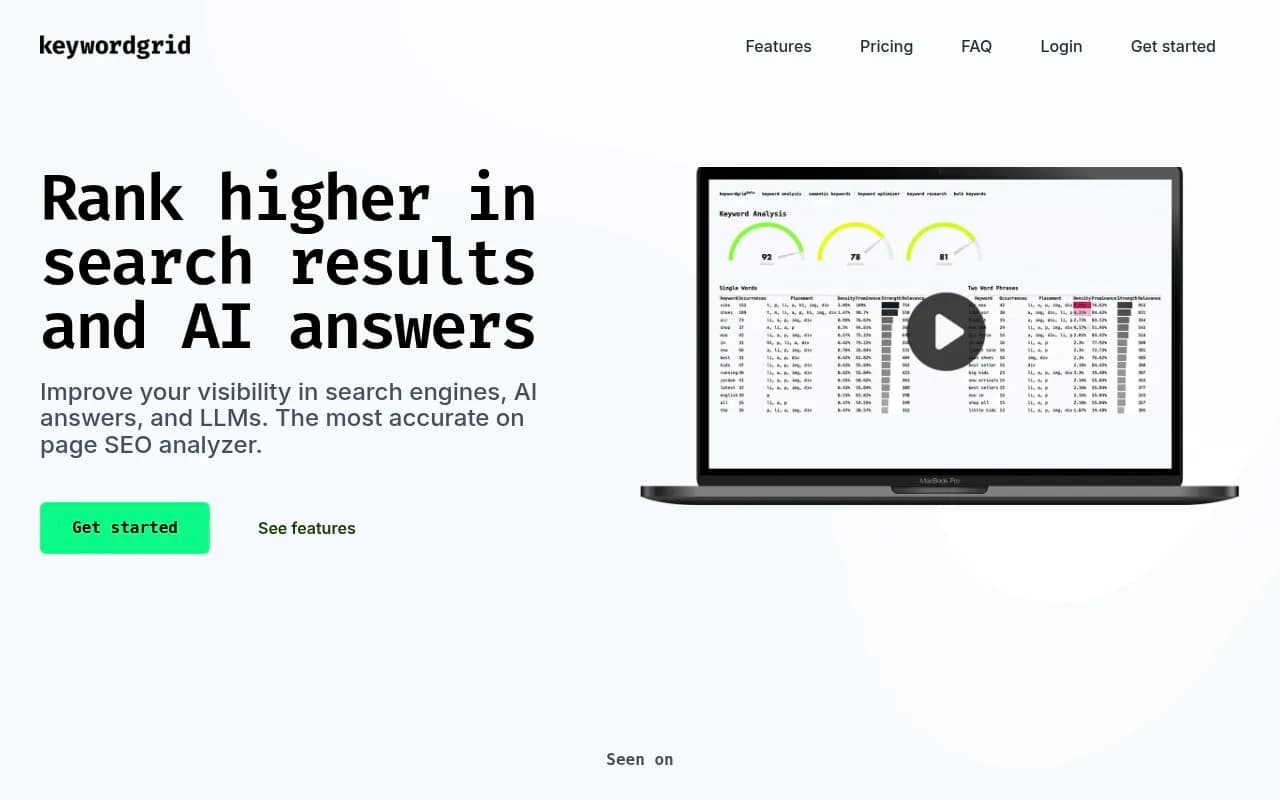
Most on-page SEO tools work backwards from correlation: they scrape the top 10 ranking pages, count keywords, and tell you to use the important ones more often. Keyword Grid takes a different route. It runs your content through the same class of relevance models that power modern search, specifically word vectorization and embedding models, and measures how semantically close your page is to what the search engine considers relevant.
The founder, Adam Clarke, is the author of the annually updated SEO 2026 book series, and the tool reflects a practitioner's mindset. You paste in a URL, get an instant analysis, and see specific things to fix. The homepage claims the underlying model ranks #1 on the MTEB (Massive Text Embedding Benchmark) leaderboard for zero-shot accuracy, which is independently checkable on Hugging Face. I like that the claim is verifiable rather than vague marketing, though note that MTEB rankings shift frequently and "the world's best relevance model" is doing a lot of work in that sentence.
The feature set covers the full on-page workflow:
- Semantic keyword analysis built on relevance models rather than raw keyword counts
- Entity extraction with NLP, plus suggestions for entities your content should mention
- Schema markup inspection on any page, including how top-ranking competitors use structured data
- Keyword research with traffic, difficulty, and relevance data, plus bulk keyword lookups
- AI writing and outlining, trained on top-ranking pages, and an optimizer that rewrites content to read naturally rather than stuffed
The AI answer positioning is where it gets interesting. Clarke's pitch is that because the tool measures relevance the same way AI search does, optimizing with it improves your visibility in both traditional results and AI answers at once. There's a dedicated tool for targeting AI answers. That logic is sound as far as it goes: if an AI system retrieves and cites your page, semantic relevance to the query matters. But there's a big gap in the story, which I'll get to.
Pricing and the credit system
Four tiers, all with access to the full feature set:
- Basic: $78/mo — 200 credits (40 reports), 1 user
- Advanced: $158/mo — 500 credits (100 reports), 2 users
- Agency: $358/mo — 1,000 credits (200 reports), 5 users
- Enterprise: Contact for bulk credit pricing, org license, onboarding and training
Every tool costs 5 credits, so the real question is how many analyses you run per month. If you're managing one or two sites, Basic is probably enough. An agency juggling a dozen client sites will burn through 200 reports fast and land on Agency pricing.
Two things to know before subscribing. First, there's no free trial. Clarke is upfront about this: sign up, and if it's not working, the 7-day money-back guarantee covers you. After 7 days, all sales are final. Second, credits don't roll over. Unused credits are lost at renewal, which stings if your workload is lumpy month to month.
The terms are also strict about seat limits. Sharing one login across an agency team is explicitly prohibited and can get the account terminated, and scraping or reverse-engineering the tool is grounds for immediate cancellation without refund. Fair enough for a solo operation protecting its product, but agencies should budget for the actual seats they need.
At $78/mo entry, it sits mid-pack for the category. Otterly.AI starts at $29/mo and Frase at $39/mo, though those are different tools. Profound and Semrush's AI Toolkit land around $99/mo. You're paying a premium for the semantic analysis depth, not for breadth of features.
Where it performs well
The semantic analysis is the real product here, and it's good. Instead of "use 'best CRM' 14 more times," you get a relevance score grounded in how embedding models actually measure meaning, plus entity gaps that are concrete and actionable. For writers and SEOs who've been burned by tools that produce keyword-stuffed garbage, the optimizer's focus on human-readable output is a relief.
The schema inspection tool is a nice inclusion. Schema is chronically underused, and being able to see exactly how the top-ranking pages structure their markup, then compare it to yours, saves a lot of manual source-diving.
The founder's involvement is also a plus in a market full of VC-funded tools chasing trends. Clarke answers for the product publicly, the terms of service are written in plain English, and the annual book series means he has every incentive to keep the tool's advice current.
Limitations and honest concerns
No monitoring, no measurement. This is my biggest issue. Keyword Grid optimizes content for AI answers, but it never tells you whether the optimization worked. There's no prompt tracking to show which queries trigger AI answers in your space, no citation analytics showing whether ChatGPT, Perplexity, or Google AI Overviews actually cite your pages, no AI crawler logs revealing whether bots like ChatGPTBot or ClaudeBot are even visiting your site, and no traffic attribution connecting AI referrals to conversions. You're optimizing blind and staying blind. If you want to know what content formats AI systems actually cite right now, Promptwatch's data on ChatGPT citation types shows product pages leading at roughly a third of citations in July 2026, with listicles growing fastest, which is exactly the kind of evidence-based targeting Keyword Grid can't give you.
No Reddit, YouTube, or offsite visibility. AI answers draw heavily on Reddit threads, YouTube videos, and third-party pages. Keyword Grid has no visibility into any of that.
Too new for review data. There are no listings on G2, Capterra, or Trustpilot, no Reddit threads, and no verifiable Product Hunt page despite the founder announcing a launch there. The "seen on" press logos on the homepage are the main social proof. That may be fine for a 7-day-refund purchase, but enterprises will balk.
Solo-founder risk. A one-person operation means fast support and direct accountability, but also a bus-factor of one and no SLAs. The Enterprise tier exists, but I'd want clearer answers on continuity before rolling it out org-wide.
Credit friction. Five credits per report with no rollover makes the effective price higher than the sticker suggests for anyone with variable workload.
Who it's for
- Content-focused SEOs and writers who want semantic, entity-level on-page analysis and will pair it with a separate rank or visibility tracker
- Solo practitioners and small in-house teams managing one or two sites, where the Basic plan fits
- Agencies doing heavy on-page optimization work, provided they budget for Agency pricing and seats
- Readers of Clarke's SEO books who want the methodology turned into software
It's a weaker fit for CMOs trying to understand AI-driven revenue, brand managers tracking share of voice in AI answers, or anyone who needs to prove AI search ROI to stakeholders. That's a monitoring problem, and this isn't a monitoring tool.
Bottom line
Keyword Grid is a legitimately interesting on-page analyzer. The embedding-based relevance scoring is more principled than most of what's on the market, the entity and schema tools are practical, and the founder's credibility is real. If your bottleneck is making pages semantically airtight, it's worth the 7-day refund test.
But it covers exactly half the AI search equation. It helps you optimize for AI answers without ever showing you whether you appear in them. For that other half, prompt tracking, citation analytics, AI crawler logs, visitor attribution from AI platforms, and automated content fixes, Promptwatch is the stronger choice, and the combination of the two is more defensible than either alone. If you're evaluating the full category, the GEO software directory at bestgeosoftware.com has a broader set of options to compare.

Tags:
Frequently asked questions
What is Keyword Grid?
How much does Keyword Grid cost?
Does Keyword Grid have a free trial?
Who founded Keyword Grid?
Can Keyword Grid track whether my brand appears in ChatGPT or AI Overviews?
Similar and alternative tools to Keyword Grid