XFunnel Review 2026
Tracks citations and maps brand visibility across the awareness-to-conversion AI buying journey; now part of HubSpot.
Key takeaways
- XFunnel is an enterprise-focused AI search visibility platform with a genuinely interesting angle: it maps brand visibility across the full buying journey, from awareness questions to conversion-stage queries, rather than just tracking brand mentions.
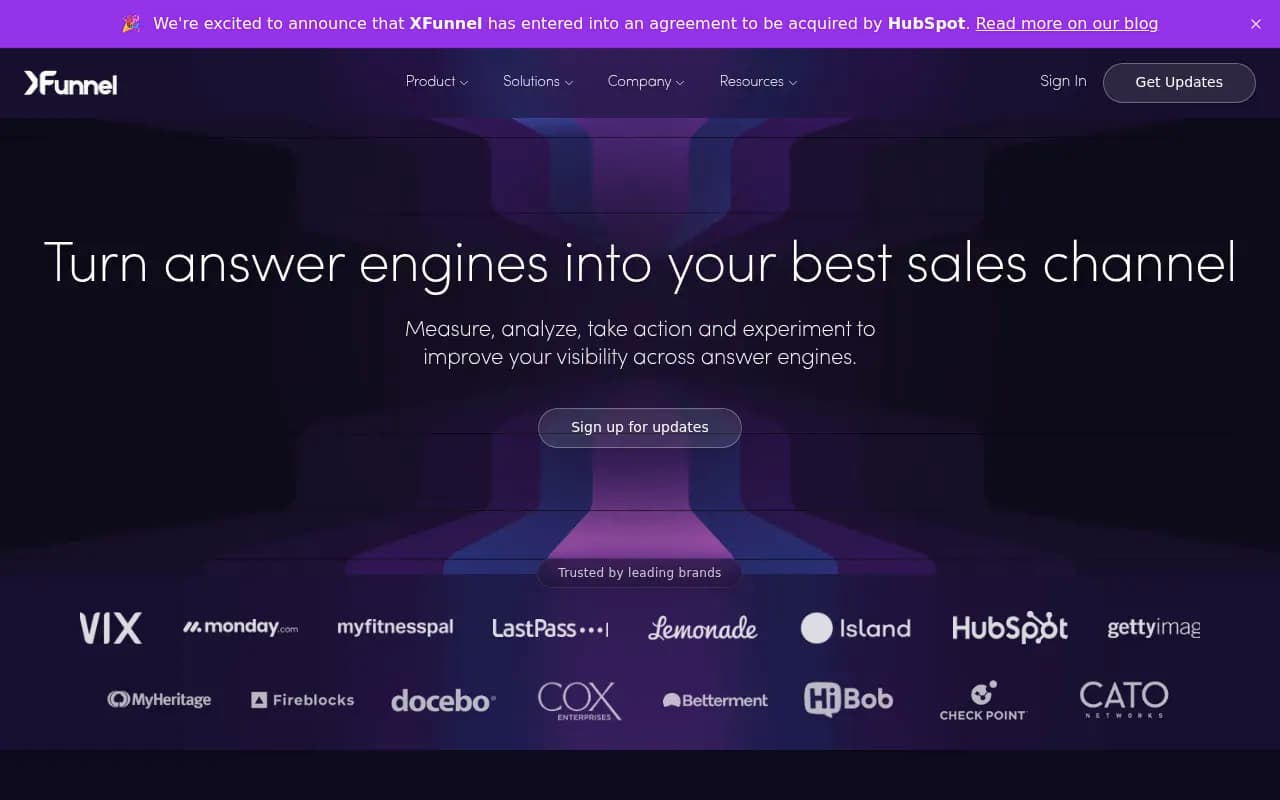
- It has been acquired by HubSpot (announced October 31, 2025) and will be folded into Marketing Hub. The standalone site is still live, but every pricing CTA now reads "Get updates" instead of "Buy" — you effectively cannot sign up for a paid plan directly anymore.
- There is no self-serve paid tier. Your options are a one-time free audit or a sales-call Enterprise plan with unpublished pricing. That's a dealbreaker for SMBs and most agencies.
- Compared to Promptwatch, XFunnel lacks AI crawler logs, visitor analytics that attribute actual AI-driven traffic and conversions, Reddit and YouTube citation tracking, ChatGPT Shopping and ads monitoring, and automated content generation with CMS publishing. It's a monitoring-plus-consulting model, not an end-to-end optimization platform.
- No G2 reviews exist yet (0 ratings at the time of writing), so you're relying almost entirely on vendor claims and a strong customer logo wall.

What XFunnel does
XFunnel, founded by Beeri Amiel and Neri Bluman, positions itself around one idea: answer engines are becoming sales channels, so you should measure and optimize them the way you would a paid channel. The product splits into four modules.
Research surfaces the questions users actually ask AI engines about your category, with topic classification, impact scoring, and segmentation by product, region, persona, and vertical. It claims to pull from nine sources, including clickstream data, Google autocomplete, ChatGPT and Perplexity answers, and review-site UGC from Reddit, G2, and Capterra. This is the module I'd call the strongest — question discovery with intent segmentation is where the buying-journey framing actually earns its keep.
Measure tracks visibility and share of voice across AI engines, with competitive benchmarking, persona-level analysis, sentiment tracking, and something they call a Hallucination Score — it flags when AI engines state inaccurate things about your product, like claiming you're SOC2 compliant when you aren't (or missing that you are). Their own study of 270k+ business queries across 437 companies found real gaps in how accurately engines represent verified business capabilities, which is a legitimately useful and under-served feature.
Analyze digs into responses, topics, and citations to explain what drives visibility and where the gaps are. Optimize is where XFunnel leans hardest into its "not just a dashboard" pitch: optimization playbooks, an experimentation platform with claimed 20-40% improvement variability, content briefs, and an Affiliate Activation Kit.
Platform coverage is broad on paper: ChatGPT, Perplexity, Claude, Gemini, Copilot, Google AI Overviews, and Google AI Mode, with Grok listed and Meta AI and DeepSeek marked "coming soon" on the Enterprise tier.
The service layer is the real product
Here's the thing that surprised me most digging through their site: a large chunk of what XFunnel sells isn't software. The Enterprise plan bundles a dedicated analyst, weekly strategy meetings, managed AI-first content creation, Reddit reputation and engagement management, Wikipedia strategy and page creation, and an AI-first affiliate network, with some of that outsourced to a partner agency.
That's a hybrid agency-plus-platform model. It can work well if you're an enterprise team that wants outcomes without building internal AEO expertise, and the logo wall (Wix, monday.com, MyFitnessPal, LastPass, Getty Images, MyHeritage, Cato Networks, HiBob) plus named testimonials from SEO leads at those companies suggests they've delivered for real teams. But it also means you're buying a relationship, not a tool you can evaluate in a trial. And some of the managed services deserve scrutiny: Wikipedia requires paid editors to disclose their conflicts, and Reddit restricts undisclosed promotional activity. Ask hard questions about how those programs operate before signing anything.
Pricing
There are exactly two tiers, which tells you a lot about who this is for.
- Free Starter ($0): a one-time audit, not an ongoing plan. 50 queries, 4 AI platforms, 1 language, 1 region, community support. Fine for a snapshot, useless for monitoring.
- Enterprise (custom): unpublished pricing, unlimited queries, daily monitoring, all languages and regions, SSO, the full managed-service bundle. You'll need a sales call.
No monthly self-serve tier, no trial of the paid product, no published price. For comparison, self-serve AI visibility platforms run roughly $95-$600/month with transparent tiers, so XFunnel's model is a deliberate choice to serve enterprise buyers only.
Strengths and limitations
Strengths:
- The buying-journey framing is more sophisticated than most prompt trackers, which stop at "were we mentioned."
- Hallucination detection for product claims is a rare and genuinely valuable feature.
- Strong enterprise customer base and named testimonials from SEO leadership at recognizable brands.
- The HubSpot acquisition means deep CRM-side integration is coming, which could be powerful for tying AI visibility to pipeline.
Limitations (and where Promptwatch pulls ahead):
- No AI crawler logs. You can't see when ChatGPTBot or ClaudeBot hit your site, what they read, or whether they hit errors. Promptwatch's Agent Analytics covers 400+ crawlers and explains the "why" behind visibility scores; XFunnel gives you no equivalent.
- No traffic attribution. XFunnel measures visibility and share of voice, but there's no visitor analytics layer connecting AI platforms to actual traffic and conversions on your site. Promptwatch tracks both.
- No Reddit or YouTube citation tracking. Given that social and community sources are heavily cited by AI engines, this is a real blind spot. XFunnel sells Reddit reputation management as a service, but doesn't surface which Reddit posts or YouTube videos are driving AI recommendations about you.
- No ChatGPT Shopping or ads monitoring. As sponsored placements spread through AI answers, competitors bidding on your prompts is something you'd want to see. Promptwatch has an Ads Radar for this; XFunnel doesn't.
- No automated content execution. XFunnel produces briefs and playbooks; Promptwatch's Content Agents plan, write, and publish GEO-optimized content straight to Webflow, Framer, or WordPress on a schedule. For teams without a dedicated analyst, that difference matters.
- No transparent pricing and no self-serve path. Promptwatch publishes plans from $95/month with a free trial; XFunnel is a sales conversation.
- Zero G2 reviews, versus Promptwatch's 4.7/5 rating across a substantial customer base.
- Acquisition uncertainty. The HubSpot deal is exciting for existing HubSpot customers but leaves standalone buyers in limbo. What happens to your contract and data when the integration lands is an open question, and the "Get updates" CTAs suggest the standalone product's days are numbered.
Who it's for
XFunnel made sense for one persona: enterprise marketing and SEO leadership (VP-level buyers at companies like the ones on their logo wall) who want a managed, high-touch program and were already heading toward HubSpot. If you're a HubSpot Marketing Hub customer in 2026, watch the native integration — that's where this technology will likely shine.
For everyone else — SEO agencies managing multiple client sites, in-house teams at SMBs and mid-market companies, anyone who wants to actually execute optimization work rather than receive playbooks — the acquisition limbo, opaque pricing, and missing execution layer make it hard to recommend as a standalone purchase today. If you're evaluating the broader category, the GEO software directory at bestgeosoftware.com and the AI rank tracking tools directory at ai-rank-tools.com are good places to compare options.
Bottom line
XFunnel built a thoughtful enterprise AEO product with a distinctive buying-journey lens and a hallucination-detection feature few others offer. But the HubSpot acquisition has left it in a strange state: still marketing, no longer really selling, and with no clear path for standalone customers. For teams that need an AI visibility platform they can start using this month — with crawler logs, traffic attribution, Reddit and YouTube tracking, and automated content publishing — Promptwatch is the stronger choice, with transparent pricing from $95/month and a 4.7/5 G2 rating to back it up. If you're all-in on HubSpot, wait for the native XFunnel integration instead of buying the standalone product.
Tags:
Frequently asked questions
Is XFunnel still available as a standalone product?
How much does XFunnel cost?
Which AI platforms does XFunnel track?
What makes XFunnel different from other AI visibility tools?
Is XFunnel a good fit for small businesses or agencies?
Similar and alternative tools to XFunnel