Key takeaways
- LowFruits is the most purpose-built long-tail tool of the three. It pulls ideas from Google Autocomplete and scores the SERPs by how many weak sites rank.
- Ubersuggest is the cheap all-rounder: keyword ideas, basic difficulty and site tools in one package, with lifetime plans.
- Keyword Grid is not really a long-tail idea generator. It is a semantic and entity analyzer for on-page optimization, and it costs the most.
- Pricing for Ubersuggest is inconsistent across the web, so check the official page before you pay.
- Most small sites should start with LowFruits or Ubersuggest, then add a semantic tool once the content is being written.
Why long-tail keywords still matter in 2026
The numbers behind long-tail research are lopsided. Ahrefs' large-scale study, as cited by Technova Partners, found that about 94.74% of keywords get 10 or fewer searches a month. That is where most realistic ranking chances live for a site that is not already a big brand.
So the question is less "which tool has the biggest database" and more "which tool helps me tell good small keywords from useless ones." Those are different problems, and the three tools here attack them differently.
One honest caveat up front: I could not find independent benchmarks of keyword-data accuracy for any of these three, and nothing on Keyword Grid's database size. What follows is based on vendor documentation, pricing pages and third-party roundups, so treat the verdicts as fit-for-purpose judgments, not lab results.
The three tools at a glance
| Tool | Core job | Entry price | Free option | Best for |
|---|---|---|---|---|
| LowFruits | Find keywords where weak sites rank | $29.90/mo ($20.75/mo yearly) or pay-as-you-go packs from $25 | 3 free KWFinder searches every 7 days on PAYG | Small sites and bloggers hunting easy wins |
| Ubersuggest | Budget all-in-one keyword and site tool | Lifetime from $120 on the official page, monthly plans vary by source | 7-day free trial, limited free queries | Solopreneurs and small teams on a tight budget |
| Keyword Grid | Semantic and entity analysis for content | $78/mo | None, 7-day money-back guarantee | Content teams optimizing pages already planned |
LowFruits: the long-tail specialist
LowFruits is the tool in this group that actually behaves like a long-tail finder. You enter a seed keyword, it pulls long-tail ideas from Google Autocomplete, and then it analyzes the live SERPs for each one.

How it works
Instead of leaning on a keyword difficulty score, LowFruits counts the number and type of weak, low-authority sites ranking for a query. If a forum thread or a tiny blog sits on page one, that keyword is probably beatable. I like this approach because KD scores are a black box, while "three weak sites in the top ten" is something you can verify by eye.
You can also import your own keyword list and have it analyze the SERPs, and there is a word-count filter that Mangools KWFinder does not have, per LowFruits' own comparison.
Pricing and credits
Subscriptions run $29.90/mo (Standard) or $79.90/mo (Premium), dropping to $20.75 and $62.45 per month when billed yearly. Standard gives 3,000 credits a month and 100 tracked keywords. Premium gives 10,000 credits and 500 tracked keywords. One analyzed keyword costs one credit, and subscription credits reset monthly without rolling over.
If you do not want a subscription, pay-as-you-go packs run from $25 for 2,000 credits to $250 for 50,000, and they expire after a year. The catch: Domain Explorer, the Boosted Keyword Finder, competitor extraction, sitemap extraction and the rank tracker are subscription only. There is a 14-day refund if you have used fewer than 100 credits.
The bias and the slow part
The most-cited roundup praising LowFruits is on LowFruits' own blog, written by a team connected to AIOSEO, whose president also runs LowFruits. Take it as a vendor view. Even that article admits the tool is "super effective" but "takes a lot of time." That matches how SERP-level analysis works: you are reviewing results, not skimming a list of volumes.
Ubersuggest: the budget all-rounder
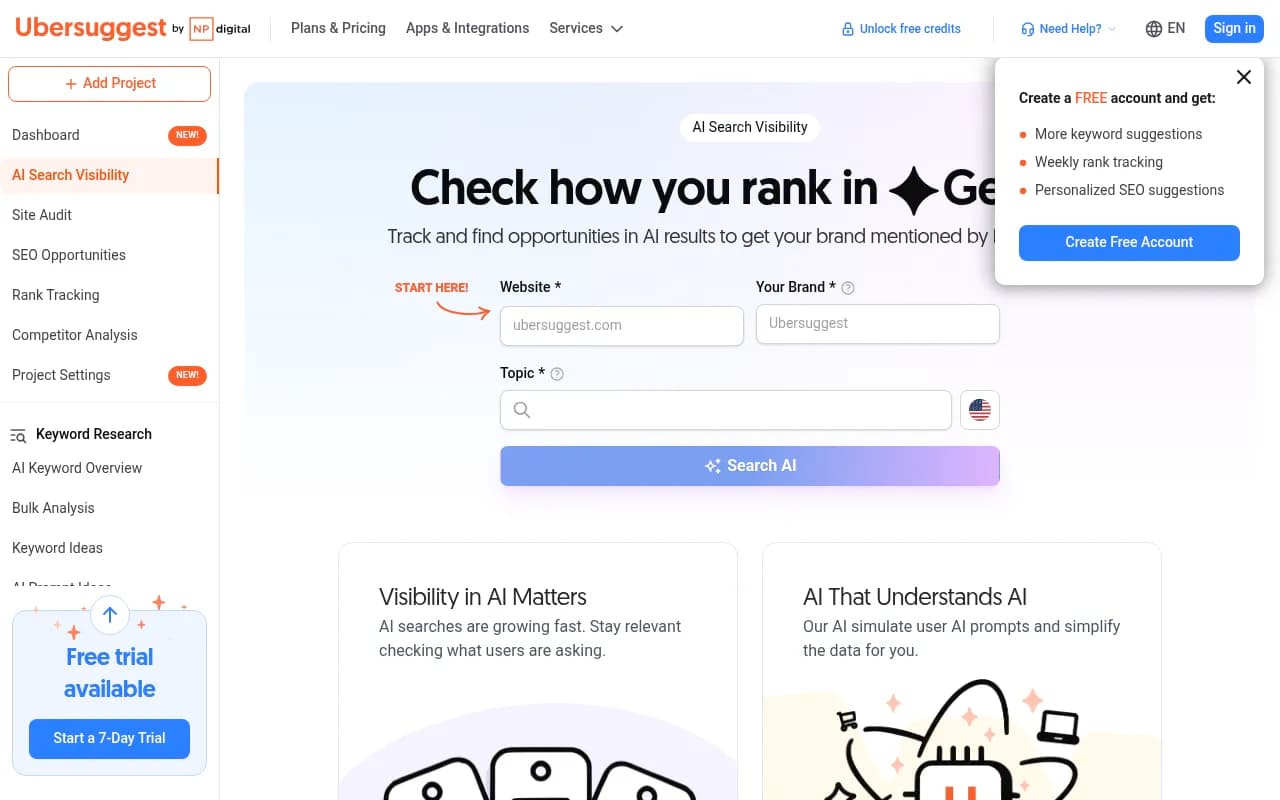
Ubersuggest, from Neil Patel's team, is the generalist. Keyword ideas, basic difficulty, content suggestions, rank tracking and site audits sit in one interface. Technova Partners scored it 17 out of 25 in their framework, with its best mark (5/5) for value and 3/5 for data depth, metrics and long-tail discovery. That is an honest summary: it does a bit of everything and nothing exceptionally.
What you get
On the official pricing page at the time of writing, lifetime plans are marked 90% off:
| Plan | Lifetime price | Websites | Keyword suggestions/month | Bulk analysis | Tracked keywords |
|---|---|---|---|---|---|
| Individual | $120 | 1 | 20,000 | 50 | 125 |
| Business | $200 | 2-7 | 50,000 | 200 | 150 |
| Enterprise | $400 | 8-15 | 100,000 | 1,000 | 300 |
Ubersuggest now also markets itself as "SEO and AI search visibility." The AI add-on costs $9, $29 or $69 a month depending on tier, and a free version covers ChatGPT insights only, at 10 prompts a month for one project. It claims 250,000+ users and shows a 4.3 Trustpilot rating from 568 reviews.
The pricing mess
This is where I would slow down. Sources disagree. One third-party review lists monthly plans at $12, $20 and $40, with lifetime at $120, $200 and $400. Others quote $29, $49 and $99 monthly, with lifetime at $290, $490 and $990. The higher numbers may be the regular price, with the official page now showing a promotional discount, but I could not confirm that. Check the official pricing page on the day you buy, and note that the old neilpatel.com/ubersuggest/pricing URL now returns a 404.
Lifetime-deal caveats
Reports say the lifetime purchase is non-refundable, that you cannot upgrade without buying the other plan, and that lifetime tiers carry fewer features than yearly plans. Lifetime is tempting, and for a solo site it may be fine. Just do not treat it as the same product as a subscription.
Keyword Grid: a different kind of tool
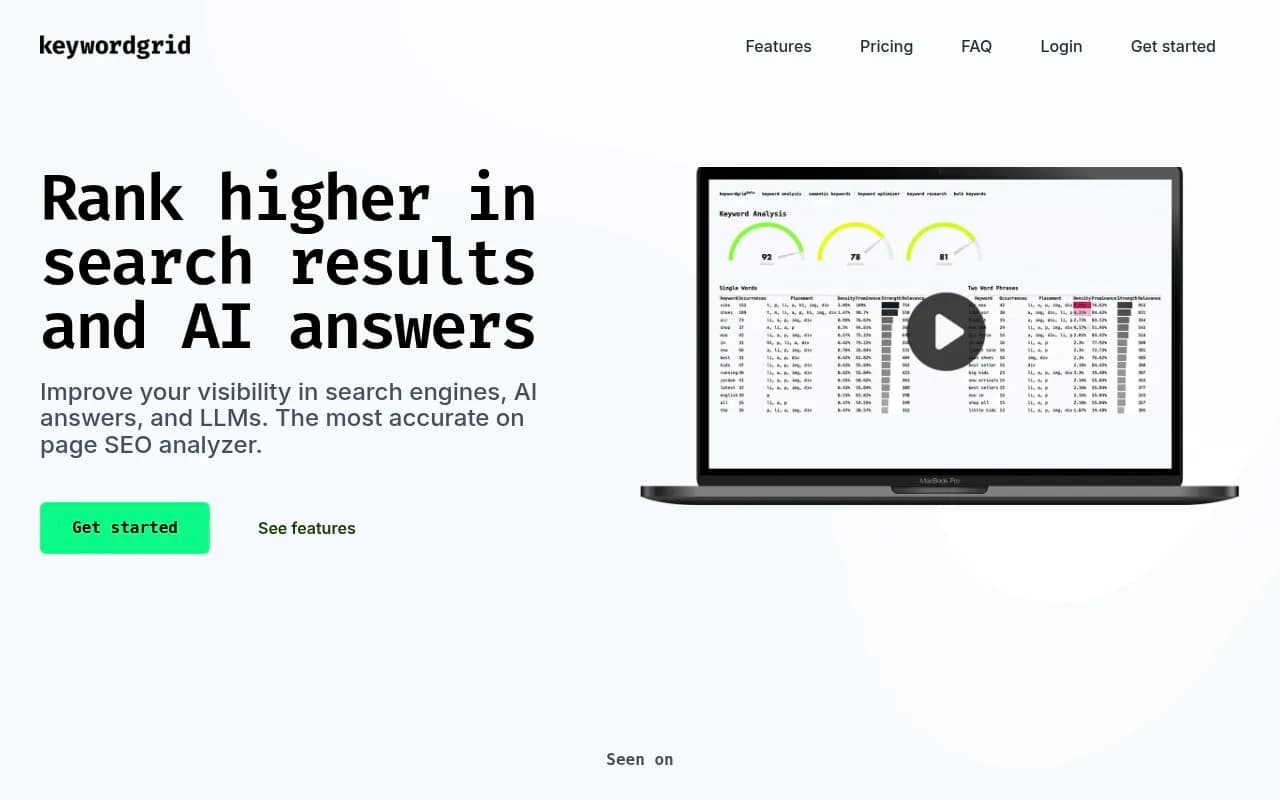
Search for "keyword grid" and you mostly get local-SEO geo-grid rank trackers like Local Falcon. That is not this. Keyword Grid is built by SEO author Adam Clarke and is an on-page and semantic analyzer.
What it does
Its feature list covers semantic keywords, NLP entity extraction, a schema viewer, AI writing and optimization, bulk keyword data (traffic, difficulty, relevance) and a tool for targeting AI answers. The relevance model is built on embeddings and word vectorization, and the site claims a number-one spot on the MTEB leaderboard. A directory listing says it finds "low difficulty fan out queries" and checks presence in AI answers, but that description comes from the vendor side and I could not verify it independently.
Pricing
| Plan | Monthly price | Credits | Users |
|---|---|---|---|
| Basic | $78 | 200 | 1 |
| Advanced | $158 | 500 | 2 |
| Agency | $358 | 1,000 | 5 |
| Enterprise | Contact sales | Custom | Custom |
Each tool run costs 5 credits, so Basic works out to roughly 40 runs a month. There is no free trial, only a 7-day money-back guarantee. For that money you are paying for depth on a page, not for a long list of cheap keyword ideas.
How they compare on the long-tail job
Technova's framework scores tools on data depth, metrics quality, long-tail discovery, workflow and value. I will not invent scores for tools they did not rate, but here is a practical read across the jobs you actually need done.
| Job | LowFruits | Ubersuggest | Keyword Grid |
|---|---|---|---|
| Generate long-tail ideas | Strong, from Google Autocomplete | Good, large monthly suggestion limits | Secondary |
| Judge how winnable a keyword is | Strong, SERP weak-site analysis | Basic difficulty score | Difficulty shown in bulk data |
| Optimize a page after choosing a keyword | Limited | Content suggestions | Strong, semantic and entity focus |
| Track rankings | 100 to 500 keywords | 125 to 300 per project | Not the focus |
| Cost for a solo user | Low to moderate | Lowest, especially lifetime | Highest |
| Learning curve | Moderate, SERP review is slow | Easy | Moderate |
Which one should you pick?
Pick LowFruits if you are chasing winnable keywords
You run a small site, you have no authority to speak of, and you want to find queries where a forum post currently outranks everyone. LowFruits was built for that exact situation. Budget for the time it takes, though.
Pick Ubersuggest if cost and simplicity matter most
You want ideas, rough difficulty and a rank tracker without a big monthly bill. Accept that the data depth is middling and verify the price first.
Pick Keyword Grid if the keywords are already chosen
Your bottleneck is writing pages that cover a topic completely, with the right entities and schema. It is a second-stage tool. Do not buy it expecting a spreadsheet of fresh long-tail ideas.
Combining them
A sensible stack for a content team: LowFruits or Ubersuggest to find and qualify the keywords, then a semantic or content optimization tool once a brief is being written. If you want alternatives for that second step, Surfer SEO, Clearscope and NeuronWriter are common picks.


If you already pay for a full suite, Semrush has its Keyword Magic Tool and Ahrefs has its own keyword explorer. One source puts Semrush's entry price at $129.95/mo, which is far above these three, so they only make sense if you need the backlink and competitive data too.
Free options worth using first
Before paying anyone, Google Autocomplete, People Also Ask and Google Trends cost nothing and cover a lot of long-tail ground. WPBeginner also runs a free keyword generator with unlimited use, and AnswerThePublic has a limited free tier for question-style queries. LowFruits itself reads from Autocomplete, so you are partly paying for the SERP analysis layered on top.
For more tools in this category, the directory at surferstack.com lists reviews, alternatives and comparisons.
Long-tail research and AI search
Long-tail queries are also where AI assistants spend their effort, since they break one prompt into several specific searches. If you want to see which of your pages AI systems actually pick up from those queries, a platform like Promptwatch tracks that across ChatGPT, AI Overviews and others. It is a separate job from keyword research, so treat it as a follow-up step, not a replacement.

Bottom line
If I had one site and one small budget, I would start with LowFruits for the keyword qualification and use free Google sources for brainstorming. Ubersuggest is the safer pick if you want a single cheap dashboard. Keyword Grid is good at what it does, but what it does is optimize content, so only buy it once the keyword list exists. Whatever you choose, confirm current pricing on the vendor's own page, because two of these three have numbers that move.