Key takeaways
- You do not need the leader's domain authority to be cited. In Promptwatch Data for August 2026, sites with domain rank 46-75 took about 46% of ChatGPT citations, while DR 91-100 sites sank to about 4%.
- ChatGPT answers are crowded. 47.6% of responses cite 10 or more domains (Sep 28 to Oct 4, 2026), so a challenger can sit beside the leader if third-party pages mention both.
- A challenger needs a platform that tells it what to fix, not just a dashboard that confirms it is behind. Monitoring-only tools are the cheapest, but they leave the work to you.
- Pick by stage: budget monitors to start, a full optimization platform once you know where the gaps are, and an enterprise suite only if your procurement demands it.
Why challengers need a different tool checklist
Most AI visibility listicles are written for the incumbent. They assume you already have a big brand, a big team, and a budget that makes a $399 or $1,000 a month plan a rounding error. A challenger has none of that. You have a smaller footprint on the web, fewer reviews, and probably one person who owns SEO along with six other things.
That changes what you should buy. A leader mainly needs to defend share and spot errors in how AI describes it. A challenger needs to find the specific prompts where it is absent, work out why, and fix them fast. So the checklist looks like this:
- Prompt-level data, not just a single visibility number
- Citation source data: which pages and domains AI pulls from when it names your competitors
- Competitor comparison on the same prompts
- A path from insight to action (content gaps, briefs, publishing)
- Pricing that does not punish you for tracking enough prompts to get a real signal
If you want to browse the wider field first, the GEO software directory at bestgeosoftware.com and the AI rank tracker directory at ai-rank-tools.com list far more tools than any single article can cover.
What the data says about beating a bigger brand
Before comparing platforms, it helps to know what you are actually trying to move. Three datasets from Promptwatch Data shape how I would approach a challenger strategy.
Authority matters less than you think
Promptwatch's ChatGPT citation share by domain rank report covers August 2026. Sites with DR 61-75 averaged 23.4% of citations and DR 46-60 averaged 22.6%. DR 76-90 held 18.9%. The very top tier, DR 91-100, averaged just 4.4% and dropped from about 7% in week one to about 3% from August 14.
The practical read: placements on a handful of giant publications are not the only way in. The report's own guidance is that a mid-authority site with relevant content is enough to get cited, and that DR 61-90 sites are a sensible target for PR and guest content. That is good news if your budget is small.
The shortlist is built from product pages, landing pages, and roundups
In Promptwatch's content type data (Sep 28 to Oct 4, 2026), product pages made up 22.4% of ChatGPT citations, landing pages 16.8%, and listicles 13.6%. For commercial prompts like "best CRM for small businesses", product pages, landing pages, listicles, and comparisons together were almost 70% of citations.
So for a challenger the job splits in two. Make your own product pages easy to compare (clear pricing, specs, who it is for). And get into the "best of" roundups and comparison pages that ChatGPT already cites for your category.
Answers are crowded, which helps you
Promptwatch's unique domains per response data shows 47.6% of ChatGPT responses cite 10 or more domains, and 52.5% of organic non-brand prompts do. Only about 6% cite three or fewer. Brand-specific prompts are tighter: only 21.3% cite 10 or more, and the most common count is five.
When answers draw on this many sources, there is room for more than one brand. You do not have to displace the leader. You have to be present in the sources that get pulled in. It also means one prompt tells you almost nothing. You want a platform that tracks hundreds of prompts and shows position and description, not just yes or no.
How to choose by stage
Here is the rough split I would use.
| Stage | What you need | Typical fit |
|---|---|---|
| Just starting, small budget | Basic monitoring across a few engines | Otterly.AI, Rankscale, Airefs, HubSpot AEO |
| Growing, need to close gaps | Citation sources, prompt data, content workflow | Promptwatch, Peec AI, Scrunch |
| Already in an SEO suite | AI module bundled into current contract | Semrush, Ahrefs Brand Radar, Conductor |
| Enterprise, procurement-heavy | Governance, scale, integrations | Profound, Bluefish, BrightEdge, Adobe LLM Optimizer |
A caveat on pricing. Vendor-reported figures from one comparison post (Surmado, a vendor that sells its own product, so treat it with salt) say Profound's $99 Starter is ChatGPT-only with multi-engine monitoring from $399, Otterly starts at $29 a month, and HubSpot's paid monitoring is $50 a month. Prices move. Check each vendor's pricing page before you plan around a number.
The platforms worth shortlisting
Promptwatch: best for challengers who want to fix gaps, not just see them
Promptwatch is where I would start if the goal is to actually overtake someone. Most tools in this category answer "was my brand mentioned?" Promptwatch is built around the next question: why not, and what do I do about it.
For a challenger, three things matter. Content gap analysis maps your pages against the prompts AI answers, so you see which prompts the leader wins and you have no page for. The Content Agent plans, writes, and publishes against those gaps to Webflow, Framer, or WordPress, with a review inbox if you want a human check. And IP-verified AI crawler logs show whether AI systems can even read your site, which is often the cheapest fix a small brand has. It also tracks Reddit, YouTube, and LinkedIn citations and shows which third-party pages name you, which maps directly onto the roundup strategy above.
Pricing starts with a free Explore plan (ChatGPT only, 10 prompts), then Essential at $95 a month for 50 prompts across all models. The automated Content Agent sits on Business at $579 a month. Confirm current plans at promptwatch.com/pricing.

Peec AI: strong mid-market analytics
Peec AI is the challenger-friendly analytics pick. It is clean, quick to set up, and good at competitor comparison across engines. The trade-off is that it is mainly a tracker: you still decide what to write and where to get mentioned. If you have a content team and just need a clear scoreboard, it works. Surmado reports $29M raised, which is vendor-reported.

Otterly.AI: cheapest credible way to start
Otterly.AI is the usual entry point for small teams. Vendor listings put it from around $29 a month. It will tell you where you appear and where you do not. It will not tell you much about why, so treat it as a first measurement, not a strategy.

Profound: the category leader, with a leader's price
Profound is the name everyone compares against. Deep enterprise analytics, big client list, and pricing that climbs fast. For a challenger the honest question is whether you need that depth yet. If your main problem is knowing what to publish, a heavier analytics layer will not solve it on its own.

Scrunch: monitoring plus agent-ready pages
Scrunch combines monitoring with pages built for AI agents to read. That second half is interesting for a challenger with a messy site, since it addresses retrieval directly. It leans toward agencies and larger brands in positioning.
Semrush, Ahrefs Brand Radar, and Conductor
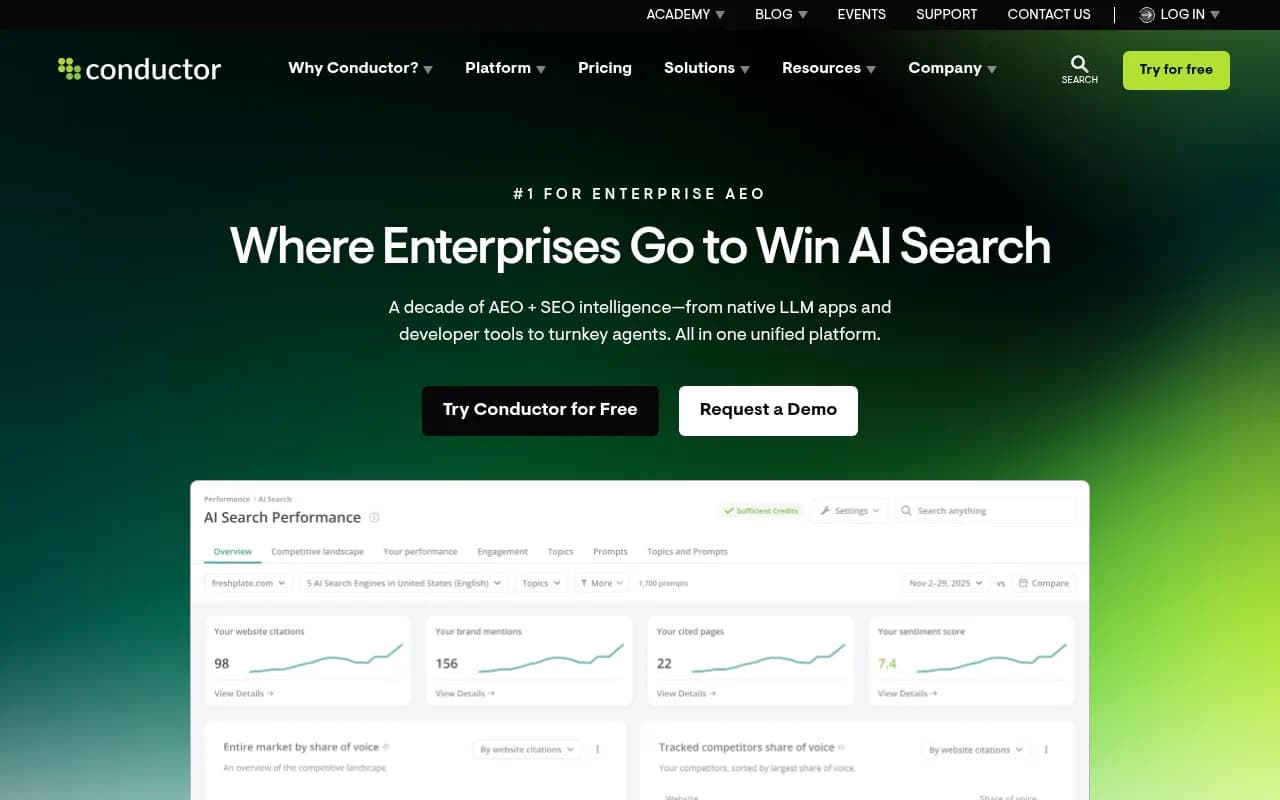
If you already pay for one of these, the bundled AI module is the zero-friction option. Semrush's AI Visibility Toolkit is listed from around $99 a month in the Clarity comparison, and Ahrefs Brand Radar at $199 a month on top of an Ahrefs plan. They are good for large-scale prompt research and for teams who want everything in one login. The AI-specific depth is thinner than dedicated platforms.

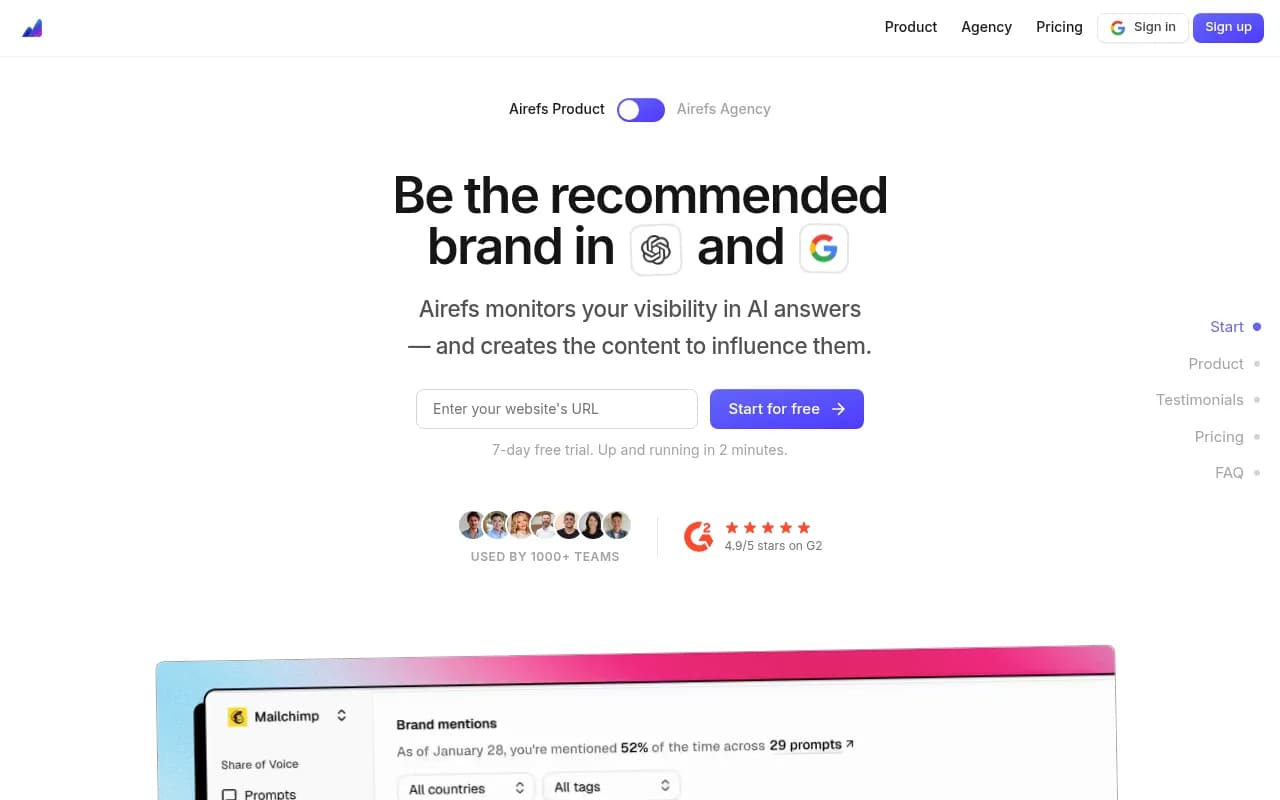
Budget challengers: Rankscale and Airefs
Rankscale and Airefs are the low-cost end. They are fine for proving the channel matters before you commit a budget. Expect fewer workflow features.
Enterprise-leaning options
Bluefish, Evertune, AthenaHQ, BrightEdge, and Adobe LLM Optimizer are all aimed at larger organizations. If you are a challenger inside a big company, or your procurement needs a named enterprise vendor, they belong on the list. A scrappy startup will mostly be paying for governance it will not use.



Side-by-side comparison
| Platform | Best for | Tracks why you are missing | Content workflow | Price signal |
|---|---|---|---|---|
| Promptwatch | Challengers who want to act | Yes (gap analysis, crawler logs, citations) | Yes (Content Agent, Action Board) | Free tier, paid from $95/mo |
| Peec AI | Mid-market analytics | Partial | No | Mid-range |
| Otterly.AI | First measurement | Limited | No | From ~$29/mo (vendor-reported) |
| Profound | Enterprise | Deep analytics | Limited | From $399 for multi-engine (vendor-reported) |
| Scrunch | Agencies, agent-ready pages | Partial | Agent-ready pages | Higher |
| Semrush / Ahrefs | Teams already on the suite | Shallow | Via suite | Add-on pricing |
| Rankscale / Airefs | Budget testing | Limited | No | Low |
A practical playbook for challengers
- Build a prompt set around the shortlist, not your brand. Include commercial prompts ("best X for Y") and competitor comparisons. Brand-name prompts flatter you.
- Run it for two weeks and note the prompts where the leader appears and you do not.
- Look at the sources cited on those prompts. Roundups, review sites, Reddit threads, and comparison pages show up again and again.
- Fix your own pages first: clear pricing, a specific audience, comparison content. Then pursue mentions on DR 46-90 sites, per the domain rank data above.
- Check crawler access. If AI bots are hitting errors on your site, nothing else matters.
- Re-measure monthly, and watch position and description, not only presence.
One warning on the data. ChatGPT's behavior shifts. Promptwatch Data recorded Reddit's share of ChatGPT citations falling from about 4% to 0.5% on August 14, 2026, the same day top-DR domains dropped. A strategy built entirely on one source type is fragile. See the Promptwatch Data hub for the latest changes.
When an agency makes sense
If you have the tool but not the hours, outside help can be the difference. 1001 SEO Media, which publishes this site, runs GEO and digital PR work for brands that want mentions on the third-party pages AI actually cites. It is worth a conversation if your bottleneck is execution rather than data.
Bottom line
If you only want a scoreboard, Otterly.AI or Peec AI will do. If you want to beat a category leader, pick a platform that connects the gap to a fix and then checks whether the fix worked. For most challengers that is Promptwatch, with a budget monitor as the fallback if cash is truly tight. Start with the free tier or a trial, track the prompts that matter, and judge any tool on whether it changed what you published in the first month.