Key takeaways
- Promptwatch is the pick if you want AI visibility tracking plus the tools to fix what you find: content gap analysis, a Content Agent, crawler logs and traffic attribution.
- Ahrefs Brand Radar suits SEO teams already living in Ahrefs who want AI visibility data next to their search data.
- Yext, SOCi and Reputation.com are the closest enterprise multi-location rivals. They cover listings, reviews and AI visibility, but all use quote-based pricing.
- BrightLocal and Synup are the budget routes. Both publish per-location prices (from about $31 and $39 a month) and suit agencies and smaller location counts.
- Podium and Chatmeter are worth a look if your real need is lead conversion or reviews and listings, not AI visibility tracking.
Why people look for Birdeye Search AI alternatives
Birdeye Search AI tracks brand visibility across ChatGPT, Gemini, Perplexity and Bing AI with location-level granularity. For a restaurant group, dental network or dealer chain, that location detail is the point. Knowing that your Tempe office is missing from AI answers while Mesa is fine is genuinely useful.
The reasons people leave are mostly about packaging and price. Birdeye does not publish prices. Its pricing page is a form that asks how many locations you have, with tiers from 1-3 up to 1000+. The Search AI module has no public price at all. Third-party reports put the broader platform at roughly $299-$449+ per location per month, and some reviewers mention setup fees. Those numbers come from a competitor's page, so treat them as unverified and get a real quote.
The second complaint is bundling. Birdeye is a broad local marketing platform covering reviews, listings, messaging, webchat, social and ticketing. If you only want AI visibility, you may be paying for a lot you will not use. Competitor write-ups say the platform feels heavy for small operations, though those are vendor-written and biased.
The third issue is that Birdeye's AI visibility is one module inside a reputation suite. Teams that want deep prompt research, crawler data or content production aimed at AI citations often need a specialist. Here is how the main options stack up.
The alternatives
Promptwatch
Promptwatch is the option here built around AI search visibility itself rather than treating it as an add-on to reputation management.

The difference from most tools in this space, Birdeye included, is that Promptwatch does not stop at reporting. It shows where you are invisible, then helps you fix it. Content gap analysis finds the prompts competitors win and you do not. The Content Agent plans, writes and publishes content to WordPress, Webflow or Framer. The Action Board gives you a prioritized to-do list. Then page tracking, IP-verified AI crawler logs and visitor analytics show whether the new pages were crawled, cited and clicked.
It monitors the real interfaces of ChatGPT, Google AI Overviews, Google AI Mode, Gemini, Perplexity, Copilot and others, rather than relying only on API outputs. It also covers Reddit, YouTube and LinkedIn citations, AI Shopping and Ads Radar, prompt volumes and difficulty, and query fan-outs. The company says it serves 1,840+ brands and agencies and is rated 4.7/5 on G2.
The honest trade-off versus Birdeye: Promptwatch is not a review, listings or messaging platform. It will not respond to Google reviews or sync your NAP data. It does support country tracking on every paid plan and state/city tracking from the Business plan, which covers a lot of local needs, but it is not built around hundreds of individual storefronts with franchise-style approval chains.
Pricing is public. Explore is free (1 project, 10 prompts, ChatGPT only). Essential is $95/mo, Professional $245/mo and Business $579/mo, with agency plans from $199/mo. Confirm current numbers at promptwatch.com/pricing.
Best for: marketing and SEO teams, agencies and e-commerce or SaaS brands that want to grow AI-driven traffic and conversions, and anyone who found Birdeye's visibility module too thin or too opaque. If you want to see how AI search is actually behaving, Promptwatch Data publishes free research, such as its ChatGPT citation share for software prompts, which found docs and help centers earning more citations than review sites in the week of Sep 28 to Oct 4, 2026.
Ahrefs Brand Radar

Ahrefs Brand Radar extends Ahrefs' data set into AI search. It offers two modes: custom prompt tracking (starting around $50/mo, free for paid Lite plans and above per Ahrefs' site) and an AI Visibility Index that shows any brand's visibility across hundreds of millions of prompts. The full Brand Radar add-on is listed from $398/mo for select platforms or $699/mo for all platforms, on top of an Ahrefs subscription.
The strength is the data foundation. If your team already uses Ahrefs for backlinks and keywords, seeing AI visibility and fan-out queries in the same account is convenient, and the Index lets you size up competitors without setup.
The weakness for Birdeye shoppers is local. Brand Radar is not location-level, and it has no reviews, listings or local execution. It is monitoring and research, not an agent that does the work. Costs also stack, since you need the base Ahrefs plan first.
Best for: SEO teams and agencies that want AI visibility alongside classic search research and do not need per-location data.
Yext
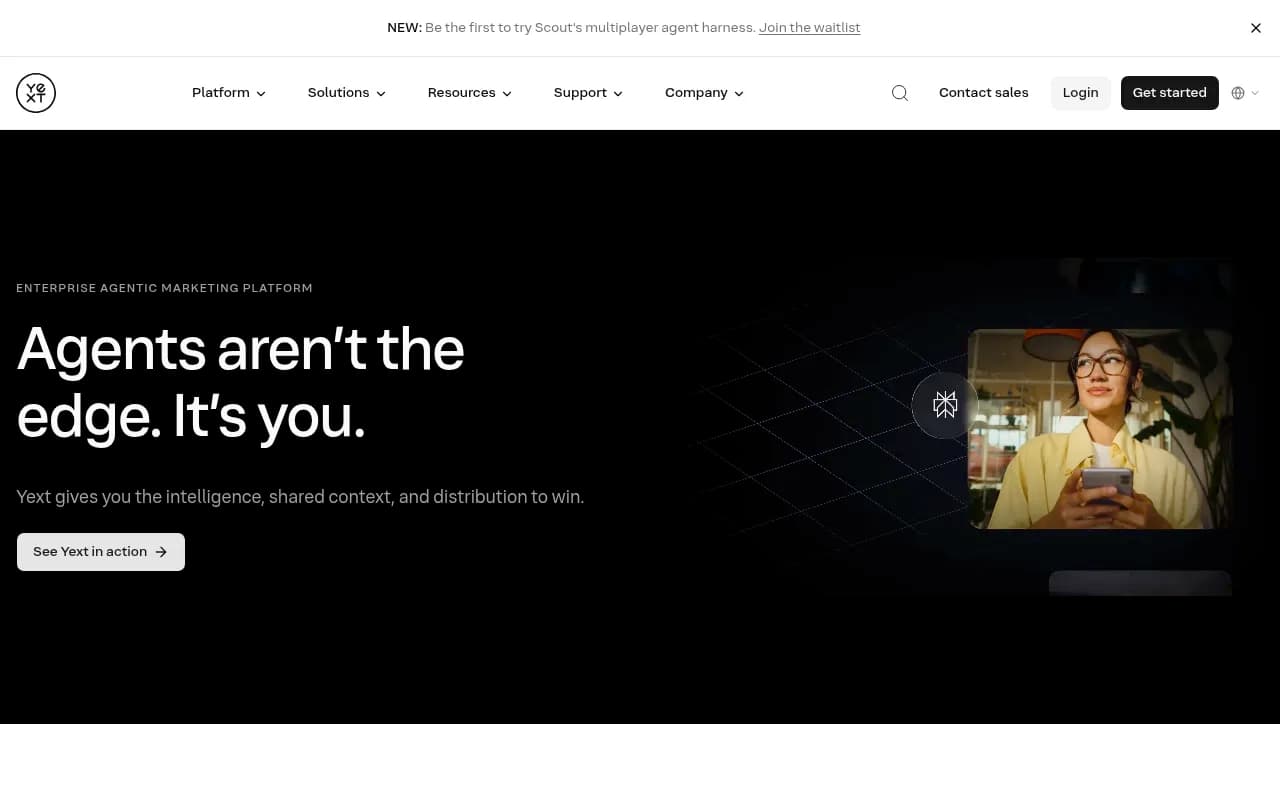
Yext is the heavyweight enterprise option, built on a Knowledge Graph of verified brand data that it distributes to search engines, maps, directories and AI channels. It now pitches itself as an enterprise agentic marketing platform, with a product called Scout for competitive visibility insight down to individual locations, plus MCP and API access.
Compared with Birdeye, Yext is stronger on the data layer. If your problem is that AI answers are wrong because your hours, addresses and attributes are inconsistent across the web, fixing the source data is arguably the right move. It is popular in regulated industries and with franchises, and says it works with brands managing 9M+ locations.
The downsides are cost and sales friction. Pricing is custom only. Third-party estimates run roughly $600-$2,500 per location per year plus onboarding fees, so treat that as a rough guide. Implementation is not light.
Best for: large franchises, healthcare systems and regulated brands where data accuracy and governance come first.
SOCi
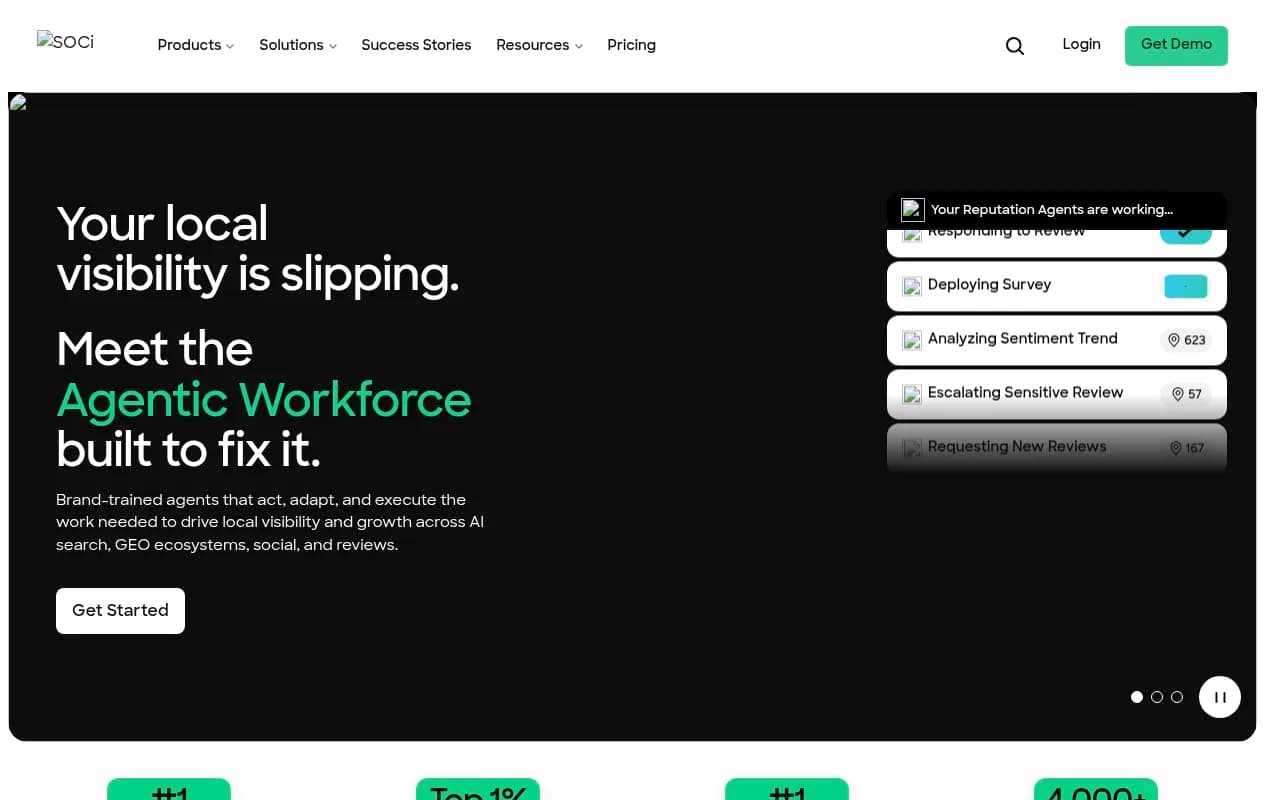
SOCi is the closest philosophical match to Birdeye: an enterprise platform for multi-location brands that leans hard on AI agents. Its Genius Agents handle listings, review responses, social publishing, chat and local search work across hundreds or thousands of locations, and it now frames the offer around visibility in AI search and GEO ecosystems.
Where SOCi can win is social. Its social publishing and content calendar tooling is a bigger part of the product than in Birdeye. Review replies in brand voice, escalation of sensitive reviews and compliance checks are also core.
The catch is the same as Birdeye: no public pricing. Third-party estimates sit around $400-$1,800 per location per year, which is unverified. Its AI visibility depth versus a dedicated tracker is something to test in a demo.
Best for: franchise, retail and financial services marketers who want agents executing local search, reviews and social at scale.
Reputation.com
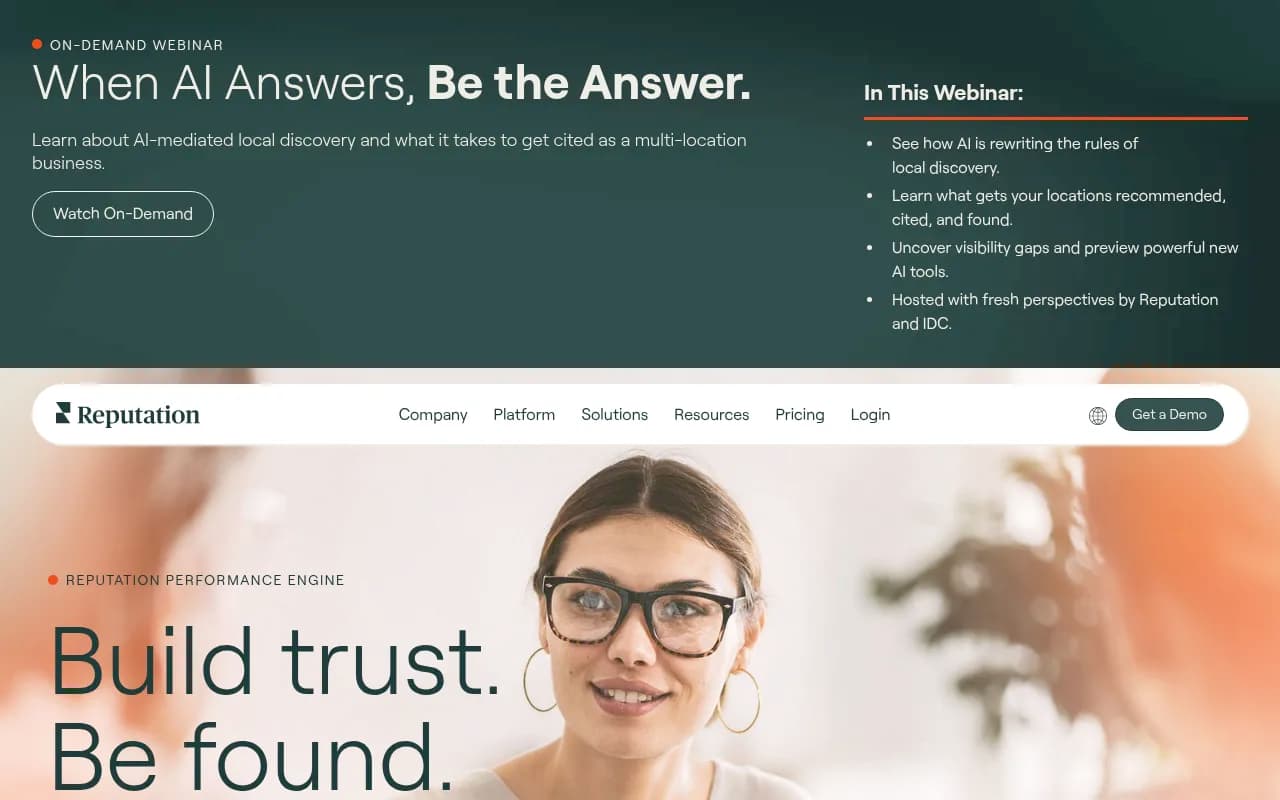
Reputation.com is a multi-location reputation platform that unifies reviews, listings, surveys and social, with AI guidance, competitive benchmarking and a Rep Score. It has been pushing AI-mediated local discovery, including a webinar with IDC on getting cited as a multi-location business.
Its edge over Birdeye is clearer entry pricing and a strong survey and experience-feedback story. The published starting point is about $80 per location per month for Rep Core, $115 for Core + Pulse, and Enterprise by quote. That is lower than the reported Birdeye range, though what is included differs, so compare line by line.
Its dedicated AI answer tracking is less of a headline than Birdeye's Search AI. It is better read as improving the upstream signals (reviews, listings, sentiment) that feed AI answers. Smaller businesses may find the enterprise workflow heavy.
Best for: dealer networks, healthcare systems, restaurants and property managers who want reputation and CX data tied together.
Chatmeter
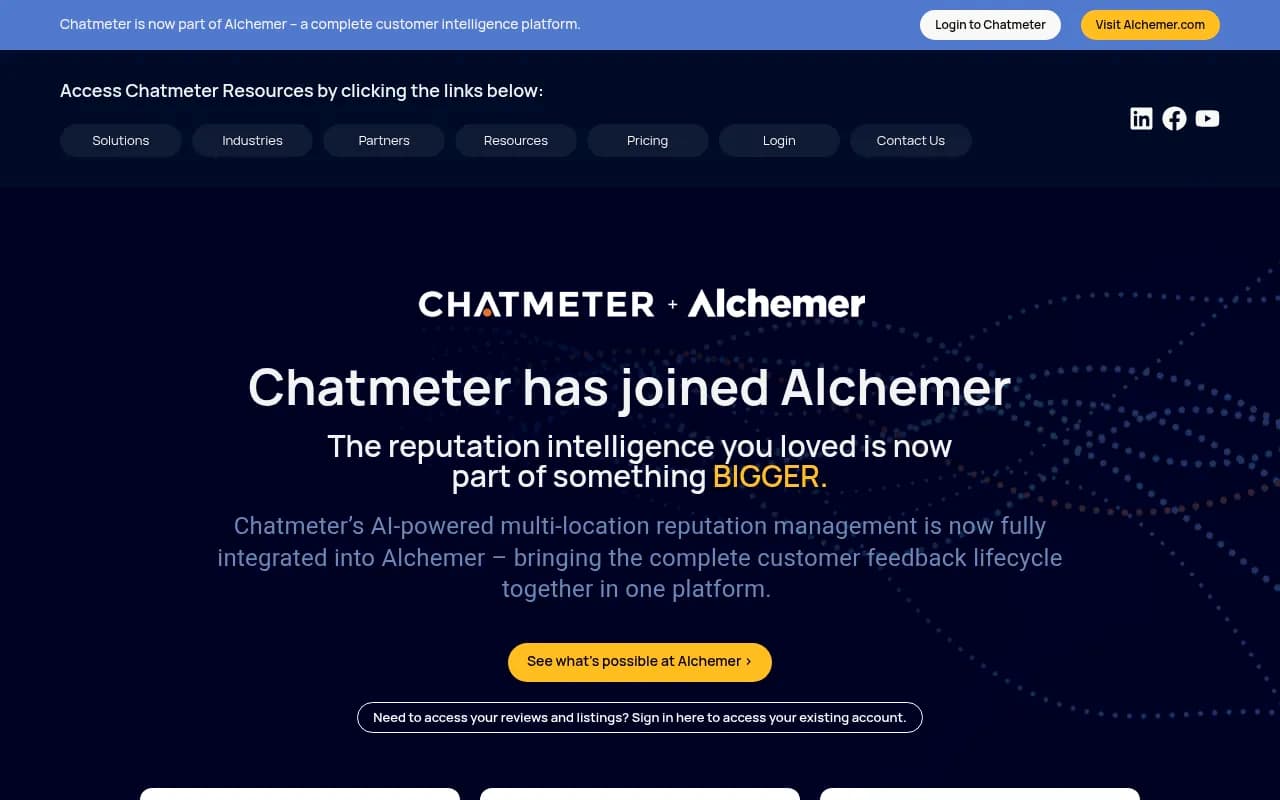
Chatmeter is now part of Alchemer and is sold as Alchemer Reputation Management. It covers reviews, listings across Google, Apple Maps and 70+ directories, and SEO-optimized local pages, priced per location with unlimited users.
The appeal is the unlimited-users model, which suits large distributed teams where every local manager needs a login. The risk is the transition. With the brand folded into Alchemer, check the roadmap and support commitments before signing. I would not pick it mainly for AI visibility, since the site emphasizes reviews, listings and pages rather than AI answer tracking.
Best for: enterprise and CX teams who want listings and reviews with unlimited seats, and are comfortable with the Alchemer direction.
BrightLocal
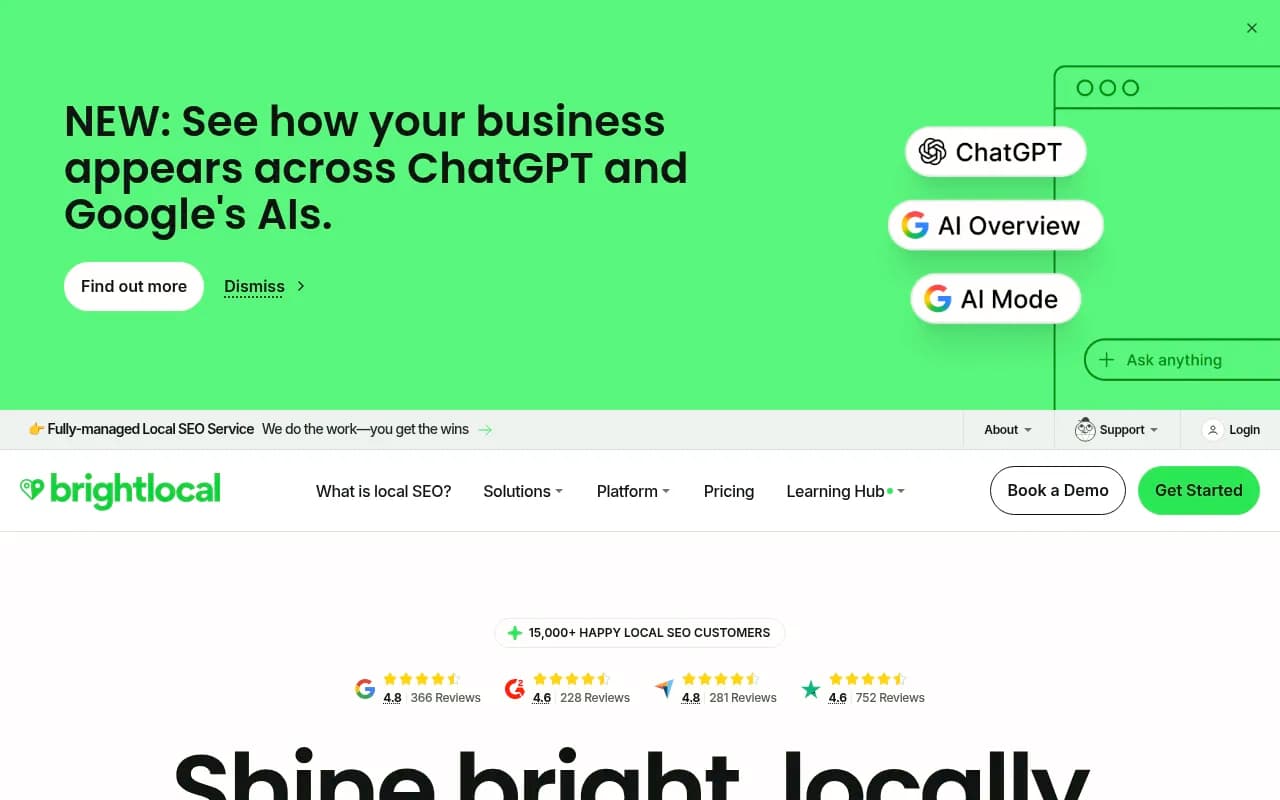
BrightLocal is the budget-friendly counterweight. It is a local SEO platform with rank tracking, citation management, review tools and a newer Local AI Visibility Tracker that shows how a business appears in ChatGPT and Google's AI.
Pricing is public and per location. For one location, Track is $41/mo monthly or about $31/mo billed annually, Manage is $54 ($40 annual) and Grow is $65 ($49 annual). Ten-ish locations cost around $104 to $197 a month depending on tier, and 91-100 locations run $524 to $989 monthly. 250+ locations are quote-led. There is a 14-day trial, and I did not verify the trial terms myself.
A fair comparison with Birdeye: BrightLocal has GEO-grid style local rank tracking that Birdeye reportedly lacks, but it has no unified messaging inbox, no deep agentic automation and a newer, lighter AI visibility feature. It is built for agencies and consultants more than for a corporate team governing thousands of locations.
Best for: agencies, consultants and small to mid-sized location counts that want transparent pricing.
Podium
Podium is less a Birdeye replacement than a different answer to a related problem. It positions itself as an AI Employee that handles inquiries, bookings and lead conversion around the clock, with review generation and replies as part of the package. It is strong in automotive, home services, wellness and retail, and claims 60,000+ businesses.
If your main pain point is leads slipping through because nobody answers texts fast enough, Podium addresses that directly. It will not give you an AI visibility tracker comparable to Birdeye Search AI, though. Pricing is custom per location, so get quotes.
Best for: local businesses where messaging and lead conversion matter more than monitoring AI answers.
Synup
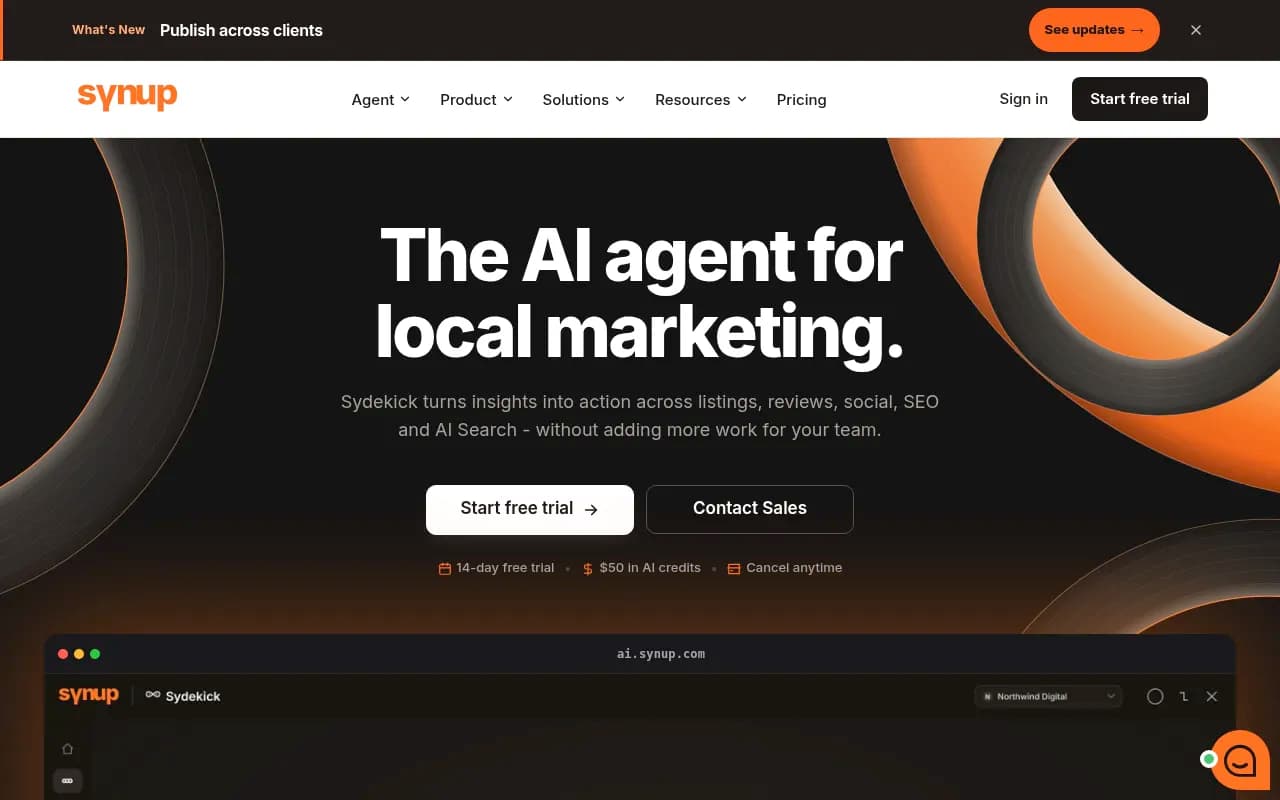
Synup is a per-location local marketing platform for agencies and multi-location brands. Its Sydekick agent handles listing sync, review replies, social posts, local rank tracking and AI search visibility, and you can drive it from Slack or Teams. Nothing is pushed live without approval, which is a sensible guardrail.
Pricing starts at $39/mo per location on annual billing, with a 14-day free trial. Agencies get white-labeling and client portals. Gartner Peer Insights lists only two ratings for it (3.3), so the review base is thin. Test it properly before committing.
Best for: agencies and mid-sized multi-location brands that want an agent-style workflow at a lower price than the enterprise suites.
How to choose
Start by asking what you are actually replacing. Birdeye bundles AI visibility with reviews, listings and messaging. Few alternatives do all of it.
- You want AI visibility you can act on, with content creation, crawler data and traffic attribution: Promptwatch. For more tools in the category, the GEO software directory at bestgeosoftware.com is a useful pointer.
- You already use Ahrefs and want AI data in the same place: Ahrefs Brand Radar.
- You run a large franchise and data accuracy is the problem: Yext.
- You want the closest agent-driven enterprise rival: SOCi or Reputation.com.
- You want published, lower prices: BrightLocal or Synup.
- You mostly need lead conversion: Podium.
Whatever you choose, ask for the price in writing, including setup fees and what the AI visibility module costs separately. That single question separates most of these vendors.