Key takeaways
- Most AI visibility tools, including Brandlight.ai, are monitoring dashboards that show you citation data but don't reveal what AI crawlers are actually doing on your site.
- Crawler log monitoring is a distinct and important capability: it tells you which AI bots visited, which pages they read, what errors they hit, and how often they return.
- Very few tools offer true crawler log monitoring in 2026. Promptwatch and Profound are the clearest examples with documented agent analytics.
- If you want to go beyond tracking and actually fix your AI visibility gaps, you need a platform that combines crawler intelligence with content gap analysis and content generation.
- The right tool depends on your team size, budget, and whether you need to monitor, optimize, or both.
Brandlight.ai does one thing reasonably well: it monitors brand mentions across AI-generated responses. You set up your brand, pick some prompts, and watch a dashboard fill up with data about how often you appear in ChatGPT, Perplexity, and Gemini answers.
The problem is what it doesn't do. It can't tell you which pages the GPTBot crawler actually visited last Tuesday. It can't show you which URLs returned a 403 error when ClaudeBot tried to read them. It can't connect a spike in AI citations to a specific piece of content you published three weeks ago. You get the scoreboard, but not the game tape.
That gap matters more now than it did a year ago. AI search is no longer a novelty metric. About 68% of Google searches ended without a click in early 2026, according to SparkToro's analysis of Similarweb clickstream data. ChatGPT crossed 900 million weekly active users in February 2026. When AI models are answering questions instead of sending traffic to websites, understanding how those models discover and read your content is a real operational need, not a nice-to-have.
This guide focuses specifically on Brandlight.ai alternatives that offer crawler log monitoring or go meaningfully further than basic mention tracking. Not every tool on this list has full crawler log support, but each one addresses a limitation that Brandlight.ai leaves open.
What crawler log monitoring actually means
Before comparing tools, it's worth being precise about what "crawler log monitoring" means, because vendors use the term loosely.
True crawler log monitoring means the platform ingests your server logs (or connects via Cloudflare, Fastly, Vercel, or a tracking snippet) and shows you:
- Which AI bot user agents visited your site (GPTBot, ClaudeBot, PerplexityBot, Googlebot-Extended, etc.)
- Which specific URLs they crawled
- How frequently they return to each page
- HTTP status codes they received (200, 301, 403, 404, 500)
- The timeline from crawl to citation -- when a bot first read a page vs. when that page started appearing in AI responses
This is different from "agent analytics" that simply reports on which AI models are citing you. Crawler logs are about what happens on your server before the citation ever appears.
Most tools in this space don't offer this. They track citations in AI outputs, which is valuable, but it's downstream data. Crawler logs are upstream -- they tell you about the discovery process itself.
The 9 best Brandlight.ai alternatives in 2026
1. Promptwatch
Promptwatch is the most complete alternative if crawler log monitoring is your primary requirement. It connects to your site via Cloudflare, Fastly, Vercel, server logs, Google Search Console, or a tracking snippet, and shows you real-time logs of AI crawler activity: which bots visited, which pages they read, what errors they hit, and how often they return.
What separates it from other tools is what it does with that data. The crawler logs feed into an action loop: you see which pages AI bots are reading (or failing to read), then use Answer Gap Analysis to find which prompts competitors rank for that you don't, then use Content Agents to generate articles engineered to fill those gaps. Page-level tracking then shows you when those new pages move from crawl to citation.
That full cycle -- find gaps, create content, track results -- is something Brandlight.ai doesn't attempt. Promptwatch also tracks 10 AI models (ChatGPT, Perplexity, Claude, Gemini, Grok, DeepSeek, Copilot, Meta AI, Google AI Overviews, and Google AI Mode), monitors Reddit and YouTube as citation sources, and includes ChatGPT Shopping tracking for e-commerce brands.
Pricing starts at $99/month for the Essential plan (1 site, 50 prompts). Crawler logs are available on the Professional plan at $249/month.
2. Profound
Profound is the strongest enterprise-grade monitoring platform in this space. Its "Agent Analytics" feature tracks AI crawler behavior and shows how content moves through the discovery-to-citation pipeline. It's not crawler log monitoring in the raw server-log sense, but it's the closest thing most enterprise teams will find outside of Promptwatch.
Profound's core strength is depth: it tracks prompt volumes, source citations, sentiment, and competitive benchmarking at a scale that suits large brands with complex reporting needs. The trade-off is price -- Profound sits at the higher end of the market, and it's primarily a monitoring tool. It will show you what's happening with impressive granularity, but it won't generate the content to fix it.
For teams that need detailed reporting and have a separate content team to act on the data, Profound is a serious option.
3. Scrunch AI
Scrunch AI has built its identity around crawler and citation intelligence, which makes it a natural fit for this list. It tracks which AI models are crawling your site, analyzes citation patterns, and surfaces competitive data about which sources AI engines prefer.
The platform is particularly useful for understanding why certain domains get cited repeatedly. If you want to know whether your site's technical setup is preventing AI crawlers from reading your content effectively, Scrunch AI surfaces that kind of diagnostic data.
It's more limited on the content creation side -- like most tools here, it's primarily a monitoring and analysis platform. But for crawler intelligence specifically, it's one of the more focused options available.
4. AthenaHQ
AthenaHQ focuses on AI search visibility monitoring with competitive benchmarking. It tracks brand mentions across major AI models and gives you a clear picture of where competitors are appearing that you're not.
It doesn't offer crawler log monitoring in the technical sense, but it does provide more structured competitive gap analysis than Brandlight.ai. If your main frustration with Brandlight is that you can see you're losing but can't figure out why, AthenaHQ gives you better diagnostic data about the competitive landscape.
The limitation is that it stops at analysis. There's no content generation, no crawler log data, and no traffic attribution. It's a better monitoring tool than Brandlight, not a fundamentally different kind of tool.
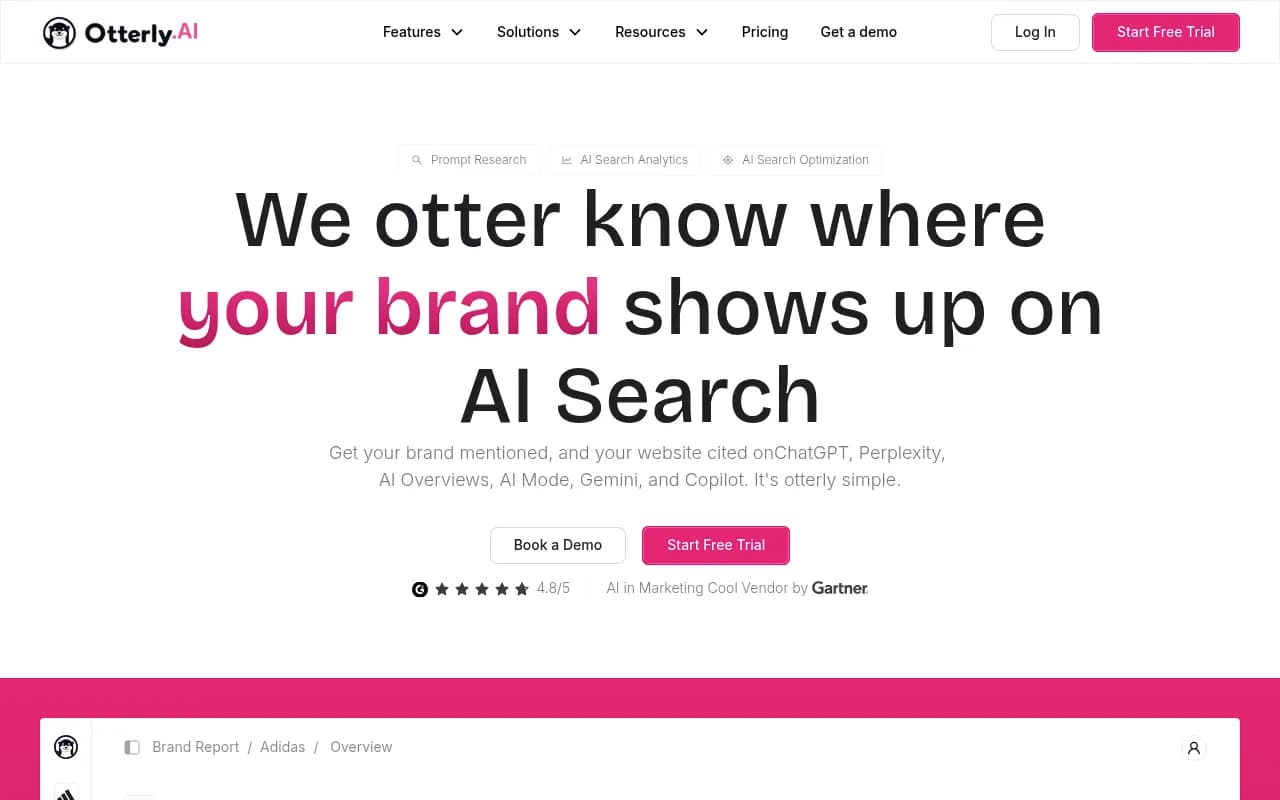
5. Otterly.AI
Otterly.AI is the budget-friendly option in this category. It tracks brand mentions across ChatGPT, Perplexity, Claude, and Gemini, with a clean interface that marketing teams find easy to use without technical setup.
It doesn't have crawler log monitoring, and it doesn't have content generation. But it's significantly cheaper than most alternatives, and for small teams that just need reliable citation tracking without the complexity of enterprise platforms, it does the job well.
Think of Otterly.AI as a step up from Brandlight.ai in terms of interface quality and data freshness, rather than a step up in capability depth.
6. Peec AI
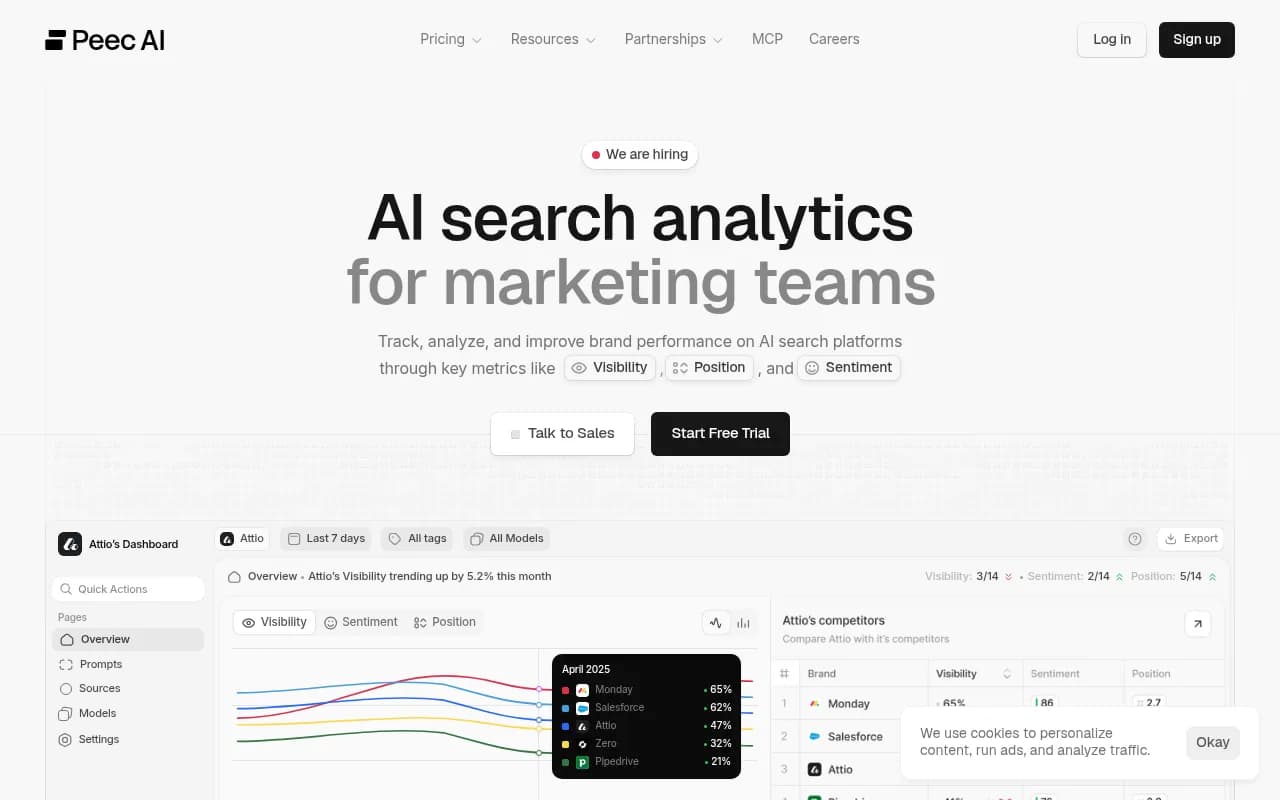
Peec AI focuses on daily prompt monitoring with smart suggestions for improving AI visibility. It tracks how your brand appears across AI engines and surfaces recommendations based on what it finds.
The "smart suggestions" angle is what differentiates it from pure monitoring tools -- it tries to tell you what to do, not just what's happening. The suggestions are prompt-level recommendations rather than full content briefs, but it's a step toward the action-oriented workflow that most monitoring tools skip entirely.
No crawler log monitoring, but the recommendation layer makes it more actionable than Brandlight.ai for teams that want guidance rather than raw data.
7. SE Ranking Visible
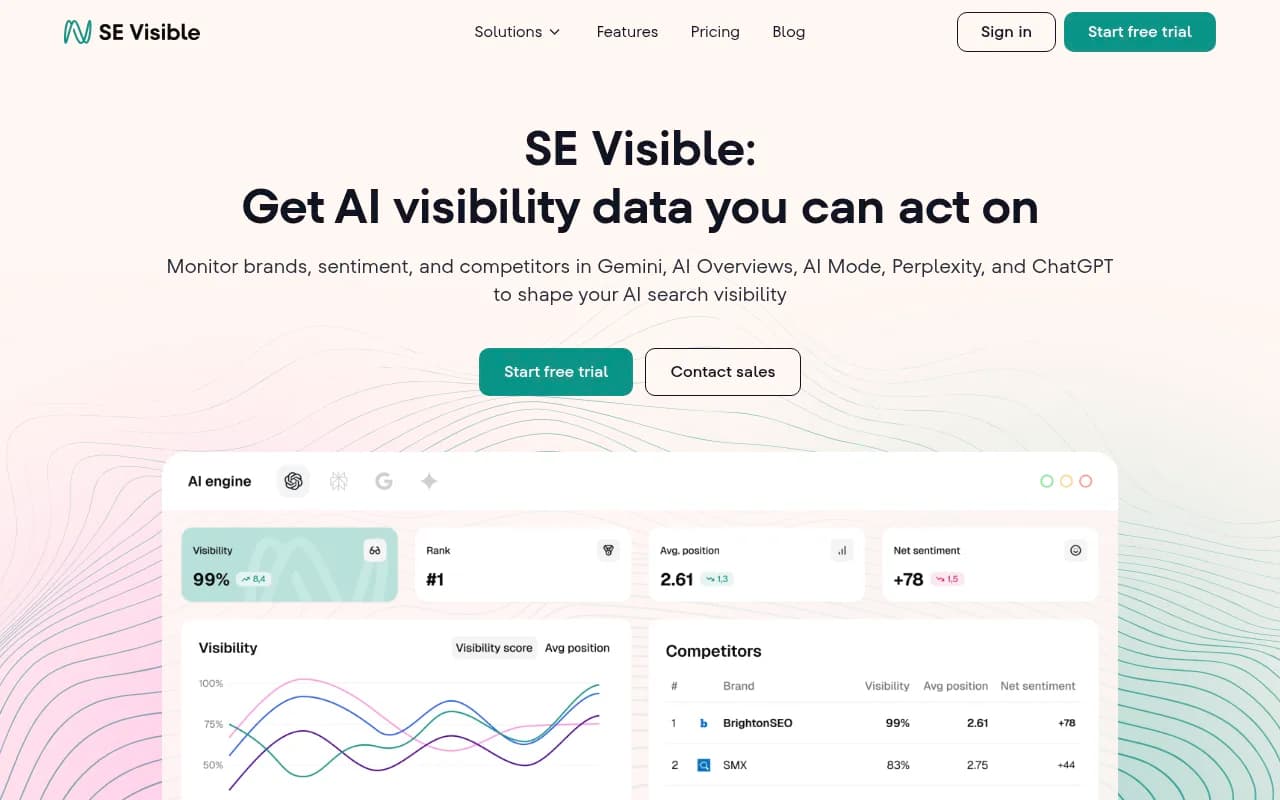
SE Ranking's AI visibility module (branded as Visible) sits inside the broader SE Ranking platform, which means you get AI citation tracking alongside traditional rank tracking, backlink analysis, and site auditing in one subscription.
For teams already using SE Ranking for SEO, adding AI visibility tracking without switching platforms is a practical win. The AI visibility features aren't as deep as dedicated platforms, but the integration with existing SEO data is genuinely useful -- you can see how your traditional search performance correlates with AI citation rates.
No crawler log monitoring specifically, but the site audit tools do surface crawlability issues that affect both traditional and AI search.
8. Ahrefs Brand Radar
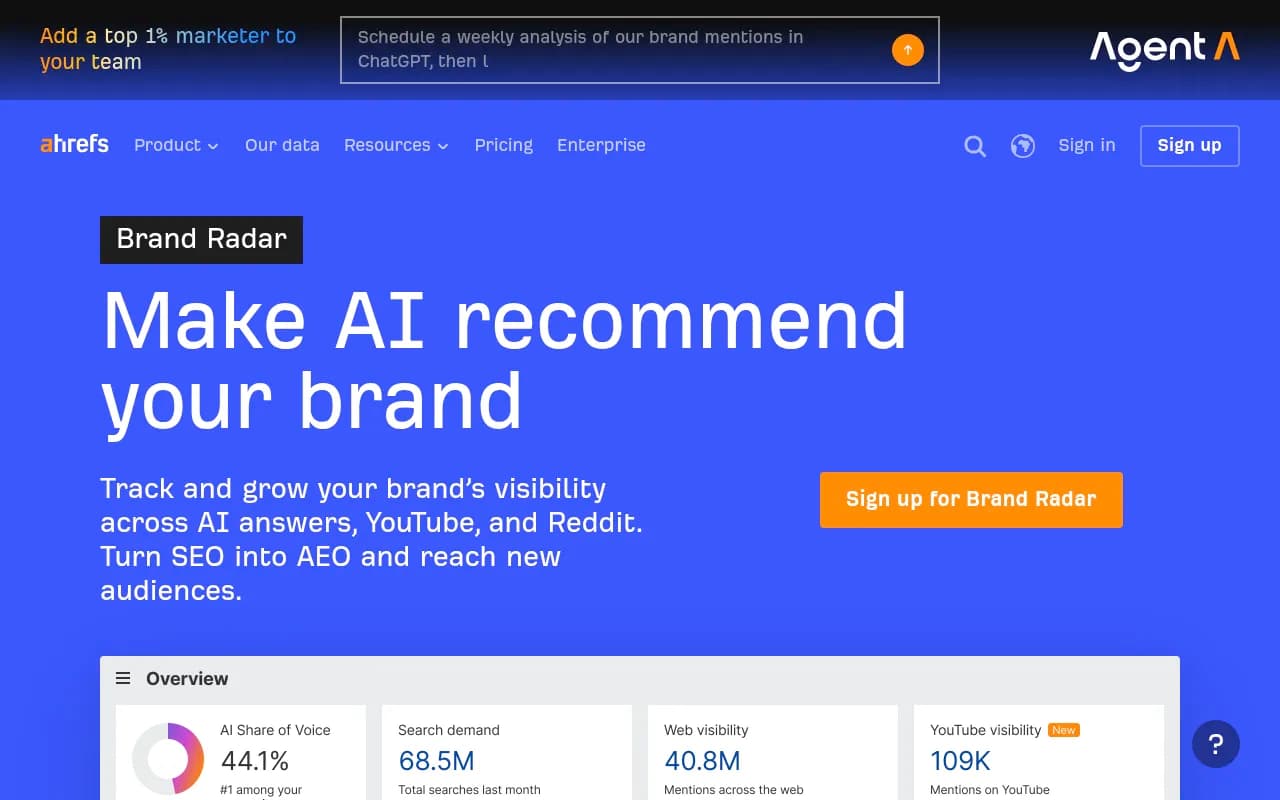
Ahrefs Brand Radar tracks brand mentions across AI search engines and integrates with Ahrefs' existing backlink and keyword data. If you're an Ahrefs user, it's the most natural way to add AI visibility tracking to your existing workflow.
The limitation is that Brand Radar uses fixed prompts rather than custom ones, which means you're tracking a predefined set of queries rather than the specific questions your customers are actually asking. There's also no AI traffic attribution -- you can see citation data but can't connect it to actual site traffic or revenue.
Still, for Ahrefs users who want a starting point for AI visibility without adding another platform, Brand Radar is a reasonable first step.
9. ZipTie
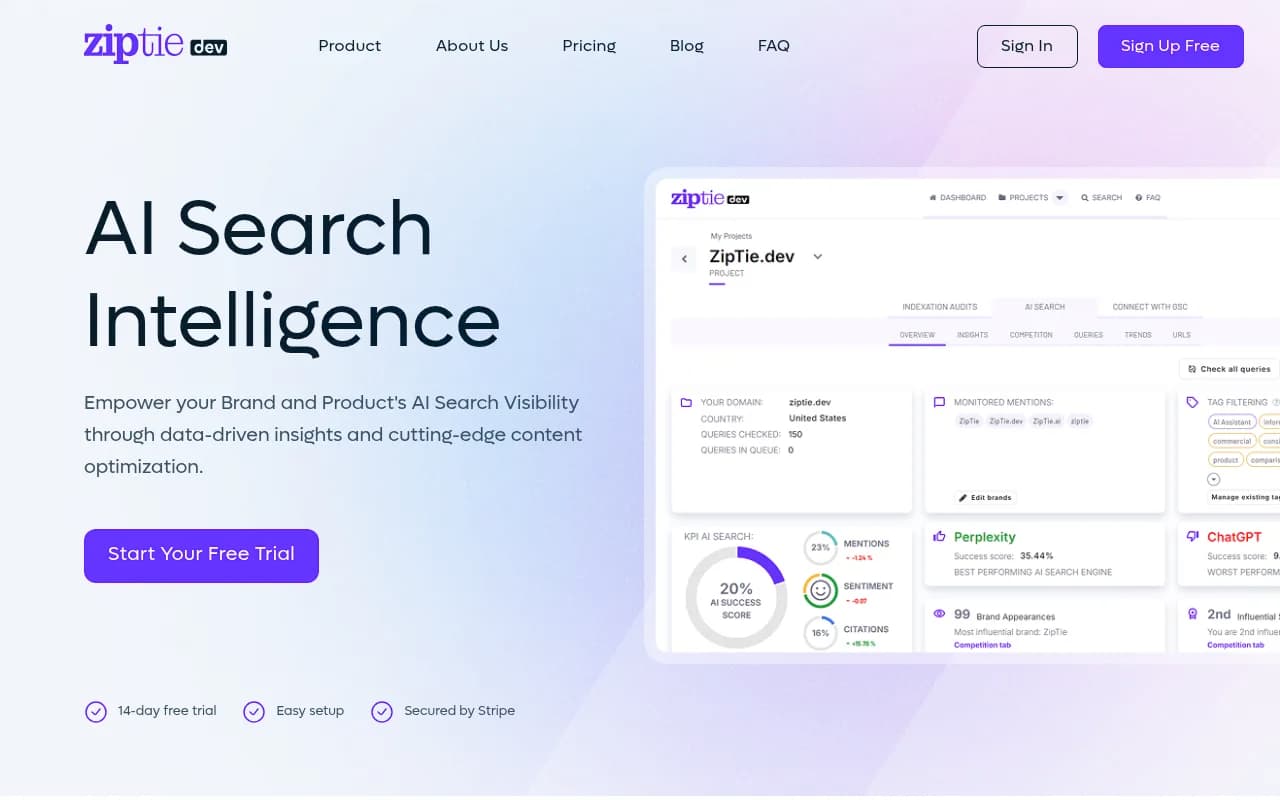
ZipTie is a focused AI search visibility tracking tool that covers the core use case -- tracking brand citations across AI engines -- without a lot of additional complexity. It's worth mentioning for teams that find Brandlight.ai's interface or data quality frustrating and want a cleaner alternative at a similar price point.
It doesn't have crawler log monitoring, content generation, or deep competitive analysis. But it's reliable for basic citation tracking and has a straightforward setup process that doesn't require technical expertise.
How these tools compare
Here's a direct comparison across the capabilities that matter most when evaluating Brandlight.ai alternatives:
| Tool | Crawler log monitoring | Content generation | Competitive gap analysis | Reddit/YouTube tracking | Traffic attribution | Pricing (starting) |
|---|---|---|---|---|---|---|
| Promptwatch | Yes (real-time) | Yes (Content Agents) | Yes (Answer Gap Analysis) | Yes | Yes | $99/mo |
| Profound | Partial (Agent Analytics) | No | Yes | No | Limited | Higher end |
| Scrunch AI | Yes (crawler intel) | No | Yes | No | No | Custom |
| AthenaHQ | No | No | Yes | No | No | Custom |
| Otterly.AI | No | No | Basic | No | No | Low |
| Peec AI | No | Suggestions only | Basic | No | No | Mid |
| SE Ranking Visible | No (site audit only) | No | Basic | No | No | Bundled |
| Ahrefs Brand Radar | No | No | Basic | No | No | Bundled |
| ZipTie | No | No | Basic | No | No | Low |
The table makes the gap clear. If crawler log monitoring is your actual requirement, Promptwatch and Scrunch AI are the only tools that meaningfully address it. If you want crawler logs plus content generation plus traffic attribution in one platform, Promptwatch is the only option on this list.
What to look for beyond crawler logs
Crawler log monitoring is important, but it's one piece of a larger picture. When evaluating any Brandlight.ai alternative, ask these questions:
Which AI models does it track? Some tools only cover ChatGPT and Perplexity. Others cover 8-10 models including Google AI Overviews, Grok, DeepSeek, and Copilot. The more models you track, the more complete your picture of AI visibility.
Does it track real user-facing responses or just API outputs? This matters because AI models sometimes give different answers in their user interfaces than they do through their APIs. Tools that track real UI responses give you more accurate data about what your customers actually see.
Can it connect visibility to revenue? Citation data is interesting. Revenue attribution is actionable. Most tools stop at citations; only a few connect AI visibility to actual traffic and conversions.
Does it cover offsite citations? Your AI visibility isn't just about your own website. Reddit threads, YouTube videos, and third-party listicles often drive more AI citations than your own content. Tools that track these offsite sources give you a more complete picture.
What does it do when it finds a gap? This is the question that separates monitoring tools from optimization platforms. Finding that a competitor appears in 40% of relevant AI responses and you appear in 8% is useful information. Knowing exactly which content to create to close that gap -- and having tools to create it -- is what actually moves the number.
The case for going beyond monitoring
The monitoring-only approach made sense in 2024 when AI search was new and teams were still figuring out what to measure. In 2026, the category has matured enough that "we track your citations" is table stakes, not a differentiator.
The teams seeing real results from AI visibility programs aren't just watching dashboards. They're using crawler log data to fix technical access issues, using gap analysis to identify missing content, and publishing that content systematically. The platforms that support that full workflow are genuinely different from the ones that stop at the alert.
Brandlight.ai sits firmly in the monitoring-only camp. If that's all you need, it's a functional tool. But if you've been using it for a few months and you're looking at citation data without knowing what to do with it, that's the signal that you need a platform built around action, not just observation.
The tools on this list represent the range of what's available in 2026. Some are better monitoring tools. A few are genuinely different kinds of platforms. The right choice depends on what your team actually needs to do with the data once you have it.
Bottom line
For teams specifically looking for crawler log monitoring, the shortlist is short: Promptwatch for the full action loop (crawler logs, gap analysis, content generation, traffic attribution), and Scrunch AI if you want crawler intelligence without the content creation layer.
For teams that want a better monitoring experience than Brandlight.ai without necessarily needing crawler logs, Profound is the strongest enterprise option, Otterly.AI is the most accessible entry point, and Peec AI adds the most guidance for teams that want recommendations alongside data.
The broader point: AI visibility is no longer a passive measurement exercise. The brands winning in AI search in 2026 are the ones treating it as an optimization program -- finding gaps, creating content, tracking results, and repeating. Pick a tool that supports that cycle, not just the first step.