Key takeaways
- Most tools marketed as "agentic" are still single-step generators with an approval button. Only a handful chain research, writing, and CMS publishing into one autonomous sequence.
- ChatGPT now cites roughly 5 sources per response, about half of what Google AI Overviews cites, so competition for each citation slot is fiercer than a traditional search results page (Promptwatch's data on sources per response).
- Product pages, listicles, and comparison pages are winning a growing share of ChatGPT citations, while generic blog posts are losing ground, according to Promptwatch's citation-type breakdown for July 2026.
- Publishing at scale without quality gates is the single biggest risk. Thin, templated pages don't just fail to rank, they can drag down an entire domain's authority.
- Platforms that pair visibility data with content generation (Promptwatch, Frase, Profound-adjacent tools) tend to outperform pure writing tools because they know what to publish, not just how fast to publish it.
Why "agentic" became this year's most abused word
Every vendor in this space now slaps "agentic" on their homepage. Type it into a search bar and you'll get 120-plus tools claiming to plan, research, write, and ship content while you sleep, per StackOne's landscape map of the category. Most of them don't do that. They do one part of it well and hand-wave the rest.
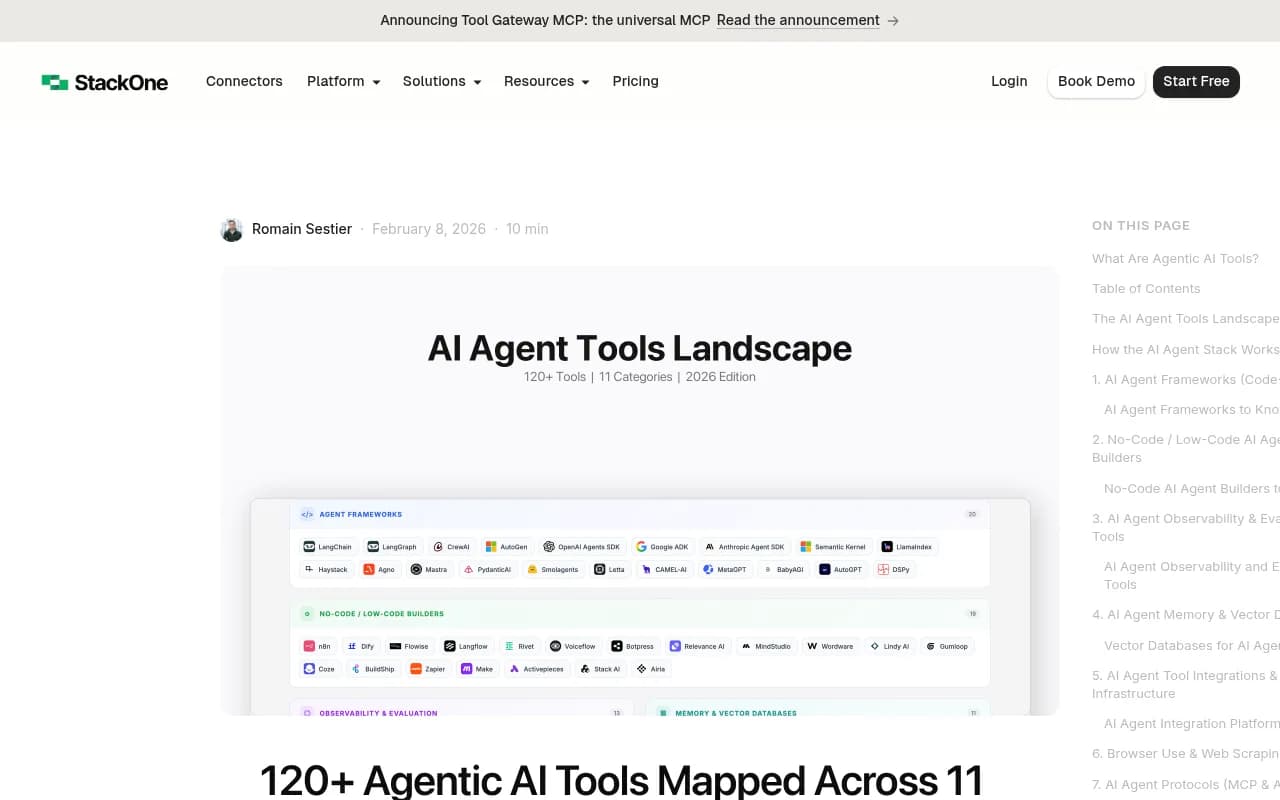
So I want to draw a line that most "best agentic AI tools" roundups skip: the difference between a tool that drafts content when you ask it to, and a tool that actually runs a pipeline, research, outline, write, quality check, publish, with a human only stepping in at defined checkpoints. That second category is much smaller than the marketing suggests.
There's also a structural reason this matters more in 2026 than it did a year ago. ChatGPT Search started using the site: operator at scale on August 8, 2026, jumping from under 0.4% to nearly 17% of fanout queries overnight, according to Promptwatch's tracking of ChatGPT's site-operator fanouts. That means the model is now directly querying your domain for a topic before answering. If your site has thin, duplicate, or unindexed pages, that costs you visibility even in cases where you'd normally rank fine on Google. Publishing volume alone doesn't help here. Publishing the right pages, indexed and structured correctly, does.
What "plan, write, publish" actually requires
Before comparing tools, it's worth being precise about what a genuinely agentic content pipeline needs to do without constant hand-holding:
- Identify a content gap or opportunity (a keyword, a competitor weakness, a prompt where you're not showing up in AI answers)
- Research the topic, pull in current data, SERP or AI-answer context, and internal linking opportunities
- Write a draft that matches your brand voice and passes some quality bar
- Route it through review, whether that's a human, a rules engine, or both
- Publish directly to your CMS, not just export a Google Doc
- Measure what happened and feed that back into the next round of planning
Most tools stop at step 3. A few reach step 5. Almost none close the loop at step 6 without you doing the analysis yourself.
The main contenders, compared
| Platform | What it actually automates | Pricing (2026) | Publishes to CMS? | AI visibility tracking? |
|---|---|---|---|---|
| Frase | Single "Agent" chains 80+ skills (research, gap analysis, outline, draft) from one instruction | Solo ~$15/mo, Basic ~$45/mo, Team ~$115/mo | Limited/export-focused | Yes, 8 engines incl. AI Overviews, Perplexity |
| AirOps | Content workflows plus visibility tracking, tiered by engine coverage | Solo $200/mo (ChatGPT only), Pro $2,000/mo (multi-engine) | Workflow-based, varies by setup | Yes, tiered by plan |
| Fountain City | Fully managed multi-agent build (research, write, distribute), not self-serve | $500-$10,000 build + $150-$2,500/mo | Yes, custom per client CMS | No, content-focused only |
| Averi.ai | Explicitly human-in-the-loop; drafts SEO/GEO-scored content, no autonomous publish | Not publicly listed, contact sales | No, queues for human approval | Partial, competitor gap scanning |
| NoimosAI | Multi-agent squad across SEO, social, GEO, credit-based usage | Pro $99/user/mo, Team $249, Advanced $499 | Yes, WordPress integration | Yes, GEO agent included |
| Promptwatch | Visibility monitoring plus Content Agents that plan, write, and publish GEO content on a schedule | Essential $95/mo to Business $579/mo | Yes, Webflow, Framer, WordPress | Yes, across 12+ AI platforms |
A quick note on that Averi.ai row: it's the rare vendor that says outright, "no autonomous decision-making." In a market full of overclaiming, that kind of honesty is worth something, even if it means less automation than the label "agentic" implies elsewhere.
Where each type of tool actually fits
Solo operators and small teams: Frase
If you're writing four to twenty articles a month by hand and want an assistant that chains research and drafting into fewer clicks, Frase is genuinely useful. The 2026 rebuild around "the Frase Agent" strings together skills, research a topic, spot content gaps, draft an outline, in one instruction rather than three separate tool switches. It also scores content for GEO likelihood, flagging which passages are likely to get picked up by ChatGPT or Perplexity.
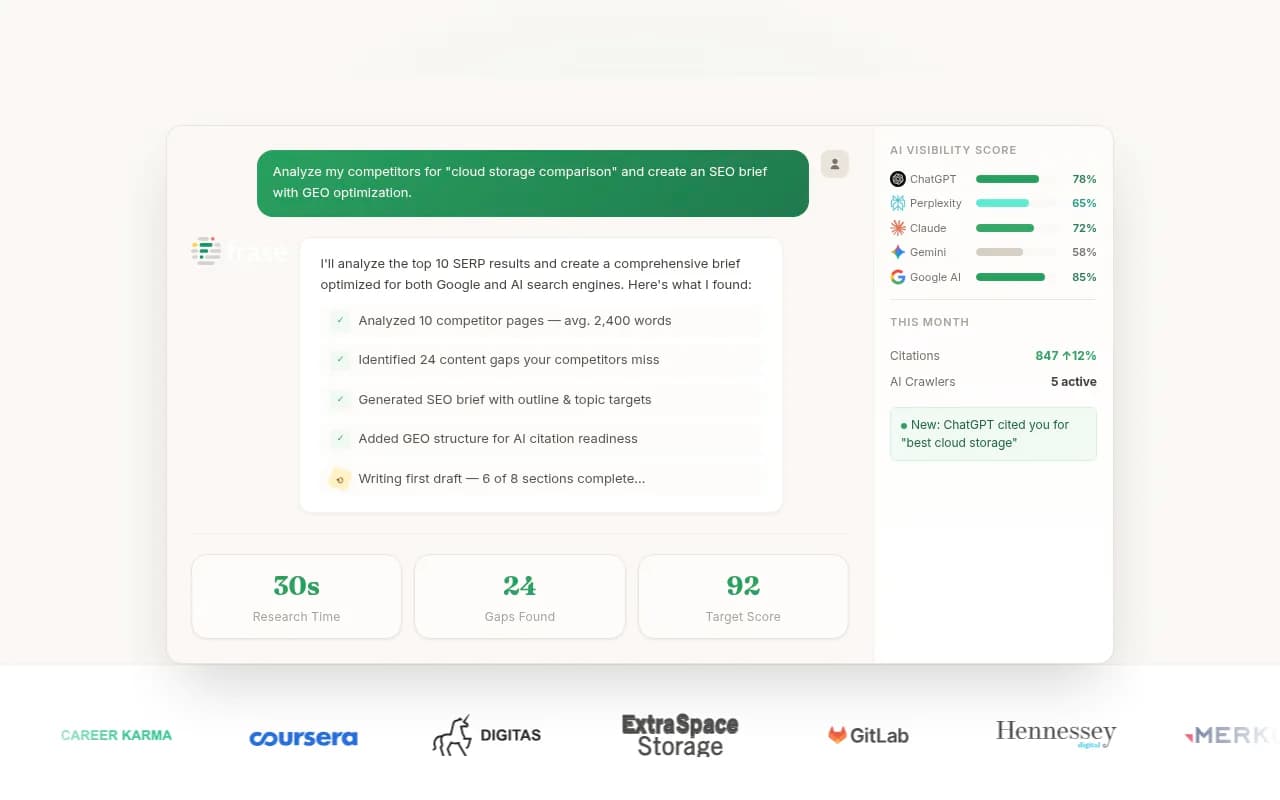
The catch: if you're already running a fully automated pipeline elsewhere, a Frase seat can feel redundant. It's built for people still doing meaningful manual work in the loop, not for teams that have already automated past that stage.
Managed, hands-off scale: Fountain City-style services
Fountain City isn't a self-serve product, you don't sign up and get a dashboard. It's a managed service that builds custom multi-agent systems (research, writing, analytics, distribution) per client, with claimed output of ten-plus new posts a week plus dozens of page edits. The tradeoff is real: weeks of onboarding versus a same-day signup, and a build cost of $500 to $10,000 before the monthly retainer even starts. That's the right model if you want zero hands-on management and have budget to match, and a bad fit if you want to log in and see what's happening yourself.
Visibility-first, content-second: AirOps and Profound
AirOps and Profound both lean toward tracking how you show up across AI engines first, with content generation as a secondary or bolted-on capability. Profound's coverage is broad, ten-plus platforms including ChatGPT, Perplexity, AI Overviews, Claude, Gemini, Grok, Meta AI, Copilot, and DeepSeek, but its self-serve publishing capability is thinner than its monitoring stack. Peec AI, which tracks seven platforms at roughly $91/mo, was ranked "best value" by Searchbloom's 2026 scoring for similar reasons: strong tracking, lighter on execution.

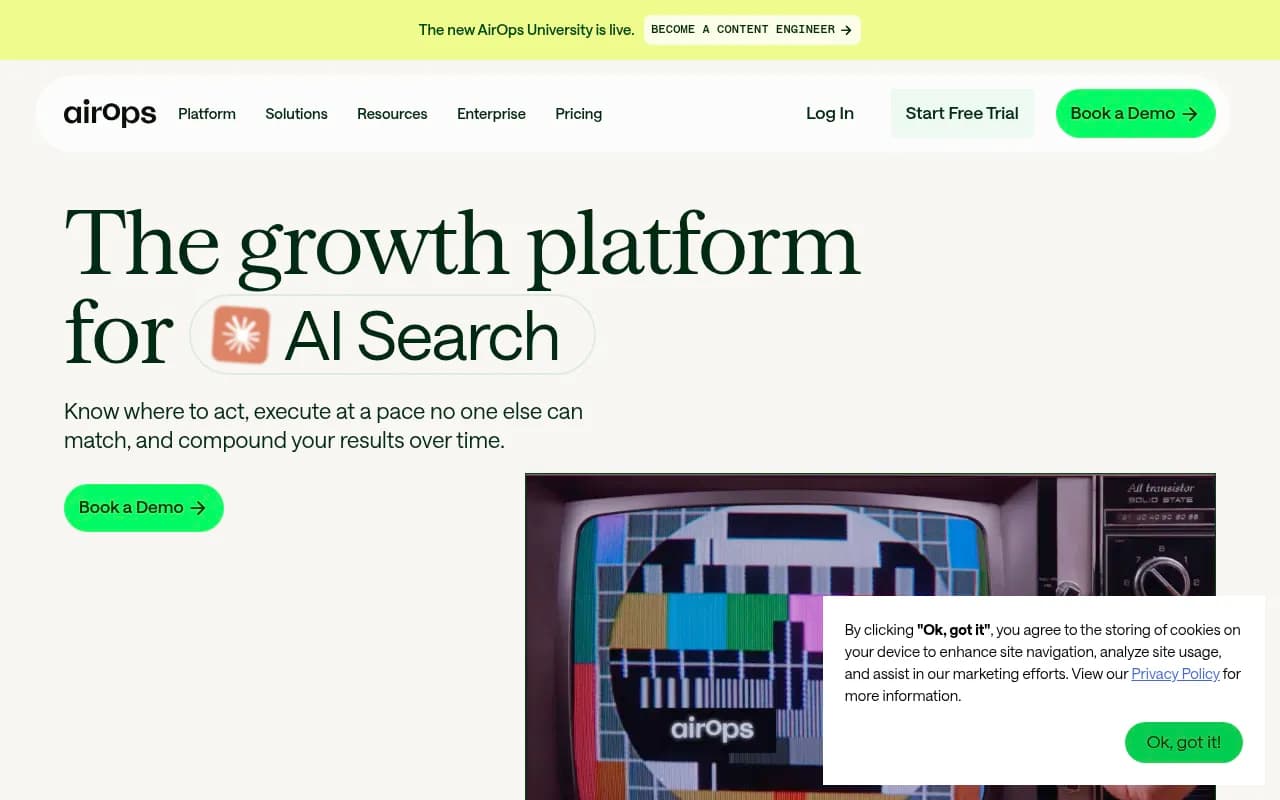
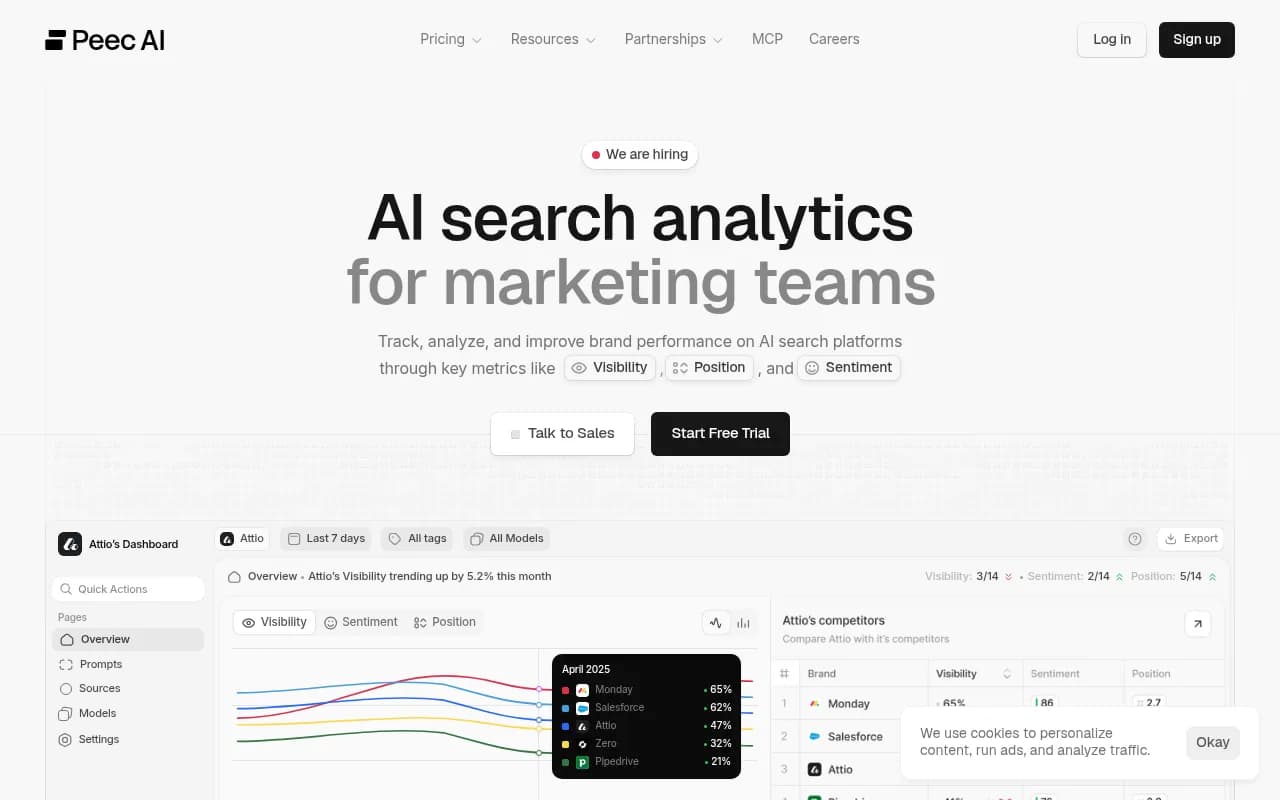
These are the right pick if your priority is understanding where you're invisible before you commit to writing anything. They're the wrong pick if you want a tool that also writes and ships the fix.
The full loop: monitoring plus agentic execution
This is the gap most of the market hasn't closed: knowing why you're not being cited, and then having an agent actually produce and publish the content that fixes it, on the same platform, without exporting to five other tools first.
Promptwatch is built around that loop. Its crawler-log analytics (Agent Analytics) show exactly when ChatGPTBot, ClaudeBot, PerplexityBot, and 400-plus other crawlers visit your pages and whether they hit errors, which explains why a visibility score looks the way it does rather than just reporting the score. From there, Content Agents plan, write, and publish GEO-optimized articles directly to Webflow, Framer, or WordPress on a schedule you set, with either a review inbox or full automation. Unified Actions turns all of that into a prioritized to-do list instead of a raw data dump.
Crisp, one of Promptwatch's customers, used this to scale to five to ten published articles a day and saw AI-driven traffic convert at roughly twice the rate of traditional channels. That's a useful sanity check on the difference between "we can generate a lot of content" and "the content we generate actually converts." At $95 to $579 a month depending on tier, it's priced closer to a mid-market SEO tool than an enterprise AEO platform, while covering twelve-plus AI surfaces including Google AI Mode and AI coding assistants like Claude Code.
For teams running a lot of experiments across multiple content and GEO tools, it's also worth browsing the broader GEO software directory at bestgeosoftware.com or the agentic SEO tools directory at agenticseotools.com to see how newer entrants stack up against the platforms above.
What to publish, based on what actually gets cited
A pipeline that writes and publishes fast is worthless if it's writing the wrong format. Promptwatch's July 2026 data on ChatGPT citation types is specific about this: product pages made up 32.8% of all ChatGPT citations that month, nearly double their March share of around 18%, while listicles held about 9.7% and comparisons sat at 2.9%. Within July alone, listicles grew from roughly 8% to over 10% of citations and how-tos climbed from 3.3% to 4.3%, gains that came directly out of generic product/landing page share (see Promptwatch's ChatGPT citation types breakdown).
The practical read: an agentic pipeline that only churns out generic blog posts is optimizing for a shrinking slice of the pie. Comparison pages, structured how-tos, and well-built product or commercial pages are the formats gaining ground. If your content agent's default output is "1,200-word blog post," you're missing where the citations are actually moving.
The guardrails nobody markets but everyone needs
This is the part vendor pages skip, and it's the part that determines whether "agentic publishing" helps or actively hurts you.
Quality collapse at scale. Publishing fifty to five hundred templated pages dilutes topical authority fast. The risk isn't usually a manual penalty, it's crawl waste and a sitewide quality drag that suppresses even your good pages. Google's guidance on scaled content abuse applies the same standard regardless of whether a human, a machine, or a human-directed machine produced the pages, per Google's own AI content guidelines. Low-effort content is low-effort content no matter who typed it.
Hallucinated facts. An agent confidently inventing a competitor's pricing or a false statistic is a brand and legal risk, not just an SEO one. Any pipeline that writes without a fact-verification step is gambling.
Autofixes with production access. Agents with write access to robots.txt, canonicals, or redirects can quietly noindex a template across your whole site or create a redirect loop. One SEO operator's blunt rule, worth stealing: agents recommend changes to high-risk files, they don't deploy them without a human sign-off. Staging validation and diff-based approval aren't optional if an agent has that kind of access.
Set a publishing throttle, cap new URLs per week relative to site size, require a minimum information-gain check before a page goes live, and keep a human in the loop for anything touching indexing or redirects. That's less exciting than "fully autonomous," but it's the difference between a pipeline that compounds and one that eventually tanks your domain.
A simple way to choose
- Writing four to twenty pieces a month yourself, want AI to speed up research and drafting: Frase.
- Want zero hands-on management and have budget for a custom build: a managed service like Fountain City.
- Need to understand where you're invisible in AI answers before committing to any content push: Profound or Peec AI.
- Want visibility tracking and content generation to close the loop in one platform, with crawler-level diagnostics and CMS publishing built in: Promptwatch.
If you're weighing any of these against a longer list of options, Promptwatch's own comparison of 21 GEO and AI visibility platforms is a reasonable next stop, and the general software directory at surferstack.com is worth a browse if you want to see how these tools stack up against adjacent SEO and content platforms outside the GEO category specifically.
Whichever you pick, the honest 2026 baseline is this: fewer than 10% of organizations have successfully scaled AI agents in any single business function, even though roughly 90% report using some form of agent in their stack, according to Fountain City's analysis of the space. Adoption is everywhere. Reliable, guarded, actually-closes-the-loop automation is still rare. Build the guardrails before you scale the output.