Key takeaways
- AI answers are now a crisis surface. A wrong or damaging claim in ChatGPT, Gemini, Perplexity or Google AI Overviews can reach buyers without ever touching your social feeds or press clippings.
- Different engines pull from different places. Viral Reddit, Facebook and YouTube content is far more likely to surface in AI Overviews than in ChatGPT, so a single monitoring setup misses things.
- Owned pages persist longest. Corrections on landing pages and docs stay cited in ChatGPT for months, while news coverage fades faster.
- A tool is only half the program. You need thresholds, owners and a response playbook before the first alert fires.
- Look for tools that track real AI interfaces, break out claims and sentiment, and show which source an AI answer came from.
Why AI answers belong in your crisis monitoring
Traditional crisis monitoring watches news, social and review sites. That still matters. But there is a newer problem: someone asks ChatGPT "is [your brand] safe?" or "why is [your product] being recalled?" and gets a confident paragraph assembled from whatever the model found. That paragraph might be accurate, outdated, or built on one angry forum thread.
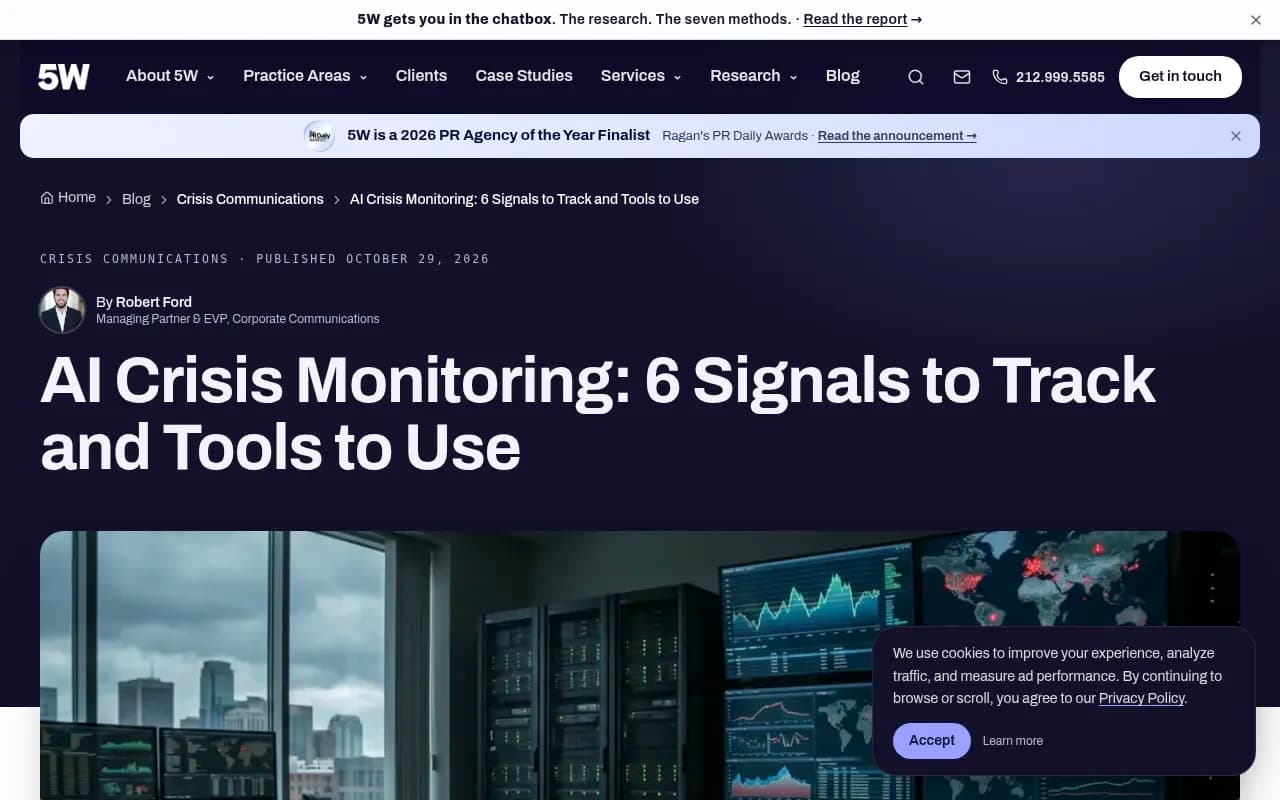
The 5WPR guide to AI crisis monitoring lists AI answers as one of six signals a monitoring program should track, with a wrong or damaging claim about the brand as the sample alert trigger. I agree with that framing, and I would go one step further: AI answers are the signal most teams have no process for at all.
The reason this is risky comes down to slots. According to Promptwatch Data's sources-per-response report, ChatGPT cites about 5 sources per web-search answer, while Google AI Overviews and Perplexity cite about 10. With five slots, one negative source takes a large share of the answer. In AI Overviews, how a brand is cited and what claim is attached to it matter as much as whether it is cited at all.
Where damaging AI answers come from
Before picking tools, understand the supply chain. A bad answer usually traces to one of four sources.
- A news story or press release from the incident itself.
- A review, comparison or listicle that frames your brand badly.
- A social thread or video (Reddit, Facebook, YouTube) that went viral.
- An outdated page of your own, such as an old pricing or policy page, that the model still trusts.
The mix differs sharply by engine. In Promptwatch's social media citations data for Oct 11 to Nov 9, 2026, social platforms made up 13.16% of AI Overviews citations, 1.94% of Perplexity's and 0.64% of ChatGPT's. YouTube alone was 6.71% of AI Overviews citations, more than the other six tracked platforms combined. Facebook was 2.34% and Reddit 2.10% there. (The October report covered 7 days and this one covers 30, so month-on-month comparisons are not like for like.)
Practical reading: a viral Reddit thread or YouTube takedown is a bigger threat in AI Overviews than in ChatGPT. ChatGPT leans more on owned pages, listicles and guides, which you can see in Promptwatch's ChatGPT content type data.
How long a bad source sticks
The ChatGPT content half-life report tracked pages cited on July 6, 2026 for 90 days. Some findings that matter in a crisis:
- News loses pages fast. Almost a quarter are never cited again after day 0, half are gone after 36 days, and 41% remain at day 60.
- Landing pages and docs last. 78% of landing pages and 76% of docs were still cited after 30 days, and 69% and 67% after 60.
- Reviews, product pages and how-tos have a half-life of roughly 74 to 77 days.
So a damaging news cycle tends to fade from ChatGPT on its own, but a damaging review or comparison page can hang around for months. And whatever correction you publish on a landing page or docs page will also last. That should shape where you put your effort.
What to look for in an AI visibility tool for crisis work
Most AI visibility tools were built for marketing. Crisis teams need a slightly different checklist.
- Real interface data. Answers pulled from the actual ChatGPT, AI Overviews or Perplexity interface can differ from API output. For crisis work you care about what users see.
- Claim-level analysis. A visibility score tells you little. You need to know that the model said "recalled" or "lawsuit" and how often.
- Sentiment by prompt and engine, with trends, so a shift stands out.
- Source tracing. Which URL fed the bad answer? Without that, you cannot fix anything.
- Alerting and refresh frequency. Daily is the baseline. Faster runs help during an active incident.
- Multi-market support, because a crisis may be local.
- A path to action: content, corrections, outreach.
I would be wary of vendor claims like "detect crises 48 hours early" or "cut detection time by 70%." Those numbers show up on agency and vendor pages (Glean, OBA PR) and I could not verify them. What is credible, as one 2026 guide on commswith.ai puts it, is that AI spots unusual volume and sentiment faster than a person scanning feeds. That is the real gain.
AI visibility tools worth shortlisting
The category is crowded. Below is a grouped view, with honest notes on fit for crisis use.
Promptwatch
Promptwatch is the platform 1001 SEO Media uses for AI visibility work, and it is the one I would start with for crisis scenarios because it covers the full chain from detection to fix. It monitors the real interfaces of ChatGPT, Google AI Overviews, Google AI Mode, Gemini, Perplexity, Copilot and others by country and language. Brand Narrative extracts the individual claims AI makes about you (for example "its mobile app lacks features") and groups them by theme with a score, and Fact Check lets you mark a claim as inaccurate and then finds the pages on your site that state it or its opposite. Citation tracking covers Reddit, YouTube, LinkedIn and Instagram, which matters given the social data above. Fact Check is on Business, Agency Scale and Enterprise plans.

Once a problem is found, the Action Board and Content Agent help produce and publish the corrections, and crawler logs show whether AI bots have actually re-read the updated page. Check promptwatch.com/pricing for current plans; Business is $579/mo, and there is a 7-day free trial on monthly billing. For a quick first look, the free AI visibility report needs no login.
Monitoring-focused alternatives
These track mentions, sentiment and citations well but mostly stop at reporting.

Profound is an enterprise option with deep analytics, usually at a higher price point.

Scrunch AI covers monitoring for brands and agencies.

Peec AI is a lighter tracker with suggestions, useful for a basic watch.

Otterly.AI is an affordable monitoring-only option.

AthenaHQ focuses on AI search visibility monitoring.
Reputation-oriented tools

LLM Pulse positions itself around AI search visibility and reputation.

Waikay tracks AI brand perception, which is closer to what a comms lead cares about than raw rank.
Maxeo AI offers managed visibility and brand reputation tracking.
SEO suites with AI tracking
Semrush's toolkit is convenient if you already live in Semrush.

Ahrefs Brand Radar works for broad brand tracking across AI engines. Suites like these often rely on fixed prompt sets and offer shallower AI-specific data than dedicated platforms.
Comparison table
| Tool | Real-interface tracking | Claim or narrative analysis | Path to fixing the problem | Best for |
|---|---|---|---|---|
| Promptwatch | Yes | Brand Narrative and Fact Check | Content Agent, Action Board, crawler logs | Detection through correction |
| Profound | Yes | Analytics-focused | Limited | Large enterprises |
| Scrunch AI | Yes | Monitoring | Agent-ready pages | Brands and agencies |
| Peec AI | Yes | Basic | Suggestions | Small teams |
| Otterly.AI | Yes | Basic | None | Budget monitoring |
| Waikay | Yes | Perception tracking | Limited | Reputation checks |
| Semrush toolkit | Fixed prompt sets | Shallow | SEO suite workflows | Existing Semrush users |
Treat this as a starting filter, not a verdict. Feature sets change quickly, so confirm details on each vendor's site. For a wider list, the directory at bestgeosoftware.com is a decent place to browse.
Build the monitoring setup
Choose the prompts that matter in a crisis
Don't just track "best [category] tool." Build a crisis panel:
- Reputation prompts: "Is [brand] legit?", "Is [brand] safe?", "[brand] reviews", "[brand] complaints".
- Incident prompts: "[brand] recall", "[brand] data breach", "[brand] lawsuit", "what happened with [brand]".
- Comparison prompts: "[brand] vs [competitor]", since AI often frames a crisis through comparison.
- Persona prompts: customers, investors and journalists ask differently.
- Executive prompts: names of your CEO and spokespeople.
Run them across every engine you can, and across the countries you operate in. Language and location should stay fixed per panel so markets don't mix.
Set thresholds before the incident
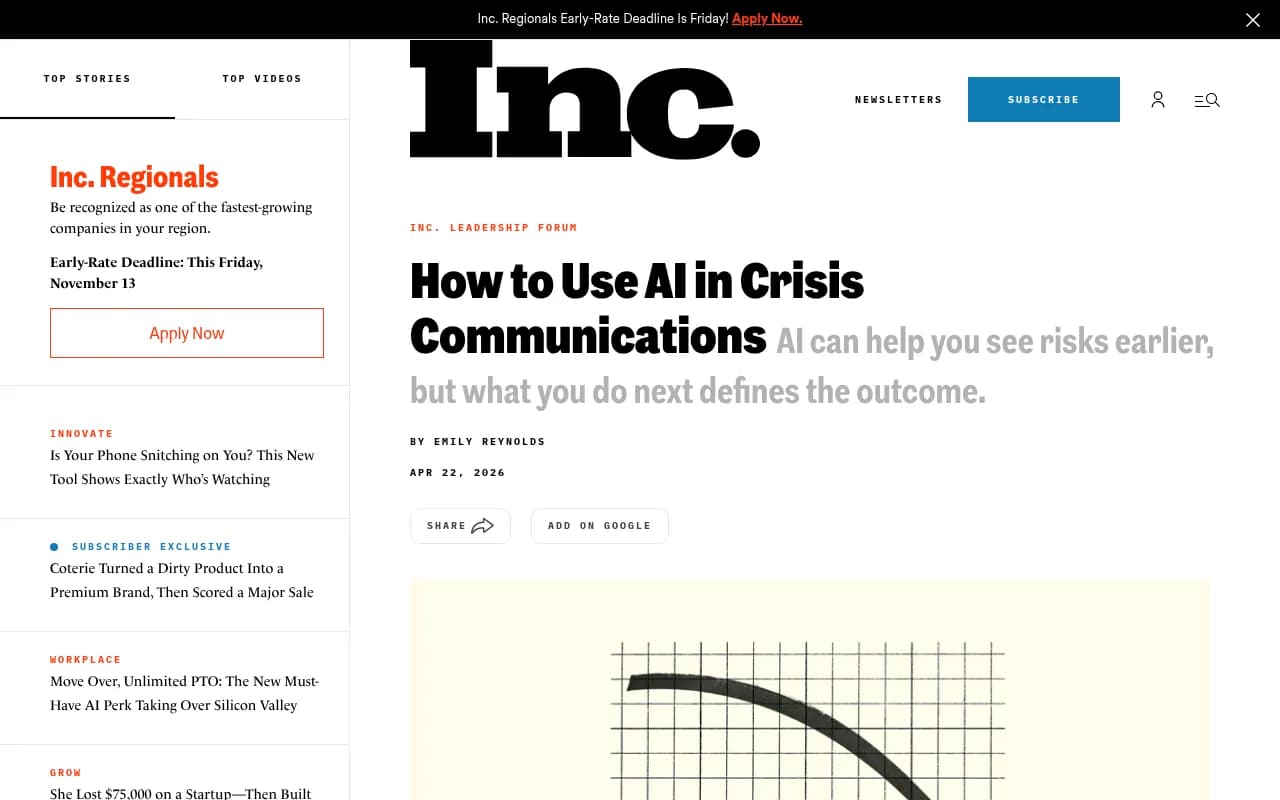
The Inc. piece by Emily Reynolds on using AI in crisis communications makes a point I think is right: not every signal needs action, and without clear thresholds teams overreact or spread thin. Define in advance what to escalate, what to watch and what to leave alone.
A workable starting scheme:
| Level | Trigger | Action |
|---|---|---|
| Watch | A new negative claim appears in one engine, low frequency | Log it, re-check in 24 hours |
| Escalate | The claim appears in two or more engines, or in more than a small share of tracked responses | Alert comms lead, trace the source |
| Respond | The claim is false and cited from a named source, or appears on high-intent prompts | Correction plan, owned-page update, outreach |
| Incident | Claim ties to an active public crisis | Move to hourly checks if your plan allows, join the crisis room |
Adjust the numbers to your volume. The point is that someone decided them in advance.
Name owners
AI answers sit between PR, SEO and content, so nobody owns them by default. Assign a monitor (usually SEO or comms ops), an approver (comms lead or legal), and a publisher (content team). If you work with an agency, put this in the scope. 1001 SEO Media runs this type of GEO monitoring as part of its AI search work, but whoever does it, write down who is on the hook.
When you find a damaging answer
1. Verify before you react
Re-run the prompt a few times and across engines. AI answers vary between runs. A one-off oddity is different from a stable claim repeated in 40% of responses. This is where a tool that aggregates responses beats manually screenshotting ChatGPT.
2. Trace the source
Look at the citations. Is it a news story, a Reddit thread, a review, or your own old page? That decides the fix. If the source is yours, update it now. If it is third-party, you are into outreach or counter-content.
3. Fix the owned layer first
Given the half-life data, landing pages and docs are the strongest correction asset, since ChatGPT keeps citing them for months. Publish or update:
- A clear, dated statement page with the facts, in plain language.
- FAQ content answering the exact prompts people use.
- Updated policy, pricing, or product pages where the old information lived.
Promptwatch's own advice is to keep prices, features and positioning on landing, docs and pricing pages accurate for this reason.
4. Address third-party sources
For inaccurate press or reviews, request corrections through normal channels. For forum or social threads, respond transparently as the company and avoid anything that looks like astroturfing. Because AI Overviews cite social more heavily, a response on a viral thread can matter more there. Publish your own YouTube explanation if a video is driving the narrative.
5. Check that AI actually picked up the fix
This step gets skipped. After publishing, confirm that AI crawlers fetched the page (crawler logs help, see Promptwatch's AI crawler logs), that it is being cited, and that the claim frequency is dropping. Expect days to weeks, not hours, and longer for sources with long half-lives.
The human side stays human
Tools find the signal. They do not write the apology. The Moxie Institute makes the point that AI identifies what people are saying, not why they are saying it or what they need to hear, and that simulated empathy is not empathy. Draft statements by hand, or at least edit AI drafts heavily. Keep legal in the loop for claims about safety or liability, and do not let an automated pipeline publish crisis content unreviewed. A review inbox with approval beats hands-off publishing here.
A short checklist
- Build a crisis prompt panel and run it daily across all major engines.
- Pick a tool that shows claims, sentiment and sources, not just a score.
- Define watch, escalate and respond thresholds.
- Assign a monitor, approver and publisher.
- Keep owned pages accurate, since they have the longest shelf life in ChatGPT.
- Trace every bad answer to a source before acting.
- Verify that the fix was crawled, cited and reflected in answers.
If you do only one thing this week, run your brand name plus "scam," "lawsuit" and "complaints" through ChatGPT, Gemini and Perplexity and read what comes back. Most teams are surprised at least once.