Key takeaways
- AirOps has a well-documented "pricing cliff": Solo runs about $199-200/month with ChatGPT-only tracking, and the next tier jumps straight to roughly $2,000/month for multi-engine coverage. There's nothing in between.
- "Closing the loop" means a platform doesn't just tell you where you're invisible in ChatGPT, Gemini, or AI Overviews, it helps you produce and publish content that fixes the gap. Monitoring-only tools stop at the diagnosis.
- Reddit's share of ChatGPT citations collapsed from roughly 3.8% to 0.5% on August 14, 2026, an 86% relative drop in a single day, according to Promptwatch Data. Any alternative you pick should reflect this kind of fast-moving reality, not a static snapshot from last year.
- ChatGPT cites roughly 5 sources per response (half of Google's ~10), per Promptwatch's average sources per response data, which is part of why mid-authority domains are now grabbing a surprising share of citations.
- We compare 8 platforms below, spanning AEO-focused tools (Profound, AthenaHQ, Searchable, Conductor), execution-heavy platforms, and workflow-automation tools like Gumloop that solve a different problem entirely.
Why people go looking for an AirOps alternative
AirOps built its reputation on an AI agent named Quill that's supposed to take visibility data and turn it into actual content, closing the loop between "here's where you're invisible" and "here's the page that fixes it." That pitch is legitimate. The problem most teams run into isn't the concept, it's the price ladder.
The Insights tier is free but capped at 1,000 tasks a month and one user. Solo costs around $199-200/month, covers 20,000 tasks and 100 tracked prompts, but only tracks ChatGPT. The moment you need Gemini, Perplexity, or multiple team seats, you're not looking at a $400 or $800 mid-tier plan, you're looking at Pro, which runs roughly $1,999-2,000/month. That's a 10x jump with no stepping stone, and it's flagged repeatedly across third-party pricing breakdowns.
I've seen this pattern discussed on Reddit too, where someone asking about AirOps alternatives got pointed toward Gumloop for workflow automation, with the caveat that Gumloop solves a completely different problem: it's a no-code agent builder, not an AI-visibility tracker. That distinction matters and gets lost in a lot of "best alternatives" roundups that lump monitoring tools and automation tools together as if they're interchangeable.
What "closing the loop" actually requires
A few third-party writeups have started using this exact phrase to describe the category split. One puts it well: the best platforms close the loop by helping you create content that gets cited, not just telling you what's missing. A Reddit thread in r/SaaS makes the buyer-side version of the same complaint: most AI visibility tools only do monitoring, and none of them tell you what to actually build to fix the gap.
So when you're evaluating AirOps alternatives, the real question isn't "does it track ChatGPT and Gemini," it's whether the platform gives you:
- Citation-level detail on which of your pages get cited and which don't
- Content gap analysis that maps your existing pages against what AI models are actually answering
- A way to generate and publish the fix, ideally with CMS integration, not just a PDF of recommendations
- Crawler-level visibility into whether AI bots are even reading your pages correctly
Most of the tools below get partway there. A few get all the way.
The 8 alternatives
1. Promptwatch
Promptwatch is the one I'd point most teams toward if the AirOps pricing cliff is the dealbreaker. It's used by 1,840+ brands and agencies, rated 4.7/5 on G2, and it tracks the full spread of AI surfaces: ChatGPT, Gemini, Claude, Perplexity, Grok, Copilot, DeepSeek, Mistral, Meta Llama, Google AI Overviews, AI Mode, and even AI coding assistants like Claude Code.

What separates it from most of the tools on this list is the crawler log data (Agent Analytics), which shows exactly when ChatGPTBot, ClaudeBot, PerplexityBot, and 400+ other crawlers hit your site, what they read, and where they error out. That's the "why" behind a visibility score, and almost nobody else in this category has it. On top of that, Promptwatch runs Content Agents that plan, write, and publish GEO-optimized articles straight to Webflow, Framer, or WordPress on a schedule, plus Unified Actions, which turns all the visibility and crawler data into a prioritized to-do list instead of a wall of charts. It also tracks Reddit and YouTube citations specifically, and has a dedicated ChatGPT Shopping and Ads Radar for ecommerce brands, both areas most competitors ignore entirely.
Pricing starts with a free Explore tier (10 prompts, ChatGPT only), then Essential at $95/month for a single site with 50 prompts and all-LLM tracking, up through Professional at $245/month with automated content generation and shopping insights. That $245 tier sits almost exactly where AirOps has a gap.
2. Profound
Profound raised a reported $180M Series D and is building toward what it calls an "AI Marketer" product. Third-party pricing puts Starter around $99/month for ChatGPT-only tracking of 50 prompts, with Growth reported at $399/month. Enterprise adds 10+ answer engines, custom prompt tracking, and full API access.

Profound's own comparison content claims an edge over Searchable on side-by-side multi-engine views and persona-level segmentation. It's a credible option if you want an enterprise-grade monitoring layer, though its content-generation and CMS-publishing depth doesn't match AirOps or Promptwatch.
3. AthenaHQ
Built by a team with Google Search and DeepMind backgrounds, AthenaHQ tracks 11 AI models on paid tiers, starting at $295/month billed monthly (or $245/month annually) for 3,600 credits. Its autonomous agent, ACE (Athena Citation Engine), independently analyzes content gaps and drafts on-brand optimizations.

One customer quote worth noting: a financial-services buyer said they were paying nearly $6,000/month for another AI visibility platform before switching to AthenaHQ. That's a useful data point if AirOps Pro's $2,000/month feels steep, though AthenaHQ's entry tier is still pricier than most others on this list.
4. Searchable
Searchable starts around $50/month per one source (others report Pro at $125/month), covering 3-4 core engines: ChatGPT, Gemini, Perplexity, and Google AI Overviews. It claims 12,000+ users and cites customer results like 40% visibility increases.

The catch, per Profound's own competitive review (take that with the appropriate grain of salt, but it's echoed elsewhere): base plans only cover three engines, Claude and Copilot require Enterprise, and there's no side-by-side multi-LLM comparison, only one engine at a time in a single chat window. If you need Claude or Grok tracking without paying Enterprise prices, this isn't your tool.
5. Conductor Intelligence
Conductor bundles three modules: a content-generation assistant, an AEO/SEO intelligence layer, and 24/7 technical monitoring. There's no public pricing, it's quote-based and sold as an annual license tied to tracked keywords and sites, with unlimited user seats on every tier.
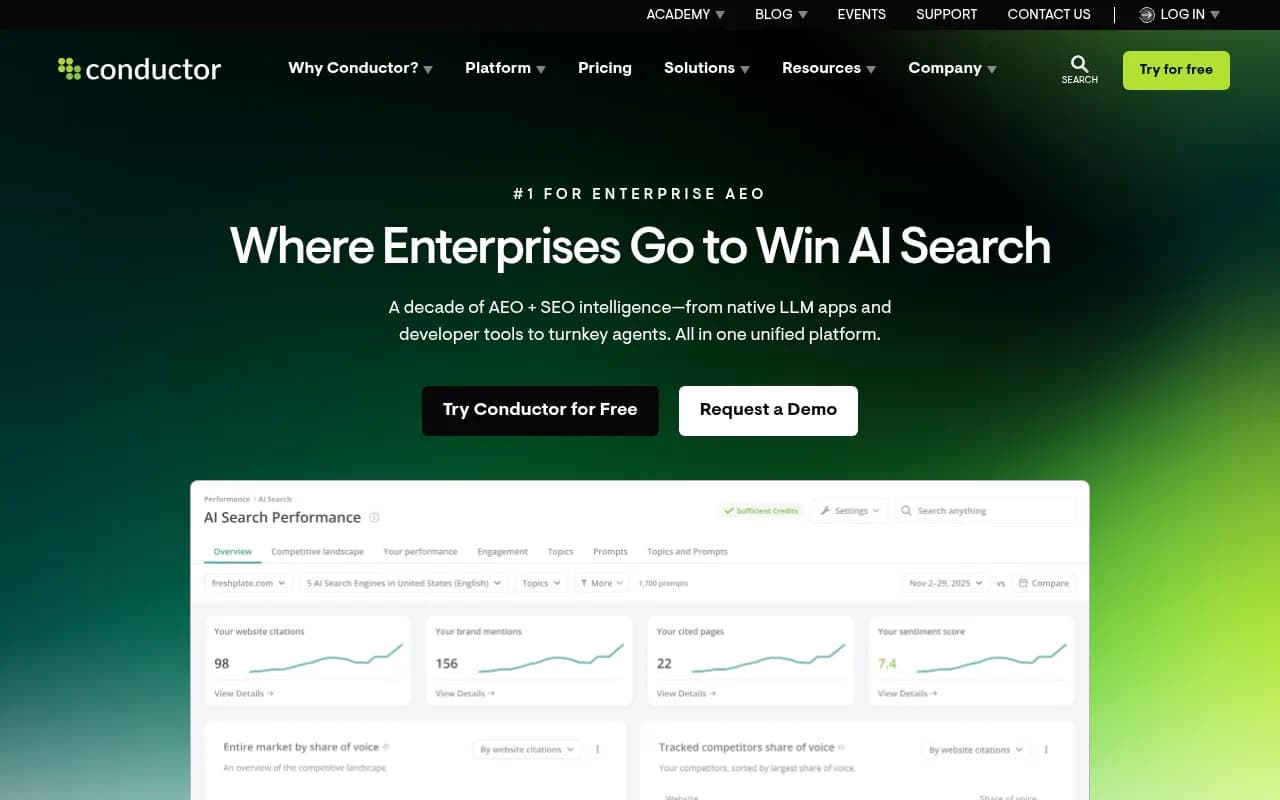
Conductor announced record FY2026 expansion as an AEO market leader in a February 2026 press release. It's aimed at global enterprises that want AEO treated as a measured channel alongside traditional SEO, not a bolted-on feature. If your procurement team is comfortable with custom quotes and annual contracts, it's worth a call; if you want transparent self-serve pricing, look elsewhere on this list.
6. Mentionova
Mentionova's standout feature is integrated Reddit monitoring with reply workflows: it discovers relevant threads, prioritizes them by citation impact, drafts brand-voice-aligned replies, and queues them for human approval. Given that Reddit still accounts for 5.19% of ChatGPT's citations even after August's crash (per Promptwatch's social media citations by AI model data), that's not a throwaway feature.
Pricing is reported inconsistently across sources, somewhere between $29 and $99/month for Starter plans, scaling to $799/month for Scale tiers with 6-engine coverage (Starter covers only 3). No pixel or code install is required, and it claims a first visibility signal within about 2 minutes.
7. Otterly.ai
Otterly is the budget option with published, transparent pricing: Lite at $29/month, Standard at $189/month (100 prompts), Premium at $489/month (400 prompts). It claims 30,000-40,000+ users and is available bundled inside Semrush's App Center.

An independent review from GenerateMore.ai calls it "best-in-class" at its price point, but flags real limitations: weekly-only data refresh instead of daily, no traffic attribution, and sentiment analysis that's advertised but not actually accessible in the product. Fine for a lightweight monitoring layer, not built for closing the loop into content.
8. Radarkit.ai
Radarkit is the cheapest full-featured option here: Lite at $29/month with 15 tracked prompts and daily refresh at the Growth tier and above ($79/month). Every plan, including Lite, tracks all 6 core models: ChatGPT, Google AI Mode, AI Overviews, Copilot, Perplexity, and Gemini.
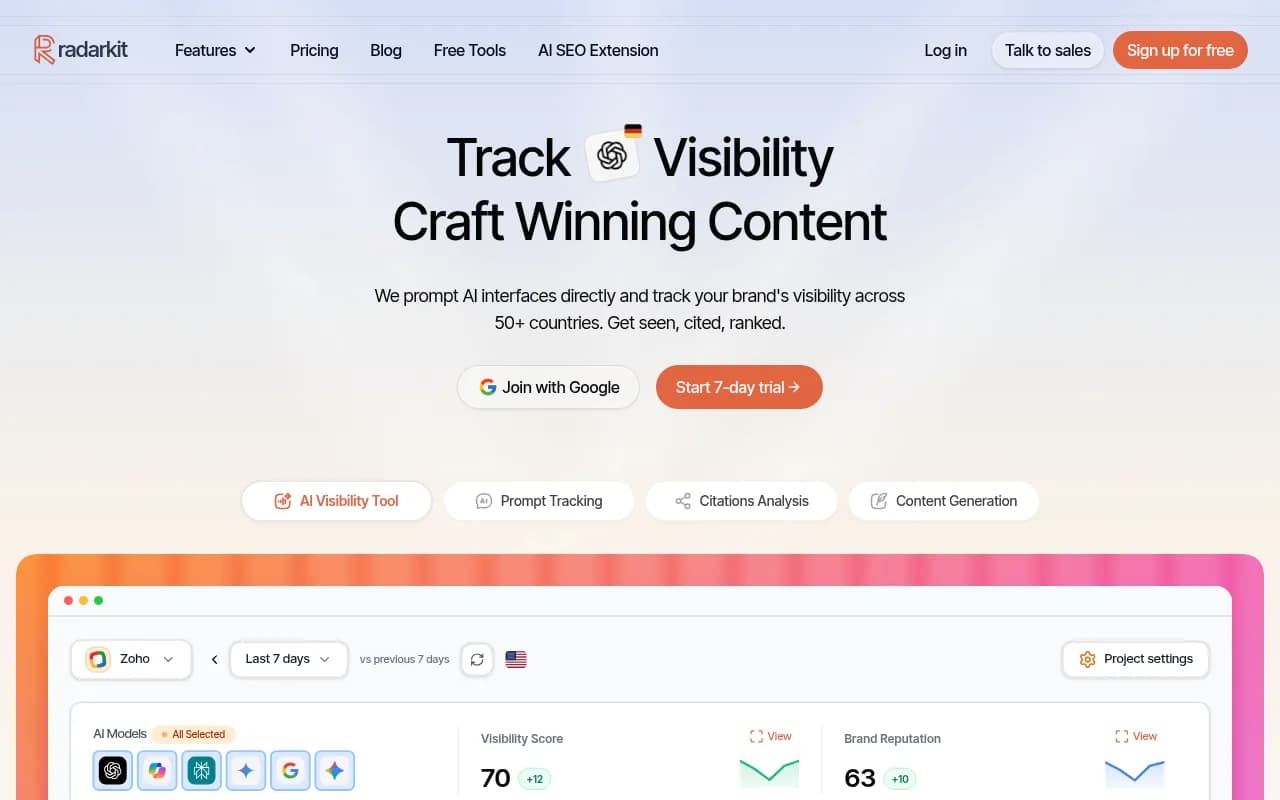
It runs five distinct agents, Content, Outreach, Reddit, Chat, and Plan, all trained on your own account's live data. That's a genuine attempt at closing the loop at a price point far below AirOps, AthenaHQ, or Conductor. The trade-off is scale: at 10-100 tracked prompts depending on tier, it's built for small-to-mid teams, not enterprise brand portfolios.
Comparison table
| Platform | Entry price | Engines on entry plan | Content generation/publishing | Best for |
|---|---|---|---|---|
| Promptwatch | Free / $95/mo | All major LLMs from Essential up | Content Agents with CMS publishing, Unified Actions | Teams that want full monitoring plus execution |
| AirOps | Free / ~$199-200/mo | ChatGPT only (Solo) | Quill agent, strong at Pro tier | Teams ready to pay $2,000/mo for multi-engine + content |
| Profound | Free trial / ~$99/mo | ChatGPT only (Starter) | Limited at lower tiers | Enterprise monitoring with growth path |
| AthenaHQ | Free / $295/mo | Multiple, expands at paid tier | ACE agent drafts optimizations | Teams burned by pricier platforms wanting more value |
| Searchable | ~$50-125/mo | 3-4 engines | Article generation included | Agencies wanting a chat-based visibility workflow |
| Conductor | Custom quote | Custom scope | Writing Assistant + monitoring modules | Global enterprises treating AEO as its own channel |
| Mentionova | ~$29-99/mo | 3 engines (Starter) | Reddit reply drafting | Brands prioritizing Reddit-driven citations |
| Otterly.ai | $29/mo | 4-6 engines depending on add-ons | None built in | Budget-conscious teams needing basic tracking |
| Radarkit.ai | $29/mo | All 6 core models on every tier | 5 agents including Content and Reddit | Small teams wanting full-stack coverage cheap |
What the data says you should actually optimize for
Picking a platform is only half the job. Whatever you choose, the underlying AI search behavior keeps shifting fast enough that a tool bought in January can be tracking the wrong things by August. A few patterns from Promptwatch's research worth building into your content strategy regardless of which platform you pick:
ChatGPT now runs a much leaner search pattern than it did last year: query fanouts dropped from roughly 2.15 searches per response in December 2025 to exactly 1.0 by April 2026, according to Promptwatch's query fanout data. Fewer searches per answer means each retrieval counts more, and average query length shrank from about 117 characters to 53, meaning ChatGPT is querying more like keyword typing than full sentences. That should change how you write headings: front-load the entity and category, keep it to 6-8 words.
How-to content and documentation are climbing fast in ChatGPT's citation mix. Per Promptwatch's citation-type tracking, how-to content more than doubled from 4.3% to 9.1% of citations across August 2026, while documentation rose from 3.3% to 8.2% over the same window. Meanwhile social posts collapsed from 4.4% to under 1% the same day Reddit's citation share crashed, which is a strong signal that a social-only GEO play is currently a weak bet on ChatGPT specifically.
Domain authority matters less than people assume. DR 46-90 domains earned close to 65% of ChatGPT citations in August 2026, while top-tier DR 91-100 domains actually fell from 7% to 3% of citations mid-month, per Promptwatch's citation share by domain rank data. If you've been assuming you need Forbes-level authority to get cited, that's not quite right anymore.
Making the call
If budget is the main blocker with AirOps, Radarkit and Otterly get you in the door for $29/month, though you'll trade away depth. If you want genuine closed-loop execution, crawler-level diagnostics, and coverage of channels most tools skip (Reddit, YouTube, ChatGPT Shopping), Promptwatch is the one built specifically to answer "how do I grow AI-driven revenue" rather than just "was I mentioned." AthenaHQ is worth a serious look if you've already been burned by a pricier platform and want more model coverage for less. Conductor and Profound make more sense once you're past the point where self-serve pricing matters and you need enterprise contracts and dedicated support.
Whichever direction you go, treat this as a decision you'll revisit within 6-12 months. The citation landscape moved enough between May and August 2026 alone (Reddit's collapse, the site: operator jump, the shift toward how-to and documentation content) that no platform's default prompt set or engine coverage stays optimal for long. For a broader look at the category, the GEO software directory at bestgeosoftware.com tracks a wider set of options if none of these eight fit.