Key takeaways
- AirOps lists Solo, Pro and Enterprise on its pricing page without a dollar price for any plan, and bills by usage. That makes budgeting hard, and it is the main reason people go looking for alternatives.
- Under $300 a month you can get solid AI visibility tracking from $29 to $245. You lose the content agents, brand kits and workflow automation that AirOps bundles in.
- The cheapest trackers measure and stop. Whether you need more depends on how many pages you have to write and refresh each month.
- Promptwatch's data shows ChatGPT cites product pages and landing pages far more than blog posts, so a tool that only makes articles covers a minority of what gets cited.
- Check every price on the vendor's own page before you buy. Roundups, including this one, go stale.
What AirOps actually is
AirOps started as a content workflow platform. It now sells what it calls AI discovery: agents that research, write, publish and refresh content under brand governance, plus AI search insights and, at the top tier, a strategy team.
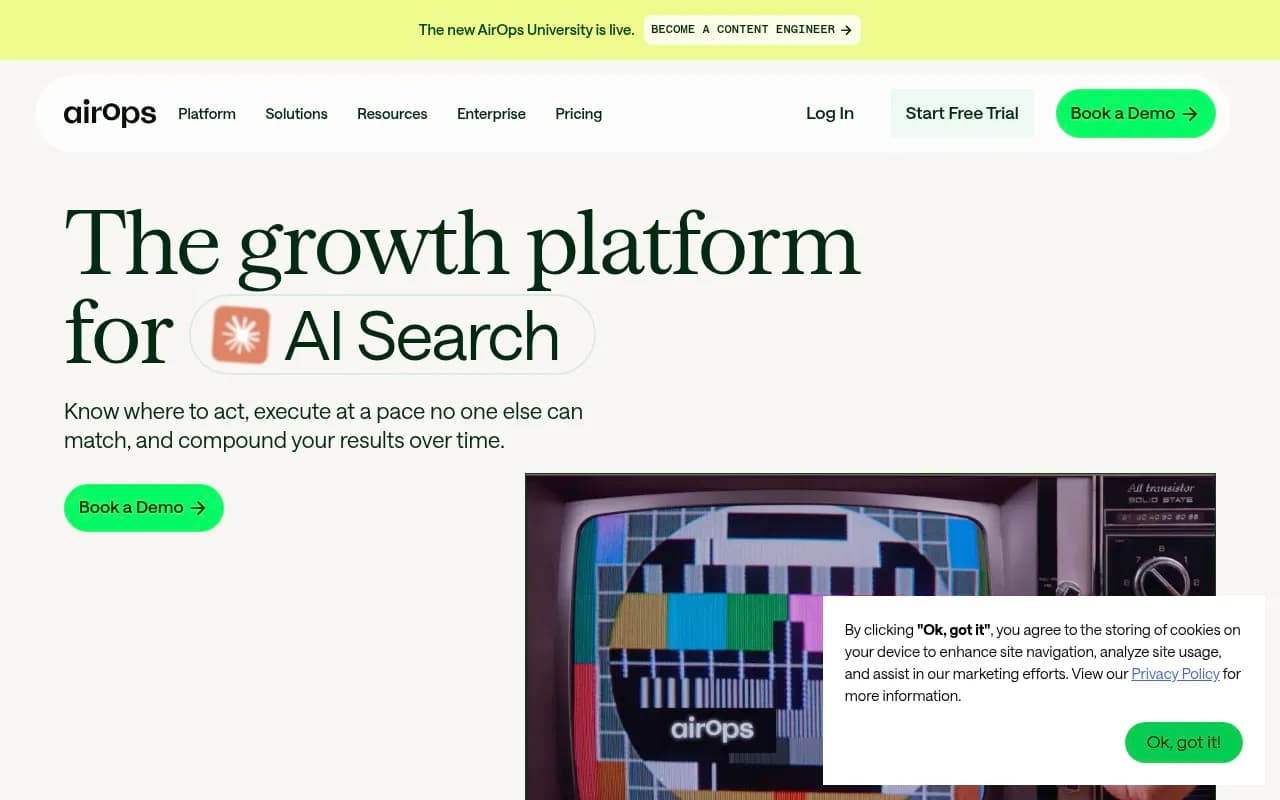
The pricing page lists three plans. Solo is for one person on one brand and includes ChatGPT insights only, 35,000 tasks, one brand kit and three knowledge bases. Pro is for small teams, with insights across "10+ answer engines", 100,000 tasks, five knowledge bases and unlimited seats. Enterprise is custom, with a dedicated account manager and custom agent builds. Solo and Pro have a "Start for free" button. None of the three shows a price.
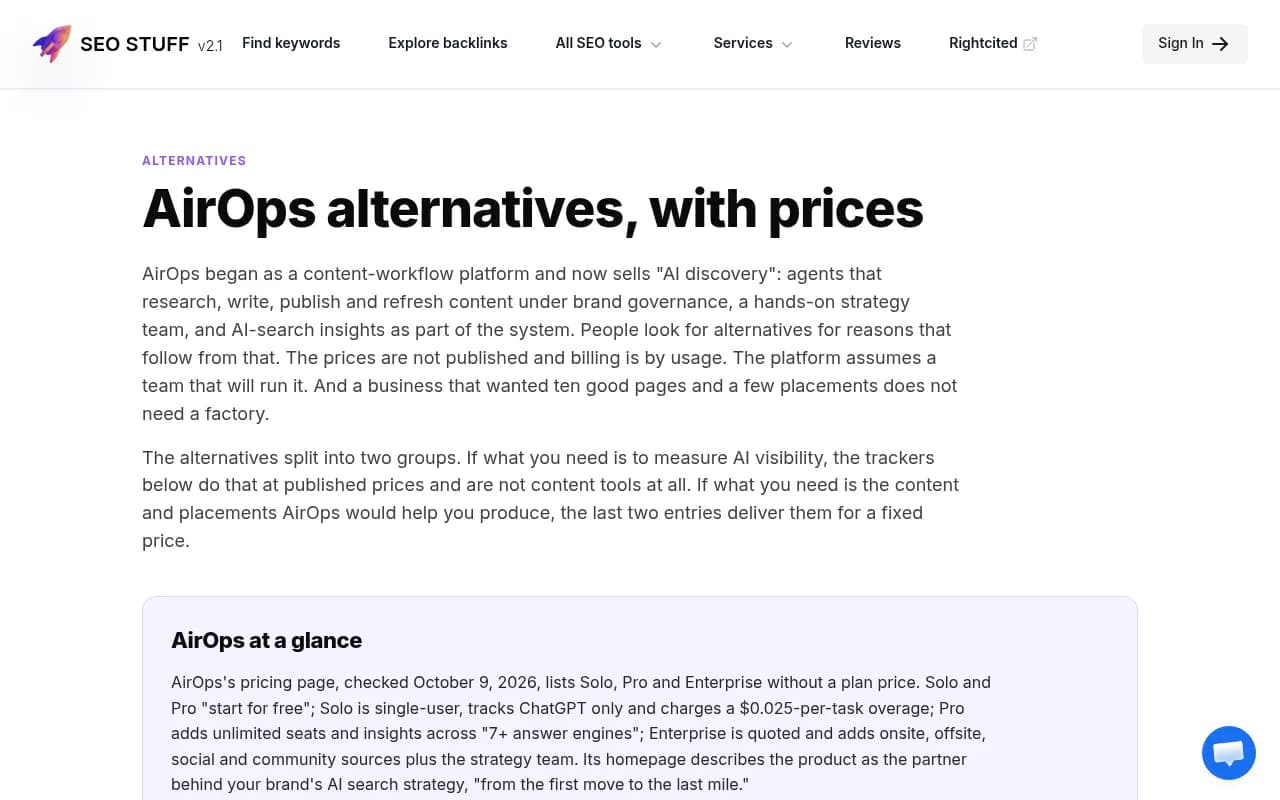
One caveat on coverage. SEO Stuff quoted "7+" answer engines for Pro on October 9, while the AirOps page now says 10+. Either the claim changed or one source is stale. Another reason to read the vendor page yourself.
So what pushes people away? Three things, mostly. No published price. Usage-based billing (SEO Stuff cites a $0.025-per-task overage on Solo) that is hard to forecast. And a product built for a team that will run a content factory every week. If you wanted ten good pages and a way to see whether AI mentions you, that is a lot of machine.
A note on sources: much of the pricing comparison online comes from vendors. AirOps' own blog compares Scrunch alternatives, and SEO Stuff sells two of the products in its own AirOps roundup. I have used them for data points but treated the rankings with suspicion.
The two jobs AirOps does
Before picking a replacement, split AirOps into two jobs, because almost nothing under $300 does both.
- Measuring whether ChatGPT, Perplexity, Gemini and AI Overviews mention or cite you.
- Producing and refreshing the pages that earn those citations.
Trackers do the first. Content tools do the second. A handful of platforms try both. The money question is which half you actually need to buy.
Why content type matters when you choose
It is tempting to buy a blog-writing engine and call it a GEO strategy. The data says that is aiming at the wrong target. In Promptwatch Data's report on which content types ChatGPT cites (Sep 28 to Oct 4, 2026), product pages took 22.4% of classified citations and landing pages 16.8%. Together that is about 39% for pages describing what a company sells. Listicles got 13.6%, how-tos 8.7%, general articles 6.1% and news 5.7%.
For commercial prompts the skew is stronger: product pages 26.0%, landing pages 20.6%, listicles 15.0% and comparisons 7.9%, almost 70% between those four.
So if a tool's whole pitch is bulk blog articles, it covers a minority of what ChatGPT cites. You want something that helps with product pages, landing pages and comparisons, or a process that lets you do that by hand.
Freshness matters too. Promptwatch's content half-life data tracked pages ChatGPT cited on July 6, 2026 for 90 days. After 60 days ChatGPT still cited 69% of landing pages and 67% of docs, but only 55% of product pages and 60% of listicles. Product pages, reviews and how-tos hit their half-life after 74 to 77 days. News is the worst: half the pages dropped out within 36 days.
The practical read: a cheap tracker tells you when a page falls out of citations. Something else, a refresh tool or an editor with a calendar, has to fix it. That gap is exactly what you pay AirOps for.
Tracker-only options under $300
If measurement is all you need, the prices are low and published. These are the ones with numbers I could source.
Otterly.AI, from $29 a month
The cheapest credible entry. It covers ChatGPT, Google AI Overviews, Perplexity and Copilot. Claude, AI Mode and Gemini are paid add-ons, and there is a free trial. You keep monitoring. You lose everything else.

Peec AI, from $95 a month
Standard plans cover three models, with up to 13 on Enterprise, and there is a free trial. It is a clean analytics product with smart prompt suggestions. No content agents, no brand kits.

Semrush AI Visibility Toolkit, from $99 a month
Covers Google AI Mode and ChatGPT, with no free trial. The appeal is if you already live in Semrush for keywords and audits. The cost is narrower AI coverage and prompt sets that are less flexible than a dedicated tracker.
Scrunch AI, around $300 a month
Exactly at the ceiling, so treat it as borderline. It covers ChatGPT, Claude, Gemini, Perplexity, AI Mode, AI Overviews and Meta, and has a 7-day free trial of Starter with no card. AirOps' own blog describes Scrunch as about $100 rising to about $300 for Starter, and says tracking alone is available for $50 to $100 elsewhere, which is a fair if self-interested point.

Tracker plus action: where Promptwatch fits
The cheap trackers answer "was my brand mentioned?". AirOps answers "how do I produce content to fix it?". Promptwatch sits between them at a published price. The Essential plan is $95 a month (annual billing is 12 months for the price of 10) and includes 50 prompts, all AI models, 500 Agent Credits, country tracking, a weekly site audit, 360 Insights and content gap analysis. Professional is $245 a month and adds 150 prompts, 1,500 Agent Credits, five AEO articles, a Knowledge Base and AI crawler logs.

What you keep relative to AirOps: gap analysis showing which prompts AI answers without citing you, an Action Board with prioritized to-dos, an editor for single articles and refreshes, and IP-verified crawler logs showing whether AI bots can even read your pages. What you lose: the fully automated Content Agent and CMS publishing to Webflow, Framer or WordPress sit on the Business plan at $579 a month, so they are above your ceiling. Under $300 you write or refresh with help, not on autopilot. Confirm limits at promptwatch.com/pricing.
That is a real trade. If you publish five to ten pages a month, Professional is plenty. If you want 5 to 10 articles a day, you are not shopping under $300 anyway.
Content-side options
If the thing you value in AirOps is the writing and refreshing, a different category fits better. I did not verify current prices for these, so check each vendor page.
- Clearscope is the stronger optimization and refresh layer, according to one marketing technologist's AirOps comparison on LinkedIn. It scores content against search data and is good at telling you what an existing page is missing.
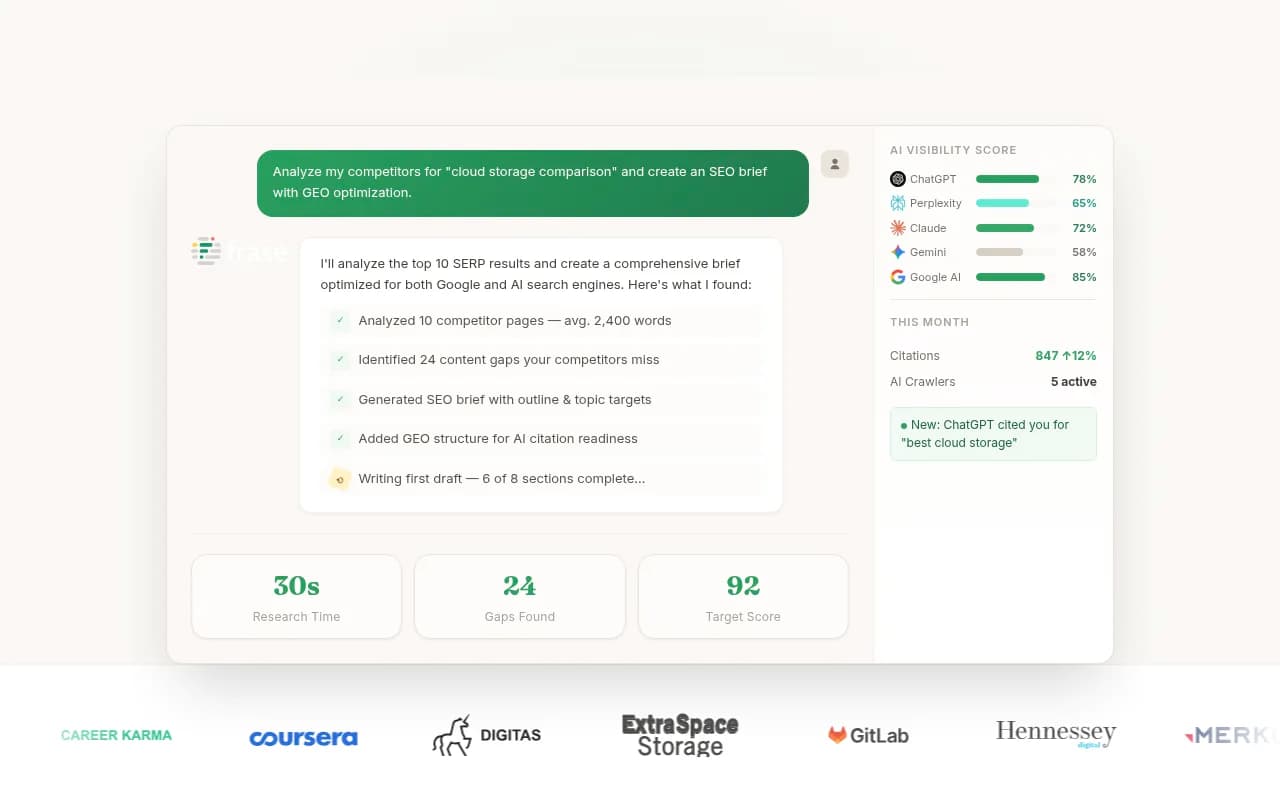
- Surfer SEO and Frase do similar optimization with built-in briefs and drafts.
- Searchable is a lighter AI visibility play.
- BlogSEO appears in roundups at around $97 for automated publishing.



These do not track AI citations in any depth. You would pair one of them with a tracker from the section above, which brings the combined bill to something like $125 to $300 a month depending on picks.
The fixed-price service route
SEO Stuff offers a Done-For-You Package at $999 once. It includes a baseline of 20 buyer questions across 4 assistants, 10 pages written to be cited and 3 DR50+ placements, delivered in 21 business days. It is not a monthly fee and not under $300, but if your real need is "ten good pages and a few placements", a one-off can beat a subscription. Remember the company sells it, so weigh the pitch accordingly.
Above the ceiling, for reference: Rightcited at $499 per brand per month does the fixes for you, and Profound is custom-priced with up to 9 engines and an AI Marketer agent.
What you keep and what you lose
| Option | Monthly price | Tracking | Content production | You lose vs AirOps |
|---|---|---|---|---|
| Otterly.AI | from $29 | 4 engines, add-ons for more | None | Agents, brand kits, workflows |
| Peec AI | from $95 | 3 models standard | None | Everything content-side |
| Semrush AI Visibility Toolkit | from $99 | AI Mode, ChatGPT | None | Broad engine coverage, content |
| Promptwatch Essential / Professional | $95 / $245 | All models, crawler logs on Professional | Gap analysis, editor, 5 articles on Professional | Automated Content Agent and CMS publishing (Business, $579) |
| Scrunch AI | about $300 | 7 surfaces | Limited | Content agents, margin below ceiling |
| Clearscope / Surfer / Frase | verify on vendor page | None | Optimization and refresh | AI citation tracking |
| SEO Stuff package | $999 one-off | 20 questions, 4 assistants | 10 pages, 3 placements | Platform, ongoing automation |
The pattern is consistent. Each step down in price drops a layer: first the automation, then the content tools, then everything except a dashboard.
How to choose
If you only need to know where you stand
Start with Otterly.AI or Peec AI. Both have free trials. Run them for a month before deciding you need more.
If you can write but cannot tell what to fix
This is the Promptwatch Professional case. Gap analysis and crawler logs tell you what is missing and whether bots reach it, and you or your writers do the rest. Take the free Explore plan first if you want to see the interface with 10 prompts on ChatGPT.
If you already have an SEO suite
Semrush at $99 may be enough as an add-on. Fine for a rough read, shallow for prompt-level work.
If you need volume content on a schedule
You will probably end up at AirOps Pro, Promptwatch Business or an agency. Under $300 you can stitch together tracker plus optimizer, but you will be the glue, and that time costs money too.
If you want to compare more tools
The GEO software directory at bestgeosoftware.com lists dozens of trackers with categories, which helps if the options here do not fit.
Questions to ask before you switch
- How many pages do I need to publish or refresh each month? If it is under ten, you probably do not need a content factory.
- Which engines do my buyers use? Three models at $95 is fine if they are ChatGPT, Perplexity and AI Overviews.
- Do I need to know if AI crawlers can read my site? If so, check that the tool offers crawler logs. Many trackers do not.
- What happens at the limits? Prompt caps and response caps differ a lot between plans.
- Do I trust the price? Usage-based billing is the thing you are escaping, so look for flat tiers.
I did not verify prompt limits, country support or seat counts for Peec AI, Otterly and Semrush on their own pages, so read those before paying.
Bottom line
AirOps is built for teams that run content at volume, and its unpublished pricing is a fair complaint if you are not one of them. Below $300 a month you can get good measurement for $29 to $100, and measurement plus guided fixes for $95 to $245. What you cannot get is autonomous agents publishing on your behalf. Pick the cheapest option that covers the job you actually have, run the free trial, and revisit once you know how many pages you are really going to ship.