Key takeaways
- AirOps is a workflow automation platform -- it connects AI models, data sources, and content tasks into custom pipelines, but doesn't own the full SEO lifecycle
- Scalenut is built around the complete content journey: keyword research, briefs, writing, and optimization in one place
- AirOps suits teams that need flexibility and scale; Scalenut suits teams that want a guided, opinionated process with less setup
- Neither tool is purpose-built for AI search visibility (GEO/AEO) -- if that's your priority, you'll need a dedicated platform alongside either one
- The right choice depends almost entirely on how your team works, not which tool has more features
What these tools actually are
Before comparing them, it helps to be clear about what each tool is trying to do -- because they're solving different problems.
AirOps is a workflow automation platform for content teams. You build pipelines: connect a keyword list to an AI model, pull in SERP data, generate a draft, run it through a quality check, push it to your CMS. It integrates with over 40 AI models and is genuinely flexible. The tradeoff is that flexibility requires setup. You're building workflows, not following a guided process.
Scalenut is an SEO content platform that covers the lifecycle from research to publish. You start with keyword research, generate a content brief, write or generate the article with SEO guidance baked in, then optimize it before publishing. It's more opinionated than AirOps -- there's a defined path -- but that's also what makes it faster to get started.

The short version: AirOps is infrastructure. Scalenut is a product. That distinction matters a lot when you're deciding which one fits your team.
How they compare across the content workflow
Research and keyword planning
Scalenut has this built in. You can run keyword research, cluster topics, and generate briefs without leaving the platform. The keyword clustering in particular is useful -- it groups related terms so you can plan content around topic authority rather than individual keywords.
AirOps doesn't do keyword research natively. You'd bring your own data (from Ahrefs, Semrush, or wherever) and build a workflow around it. That's fine if you already have a research process -- AirOps can automate the downstream steps. But if you're starting from scratch, you're adding tools.
Content briefs
Scalenut generates structured briefs based on SERP analysis. They include suggested headings, NLP terms to cover, competitor insights, and word count targets. For writers, this is genuinely useful -- it removes a lot of the guesswork.
AirOps can generate briefs too, but you're configuring the prompt and data inputs yourself. The output quality depends on how well you've set up the workflow. Teams with a strong prompt engineering background will get good results; teams without that background will spend time figuring it out.
Writing and generation
Both tools generate content, but the experience is different. Scalenut's editor keeps you in a guided environment -- you can see your SEO score updating as you write or generate, with real-time feedback on term coverage and readability.
AirOps generates content as part of a pipeline. The output lands wherever you've configured it to go -- a Google Doc, a CMS, a spreadsheet. There's no live editing environment with SEO feedback. That's fine for programmatic content at volume; it's less useful for a writer who wants to iterate on a single piece.
Optimization
Scalenut has an optimizer built in. After generating or writing content, you can run it through the optimizer to check NLP coverage, fix gaps, and improve the score before publishing.
AirOps doesn't have a native optimizer. You'd integrate with a tool like Surfer SEO or Clearscope to add that capability.


Publishing and CMS integration
AirOps connects to more destinations. It can push content to WordPress, Webflow, Contentful, and other CMS platforms as part of an automated workflow. For programmatic SEO at scale -- generating hundreds of location pages or product descriptions -- this is a meaningful advantage.
Scalenut has CMS integrations too, but the workflow is more manual. You're exporting and publishing rather than automating the full pipeline.
Feature comparison table
| Feature | AirOps | Scalenut |
|---|---|---|
| Keyword research | No (bring your own) | Yes, built-in |
| Topic clustering | No | Yes |
| Content briefs | Configurable | Guided, SERP-based |
| AI writing | Yes (40+ models) | Yes |
| Real-time SEO editor | No | Yes |
| Content optimizer | No (needs integration) | Yes, built-in |
| Workflow automation | Yes, core feature | Limited |
| CMS publishing | Yes, automated | Manual/export |
| Brand governance | Limited | Moderate |
| GEO/AI search tracking | No | Partial (ChatGPT, Google AIO) |
| Setup complexity | High | Low-medium |
| Best for | Scale, custom pipelines | Guided lifecycle, individual pieces |
Where AirOps genuinely wins
The programmatic SEO use case is where AirOps earns its place. If you need to generate 500 location pages, or refresh 1,000 product descriptions with updated specs, or run a daily pipeline that pulls trending topics and drafts articles automatically -- AirOps handles that in a way Scalenut simply doesn't.
The multi-model flexibility is also real. Being able to route different content types to different AI models (GPT-4o for long-form, Claude for tone-sensitive copy, a fine-tuned model for technical content) within the same workflow is something Scalenut can't match.
For teams with a technical content ops function -- someone who can build and maintain workflows -- AirOps is a serious production tool.
Where Scalenut genuinely wins
Speed to first draft is Scalenut's strength. A writer or content manager with no workflow-building experience can go from keyword to optimized draft in under an hour. The guided process removes friction that AirOps introduces.
The built-in optimizer is also underrated. Having SEO feedback in the same environment where you're writing means you don't lose context switching between tools. For teams producing individual pieces of content rather than bulk programmatic output, this matters.
Scalenut's AI brand monitoring (ChatGPT and Google AI Overviews on standard plans, Perplexity on higher tiers) is a feature AirOps doesn't have at all. It's not a full GEO platform, but it gives content teams some visibility into how their brand appears in AI search results.
The GEO gap both tools share
Here's something worth being direct about: neither AirOps nor Scalenut was built primarily for generative engine optimization. They're content creation tools, and GEO is a monitoring and optimization discipline that sits alongside content creation.
Scalenut has added some AI brand monitoring features, which is a start. But tracking how your content performs across ChatGPT, Perplexity, Claude, Gemini, and Google AI Overviews -- understanding which prompts you're visible for, which competitors are outranking you in AI responses, and what content gaps exist -- requires a dedicated platform.
If AI search visibility is a real priority for your team (and in 2026, it probably should be), you'll want something like Promptwatch running alongside whichever content tool you choose. It tracks visibility across 10 AI models, shows you exactly which prompts competitors appear for that you don't, and has content generation tools built around closing those gaps.

The distinction matters: AirOps and Scalenut help you create content. A GEO platform helps you understand whether that content is actually being surfaced in AI answers -- and what to do when it isn't.
Who should use AirOps
AirOps makes sense if:
- You're running programmatic SEO at scale (hundreds or thousands of pages)
- You have a technical content ops person who can build and maintain workflows
- You need to connect multiple AI models, data sources, and publishing destinations
- Your content formats are relatively standardized and template-friendly
- You already have keyword research and optimization tools in your stack
It's a harder sell if you're a small team without workflow-building experience, or if your content is editorial and requires heavy iteration.
Who should use Scalenut
Scalenut makes sense if:
- You want a guided, end-to-end process without building custom workflows
- Your team includes writers who need SEO feedback while they work
- You're focused on individual content pieces rather than bulk programmatic output
- You want keyword research, briefing, writing, and optimization in one place
- You're newer to SEO content and want opinionated guidance
It's less suited to teams that need to automate publishing pipelines or generate content at very high volume.
Alternatives worth considering
If neither tool quite fits, a few others are worth looking at depending on your specific need.
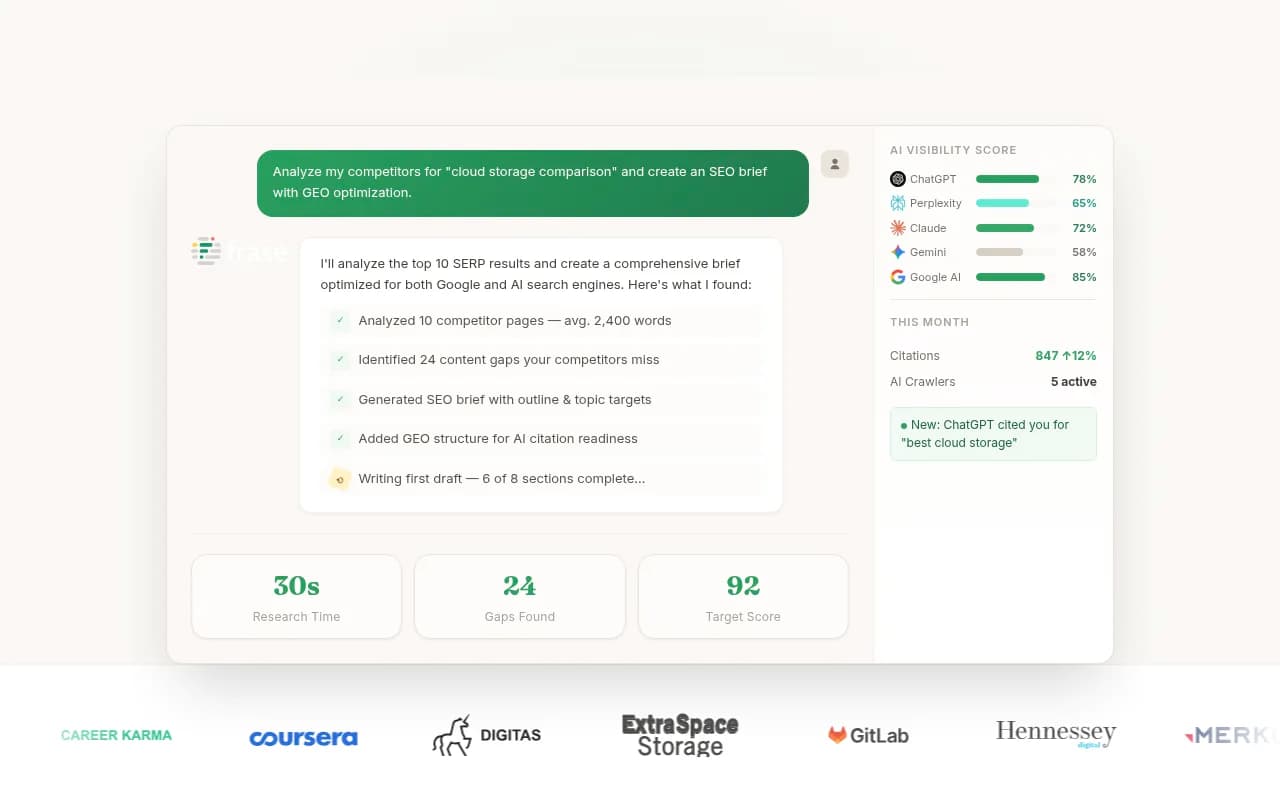
For content optimization with strong SEO grounding, Frase and Surfer SEO both do the research-to-optimization workflow well.
For enterprise content strategy with AI planning, MarketMuse goes deeper on topic modeling and content gap analysis than either AirOps or Scalenut.
For teams that want AI writing with strong brand governance, Writer is worth a look -- it's built specifically for enterprise brand consistency in a way AirOps only partially addresses.

For NLP-based content optimization at a lower price point, NeuronWriter covers a lot of the same ground as Scalenut's optimizer.


The honest verdict
AirOps and Scalenut aren't really competing for the same customer. AirOps is infrastructure for teams that want to build custom content pipelines. Scalenut is a product for teams that want a defined process.
If you're choosing between them, the question isn't "which has better features" -- it's "what kind of team are we?" A technical content ops team building at scale should look at AirOps. A content team that wants to move fast without building workflows should look at Scalenut.
What both tools share is a gap in AI search visibility. Creating content is one thing. Knowing whether that content is being surfaced in ChatGPT, Perplexity, or Google AI Overviews -- and having a systematic way to close the gaps when it isn't -- is a separate problem that neither tool fully solves. That's worth factoring into your stack decisions in 2026.