Key takeaways
- Azoma is an enterprise Agentic Commerce Optimisation platform built around Amazon and Walmart marketplace agents. Pricing is custom and a demo is required.
- Goodie AI is the broadest closed-loop option: SKU-level tracking, feed fixes, and revenue attribution. Third-party sources put pricing at about $295/month for entry tiers, with enterprise quotes above that.
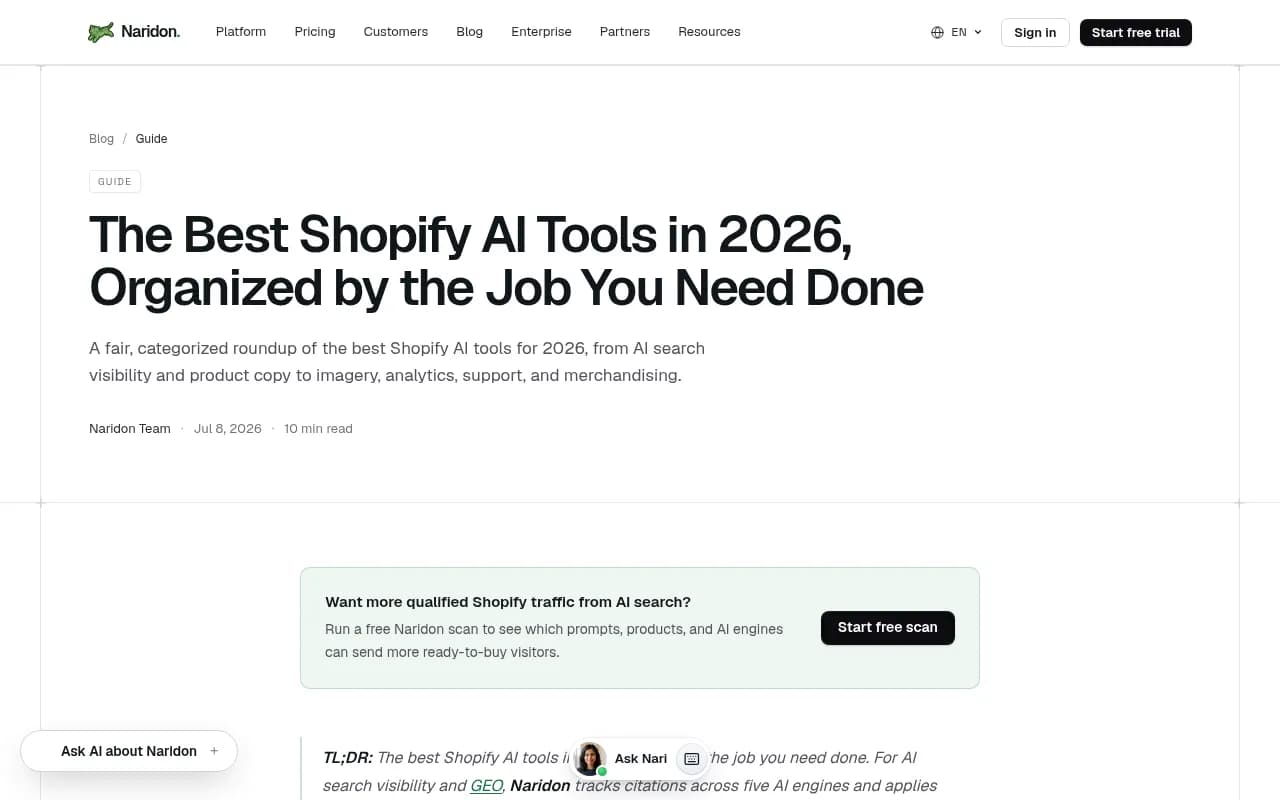
- Naridon is Shopify-native, has published credit-based pricing (free tier, then $49 to $899/month), and applies schema, copy and llms.txt fixes straight to a store.
- Shopify's Agentic Storefronts already syndicate your catalog to AI channels. These tools sit on top and answer the questions Shopify does not: are you recommended, why not, and what should you fix?
- There are no independent head-to-head tests of the three. Most claims in this comparison come from vendors or third-party roundups, and I flag that where it matters.
Why this comparison exists
Three tools keep showing up when people search for agentic commerce and Shopify GEO software. They look similar from a distance. Each one says it tracks AI shopping agents and helps your products get recommended. Up close they are built for different companies.
A quick framing helps. Agentic commerce means AI agents that research, compare and sometimes buy products for a shopper. The optimization work is making sure your catalog is readable, accurate and well cited so those agents pick you. Shopify has handled much of the plumbing: per the NoGood roundup, Agentic Storefronts began activating for all stores in late March 2026 and auto-syndicate products to ChatGPT, Perplexity, Copilot, Google AI Mode and Gemini. What Shopify does not give you is a scoreboard or a diagnosis. That is the gap these tools fill.
The three tools in one table
| Azoma | Goodie AI | Naridon | |
|---|---|---|---|
| Positioning | Agentic Commerce Optimisation (ACO) for enterprise | Closed-loop AEO and agentic commerce platform | Shopify-native GEO on autopilot |
| Best fit | Big brands with Amazon and Walmart catalogs | Retail and CPG teams wanting monitoring plus execution | Shopify brands, roughly $1M to $50M GMV |
| Marketplace agents | Alexa for Shopping, Walmart Sparky, Amazon COSMO | Amazon, Walmart Sparky (per aiclicks), ChatGPT, Perplexity, Google AI Mode shopping | Not a focus |
| LLM engines | ChatGPT, Gemini, Perplexity, Meta AI, Claude, AI Overviews | 11 to 12 engines including Claude, Grok, Copilot, DeepSeek, Meta AI | ChatGPT, Claude, Gemini, Perplexity, Bing Copilot by default |
| Execution | Product data enrichment, listing and off-site content, correcting wrong AI claims | One-click feed remediation, descriptions, FAQs, schema, image optimization | Schema, descriptions, FAQs, llms.txt applied via Shopify |
| Attribution | SKU-level revenue tie-in | Surface and SKU-level revenue, match-back and incrementality | Measures after fixes are applied |
| Pricing | Custom, demo required | From about $295/month reported, enterprise by quote | Free, then $49, $249 and $899/month |
| Shopify angle | One integration among many | One integration among many | Core product |
Azoma: the marketplace-first enterprise pick
Azoma calls its category Agentic Commerce Optimisation, and the vertical focus is real. It measures at SKU and revenue level rather than brand-mention level, and its prompts come from marketplace and catalog data rather than panel data.
The agent coverage is the main draw. Beyond ChatGPT, Gemini, Perplexity, Meta AI and Claude, it tracks Alexa for Shopping, Walmart Sparky and Amazon COSMO. One naming note: Amazon renamed Rufus to Alexa for Shopping on 13 May 2026, merging Rufus and Alexa+. Older articles, including some cited here, still use the old names.
Integrations are heavy on the enterprise side: Amazon Seller Central and Vendor Central, Walmart, Shopify, Google Merchant Center, Salsify, and PIM and DAM systems, with support for the ACP, UCP and AMP protocols. It has raised an $11.2M Series A, and names customers like L'Oreal, Unilever, Mars, P&G, Colgate, Beiersdorf and Reckitt.
Azoma also moves fast on new surfaces. In September 2026 it announced coverage for Meta Muse, after Shopify added Meta as an AI channel in Agentic Storefronts. Note the caveat in that same release: Muse launched weeks earlier, so nobody has measured outcomes yet. And Amazon blocked Muse from Amazon.com on September 20, 2026, which is a reminder that these surfaces change under your feet.
The one outcome number I found is a Mars result: +17.7% agentic shelf visibility and +68% year-over-year SKU revenue uplift. That is self-reported by the vendor, so treat it as a claim, not a benchmark.
Where Azoma is weaker
Pricing is custom with separate brand and agency plans, so you cannot size it up before a sales call. And for a pure DTC Shopify store with no Amazon or Walmart presence, a lot of its strongest coverage is wasted. Aiclicks calls it overkill for that case, which matches my read.
Goodie AI: the broadest closed loop

Goodie AI is the one most roundups put at or near the top, and the reasoning holds up. It tries to cover research, monitoring, action and measurement in one place. The brand-side tracking covers about 11 to 12 AI engines (sources differ on the count), including ChatGPT, Gemini, Claude, Perplexity, Grok, Copilot, AI Overviews, AI Mode, Meta AI and DeepSeek.
The Agentic Commerce Suite is the part that matters for retail. It tracks products at the SKU level across AI shopping surfaces: which products get mentioned, where they rank in comparisons, which merchants sell them, and which competitor products appear next to yours. Then it acts, with one-click feed remediation, generated product descriptions and FAQs, schema injection and image optimization pushed to storefronts and ad feeds. Integrations listed include Shopify, BigCommerce, Google Merchant Center, Meta Catalog and Amazon Seller Central.
Attribution is where it separates from simple trackers. It reports assisted carts and checkouts, with revenue attributed by surface and SKU, plus match-back and incrementality reporting. If you need to show a CFO carts rather than mentions, this is the strongest pitch of the three.
Case studies in the NoGood piece include Dermalogica (127% increase in AI conversions) and SteelSeries (3.2x AI search conversions in six months). Again, vendor-supplied.
Where Goodie AI is weaker
The pricing is murky. NoGood lists plans from $295/month with quote-based enterprise tiers, and aiclicks says every tier is quote-and-demo only and that commerce features begin on the mid tier. Verify on higoodie.com before budgeting. It is also a lot of product if you only want a mention tracker.
Naridon: the Shopify-native budget option

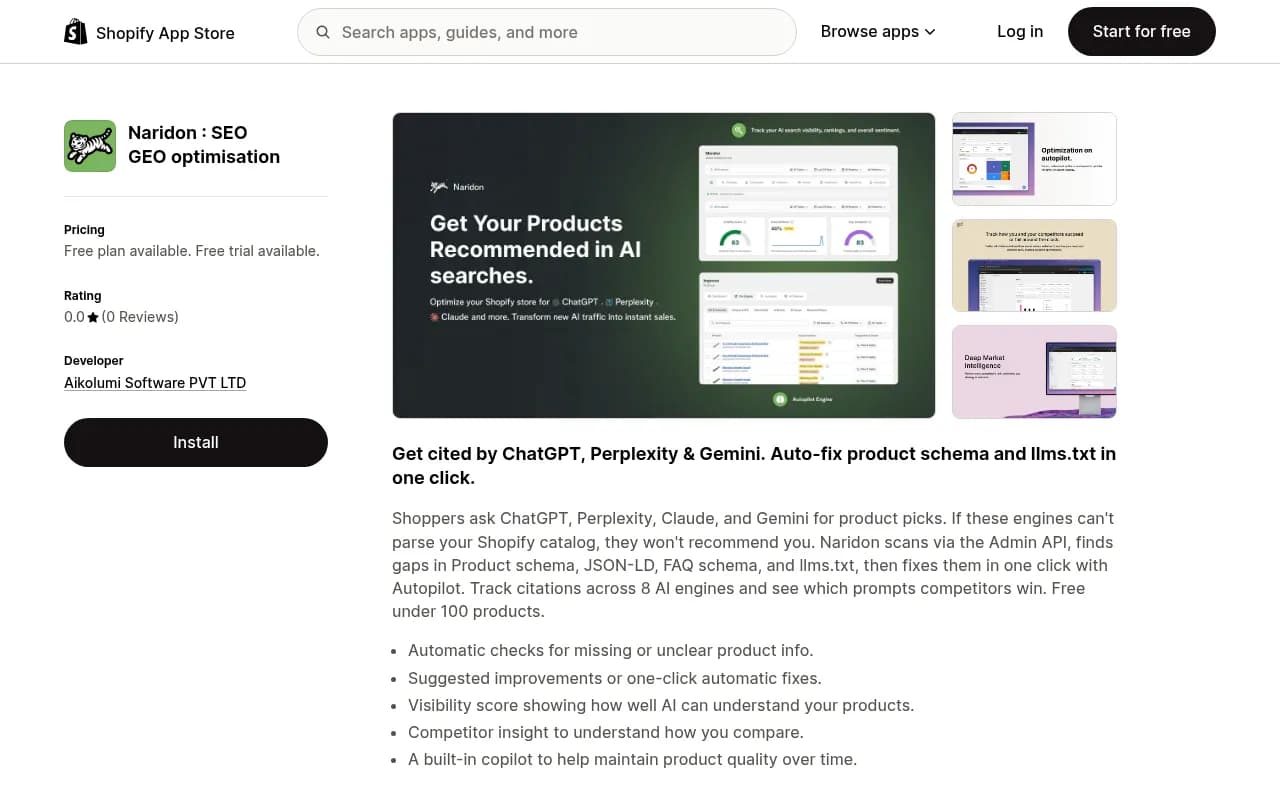
Naridon is the odd one out, deliberately. It is built for Shopify merchants, not for enterprise marketplace sellers. The workflow is: detect a gap, generate a fix, verify it with an LLM, apply it through the Shopify adapter, then measure. Fixes target schema, product descriptions, FAQs and llms.txt.
It tracks ChatGPT, Claude, Gemini, Perplexity and Bing Copilot by default. Grok, Meta AI, DeepSeek and AI Overviews require a bring-your-own-key add-on, at +$50/month on Starter and +$100/month on Growth. It supports 11 languages and says it is aimed at brands with $1M to $50M GMV. It also says plainly that it is not a storefront chatbot and not for portfolio-wide non-Shopify reporting.
Naridon pricing, which is the clearest of the three
Pricing is credit-based. Per Naridon's own blog and the Shopify App Store listing:
| Plan | Price | Credits |
|---|---|---|
| Free | $0 | 150/month |
| Starter | $49/month (7-day trial) | 3,000 |
| Growth | $249/month | 25,000 |
| Enterprise | $899/month | 150,000 |
Costs per action: a scan is 1 credit, a prompt run 3, fix generation 2, a deep dive 5, a blog post 5. Applying or reverting a fix is free. Top-up packs never expire (500 credits for $10, 2,000 for $35, 5,000 for $60).
One discrepancy to check before you buy: the App Store snippet I saw lists only the $249 and $899 tiers, showing 100 prompts and 10 competitors on the lower one. The free and Starter tiers appear on Naridon's blog. Confirm the current plans in the Shopify listing.
Where Naridon is weaker
Its reviews and comparisons are published on its own blog, so claims like "most complete GEO option" are unverified. It does not cover Amazon or Walmart agents in any depth, and it is not designed for SKU-level revenue attribution at the scale Goodie or Azoma pitch.
Which one should you pick?
| Your situation | Likely pick |
|---|---|
| Big CPG or brand with large Amazon and Walmart catalogs | Azoma |
| Retail team that wants monitoring, feed fixes and SKU revenue attribution in one platform | Goodie AI |
| Shopify store that wants cheap, automatic schema and content fixes | Naridon |
| Mixed: Shopify DTC plus Amazon, with real budget | Goodie AI, with Azoma worth a demo |
| Small store, no sales cycle wanted | Naridon, or a simpler tracker |
My honest read: these are not three competitors for one buyer. Azoma and Goodie overlap at the enterprise end, and the choice there comes down to how much of your revenue lives on marketplaces versus your own site. Naridon is a different weight class and a different job.
Manage expectations on ChatGPT Shopping
It is easy to over-invest here. Promptwatch's ChatGPT shopping usage data shows shopping features attach to only a low single-digit share of citation-enabled web-search responses overall. The rate moves in steps, roughly doubling overnight in late May before falling back, which looks like OpenAI tuning when product cards appear. Trigger rates are much higher on commercial and transactional prompts than the all-prompt average suggests.
Two takeaways. First, ChatGPT shopping volume is small and controlled by OpenAI, so measure it but do not build a business case on one number. Second, the prep is the same whichever tool you use: complete Product schema, accurate price and availability, a clean merchant feed, and a habit of running buyer-intent prompts to see which brands fill the cards.
As for where agents get their information, Azoma's own Q2 2026 analysis (vendor data) found ChatGPT leaning on earned media (41%) and retailers (37%), Gemini on retailers (41%), and Alexa for Shopping on affiliate sites (73%). If even roughly right, it means off-site presence matters as much as your product pages.
Questions to ask in any demo
- Does tracking use real agent interfaces or APIs? Shopping answers often differ between the two.
- Which prompts do you track, and where do they come from?
- Can you show SKU-level results for a customer on my platform, not just a brand-level dashboard?
- What do fixes touch: only my site, or feeds and marketplace listings too?
- How do you attribute revenue, and does it rely on match-back modeling?
- What happens to my data and fixes if I cancel?
Alternatives worth a look
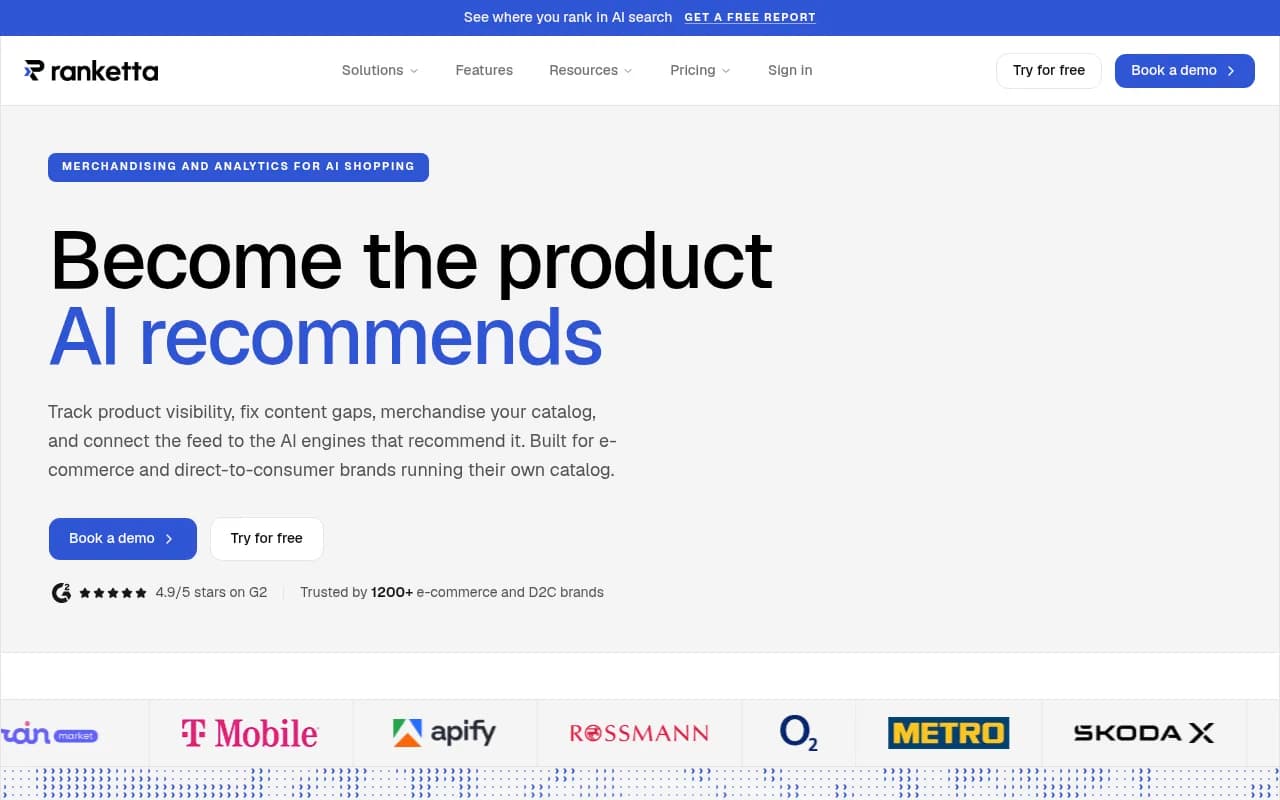
If none of these fits, the field is crowded. Ecommerce-focused options in our catalog include Yotpo Discover, Ranketta, Alhena AI and Bluefish AI.
Yotpo Discover

If your main need is understanding why AI does or does not cite your site across all engines, not just shopping, a broader platform like Promptwatch covers crawler logs, citation analytics and AI traffic, which the shopping-specific tools mostly skip.

For wider browsing, the GEO software directory at bestgeosoftware.com lists more options by category.
Bottom line
Pick Azoma if marketplaces are your revenue. Pick Goodie AI if you want the most complete monitor-fix-measure loop and can handle a sales process. Pick Naridon if you run a Shopify store and want fixes applied for a published price. Whichever you choose, ask for proof on your own catalog, because no independent test has compared them yet.