Key takeaways
- Marketplace and platform businesses have fundamentally different AI visibility needs than single-brand companies -- you're tracking visibility for a brand, a product catalog, and often seller or service-provider reputations simultaneously.
- Most AI visibility tools were built for single-brand monitoring. Only a handful handle the complexity of multi-sided platforms, product-level tracking, and category-level prompt analysis.
- The tools that matter most in 2026 go beyond monitoring: they identify content gaps, surface which prompts your competitors are winning, and help you create content that AI models actually cite.
- Prompt volume data and query fan-outs are especially valuable for marketplaces, where a single category prompt can branch into dozens of sub-queries across price tiers, use cases, and geographies.
- Promptwatch is the only platform in this comparison rated as a "Leader" across all evaluation categories, and its Action Loop (find gaps, create content, track results) maps directly to how marketplace teams actually work.
Why marketplace businesses have a harder AI visibility problem
If you run a marketplace -- whether that's a two-sided platform connecting buyers and sellers, a SaaS platform with a partner ecosystem, or an e-commerce marketplace with thousands of third-party SKUs -- AI visibility is genuinely more complicated for you than it is for a single-brand business.
Here's the core issue: when someone asks ChatGPT "what's the best project management tool for remote teams," a SaaS company either shows up or it doesn't. Clean problem, clean answer. But when someone asks "what's the best marketplace to buy vintage furniture," the AI response might mention your platform, a competitor platform, specific sellers on your platform, Reddit threads comparing platforms, and review aggregators -- all in the same answer. You're not just tracking one brand signal. You're tracking a whole ecosystem of signals.
That complexity shows up in a few specific ways:
- Category-level prompts matter as much as brand prompts. "Best freelance platform for designers" is a different query than "is Fiverr good for designers" -- and you need to win both.
- Product-level visibility matters. For e-commerce marketplaces, AI assistants are increasingly recommending specific products, not just platforms. If your catalog isn't structured in a way AI agents can parse, you lose at the product layer even if you win at the brand layer.
- Seller and partner reputation bleeds into platform reputation. If your top sellers are getting mentioned negatively in AI responses, that affects how AI models perceive your platform overall.
- Multi-region and multi-language complexity is higher. Marketplaces typically operate across geographies, and AI models behave differently by region and language.
Most AI visibility tools weren't designed with any of this in mind. They were built to track "is brand X mentioned in ChatGPT's answer to prompt Y." That's a starting point, not a solution.
What to actually look for in a platform
Before getting into specific tools, here's a practical framework for evaluating platforms if you're running a marketplace or multi-sided business.
Prompt coverage and volume data. You need to track category-level prompts, not just branded ones. "Best platform for X" queries are where marketplaces win or lose discovery. Tools that only let you track a handful of branded prompts will miss most of your actual exposure.
Query fan-out analysis. A single category prompt branches into dozens of sub-queries. "Best freelance marketplace" fans out into "best freelance marketplace for developers," "best freelance marketplace for small businesses," "best freelance marketplace under $50 budget," and so on. You need to see that branching structure to prioritize where to invest.
Competitor heatmaps. You're not just competing with one brand -- you're competing with every other platform in your category. A heatmap showing which platforms are winning which prompts across which AI models is essential for marketplace strategy.
Content gap analysis with action. Knowing you're invisible for a prompt is table stakes. Knowing exactly what content would make you visible -- and being able to generate that content -- is what separates useful tools from expensive dashboards.
AI crawler logs. For marketplaces with large catalogs, knowing which pages AI crawlers are actually reading (and which they're ignoring or hitting errors on) is critical. If your product pages aren't being crawled, no amount of optimization will help.
Multi-model coverage. ChatGPT, Perplexity, Google AI Overviews, Claude, Gemini, Grok -- your customers are using all of them. A tool that only tracks one or two models gives you an incomplete picture.
The platforms worth considering in 2026
Promptwatch
Promptwatch is the most complete option for marketplace businesses, and the reason is structural: it's built around an action loop rather than a monitoring dashboard.
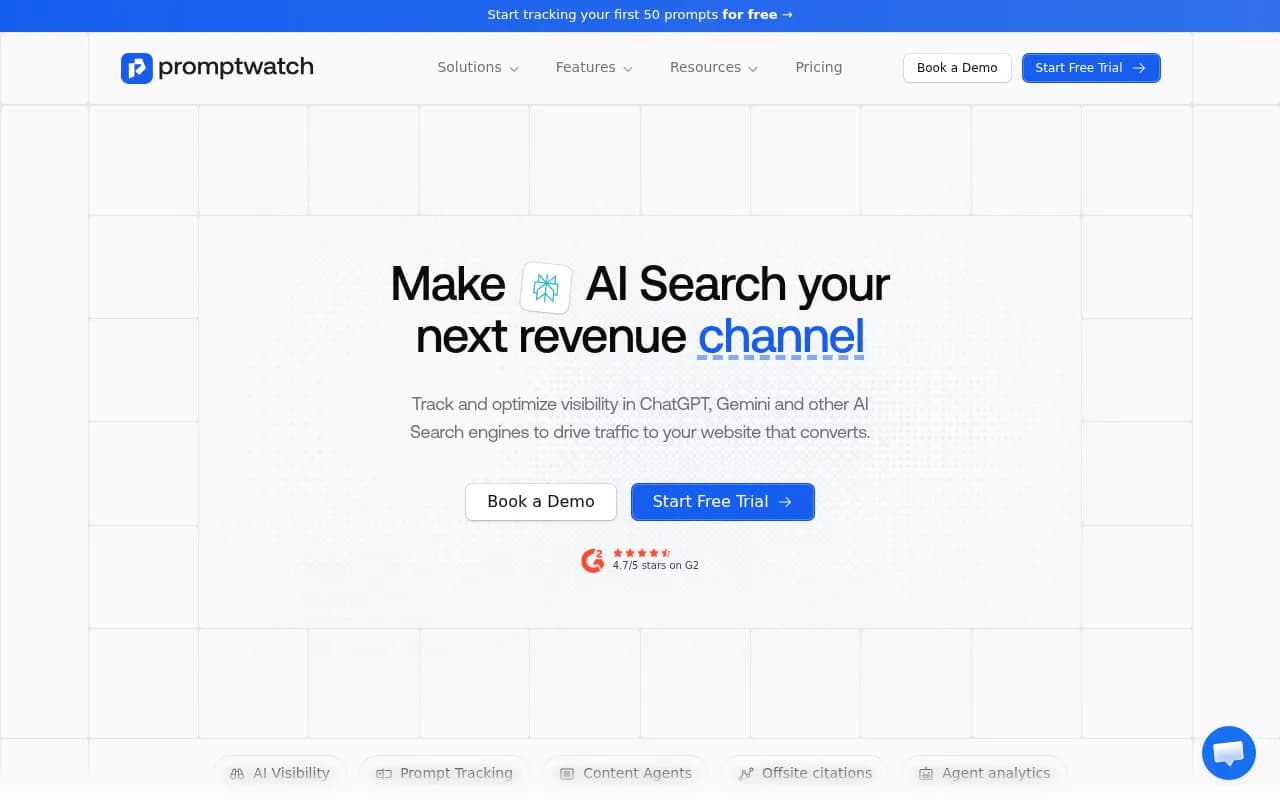
Most tools show you where you're invisible. Promptwatch shows you where you're invisible, then helps you fix it. For a marketplace team, that distinction matters a lot. You're not just trying to understand your AI visibility -- you're trying to improve it systematically across dozens of category prompts, multiple AI models, and potentially thousands of product pages.
The Answer Gap Analysis is particularly useful for marketplaces. It shows you exactly which prompts competitors are appearing in that you're not -- not as a vague "you're missing coverage here" signal, but as a specific list of prompts with volume estimates and difficulty scores. For a marketplace, this translates directly into a content roadmap: these are the category pages, comparison articles, and use-case guides you need to build.
The AI Crawler Logs feature is something most competitors don't have at all. For marketplaces with large catalogs, this is genuinely valuable. You can see which pages ChatGPT's crawler is reading, which ones it's bouncing off with errors, and how often it returns. If your product feed pages aren't being crawled properly, you'll know immediately rather than wondering why your visibility scores aren't moving.
Promptwatch also tracks 10 AI models (ChatGPT, Perplexity, Google AI Overviews, Google AI Mode, Claude, Gemini, Meta/Llama, DeepSeek, Grok, Mistral, Copilot), supports multi-language and multi-region monitoring, and includes Reddit and YouTube tracking -- which matters for marketplaces because those channels heavily influence how AI models perceive platform reputation.
Pricing starts at $99/month for the Essential plan (1 site, 50 prompts, 5 articles), $249/month for Professional (2 sites, 150 prompts, crawler logs, state/city tracking), and $579/month for Business (5 sites, 350 prompts, 30 articles). For larger marketplace operations, agency and enterprise pricing is available.
Profound
Profound is a strong enterprise option, particularly for larger marketplace businesses with dedicated analytics teams. It tracks 10+ AI engines and has processed 400M+ prompt insights, which gives it solid data depth.
Where Profound works well for marketplaces: its competitive benchmarking is detailed, and it handles enterprise-scale prompt tracking without much friction. The reporting is polished enough for executive presentations.
Where it falls short: Profound is primarily a monitoring platform. It doesn't have content generation capabilities, and it doesn't have AI crawler logs. You'll know where you're invisible, but the path from insight to action requires additional tools. It's also priced for enterprise, which makes it harder to justify for mid-market marketplace teams.
Semrush AI Visibility Toolkit
Semrush is the obvious choice if your team is already deep in the Semrush ecosystem. The AI Visibility Toolkit integrates with existing SEO workflows, which reduces the learning curve.
For marketplaces, the main limitation is that Semrush uses fixed prompts rather than custom prompt sets. You can't easily build out a prompt library that reflects your specific category structure. If your marketplace operates in a niche vertical, the fixed prompt library may not cover your actual competitive landscape well.
The broader Semrush platform is genuinely useful for content strategy, so if you're already paying for it, the AI Visibility Toolkit is worth activating. Just don't expect it to replace a dedicated GEO platform.
Ahrefs Brand Radar
Ahrefs Brand Radar is a reasonable starting point for teams that want AI visibility data without committing to a dedicated platform.
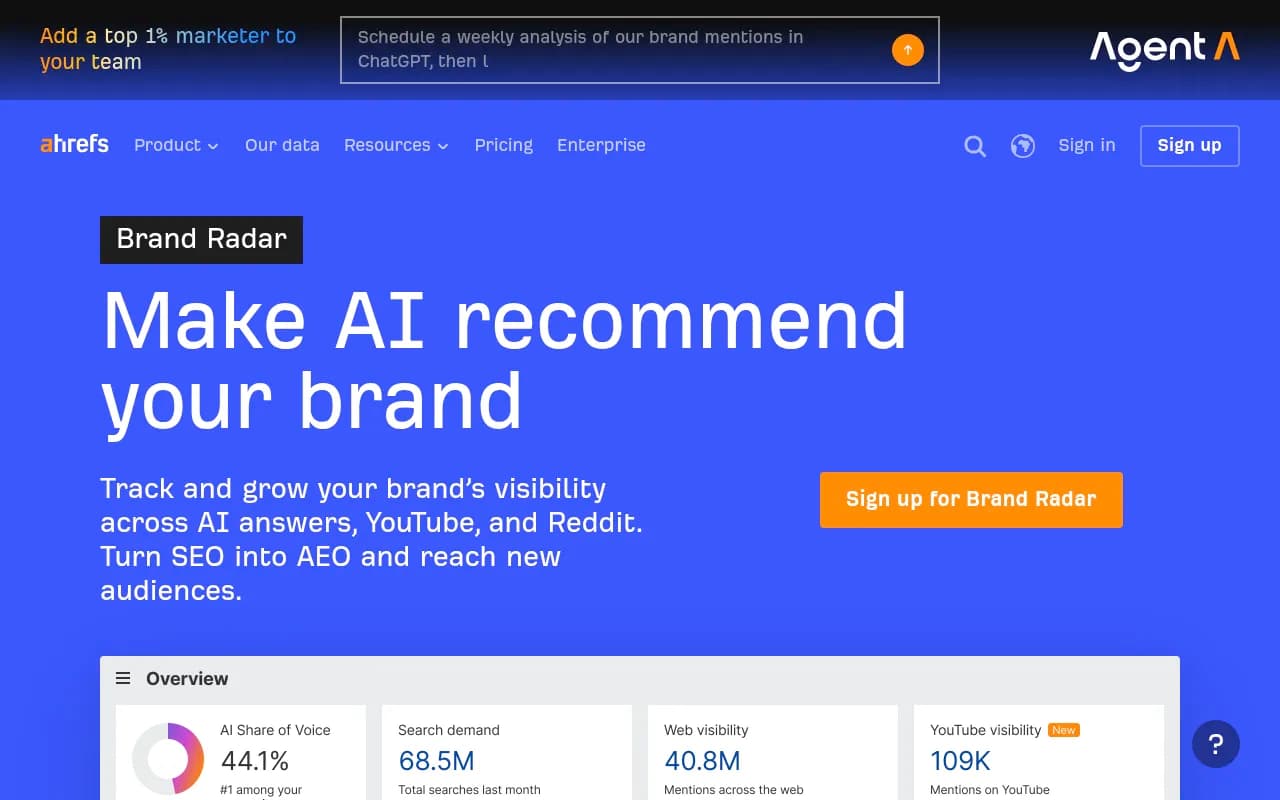
The honest limitation: it uses fixed prompts, has no AI traffic attribution, and doesn't generate content. For a marketplace with complex category structures and competitive prompt landscapes, it's going to feel thin fairly quickly. It's useful for getting a baseline read on brand-level visibility, but not much more than that.
AthenaHQ
AthenaHQ focuses on AI search visibility monitoring with decent model coverage and a clean interface.
It's monitoring-focused, which means it's better suited to teams that have a separate content operation and just need the data layer. For marketplaces that want a tool to handle both tracking and optimization, AthenaHQ will leave you needing additional tooling.
Otterly.AI
Otterly.AI is the most affordable entry point in this category, and it's genuinely useful for smaller marketplace businesses or teams that are just starting to think about AI visibility.
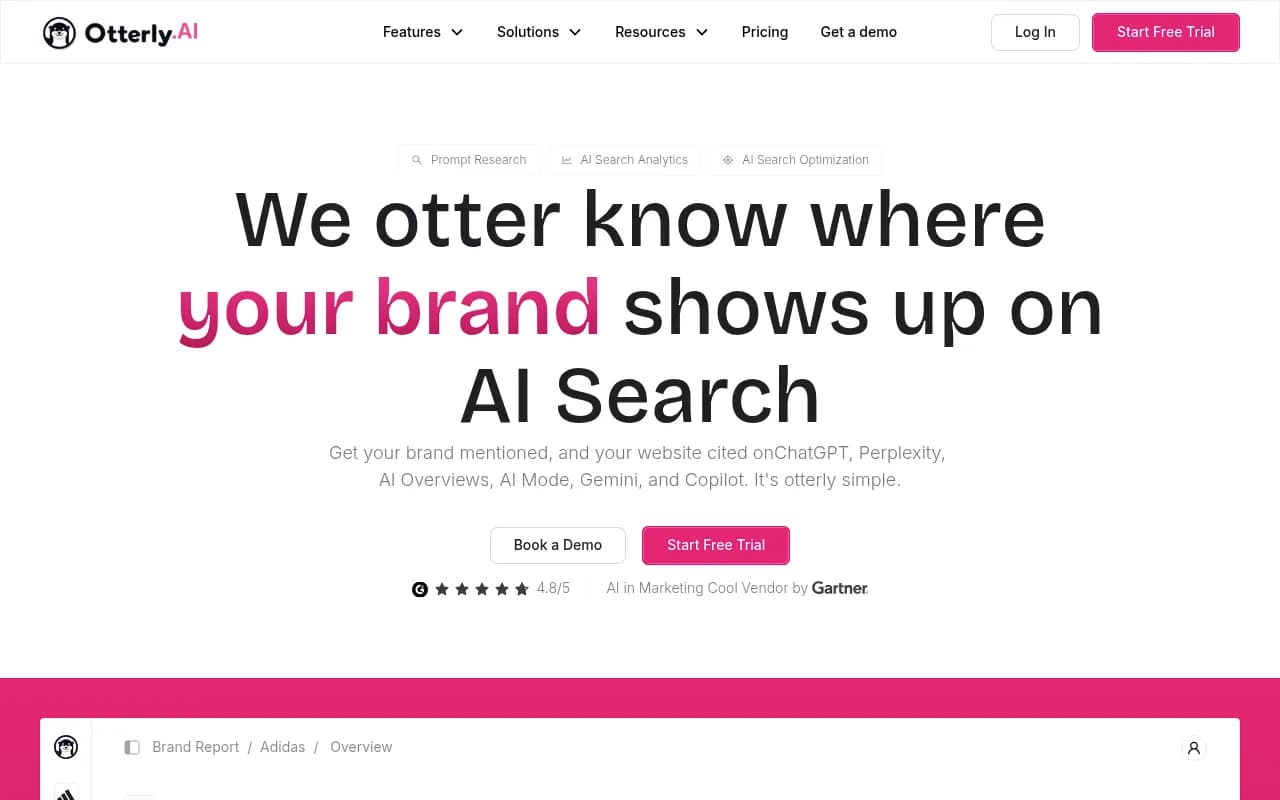
It tracks brand mentions across major AI models and provides basic competitive benchmarking. What it doesn't have: crawler logs, content generation, prompt volume data, or query fan-out analysis. For a marketplace at the early stages of building an AI visibility strategy, it's a reasonable place to start. For a marketplace that's serious about winning category-level prompts, you'll outgrow it quickly.
Peec AI
Peec AI sits in a similar position to Otterly.AI -- solid monitoring, limited action capabilities.
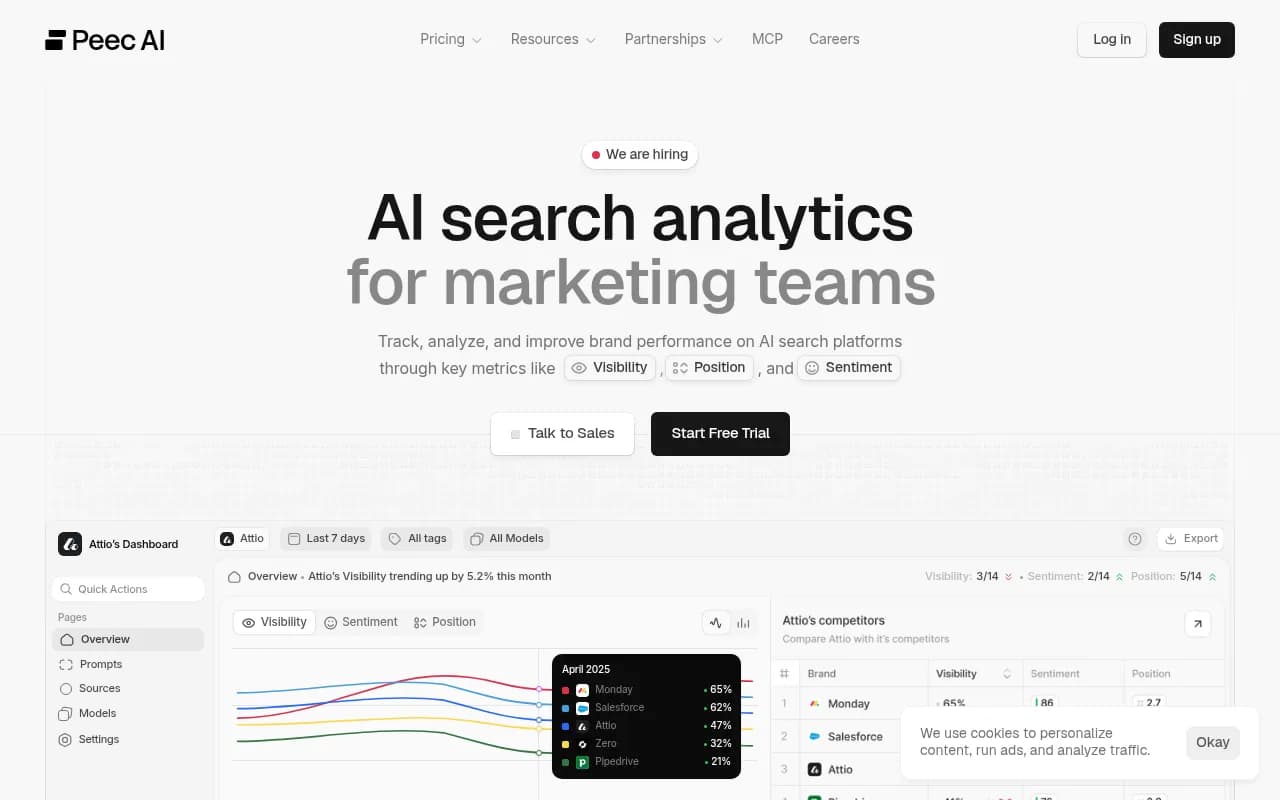
It includes smart suggestions for optimization, which is a step beyond pure monitoring. But it doesn't have the depth of prompt data, crawler logs, or content generation that marketplace teams need to move the needle systematically.
Scrunch AI
Scrunch AI is worth mentioning for marketplace businesses that are primarily concerned with brand perception rather than category-level prompt coverage.
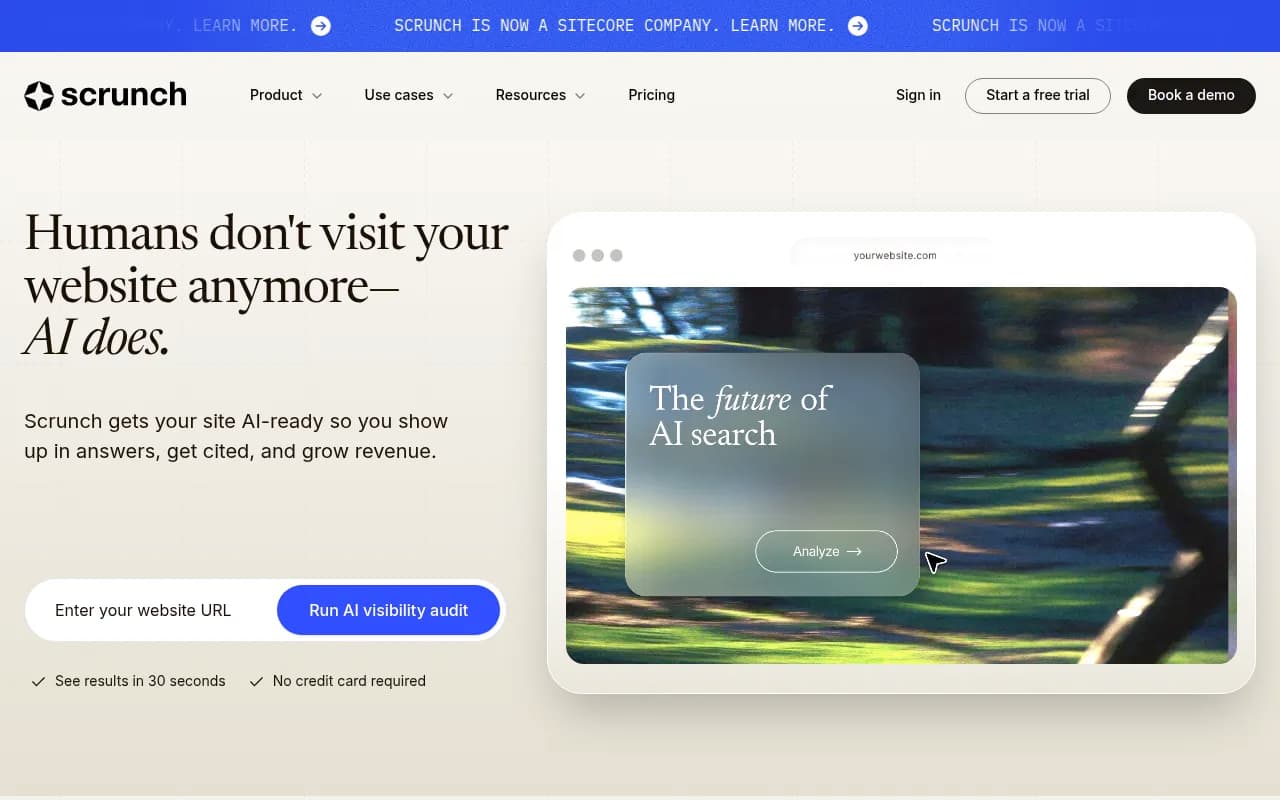
It has a strong feature set for understanding how AI models describe your brand and how that compares to competitors. The pricing is on the higher end relative to what you get, and it lacks content generation. But if brand sentiment in AI responses is your primary concern -- relevant for marketplaces where platform trust is the main purchase driver -- Scrunch AI is worth evaluating.
How the platforms compare
Here's a direct comparison across the dimensions that matter most for marketplace and platform businesses:
| Platform | Custom prompts | Query fan-outs | AI crawler logs | Content generation | Reddit/YouTube tracking | Multi-model coverage | Best for |
|---|---|---|---|---|---|---|---|
| Promptwatch | Yes | Yes | Yes | Yes (Content Agents) | Yes | 10 models | Full-stack GEO for marketplaces |
| Profound | Yes | No | No | No | No | 10+ models | Enterprise monitoring |
| Semrush AI Toolkit | Fixed prompts | No | No | Via Semrush | No | Limited | Teams already on Semrush |
| Ahrefs Brand Radar | Fixed prompts | No | No | No | No | Limited | Baseline brand tracking |
| AthenaHQ | Yes | No | No | No | No | Multiple | Monitoring-focused teams |
| Otterly.AI | Yes | No | No | No | No | Multiple | Small teams, early-stage |
| Peec AI | Yes | No | No | No | No | Multiple | Basic monitoring + suggestions |
| Scrunch AI | Yes | No | No | No | No | Multiple | Brand perception tracking |
The specific use cases where each tool wins
You're a marketplace with a large product catalog and need to understand which product categories AI models are recommending: Promptwatch's Answer Gap Analysis and crawler logs make this tractable. You can map which category prompts you're winning, which you're losing, and which pages AI crawlers are actually reading.
You're an enterprise marketplace with a large analytics team and need polished reporting: Profound is a reasonable choice. The data depth is solid and the reporting is executive-ready.
You're already paying for Semrush and want to add AI visibility without a new vendor: Semrush AI Visibility Toolkit is the path of least resistance. Just understand its limitations around custom prompts.
You're a small marketplace just starting to track AI visibility and have a limited budget: Otterly.AI gets you started. Plan to upgrade as your strategy matures.
You're a marketplace where platform trust is the core purchase driver and brand sentiment in AI responses is your primary concern: Scrunch AI or Promptwatch, depending on whether you also need content generation.
The action loop problem
One thing worth being direct about: most of the tools in this list are monitoring platforms. They're good at telling you where you stand. They're not built to help you change where you stand.
For marketplace businesses, this is a real problem. Category-level AI visibility doesn't improve by itself. It improves when you publish content that answers the specific questions AI models are asking -- comparison guides, category explainers, use-case articles, structured product data. That content needs to be grounded in actual prompt data, not generic SEO intuition.
The tools that close this loop -- where you go from "we're invisible for this prompt" to "here's the content that will make us visible" to "here's the traffic and citation data showing it worked" -- are rare. Promptwatch is the clearest example of a platform built around that full cycle rather than just the first step.
Practical recommendations for marketplace teams
If you're building an AI visibility strategy for a marketplace in 2026, here's what actually matters:
Start with your category prompts, not your brand prompts. "Best [your category] marketplace" and "top platforms for [your use case]" are the queries that drive discovery. Brand prompts matter too, but category prompts are where new users find you.
Map your prompt landscape before picking a tool. Spend a week manually testing prompts in ChatGPT, Perplexity, and Google AI Overviews. See which competitors show up, which content they're citing, and what questions you're not answering. This gives you a baseline that makes tool evaluation much more concrete.
Prioritize tools with crawler log access if you have a large catalog. If AI crawlers aren't reading your product pages, you have a technical problem that no amount of content strategy will fix. Knowing about it is the first step.
Don't treat AI visibility as a separate workstream from content. The teams that are winning AI visibility in 2026 are the ones that have integrated prompt data into their content planning process. The tools that support that integration -- rather than sitting in a separate dashboard nobody checks -- are the ones worth paying for.
Track results at the page level, not just the brand level. Knowing your overall visibility score went up is less useful than knowing which specific pages are being cited, by which AI models, and for which prompts. Page-level attribution is what lets you double down on what's working.
The marketplace businesses that figure this out in 2026 will have a meaningful advantage. AI search is already a commercial channel, and it's only becoming more so. The question isn't whether to invest in AI visibility -- it's whether you're investing in tools that actually help you improve it, or just tools that help you watch it.