Key takeaways
- Local businesses need two toolsets in 2026: a local SEO tool for rankings, citations and reviews, and an AI visibility tool to see whether ChatGPT, Gemini and AI Overviews recommend you.
- BrightLocal and Whitespark remain the practical starting points for local rank tracking and citations. Semrush and SE Ranking cover local tracking inside a broader suite.
- Content tools like Surfer SEO and Frase help with service and location pages, but they will not fix a messy Google Business Profile.
- Per Promptwatch Data, ChatGPT cites product and landing pages most (22.4% and 16.8% of citations, Sep 28 to Oct 4, 2026). Your service pages matter more than your blog.
- Start with one local tool and one AI visibility tool. Do not buy a stack of six.
What local businesses actually need from AI SEO tools
Most "best AI SEO tools" lists are written for SaaS companies and publishers. They push content generators and enterprise suites. If you run a dental clinic, a plumbing company or three coffee shops, most of that is noise.
Local SEO comes down to a short list of jobs:
- Track rankings by location, ideally on a grid, not just one city-wide number.
- Keep your name, address and phone consistent across directories (citations).
- Collect and respond to reviews.
- Keep your Google Business Profile accurate and active.
- Publish service and location pages that say clearly what you do and where.
- Find out whether AI assistants mention you when someone asks for a recommendation nearby.
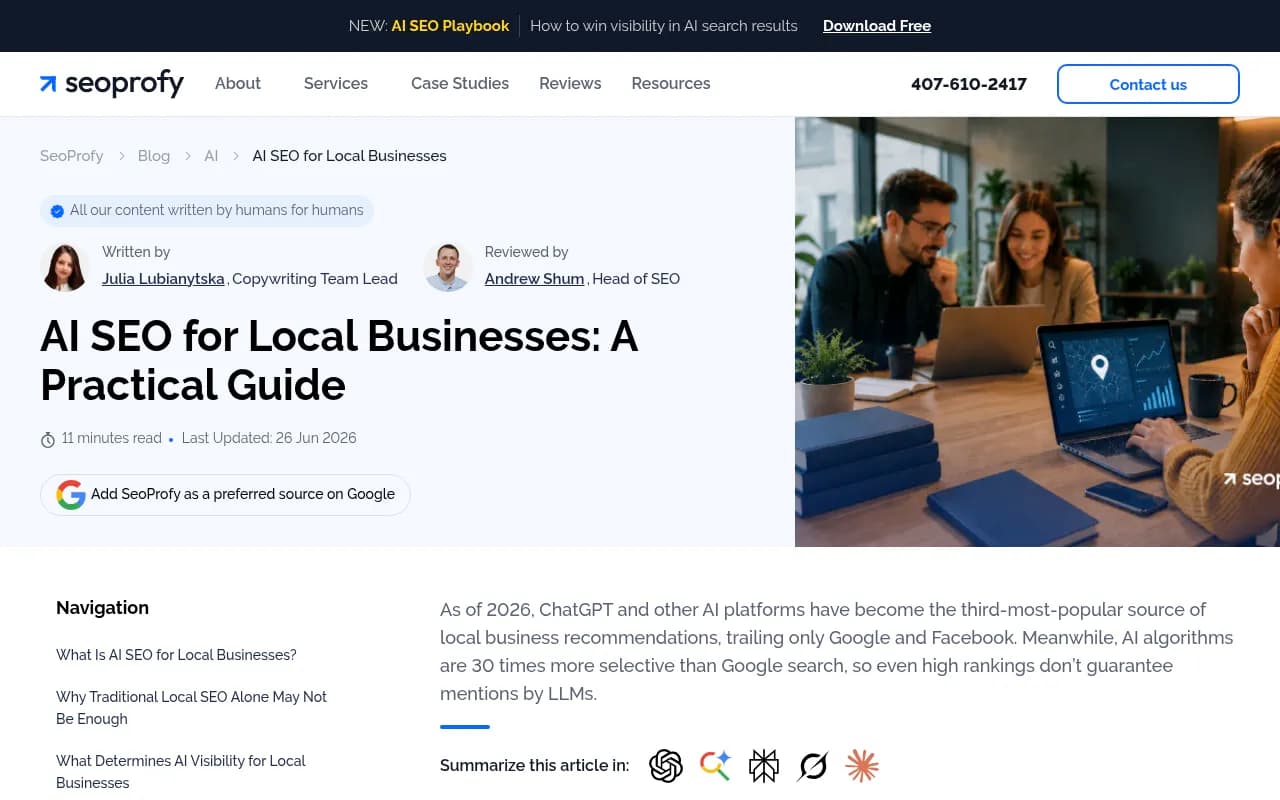
That last one is new. SeoProfy reports that ChatGPT and other AI platforms have become the third most popular source of local business recommendations, behind only Google and Facebook. I would treat that as directional rather than exact, but the behavior is real. People ask an assistant "who is the best electrician near me" and take the first names they see.
The tools at a glance
| Tool | Main job | Pricing note | Best for |
|---|---|---|---|
| BrightLocal | Local rank tracking, citations, reviews | Single-location plans from about $31/mo billed annually | Single and multi-location businesses, agencies |
| Whitespark | Citation finder, local rank tracker | Local Platform listed at $1 per location per month by a third party | Citation cleanup and building |
| Semrush | All-in-one SEO with local tools | Higher entry price | Teams already doing broader SEO |
| SE Ranking | Local rank tracking, GBP management | Mid-range | Small teams wanting one suite |
| Birdeye Search AI | Local AI visibility, location-level tracking | Quote-based | Multi-location brands |
| Promptwatch | AI visibility and optimization | Free tier, paid from $95/mo | Brands that want to be recommended by AI |
| Surfer SEO | Content optimization | Mid-range | Service and location page writing |
Pricing changes often. Confirm on each vendor's page before you buy.
Local SEO tools: the foundation
BrightLocal
BrightLocal is the tool most local SEOs name first, and for good reason. It focuses on local rankings, citations and reviews rather than general SEO. Veza Digital's review puts it bluntly: if local search matters to your business it is a clear choice, otherwise it offers little value. I agree with that.
On pricing, the numbers floating around are inconsistent. Veza lists Single Business at $39/mo, while BrightLocal's own pricing page shows Track, Manage and Grow plans at about $31, $40 and $49 per month for a single location when billed annually ($369, $485 and $584 per year). Multi-location pricing for 6 to 10 locations runs roughly $62 to $98 per month on annual billing. The older $39 figure is probably the monthly-billed price, but check the live page.
Where it helps most: grid-style local rank tracking, citation audits, and review monitoring in one place. Where it is thinner: anything beyond local, such as content or backlinks.
Whitespark
Whitespark is the citation specialist. Its Citation Finder is useful when you need to find where competitors are listed and you are not, and its local rank tracker is a cheaper alternative to a full suite. One third-party summary lists the Local Platform at $1 per location per month, Rank Tracker at $14 to $200 per month and Citation Finder at $33 to $149 per month. Treat those as a rough guide and verify them.
If your main problem is inconsistent listings across directories, start here or with BrightLocal. You rarely need both.
Semrush and SE Ranking
If you already do general SEO, a suite can cover local tasks without another login. [tool:semrush]
Semrush has local listing and rank tracking features and a growing AI visibility toolkit. It is heavier and pricier than a local-only tool, and many small businesses will use 15% of it. [tool:semrush-ai-visibility-toolkit]
SE Ranking is the one I would look at first among suites for small teams. Its rank tracker supports city-level tracking and its local marketing tools cover Google Business Profile management, local pack tracking and citation monitoring. Devenup also points out that those citation and GBP features feed directly into the AI-driven local recommendations that ChatGPT and Perplexity generate. [tool:se-ranking]
Birdeye Search AI
Birdeye started in reviews and reputation, and its Search AI product adds local AI visibility with location-level tracking. For a multi-location brand that wants reviews, listings and AI mentions tied together, it is worth a demo. I could not verify current pricing, and it is typically quote-based, so expect a sales call. [tool:birdeye-search-ai]
AI visibility tools: are you recommended?
This is the category that did not exist for local businesses three years ago. These tools run prompts like "best Italian restaurant in Leeds" through ChatGPT, Gemini, Perplexity and Google AI Overviews, then show whether your business appears, in what position, and which sources the AI used.
Here is the catch I want to be honest about. Most AI visibility tools were built for brands and SaaS companies, and their prompt tracking works best at the country or city level. Genuine neighborhood-level local data is still patchy across the market. Birdeye is explicitly local. Others are adapting.
Promptwatch
Promptwatch is the one I would put first for a local business that wants to do something about its AI visibility, not just watch it. It tracks the real interfaces of ChatGPT, Google AI Overviews, AI Mode, Gemini, Perplexity and Copilot, with country tracking on every paid plan and state and city tracking from the Business plan. Beyond monitoring, it shows which pages AI cites, logs AI crawler visits to your site, and suggests content to close the gaps. That matters for a local business because the usual reason for being invisible is dull: the AI crawler cannot read your site, or there is no page that clearly answers the question.

The free Explore plan (1 project, 10 prompts, ChatGPT only) is enough to see whether you show up at all. Paid plans start at $95 per month for Essential. Check promptwatch.com/pricing for current details. There is also a free AI Visibility Report that needs no login.
One caveat: I did not find a Promptwatch report that covers local pack or Google Business Profile citations in AI answers specifically, so treat its local coverage as prompt-level tracking rather than a map-pack tool.
Other AI visibility options
If you want something cheaper or simpler, several tools in this directory are worth a look:
- Otterly.AI is an affordable monitoring-only option. [tool:otterly-ai]
- Peec AI is a clean prompt tracker with suggestions. [tool:peec-ai]
- SE Ranking Visible adds AI tracking from a brand many small teams already use. [tool:se-ranking-visible]
- Airefs is a budget tracker for tight budgets. [tool:airefs]
These will tell you whether you are mentioned. They mostly will not tell you what to build next. If you want a longer shortlist, the GEO software directory at bestgeosoftware.com lists more options.
What AI actually cites, and what it means for local pages
Before buying anything, look at what AI engines pull from. Promptwatch's data on ChatGPT content types (Sep 28 to Oct 4, 2026) found that product pages were the most cited type at 22.4% of classified citations, with landing pages next at 16.8%. Put together, about 39% of citations go to pages describing what a company sells. Listicles got 13.6%, how-tos 8.7%, and reviews 1.7%. Source: Promptwatch Data
For commercial prompts like "best plumber for small businesses", product pages were 26.0%, landing pages 20.6% and listicles 15.0%. For branded prompts, reviews rise to 5.6%, more than three times their share across all prompts. So when someone asks about you by name, review sites count.
For a local business, translate that this way:
- Write a real page per service, with prices or price ranges, who it is for, and the areas you cover.
- Add an FAQ section on those pages. Promptwatch's own advice for branded prompts is to keep pricing, features and "who it's for" complete, collect reviews on trusted sites, and add an FAQ page.
- Get included in local "best of" lists. Listicles are the third most cited format for commercial prompts.
In adjacent verticals the same pattern shows up. In travel, third-party directories and aggregators dominate over brands' own sites: Skyscanner, Going and Tripadvisor lead, and booking and search sites earn over half of citations shown (Promptwatch Data, travel, Sep 28 to Oct 4, 2026). Promptwatch's advice there is to keep aggregator listings accurate and collect reviews on Tripadvisor and Trustpilot. If you run a hotel, tour company or restaurant, that is your to-do list.
Social platforms are not equal
Social citations vary a lot by engine. Per Promptwatch Data (Sep 28 to Oct 4, 2026), ChatGPT drew only 0.46% of its citations from social platforms, while Google AI Overviews drew 12.2%, about 26 times as much. In AI Overviews, YouTube was 4.28%, Facebook 2.38% and Instagram 1.61%. Full report
Reddit in ChatGPT fell from about 4% to 0.5% on August 14, 2026, so chasing Reddit threads for ChatGPT visibility is a poor bet right now (Promptwatch Data). The practical read for a local shop: keep your public Facebook page and Instagram profile complete and active, because Google AI Overviews does pull from them, and consider YouTube if you can make short service videos.
Content tools for service and location pages
You do not need an AI writer pumping out 50 blog posts. You need a few good pages. Still, a content tool helps when you are writing about ten services across five towns without repeating yourself.
| Tool | What it does | Good for local when |
|---|---|---|
| Surfer SEO | Scores content against top results | You want a checklist for each service page |
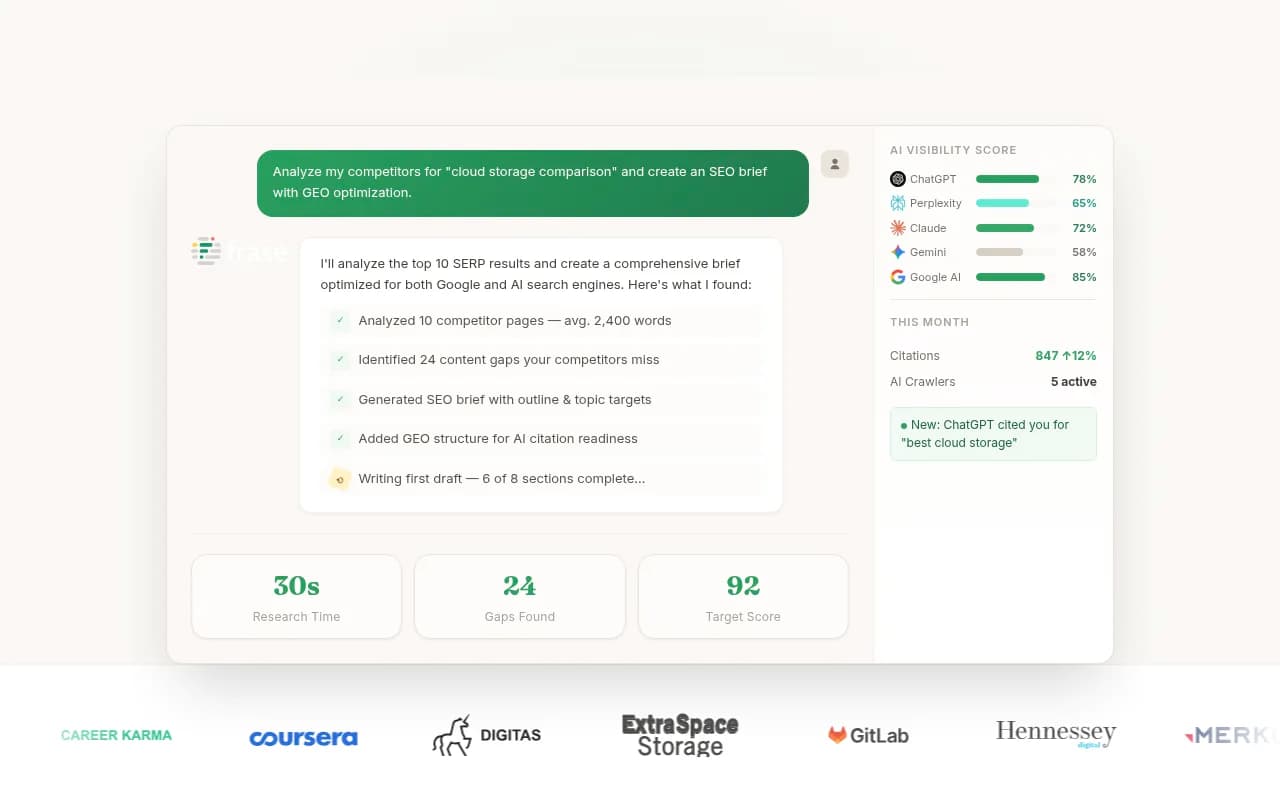
| Frase | Briefs and optimization | You want cheaper briefs |
| Clearscope | Content grading | You have a writer and an editing budget |
| Simplified | All-in-one AI marketing suite | You want social, copy and design in one place |
| GrowthBar | Budget AI SEO with Chrome extension | You are on a tight budget |

I would be wary of fully automated content tools (Outrank, Autoblogging.ai and similar) for local sites. Thin, generic pages about "plumbing tips" rarely help a local business, and they can dilute a site that should be clear about what it sells and where.
Which stack to choose
Three realistic setups:
- Solo owner, one location, under $150/month: BrightLocal Track or Manage for rankings, citations and reviews, plus Promptwatch's free Explore plan to check AI visibility. Use ChatGPT or Claude for drafting page copy and edit by hand.
- Small team, 2 to 10 locations: SE Ranking or BrightLocal multi-location, plus a paid AI visibility tool such as Promptwatch Essential or Professional, plus Surfer SEO for page optimization.
- Multi-location brand or agency: Birdeye or BrightLocal for local operations, and an AI visibility platform with reporting and crawler data. Agencies get dedicated Promptwatch plans with unlimited projects, starting at $199 per month.
More comparison lists are on the directory at surferstack.com if you want to browse beyond these picks.
A simple local AI SEO checklist
- Claim and complete your Google Business Profile. Categories, services, hours, photos, products.
- Audit citations with BrightLocal or Whitespark and fix name, address and phone mismatches.
- Create one page per core service, and one per major location if you serve several areas.
- Add FAQs, pricing ranges and clear "who this is for" copy to each page.
- Check that AI crawlers can access your site. A blocked robots.txt silently kills visibility.
- Collect reviews on Google and one or two relevant industry sites.
- Test 10 to 20 prompts customers would actually ask in ChatGPT, Gemini and AI Overviews. Track them monthly.
- Keep public Facebook, Instagram and YouTube profiles current.
What to skip
- Enterprise AI visibility suites like Profound, BrightEdge or Conductor. They are built for large brands and priced accordingly.
- Tools that promise guaranteed AI rankings. Nobody controls that.
- Bulk article generators. Local intent rewards specificity, not volume.
- Stacking three rank trackers. Pick one and use it properly.
Do you need an agency?
Sometimes. If you have no time, multiple locations, or a messy site, a specialist can set up the basics faster than you can learn them. 1001 SEO Media is an SEO and GEO agency that works with local and national brands without long-term contracts. Otherwise, the tools above are enough for a motivated owner.
Bottom line
Pick one local SEO tool and one AI visibility tool. BrightLocal is the safest local pick, and Promptwatch is the AI visibility platform I would try first because it goes beyond showing mentions to showing what to fix. Then spend your time on the unglamorous parts: accurate listings, clear service pages, real reviews. Those still decide who gets recommended, whether the answer comes from Google or an assistant.