Key takeaways
- Grok is now a meaningful citation source for brands, but most AI visibility platforms treat it as an afterthought or don't track it at all
- Promptwatch is the only platform in this comparison that combines Grok tracking with content gap analysis, AI content generation, and crawler logs -- making it the only tool that helps you actually improve Grok visibility, not just measure it
- Profound is the strongest enterprise option if you need deep analytics and don't need content generation
- Peec AI and Otterly.AI are solid monitoring tools for smaller teams, but both stop at dashboards -- you'll need to act on the data yourself
- If Grok citations are a priority for your brand, the platform's ability to track real user-facing responses (not just API outputs) matters more than most buyers realize
Grok has quietly become a citation source worth caring about. X's AI model now surfaces brand recommendations, product comparisons, and informational answers to hundreds of millions of users. And yet, when you look at most AI visibility platforms, Grok support ranges from "limited" to "we're working on it."
That gap matters. If you're running a GEO strategy in 2026 and ignoring Grok, you're missing a real slice of AI-driven traffic. The question is which platform actually helps you track -- and improve -- your Grok citations, rather than just checking a box on a feature list.
This guide ranks four of the leading platforms: Promptwatch, Profound, Peec AI, and Otterly.AI. I looked at how each handles Grok specifically, but also at the broader question of what you can actually do with the data they give you.
Why Grok tracking is harder than it sounds
Before getting into the rankings, it's worth understanding why Grok is tricky to monitor.
Most AI visibility platforms query models through their APIs to simulate prompts and capture responses. That works reasonably well for ChatGPT and Perplexity. But Grok's user-facing behavior -- the answers real users see inside X -- can differ meaningfully from what the API returns. Shopping recommendations, citation formatting, and brand mentions can all look different depending on whether you're hitting the API or watching real user sessions.
This is why "supports Grok" on a feature comparison table doesn't tell you much. The real question is whether the platform tracks how Grok behaves in the wild, not just in a controlled API call.
The platforms, ranked
1. Promptwatch -- best overall for Grok visibility and optimization
Promptwatch tracks 10 AI models including Grok, and it's the only platform here that goes beyond monitoring into actual optimization. The distinction matters a lot in practice.

Most platforms will show you that a competitor is getting cited by Grok for a prompt you're not. Promptwatch shows you the same thing -- but then it tells you why you're missing, what content your site lacks, and generates a content brief (or a full article) to close that gap. That cycle of find-gap, create-content, track-results is what separates it from everything else in this comparison.
A few things stand out specifically for Grok tracking:
Promptwatch monitors real user-facing AI responses, not just API outputs. This matters for Grok because the X-integrated experience can surface different citations than the API. The platform's AI Crawler Logs also show you when Grok's crawlers are hitting your site, which pages they're reading, and whether those pages are converting into citations -- something no other platform in this comparison offers.
The Answer Gap Analysis is genuinely useful here. You can see exactly which prompts Grok is answering with competitor content instead of yours, then feed that directly into the Content Agents to generate targeted articles. Page-level tracking then shows whether those new pages get picked up.
Pricing starts at $99/month for the Essential plan (1 site, 50 prompts, 5 articles). Crawler logs and city-level tracking come in at the Professional tier ($249/month). For most marketing teams tracking Grok alongside ChatGPT and Perplexity, the Professional plan is the practical entry point.
The main limitation: the 7-day trial is short for a proper evaluation, and the prompt cap scales steeply if you're tracking hundreds of queries across multiple sites.
2. Profound -- best for enterprise analytics
Profound is a strong platform, particularly for larger organizations that need deep analytics and structured reporting. It covers 7+ AI platforms including Grok, and its crawler log support is genuinely good -- one of the few areas where it matches Promptwatch.
Where Profound pulls ahead of Promptwatch for some enterprise buyers is in its visitor analytics and the depth of its competitor benchmarking. The platform gives you a more complete picture of how AI-driven traffic is flowing to your site, and its reporting is built for stakeholder presentations.
The gap is on the action side. Profound doesn't generate content. It gives you excellent data about what's happening, but the work of actually fixing your Grok visibility -- writing new content, optimizing existing pages -- is left entirely to your team. For a large organization with a dedicated content team, that's fine. For a lean marketing team, it means the insights sit in a dashboard rather than turning into published pages.
Profound is also priced for enterprise, which puts it out of reach for most SMBs and smaller agencies. If budget is a constraint and you need content generation alongside tracking, Promptwatch is the more practical choice.
3. Otterly.AI -- best for teams that want simplicity
Otterly.AI has built a genuinely solid monitoring product. It covers multiple AI engines including Grok, offers citation analysis, competitor benchmarking, and prompt history. The interface is clean and the data is accessible without a steep learning curve.
For smaller teams or agencies that want a clear view of AI visibility without complexity, Otterly.AI is a reasonable choice. Its MCP server integration is a nice differentiator -- it lets AI-native teams query brand data directly without leaving their workflow, which is a clever approach.
The honest limitation is that Otterly.AI is a monitoring tool. It shows you what's happening with your Grok citations, but it doesn't help you change the outcome. There's no content generation, no content gap analysis that produces actionable briefs, and no crawler logs that connect AI crawls to citation outcomes. You get a clear picture of the problem; the solution is up to you.
For teams that already have strong content operations and just need reliable tracking data, that's a perfectly acceptable trade-off. For teams that want to actually move their Grok visibility numbers, it's a meaningful gap.
4. Peec AI -- best for daily monitoring on a budget
Peec AI is a capable tracking tool with a clean interface and reasonable pricing. It covers multiple AI engines, offers daily monitoring, and includes some content suggestions alongside its tracking data.
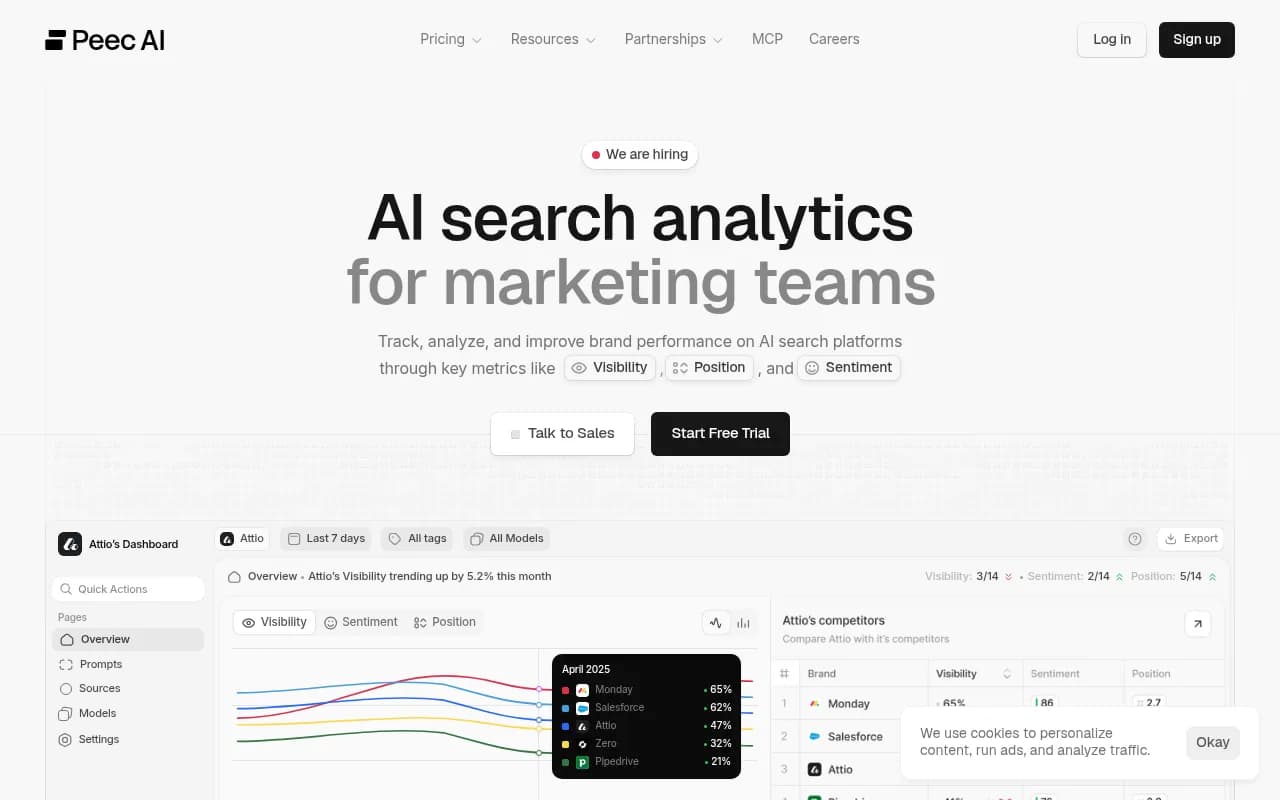
For Grok specifically, Peec AI provides citation tracking and visibility scores. The content suggestions are a step above pure monitoring -- the platform will flag gaps and point you toward topics worth covering. But the suggestions are lightweight compared to Promptwatch's Content Agents, which generate full articles grounded in real prompt data, competitor analysis, and brand guidance.
The bigger limitation is what's missing: no crawler logs, no visitor analytics, no AI traffic attribution. You can see your Grok visibility score, but you can't trace that back to specific pages, crawl events, or revenue impact. For teams that need to report on AI-driven ROI, that's a real gap.
Peec AI is a solid starting point if you're new to AI visibility tracking and want to understand the basics before committing to a more expensive platform. But most teams outgrow it once they start asking "what do we do about this?"
Head-to-head comparison
| Feature | Promptwatch | Profound | Otterly.AI | Peec AI |
|---|---|---|---|---|
| Grok tracking | Yes | Yes | Yes | Yes |
| Real user-facing responses | Yes | Partial | Partial | No |
| AI crawler logs | Yes (Pro+) | Yes | Beta | No |
| Visitor analytics / traffic attribution | Limited | Yes | Limited | No |
| Content gap analysis | Yes | Partial | Yes | Basic |
| AI content generation | Yes | No | No | No |
| Competitor benchmarking | Yes | Yes | Yes | Yes |
| Reddit & YouTube tracking | Yes | No | No | No |
| ChatGPT Shopping tracking | Yes | No | No | No |
| Prompt volume & difficulty scores | Yes | Partial | No | No |
| Multi-language / multi-region | Yes | Yes | Partial | Partial |
| API access | Yes | Yes | Yes | Limited |
| Starting price | $99/mo | Enterprise | Lower tiers | Lower tiers |
| Best for | Full-stack GEO | Enterprise analytics | Simple monitoring | Budget monitoring |
What to actually look for when evaluating Grok tracking
The feature table above gives you a starting point, but a few things matter more than they might appear:
Real responses vs. API responses. Ask any platform whether they're capturing what Grok actually shows users or just querying the API. For Grok specifically, the difference can be significant because of how X integrates the model into its feed and search experience.
Page-level citation data. Knowing your brand appears in Grok responses is useful. Knowing which specific page on your site is being cited -- and which pages are being crawled but not cited -- is actionable. Most monitoring-only tools give you the former.
The action layer. If a platform shows you that a competitor is outranking you for a Grok prompt, what happens next? Do you get a content brief? A generated article? A list of specific changes to make? Or do you get a chart? The answer to that question determines whether a platform is a tracking tool or an optimization tool.
Crawler log access. AI crawlers (including Grok's) visit your site before they cite it. Platforms that expose these logs let you see indexing issues, crawl frequency, and the timeline from crawl to citation. This is genuinely diagnostic data that monitoring-only tools can't provide.
Other platforms worth knowing about
If none of the four above feel right, a few others are worth a look depending on your situation.
Scrunch AI covers multiple engines with strong competitor benchmarking and some content generation capabilities. It's a reasonable middle ground between Profound's analytics depth and Promptwatch's content focus.
AthenaHQ takes a more technical SEO approach to AI visibility. It's solid for teams with a technical background who want to understand the structural reasons behind citation gaps, though it lacks content generation.
Search Party is built with agencies in mind and has good multi-client management. Grok coverage is present but prompt metrics are thinner than Promptwatch or Profound.
The honest verdict
If Grok citations genuinely matter to your brand strategy in 2026, the platform choice comes down to one question: do you want to track the problem or solve it?
Profound, Otterly.AI, and Peec AI are all legitimate tracking tools. They'll show you where you stand with Grok, how you compare to competitors, and how your visibility changes over time. That data has real value.
Promptwatch is the only platform in this comparison that closes the loop -- from identifying which Grok prompts you're losing, to generating the content that fixes it, to tracking whether that content gets crawled and cited. For most marketing teams, that difference is what turns a visibility dashboard into a growth channel.
The right choice depends on your team's capacity. If you have a strong content team that just needs reliable data, Profound or Otterly.AI might be enough. If you need the platform to do more of the heavy lifting -- especially for a relatively new citation source like Grok where best practices are still forming -- Promptwatch is the more complete bet.