Key takeaways
- Almost every security claim in the GEO market (SOC 2, SSO, HIPAA) is self-reported by the vendor or relayed by a competitor. Ask for the actual report and the audit period dates.
- No independent head-to-head accuracy test of enterprise GEO tools exists that we could find. Compare trends on one frozen prompt set, not single-day scores.
- Support tiers vary a lot inside the same vendor. Dedicated Slack and SLAs often sit only on the top plan.
- The bigger split between platforms is execution: can a finding become an approved change on your live site, or does it end at a dashboard?
- Be skeptical of vendor-authored "best enterprise GEO" listicles, including ours. Run a short paid pilot with your own prompts before signing.
What we did and did not test
Let me be upfront, because most guides in this category are not. We did not run a hands-on penetration test of any vendor, and we did not measure support response times ourselves. The research behind this guide is public documentation, vendor comparison pages, pricing roundups, and Promptwatch's own first-party data on how AI engines behave.
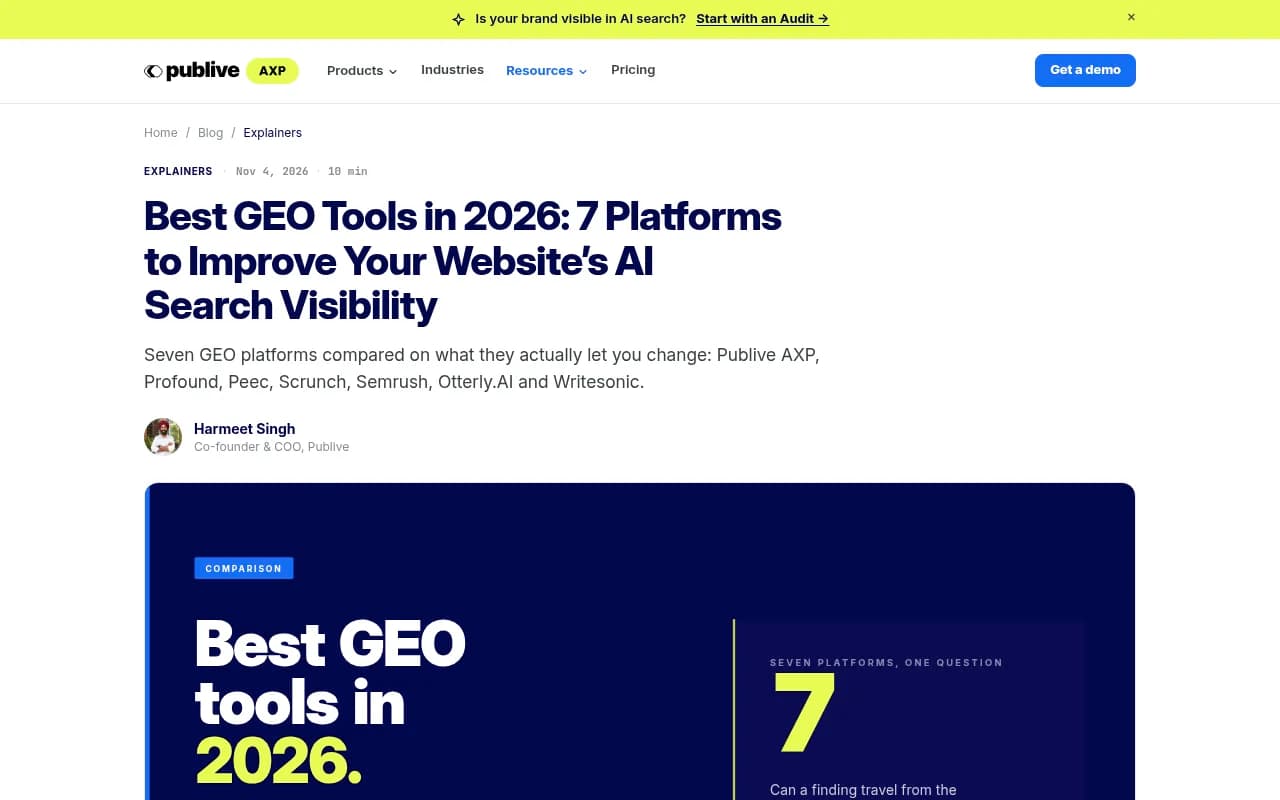
That matters because the title promises "tested". What we can honestly test is the claims: which ones can be checked, which ones conflict across sources, and which ones are one competitor describing another. Many of the "best enterprise GEO tools" pages are written by vendors. One of them, Publive's comparison, says so plainly: it is an editorial read of public documentation, not a controlled benchmark. Credit to them for saying it.
So treat the rest of this guide as a buying framework with evidence labels attached, not a leaderboard.
Security: what to ask for and what is actually claimed
The baseline for a regulated buyer is a current SOC 2 Type II report. Profound's own buyer's guide calls it the line item that decides whether a tool ever gets evaluated, and adds HIPAA if health data is anywhere in the picture. That is a vendor saying it, but it matches what procurement teams tell us in practice.
Claims we found, with their source
| Vendor | Reported security and compliance | Who said it |
|---|---|---|
| Profound | SOC 2 Type II, independent HIPAA assessment, SSO/SAML, RBAC, SCIM | Profound's own pages |
| AthenaHQ | SOC 2 Type I (Oct 2025), Type II (Jun 2026), GDPR, NIST CSF 2.0 alignment, SAML/OIDC SSO | AthenaHQ's own comparison page |
| Scrunch | SOC 2 Type II, GDPR and CCPA | Profound's comparison page (a competitor) |
| Evertune | One roundup says no SOC 2 | Third-party roundup, unverified |
| Promptwatch | ISO/IEC 27001 certified, GDPR compliant, EU-based company, SSO and white-label portal on Enterprise, audit log on Business and up | Promptwatch |
Read that table with a squint. Every row is a claim, not an audit. The useful move is procedural: ask each vendor for the report itself, check the audit period dates, and confirm which plan the controls apply to. Per AthenaHQ's comparison page, Profound reserves SSO/SAML, SOC 2 and dedicated Slack support for its Enterprise tier. If that is accurate, a team on a lower plan is not buying the security posture the marketing page describes. That is also a competitor's claim, so verify it with Profound directly.
The procurement checklist
These items come up repeatedly across the buyer guides we reviewed, and they are the ones we would put in an RFP:
- Current SOC 2 report (or ISO 27001 certificate) with audit dates
- SSO/SAML and role-based access, and which plan includes them
- Data processing locations, retention terms, and data residency options
- Audit logs that show whether a change came from the UI, API, or an agent
- Workspace separation for regions, business units, and agencies
- Approval processes before anything is published
- Contractual exit procedures, including data export
- Vendor stability, since a seed-stage vendor with 19 employees (Tracxn's figure for AthenaHQ as of September 30, 2026, relayed by Strategi) is a different risk than a vendor with a large funding round
One thing worth saying about vendor stability: funding numbers get repeated until they sound like facts. A third-party review reports Profound raised a $96M Series C at a $1B valuation in February 2026, and another source, Strategi, calls that figure second-hand. Ask for it directly if it matters to your risk review.
Data accuracy: why two tools never agree
Here is the uncomfortable part. We found no independent, published accuracy test comparing enterprise GEO tools head to head. Strategi's review says the same about AthenaHQ versus Profound. Different tools will not return the same number for the same prompt, and that is not necessarily a defect.
Why the numbers diverge
There are a few real causes:
- Real interface versus API. User-facing answers and citations can differ from API output. Tools that scrape the actual ChatGPT or AI Overviews interface see what buyers see. API-only tools see something adjacent.
- Prompt sets. A tool is only accurate if its prompts reflect how engines actually query. Promptwatch Data's ChatGPT query fanout report shows how fast that moves: average searches per response were about 2.15 in early December and about 1.84 by early March, then 1.0 per response from April after a data gap. Average query length fell from about 117 characters to roughly 53. If a vendor's methodology froze in the winter, its fanout assumptions are stale.
- Citation counts per engine. Promptwatch's average sources per response data (September 2025, web-search responses only) shows ChatGPT citing about 5 sources, AI Overviews about 10, and Perplexity almost exactly 10 every day. Copilot swung from under 2 to nearly 17 within weeks. A single blended visibility score hides all of that, and a Copilot swing is likely a retrieval change on Microsoft's side, not a change in your brand.
- Sampling. Evertune says it samples each prompt 100 times across 10+ models and uses a 25-million-person panel. That is a vendor claim relayed by Botric, but the question behind it is right: how many runs sit behind each number, and how noisy is it?
How to test accuracy yourself
Because nobody has done it for you, run a pilot. It takes about four weeks.
- Freeze one prompt set of 50 to 100 prompts, covering branded, competitor comparison, and category queries in your real markets.
- Run the same set in two or three shortlisted tools.
- Manually check 20 responses per tool in the actual AI interface. Do the mentions and cited URLs match?
- Compare week-over-week trends, not absolute scores. Strategi's advice to compare trends over weeks on a frozen set is the most sensible line in the whole research pile.
- Ask each vendor how often they recalibrate when an engine changes behavior, and how they flag it in the data.
On that last point, ChatGPT's retrieval changes in steps. Promptwatch Data recorded ChatGPT using the site: operator at scale from August 8, 2026, with site: queries jumping from about 0.4% to about 17% of fanouts overnight. A tool that does not annotate that kind of shift will show you a trend line that looks like your brand moved when the engine did.
Support: the part vendors describe least
Support is where we have the thinnest evidence. We found no verified response-time data. What exists is plan structure:
- Profound states Enterprise includes a dedicated Slack channel and a 24-hour SLA. Per AthenaHQ, Starter and Growth get email only.
- One source calls Profound harder to learn and heavier to manage, but it comes from a competitor's promotional page with no test method.
- Reviews of AthenaHQ mention manual prompt setup and thin documentation, with no frequency data.
So what do you do with that? Put support in the contract. Ask for named contacts, response targets by severity, onboarding hours, and who does prompt setup. And ask whether documentation is public, because a vendor with a deep public docs library is easier to evaluate before you sign.
Execution: the real dividing line
Publive's comparison makes a point we agree with: the platforms differ less on monitoring than on what a team can do afterwards. A dashboard that says you are missing from AI answers does not tell you what to change. The useful demo question is whether a finding can travel from the dashboard to an approved change on the live site, with an audit trail.
That is also why security and execution are linked. A platform that publishes content or edits pages for you needs approval workflows, role separation, and logs. A read-only monitor needs less of that, but it also leaves the work with you.
Shortlist: enterprise-oriented platforms
This table summarizes positioning, not test results.
| Platform | Positioning | Enterprise evidence to request |
|---|---|---|
| Promptwatch | Monitoring, crawler logs, content agents and publishing in one loop | ISO 27001 certificate, audit log scope, SSO plan |
| Profound | Enterprise analytics, broad engine coverage | SOC 2 Type II report, tier-by-tier support terms |
| AthenaHQ | Monitoring with hallucination and knowledge-gap flags | SOC 2 Type II report (Jun 2026), vendor financial stability |
| Scrunch | Monitoring plus agent-ready pages | SOC 2 Type II report |
| Evertune | Large-sample response analysis | Security documentation, pricing for enterprise tier |
| Brandlight | Enterprise AI visibility operating system | Security documentation |
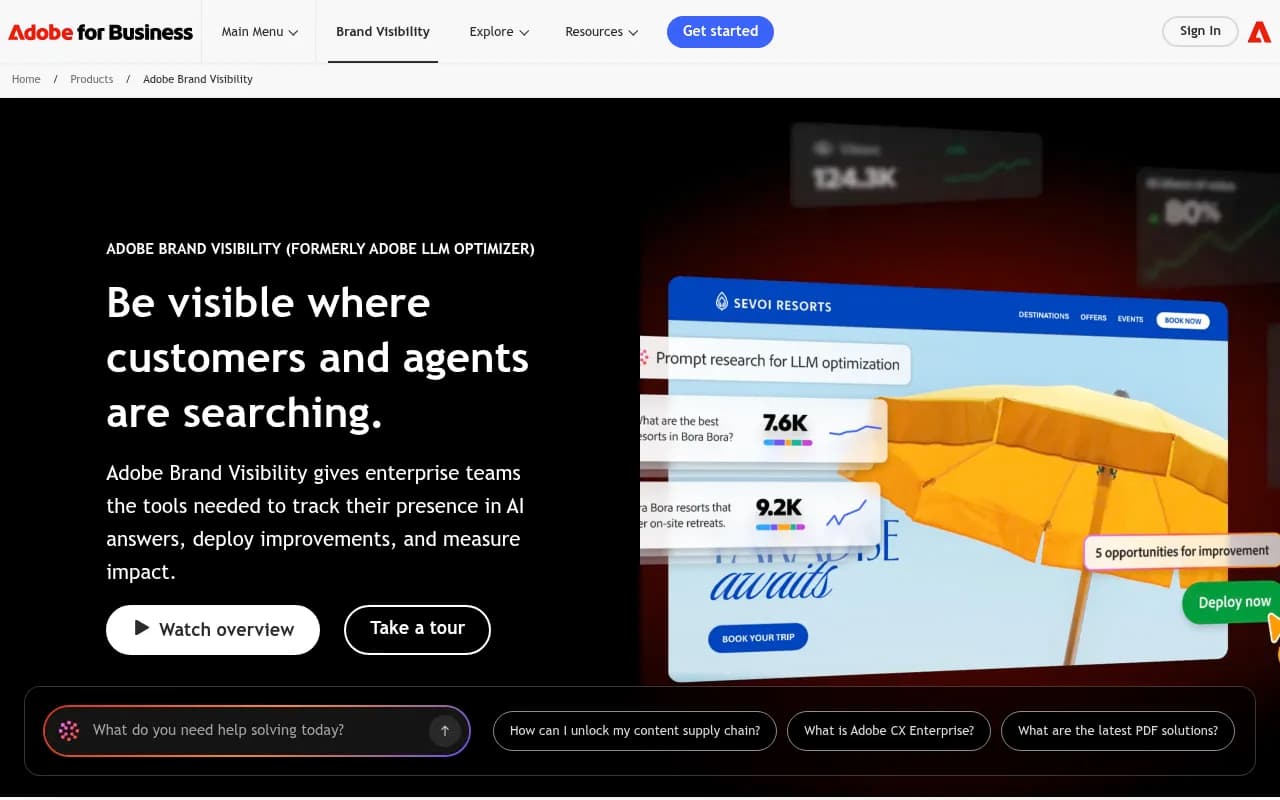
| Adobe LLM Optimizer | Inside Adobe Experience Cloud | Fit with existing Adobe contract and data terms |
| BrightEdge, Conductor, seoClarity | Enterprise SEO suites adding AI search | How much AI data is first-party versus fixed prompt sets |
Promptwatch
Promptwatch is the platform we use at 1001 SEO Media, so weigh that when reading this section. It tracks ChatGPT, Gemini, Claude, Perplexity, Google AI Overviews, AI Mode, Copilot and others from the real interfaces by country and language, and pairs that with IP-verified AI crawler logs, visitor analytics, and a Content Agent that publishes to WordPress, Webflow or Framer. For the security conversation, it is ISO/IEC 27001 certified, GDPR compliant and run by an EU-based company, with an organization audit log on Business and above that shows whether a change came from the dashboard, API, an MCP client or Agent Chat. SSO and the white-label client portal are Enterprise. Check Promptwatch pricing for current plans; Business is $579/month and is the first tier with the Content Agent, hourly tracking and Fact Check.

If you want a quick baseline before any sales call, the free AI visibility report needs no login. A head-to-head page exists too: Promptwatch vs Profound.
Profound
Profound is one of the best-known enterprise platforms, praised in third-party roundups for deep analytics, reporting and wide engine coverage. Its stated security stack is the most complete among the pure monitoring vendors (SOC 2 Type II, HIPAA assessment, SAML SSO, SCIM). Pricing is sales-led for brands, and conflicting plan prices still circulate online, so get a written quote.

AthenaHQ
AthenaHQ publishes SOC 2 Type I and II dates, which is more specific than most. Reported pricing disagrees across sources ($295/month monthly on Starter per Strategi, $245 annual per HubSpot), and the Citation Engine and multi-region tracking are Enterprise-only. Its small team size is a diligence item for large buyers.
Scrunch, Evertune and others


The enterprise SEO suites are worth a look if procurement already approved them:
For a wider survey, the GEO software directory at bestgeosoftware.com lists far more options than fit here.
Reading the listicles critically
A quick note on the sources behind this topic. The pages most likely to show up when you search "best enterprise GEO platform" are mostly written by vendors, and rankings follow the author. Even the First Page Sage ranking of GEO agencies, which uses a published weighted formula, is written by an agency that ranks itself first. That does not make the information useless. It means you should weight the criteria lists (what to compare) more than the rankings (who wins).
A scoring sheet you can copy
Weight these to your situation. A regulated bank will weight security at 40% or more; a retail brand may care more about shopping data.
| Criterion | Suggested weight | Evidence to collect |
|---|---|---|
| Security and compliance | 25% | Reports, dates, tier-by-tier controls |
| Data accuracy and method | 25% | Pilot results on frozen prompts, real-UI collection, recalibration policy |
| Execution and workflow | 20% | Demo of a finding becoming an approved live change |
| Support and onboarding | 15% | SLA in contract, named contacts, docs |
| Coverage (engines, languages, regions) | 10% | Engines per tier, market limits |
| Commercial terms | 5% | Exit terms, data export, price lock |
Questions to ask on every demo
- Can I see the SOC 2 report or ISO certificate, and what are the audit period dates?
- Which of these controls and support terms apply to my plan, not just the top tier?
- Do you collect from the live interfaces or from APIs, and how many runs sit behind each score?
- What happens in your data when ChatGPT or Copilot changes retrieval behavior?
- Can a finding go from dashboard to approved change on my site, and where is that logged?
- What does leaving look like, and in what format do I get my data?
No platform can guarantee a citation in ChatGPT or Gemini, because retrieval stays with the AI system. Anyone who promises one in a sales call has told you something useful about the rest of their claims.
Bottom line
Shortlist two or three vendors, request the actual compliance documents, and run a four-week pilot on a frozen prompt set against what you see in the real interfaces. Decide on evidence you collected, not on the vendor listicle that ranked its own product first. If you also need help running the program, an agency such as 1001 SEO Media can set up the pilot and the reporting, but the evaluation criteria above apply to any vendor, including the ones we use.