Key takeaways
- Gauge's Growth plan is $599/month for 600 daily prompts across 3 AI models and 18 content-engine articles. There is no cheaper tier and no free plan or trial, so the entry price is the main reason teams look elsewhere.
- For B2B SaaS, the prompts that matter are category ("best X software"), alternatives, versus, and constraint prompts ("with SOC 2 and Salesforce sync"). Judge every tool on how well it handles those, not on its engine count.
- Prompt counts are not comparable across vendors. Normalize by models, cadence and markets before you compare prices.
- If you want tracking plus a fix-it workflow, Promptwatch is the closest match to what Gauge sells. If you only need a cheap baseline, Otterly.AI, Peec AI and Trakkr are the usual starting points.
- Almost every price and feature comparison online is written by a vendor. Run a two-week pilot with your own prompt set before you sign anything.
Why teams look for a Gauge alternative
Gauge is one of the few products aimed squarely at B2B SaaS GEO work. Its defaults (prompt templates, competitor sets, reporting) assume a considered purchase with a long cycle, and it adds a content engine that drafts pages from the gaps it finds. It also has an MCP server, data export on Growth and Enterprise, and publishing to your own site.
The friction is mostly commercial. The Growth plan is $599/month, there is nothing below it, and there is no trial. If you are a seed-stage team that wants to check whether AI search matters before arguing for budget, that is a hard sell. Other teams have the opposite problem: they already pay for it, but want crawler logs, traffic attribution or deeper citation analysis in the same product.
One caution before going further. Most comparison pages for this category, including the ones I read for this guide, are written by vendors. Gauge's own pages claim Profound quotes above $3,000/month, based on customer reports, while Gauge says Profound now has a free trial and custom Enterprise pricing. Dageno's blog lists its own prices favorably. I could not find independent testing of how accurately any tool tracks comparison prompts. Treat every figure here as vendor-reported and confirm it on the pricing page.
What comparison prompts actually look like in B2B SaaS
Buyers do not search for your brand. They type something like "ClickUp vs Asana for product teams" or "alternatives to Notion for technical docs" and get a generated shortlist. G2 surveyed 1,076 B2B software buyers in March 2026 and found 51% start research with an AI chatbot more often than Google, and 69% chose a different vendor than planned because a chatbot recommended it.
A useful B2B prompt set covers four shapes:
| Prompt shape | Example | Why it matters |
|---|---|---|
| Category | "best project management software for agencies" | Decides whether you make the first shortlist |
| Alternatives | "alternatives to [rival]" | Catches buyers already unhappy elsewhere |
| Versus | "[you] vs [rival]" | Late stage, framed by whatever pages the model cites |
| Constraint | "[category] with SOC 2 and Salesforce sync" | Narrow, high intent, easy to miss |
A realistic 80-prompt starting set from Rework's framework: roughly 20 category prompts, 16 alternatives prompts (8 rivals, two phrasings), 12 versus prompts, 16 use-case and role prompts, 10 integration and compliance prompts, and 6 branded prompts. That volume is what breaks cheap plans, which is why prompt economics decide most purchases.
What the citations look like
Promptwatch's data on ChatGPT citations (Sep 28 to Oct 4, 2026) shows why this matters for what you publish, not just what you track. For commercial prompts, product pages get 26.0% of citations, landing pages 20.6% and listicles 15.0%. Comparison pages get 7.9%, up from 5.9% across all prompts. Those four types are almost 70% of commercial citations. See the full ChatGPT citation share by content type report. The practical takeaways are to make product pages easy to compare (clear pricing, specs, target buyer), get into the "best of" roundups ChatGPT cites, and publish your own comparison pages.
Query fan-outs matter too. In Promptwatch's fan-out data, the average fan-out query shrank from about 117 characters in early December to about 53 characters in April. Short, keyword-like headings on your comparison pages match that better than clever ones.
How to compare alternatives fairly
Before looking at any tool, normalize the numbers. Gauge's 600 prompts run daily across 3 models, which works out to about 54,000 answers a month, or $11.09 per 1,000. Another tool's 150 prompts may run on more models or at a slower cadence, so the sticker comparison is meaningless.
Ask each vendor:
- How is a prompt counted when I add a second model or a second market?
- How often does it run, and how many samples back each data point?
- Is competitor tracking capped?
- Are answers captured from the real interfaces or from APIs?
- Can I export responses and citations?
- Does it connect to traffic or pipeline, or stop at a visibility score?
Gauge alternatives at a glance
Prices below are vendor-reported or from third-party comparisons, and several come from competitors' own blogs. Confirm before buying.
| Tool | Reported entry price | Best for | Main trade-off |
|---|---|---|---|
| Promptwatch | $95/mo Essential, $245 Professional, $579 Business (7-day free trial) | Tracking plus fixing, crawler logs, traffic attribution | Content Agent starts on Business |
| Peec AI | $95 / $245 / $495 (July 2026) | Competitor and category tracking | Analytics-first, little execution |
| Otterly.AI | About $29/mo for 15 prompts | Cheap first pilot | Few models on entry plan, basic benchmarking |
| Trakkr | $100/mo for 50 prompts | Lean teams, breadth of models | Run frequency on entry plan |
| Dageno AI | $79 / $199 / $499 | End-to-end GEO workflow | Prices from its own blog |
| AthenaHQ | Free tier, then about $295 | Free test, weekly tracking | Credit model needs math |
| Profound | About $99 yearly (one engine), $399 Growth | Enterprise depth | Needs a full-time owner |
| Ahrefs Brand Radar | About $50 for prompt tracking | Teams already on Ahrefs | Suite add-on depth |
| Semrush AI Visibility Toolkit | About $99 per domain | Teams already on Semrush | 25 custom prompts at entry |
The alternatives, one by one
Promptwatch: when you want the fix, not only the dashboard
Gauge's pitch is tracking plus a content engine. The closest like-for-like in that sense is Promptwatch, which tracks how ChatGPT, Gemini, Claude, Perplexity, Google AI Overviews, Google AI Mode and Copilot mention and cite you, then helps you act on it.

For comparison prompts specifically, a few things are useful. Prompts are collected from the real interfaces of the AI engines per country and language, and you can group them into topics and personas, so your alternatives and versus prompts get scored separately from your category prompts. Brand Narrative pulls out the individual claims AI makes about you and your competitors (for example "affordable for small teams" or "lacks integrations"), which is exactly what shows up in versus answers. Content gap analysis maps your pages against the prompts AI answers, and the Content Agent (Business plan and up) writes and publishes pages to WordPress, Webflow or Framer, with a review inbox if you want a human in the loop.
Then it closes the loop. IP-verified AI crawler logs show whether bots can read your comparison page, Page Tracker shows whether AI cites it, and visitor analytics show whether it sends traffic and conversions. That last part is where trackers usually stop. Crisp, for example, reported 2x higher conversion rates from AI traffic than from traditional channels, per its case study.
Pricing is $95/month (Essential, 50 prompts), $245 (Professional, 150 prompts), and $579 (Business, 350 prompts, faster-than-daily tracking, Fact Check, Ads Radar, Content Agent). Every plan tracks all supported models and includes unlimited seats. Check promptwatch.com/pricing for current numbers. Unlike Gauge there is a 7-day free trial on monthly billing, and a free AI visibility report if you only want a first look. For a direct feature walkthrough of the GEO field, see the 2026 platform comparison.
Peec AI: the strongest pure competitor-tracking fit
Rework scored Peec AI the best fit for B2B SaaS on competitor and category tracking. It offers unlimited competitors on every tier, competitor and prompt suggestions, prompt volume scored 1 to 5, intent classification and a branded versus non-branded split. It is built for speed to a first baseline, not enterprise governance.

July 2026 published prices are $95, $245 and $495. One thing to check: how prompt allowances are counted when you add a second engine or market. Treat sources that list Peec from $89 as unreliable. There is also a head-to-head: Promptwatch vs Peec.
Otterly.AI: the cheap first pilot
Otterly.AI checks prompts daily across ChatGPT, Google AI Overviews, Perplexity and Copilot. Gemini, Google AI Mode and Claude are paid add-ons. Lite is about $29/month for 15 prompts. It compares you against your top 5 competitors and includes AI prompt research on every tier.

Fifteen prompts is not enough for the 80-prompt B2B set above, and the benchmarking is basic. It is fine for a baseline, not a long-term home.
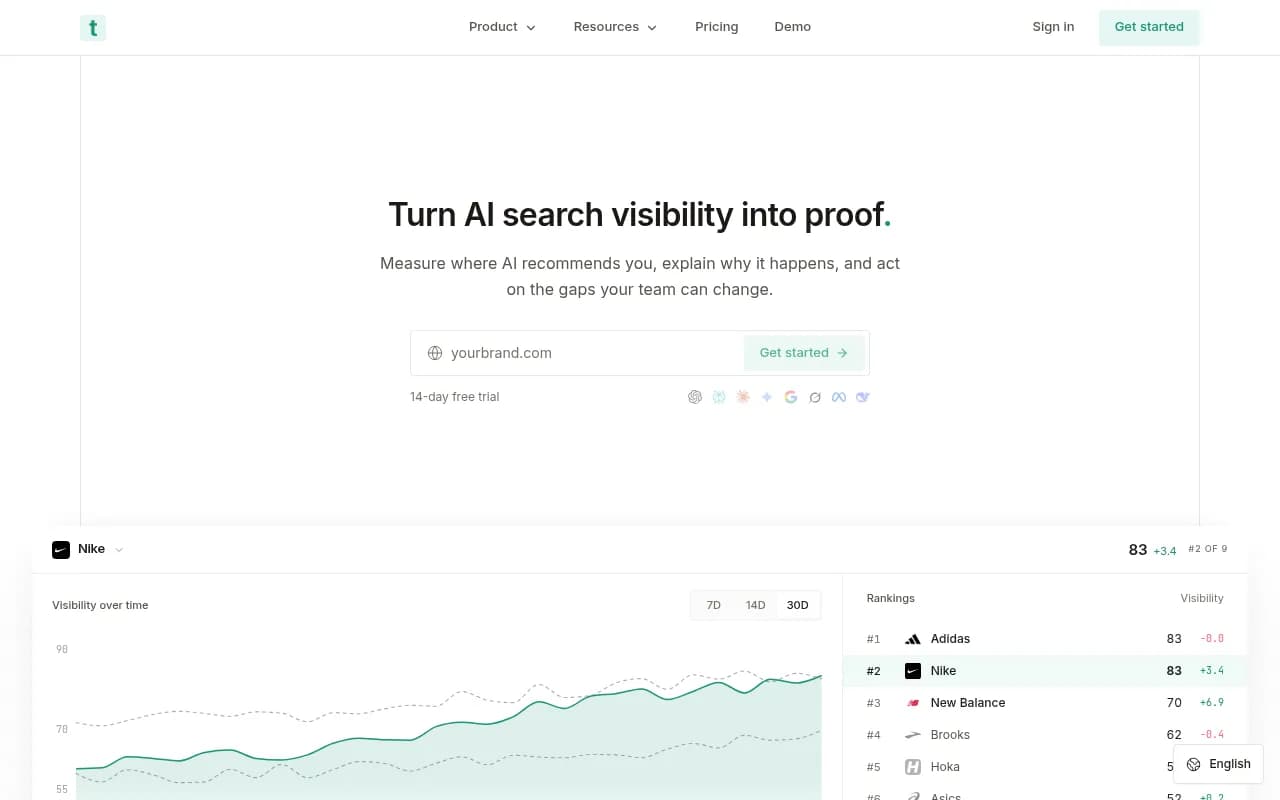
Trakkr: breadth without credit math
Trakkr tracks 8 models on every plan, according to one source, and Rework found it had the lowest bill at 80 prompts. Growth is listed at $100/month for 50 prompts with 25 articles plus actions. The trade-off is run frequency on the entry plan, so verify cadence before a fast-moving competitive push.
Dageno AI: end-to-end workflow at a lower entry price
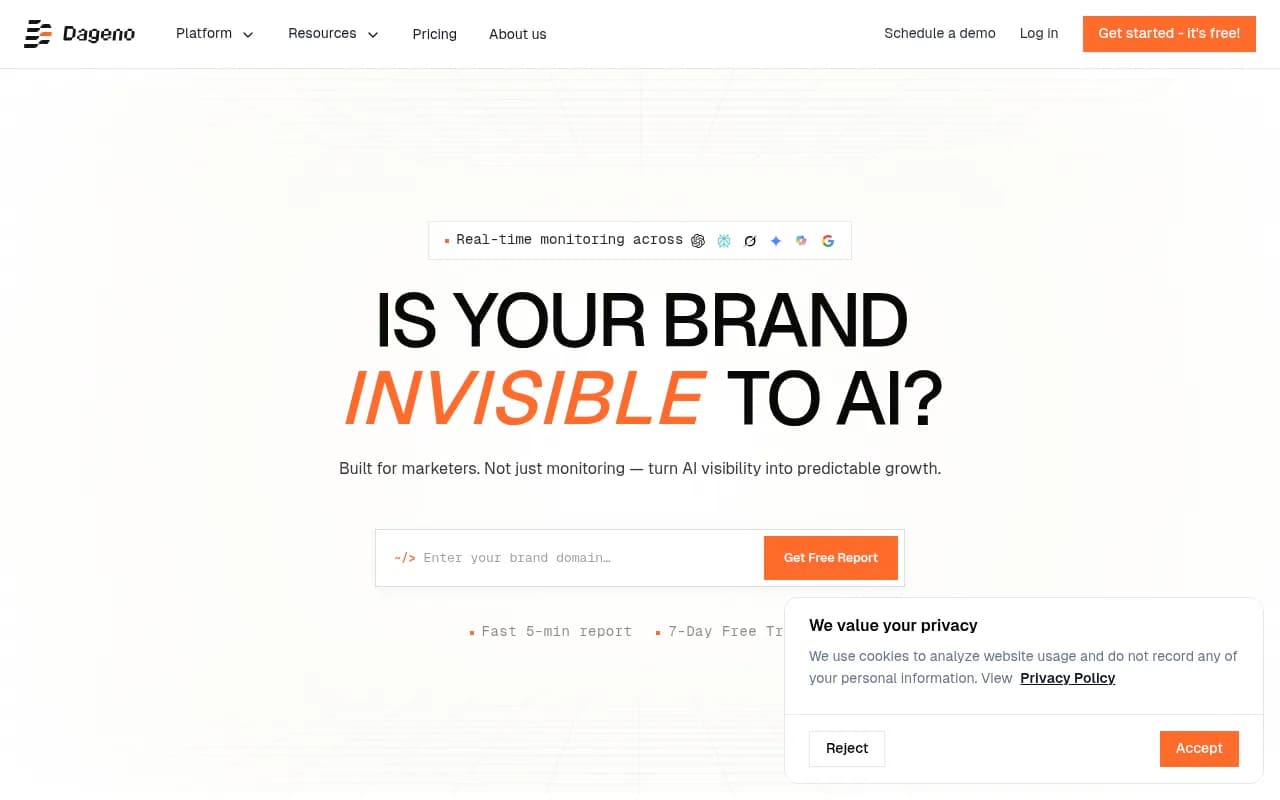
Dageno positions itself around monitoring, prompt and citation analytics, opportunities, content workflow and result attribution. Listed plans are $79 for 50 daily prompts, $199 for 150 and $499 for 500, each covering 3 chosen platforms and up to 10 competitors. Those figures come from Dageno's own Gauge-alternative post, so confirm them.
AthenaHQ: free test, then weekly tracking
AthenaHQ has a genuine free tier and tracks many engines on a credit model where one credit buys one AI response. A paid tier near $295 a month is cited by Sona's comparison. Its pitch is tying citations to traffic and revenue, so check which analytics integrations your tier includes.

Profound: enterprise depth
Profound is the usual enterprise name. Vendors report Starter at $99/month billed yearly (one engine, ChatGPT only), Growth at $399, and custom Enterprise with SSO and wider coverage. I did not verify these on Profound's own site. It pays back when an analyst owns the dataset daily. Compare directly in Promptwatch vs Profound.

Ahrefs Brand Radar and Semrush: suite add-ons
If your SEO team already pays for one of these, test it first. Ahrefs Brand Radar benchmarks AI share of voice against competitors, and its Index shows any brand's visibility across 447M prompts (Ahrefs' own figure as of 6 October 2026) with no setup. Semrush's AI Visibility Toolkit has a Competitor Research report surfacing prompts where rivals are cited and you are not, with 25 custom prompts at the entry tier. Both are shallower than dedicated tools on prompt control.

LLM Pulse
LLM Pulse starts at EUR 49/month, tracks five standard models, and has a REST API, MCP and Looker Studio connector. It does not advertise a native HubSpot or Salesforce connector.

Which one fits which team
| If you need... | Start with... |
|---|---|
| Tracking, content, crawler logs and traffic attribution in one place | Promptwatch |
| The strongest competitor and category tracking | Peec AI |
| Lowest cost for a realistic 80-prompt set | Trakkr |
| Every price public before a call | Otterly.AI |
| A free first test, then weekly tracking | AthenaHQ |
| AI data inside a suite you already pay for | Ahrefs Brand Radar or Semrush |
| Enterprise governance and an analyst | Profound |
If you are staying with Gauge, that is also reasonable. Its defaults are built for long B2B cycles, and a content engine that drafts from your gaps saves time. Just review every draft against your product facts before publishing.
Run a two-week pilot
- Write 40 to 80 prompts across the four shapes above, with at least two phrasings of each alternatives prompt.
- Load the same set into two or three tools. Use the free tiers or trials where you can.
- Compare, for the same prompts: whether the tools agree on whether you are mentioned, which pages they say are cited, and how sentiment is classified. Spot-check a sample manually in the live chatbot.
- Check what you can export and whether the output reaches your analytics or CRM.
- Price the plan you would actually need after normalizing for models, cadence and markets.
For more options, the GEO software directory lists dozens of trackers beyond the ones here.
What to do with the data
Tracking only pays off if it changes what you publish. If you are missing from "alternatives to [rival]" answers, look at which listicles and comparison pages the model cites and get listed in them. If you lose versus prompts, publish an honest comparison page with clear pricing and a short heading structure that reads like a search query. Then check that AI crawlers can actually read it. A tool that shows you the gap and then leaves you alone is a dashboard. Pick the one that gets you to the next action fastest.
If you would rather hand the whole program to specialists, 1001 SEO Media runs GEO programs for B2B brands on top of Promptwatch.