Key takeaways
- Local SEO tools and AI search visibility tools are still mostly separate products. Few platforms do both well, so most multi-location brands end up running a local stack plus a GEO stack.
- Listings, reviews, and Google Business Profile management feed AI answers indirectly. The platforms that own that data (Yext, Birdeye) are now building AI visibility layers on top.
- Per-location pricing gets expensive fast. Check how each tool bills before you count 200 locations.
- For the AI side, look for location-level prompt tracking, citation data, and some way to act on gaps, not just a dashboard.
- Pricing and feature claims below come from vendor positioning and third-party roundups. Confirm everything on vendor pricing pages before you buy.
Why local and AI search are now one problem
For a single-location dentist, local SEO used to mean three things: a clean Google Business Profile, consistent citations, and reviews. For a franchise with 400 locations, it meant the same three things multiplied by 400 and wrapped in governance rules.
Then people started asking ChatGPT, Gemini, and Google AI Mode things like "best urgent care near me that takes my insurance." The answer is a short list of names, not ten blue links. If your location isn't on the list, there's no page two.
Here is what makes this different from classic local SEO. AI answers pull from a wider mix of sources than the map pack does. Promptwatch Data shows that between Sep 28 and Oct 4, 2026, product pages (22.4%) and landing pages (16.8%) were the most cited content types in ChatGPT, followed by listicles at 13.6%. For branded prompts, reviews climb to 5.6% of citations, more than three times their share across all prompts. Translation for a multi-location brand: your location pages, your "best of" roundup placements, and your review profiles are all doing citation work.
Social is less helpful than people assume. In the same period, ChatGPT drew just 0.46% of its citations from social platforms, while Google AI Overviews drew 12.2%. YouTube (4.28%) and Facebook (2.38%) matter for the Google side. Reddit threads, which used to be a popular local tactic, barely register in ChatGPT anymore, as Promptwatch's Reddit citation data shows.
One honest caveat: Promptwatch has no first-party dataset on local-specific queries yet, so treat the above as directional for local, not definitive.
How to evaluate these platforms
I sorted the tools by the job they do, because "best" depends on what's broken. Five questions matter for multi-location brands:
- Does it track visibility per location, city, or region, or only at the brand level?
- Does it show which sources AI engines cite, so you know where to fix things?
- Can it help you fix gaps (content, listings, reviews), or does it only report?
- How does pricing scale with location count and prompt count?
- Does it connect to traffic or revenue, or stop at mention counts?
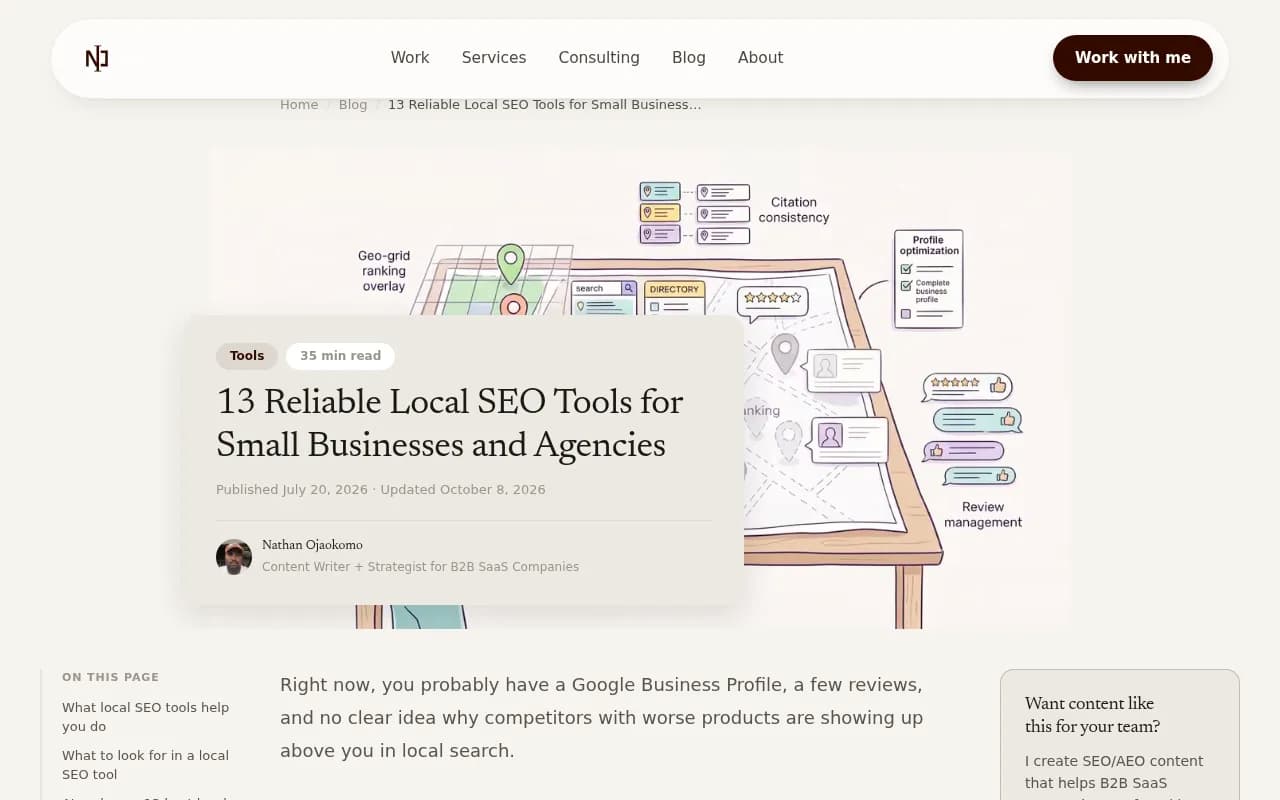
A quick note on the geo-grid piece. Local Falcon-style grid tracking shows where you rank in Google Maps from different GPS points around a location. A single average ranking hides the fact that you may rank first half a mile away and not at all across town. That's classic local, and it still matters, but it doesn't tell you what ChatGPT says.
The 10 platforms at a glance
| Tool | Main job | Local depth | AI search coverage | Best for |
|---|---|---|---|---|
| Promptwatch | AI visibility plus action | Country tracking on all paid plans, state/city from Business | ChatGPT, AI Overviews, AI Mode, Gemini, Perplexity, Copilot, Claude and more | Brands that want to fix AI visibility, not just watch it |
| Yext Scout | Enterprise AI competitive intelligence | Strong, built on Yext's listings data | AI answer tracking | Large enterprises already on Yext |
| Birdeye Search AI | Location-level AI visibility | Native, location-based | Local AI visibility | Review-driven multi-location brands |
| Semrush AI Visibility Toolkit | SEO suite with AI tracking | Moderate (Semrush also sells Local) | AI visibility add-on | Teams already in Semrush |
| Profound | Enterprise GEO analytics | Brand-level, regional prompts | 10+ engines | Enterprise GEO programs |
| Scrunch AI | Monitoring and persona testing | Persona-based | Multiple engines | Agencies and brand teams |
| Otterly.AI | Affordable monitoring | Basic | Six-platform coverage | Small teams on a budget |
| Peec AI | Prompt tracking | Basic | Multi-engine | Marketers wanting simple tracking |
| Search Atlas | All-in-one SEO and AI | Mixed | AI visibility included | Agencies wanting one login |
| Brandlight | Enterprise AI visibility OS | Brand-level | Multi-engine | Large brand governance |
The rest of this guide goes through each with an opinion.
1. Promptwatch: best for fixing AI visibility, not just measuring it
Promptwatch is the one I'd start with if the question is "why aren't our locations showing up in AI answers, and what do we do about it?" Most tools in this category stop at "was my brand mentioned." Promptwatch goes further: it shows where AI finds your content, which of your pages get cited, whether AI crawlers can even read your location pages, and then helps produce the fix.

The pieces that matter for multi-location brands:
- Monitors the real user interfaces of ChatGPT, Google AI Overviews, AI Mode, Gemini, Perplexity, and Copilot, per country and language. User-facing answers often differ from API outputs, which matters when a local recommendation is the whole point.
- Country tracking is on every paid plan, and state and city tracking starts on the Business plan.
- IP-verified AI crawler logs show whether GPTBot or ClaudeBot hit errors on your store-locator pages. A surprising number of multi-location sites hide location data behind JavaScript widgets that crawlers never see.
- Citation tracking covers third-party pages, Reddit, YouTube, and LinkedIn, and Offsite Mentions catches pages that name your brand without linking.
- The Action Board and Content Agent turn gaps into prioritized tasks and publish content to WordPress, Webflow, or Framer.
Pricing at the time of writing runs from a free Explore tier to Essential at $95/mo, Professional at $245/mo, and Business at $579/mo, with agency plans from $199/mo. Confirm current numbers at promptwatch.com/pricing. The trade-off: it is an AI search platform, not a listings manager. You still need something for citations and GBP.
2. Yext Scout: best for enterprises already running Yext
Yext built its business on listings distribution, pushing accurate business data to directories, maps, and aggregators. Scout is its AI search competitive intelligence layer for enterprise brands.
Yext Scout
The appeal is data lineage. If Yext already holds your canonical location data, Scout can connect what AI says to what your listings say. That's a real advantage when wrong hours or phone numbers show up in AI answers. The downside is the usual enterprise one: heavy contracts, and it makes the most sense if you're already a Yext customer. In one third-party scoring of specialist tools, Yext scored highest on listings and citations but zero on geo-grid, so you'd pair it with a rank tracker.
3. Birdeye Search AI: best for review-led local brands
Birdeye comes from the reviews and reputation world, which is a strong starting point. Reviews are one of the strongest local ranking signals, and they surface in AI answers for branded queries.
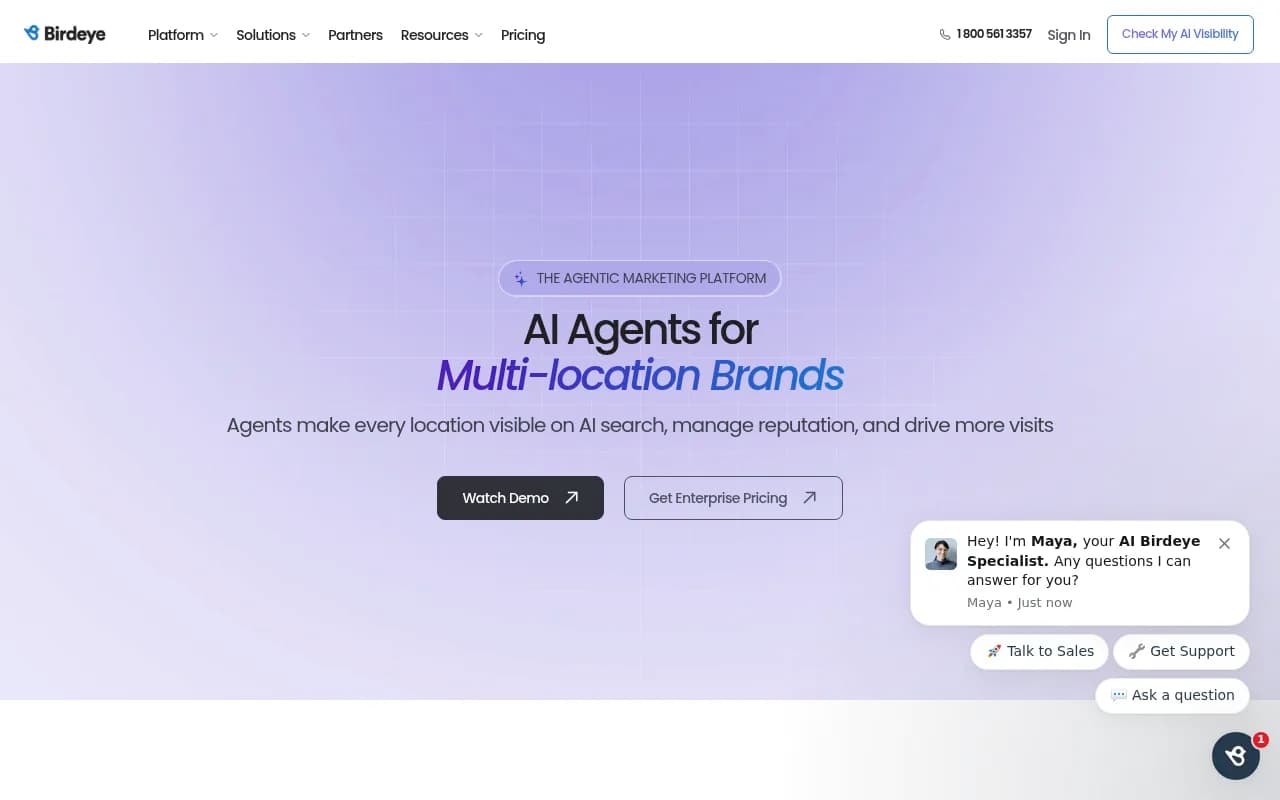
Birdeye Search AI is positioned around local AI visibility with location-level tracking. That's the specific thing most pure GEO tools lack. If your pain is "which of our 150 clinics does ChatGPT recommend, and which does it ignore," this is worth a demo. I'd want to verify how many AI engines it covers and how deep its citation data goes, since both are less documented than the review side.
4. Semrush AI Visibility Toolkit: best if local is one part of a wider SEO program
Semrush sells both a Local product (geo-grid tracking, automated GBP posts, AI-assisted review replies, listings on higher tiers) and an AI visibility toolkit. If your team already lives in Semrush, adding AI tracking is the lowest-friction move.
The catch is depth. Traditional SEO suites tend to bolt on AI tracking with fixed prompt sets and shallow AI-specific data. Good enough to start measuring, rarely enough to explain why a location is invisible. See also Semrush as the core suite.
5. Profound: best for enterprise GEO programs
Profound is one of the best-known enterprise names in AI visibility, covering 10+ engines per one third-party roundup, with prompt volume data.

It's strong at monitoring and analytics. For multi-location use, the question is whether you can structure prompts by region and location cleanly, and what the price looks like at scale. Compared to Promptwatch, you'll find higher price points and less emphasis on agentic execution and crawler-level diagnostics.
6. Scrunch AI: best for agencies that want persona testing
Scrunch AI pairs monitoring with optimization work and persona-based testing, which is useful when "a parent searching for pediatric dentists" and "a retiree searching for dentures" should get different answers.

It's a reasonable pick for agencies managing several multi-location clients. Check how it handles location-specific prompt sets before committing.
7. Otterly.AI: best budget monitor
Otterly.AI is the marketer-built, fairly priced option, with roughly six-platform coverage and daily updates per third-party reviews.

It's a good way to learn what your AI visibility looks like. It's a basic tracker, though: expect no crawler logs, no visitor analytics, and no content generation. Fine for ten locations in one region. Thin for a national franchise.
8. Peec AI: best for simple prompt tracking
Peec AI is clean and quick to set up, with smart prompt suggestions.

Like Otterly, it answers "was I mentioned" well and "what do I do about it" less well. Good as a first tool, and many teams outgrow it.
9. Search Atlas: best all-in-one login for agencies
Search Atlas bundles traditional SEO and AI search features in one platform. For small agencies that don't want five subscriptions, that has real appeal.
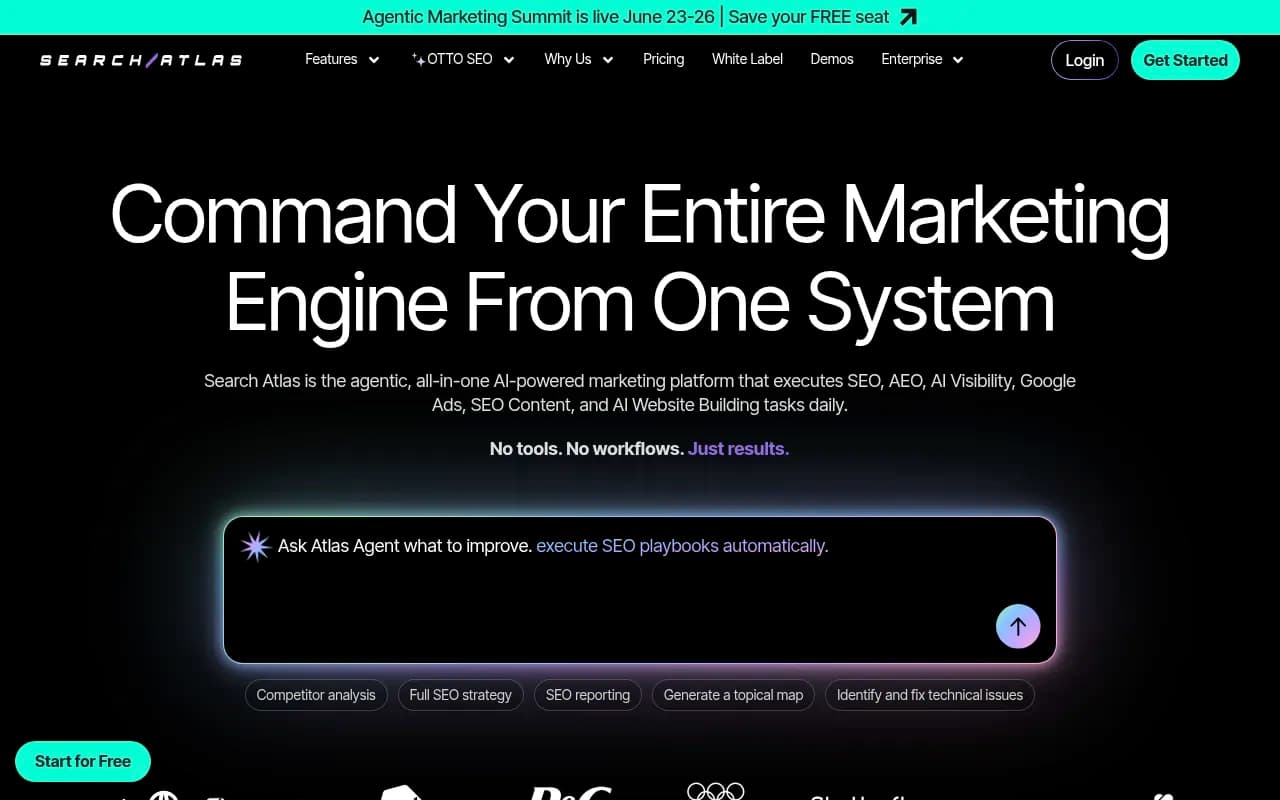
Wide beats deep here. If local rank tracking and GBP workflows are central to your offer, you'll likely still add a specialist like Local Falcon for geo-grid work.
10. Brandlight: best for enterprise brand governance
Brandlight positions itself as an enterprise AI visibility operating system.

Worth a look when brand consistency across hundreds of locations is the headline concern and procurement wants an enterprise vendor. Less relevant for lean teams.
The local-only tools you'll probably still need
None of the ten above replace the classic local stack. Third-party roundups consistently single out a few specialists:
- Local Falcon for geo-grid map rank visualization.
- Grid My Business, which combines geo-grid tracking, GBP management, and some AI search tracking, and gets recommended as good value for agencies managing many profiles.
- Localo for AI-guided GBP optimization, though its rank tracking is basic.
- BrightLocal for citation monitoring and local rank tracking.
- Yext and Google Business Profile itself for listings and reviews.
I haven't verified current pricing or features on these, so check vendor pages. The point is architectural: you probably need one tool for the map pack and one for AI answers.
Which stack fits which brand
| Situation | Suggested stack |
|---|---|
| 5 to 20 locations, tight budget | Otterly.AI or Peec AI plus Google Business Profile and a geo-grid tool |
| 20 to 200 locations, review-heavy | Birdeye Search AI plus Promptwatch for crawler, citation, and content work |
| Enterprise, already on Yext | Yext plus Scout, plus Promptwatch or Profound for deeper GEO |
| Agency with many small clients | Promptwatch agency plans or Search Atlas, plus Grid My Business or Local Falcon |
| Already deep in Semrush | Semrush Local plus AI Visibility Toolkit, add a dedicated GEO tool if gaps appear |
A practical rollout plan
- Audit your location pages for crawlability. Check robots.txt, JavaScript-rendered store locators, and whether each location has its own indexable URL with unique content.
- Clean up listings and reviews first. Wrong hours in a directory will be repeated by an AI engine.
- Build a prompt set per market: "best [service] in [city]," "[brand] near me," and comparison prompts against two or three local competitors.
- Find the sources AI cites for those prompts. Often it's a listicle or aggregator, not your site. Getting included in those roundups matters because listicles make up 13.6% of ChatGPT citations in the Promptwatch data.
- Fix, publish, and re-measure. Keep location pages complete: services, prices, hours, specs. Landing pages and docs also stay cited longest, per Promptwatch's content half-life report, while news loses half its cited pages within about 36 days.
If you need an agency to run this for you, 1001 SEO Media handles local SEO and AI search work, and uses Promptwatch for the GEO side.
For wider comparisons, the GEO software directory at bestgeosoftware.com lists far more options than fit here.
Final take
The local stack and the AI stack are converging, but they haven't merged. Yext and Birdeye are moving from listings and reviews toward AI visibility. GEO platforms are adding location tracking. My advice: pick your local foundation based on whichever of listings, reviews, or rank tracking is weakest today, then add one AI platform that can explain why a location is missing and help you fix it. Start by running your top ten location prompts through a free scan, and see which of your cities don't appear at all.