Key takeaways
- Profound's self-serve brand tiers appear to have been withdrawn after its September 15, 2026 Series D. Brands now go from a 7-day trial to custom Enterprise pricing, according to a competitor's pricing analysis, so confirm with Profound directly.
- Finance teams should judge tools on SOC 2 or ISO 27001, SSO, multi-country coverage, exports and API, and whether the tool helps fix what AI says, not only report it.
- ChatGPT cites product and landing pages for 39% of citations, so fee, rate and eligibility pages are your main citation surface (Promptwatch Data, Sep 28 to Oct 4, 2026).
- Almost half of ChatGPT responses cite 10 or more domains, so measure position and description accuracy across many prompts, not just whether you were mentioned.
- Every roundup I found ranks its own publisher first. Run a trial on your own prompts before you trust any list, including this one.
Why finance teams are looking past Profound
Profound is a capable enterprise platform. It raised $180M at a $1.8B valuation in September 2026 and is repositioning around an AI Marketer agent. That is good for the product and awkward for buyers who liked the old price list.
According to GEOtoolbox, a competing vendor that cites Profound's own page and an archived copy, the Starter ($99/mo) and Growth ($399/mo) tiers were listed on June 11, 2026, still showed in an archive from September 14, and were gone by about September 17. Today brands get a free 7-day trial (50 prompts on ChatGPT, Gemini and Google AI Overviews), then custom Enterprise pricing. Agencies pay $99/mo plus $399/mo per client workspace. Maintouch estimates Enterprise at $2,000 to $5,000+ a month, but that is a competitor's guess, not a vendor figure. Several roundups, including the Omnia one, still quote the old $399 Growth plan.

The tool catalog has [tool:profound] if you want to review it directly. But if you are a mid-sized lender, a wealth platform or a payments company, the pricing change is only one reason to look around. The others are specific to finance.
- Regulated content. AI answers about rates, fees, coverage and eligibility can be wrong, and wrong in ways that create complaints or compliance headaches.
- Many markets. Licences are country-specific, so a UK answer and a German answer are different problems.
- Security review. Procurement will ask about SOC 2 or ISO 27001, SSO, audit logs and data handling before anyone signs.
- Small teams. Most fintech marketing teams do not have a dedicated analyst to interpret dashboards.
One honest caveat. I found no finance-specific research on how AI cites banks or insurers, and no public case studies from fintech teams on these tools. What follows applies general AI-search evidence to financial work, and I flag where that is inference.
What AI search data tells finance teams to prioritize
Promptwatch has no finance report, but its general data is useful. In Promptwatch's ChatGPT content type data for Sep 28 to Oct 4, 2026, product pages made up 22.4% of classified citations and landing pages 16.8%. For commercial prompts, where people compare options before buying, product pages hit 26.0%, landing pages 20.6%, listicles 15.0% and comparisons 7.9%. Those four types are almost 70% of commercial citations.
My inference: for a fintech, your pricing, fees, rates and eligibility pages are the main thing AI reads and quotes. If those pages are thin, out of date or hidden behind scripts, no tool will rescue you.
The second finding is about crowding. Promptwatch's unique domains data shows 47.6% of ChatGPT responses with citations cite 10 or more domains, and 52.5% of organic prompts that do not name a brand do. You share every answer with many others. Third-party listicles, review sites and comparison pages are the route into those organic answers.
Third, freshness matters for anything that changes. Promptwatch's content half-life data found news pages lose half their citations in about 36 days, while landing pages and docs stay cited for months. Rate announcements decay fast. Evergreen product pages do not.
For regulated verticals, Promptwatch's healthcare report is the closest analogue: ChatGPT leans heavily on government and public health sources there. Expect something similar for finance, with regulators and established institutions favored, but that is a hypothesis to test in your own tracking, not a measured result.
What to check before you buy
Here are the criteria I would use. They are my suggestions, not an industry standard.
- Security posture: SOC 2 or ISO 27001, SSO/SAML, audit logs, scoped API keys. Ask for evidence, not a badge on a pricing page.
- Coverage you actually pay for: which engines, countries, languages and prompts the quote includes. Maximum platform coverage often differs from purchased scope.
- Real interface data: answers pulled from the actual ChatGPT or AI Overviews interface, not only API calls, since they can differ.
- Accuracy of descriptions: can you see how the AI describes your fees or products, and flag wrong statements? Mention counts alone will not tell you.
- Exports and API: your compliance and BI teams will want the raw responses.
- Workflow: does it tell you what to fix, and can it help ship the fix?
- Agency or workspace support if you run several brands or regions.
Profound alternatives compared
Prices below are vendor-published or from competitor roundups and shift often. The research notes show conflicting figures for AthenaHQ (about $295/mo in one source, about $400/mo in another), so verify everything.
| Tool | Entry price seen | Strength | Watch out for |
|---|---|---|---|
| Promptwatch | $95/mo (Essential), free tier | Monitoring plus content fixes, crawler logs, ISO 27001 | Content Agent is Business and above |
| AthenaHQ | ~$295 to ~$400/mo | Closest to Profound's reporting depth | Conflicting price reports |
| Peec AI | From EUR 85/mo | Clean per-prompt reporting | Monitoring-focused |
| Otterly.AI | From $29/mo | Cheap entry | Basic tracking |
| Scrunch | Varies by plan | Agent-readable pages and site audits | Page optimizations metered by plan |
| Semrush AI Visibility Toolkit | Suite pricing | Fits existing SEO stack | Fixed prompt sets, shallow AI data |
| Ahrefs Brand Radar | Suite pricing | Mentions plus backlink data | No crawler logs |
| Frase | Varies | Tracking joined to content work | Vendor ranks itself first in its own roundup |
| Omnia | EUR 79/mo | Unlimited geography, built-in agent | Price is vendor-stated |
| LLM Pulse | EUR 49/mo | Budget weekly tracking | Light on action |
Promptwatch
Promptwatch is the one I would put first for a finance team that needs to act, and that is also how 1001 SEO Media's agency uses it. It tracks the real interfaces of ChatGPT, Google AI Overviews, Google AI Mode, Gemini, Perplexity, Copilot and more, per country and language. The part that matters here is the diagnosis layer: IP-verified AI crawler logs show whether bots can actually read your rate and eligibility pages, and a weekly site audit flags technical blockers. Sentiment and position metrics show how you are described, not only whether you appear.
On security, it is ISO/IEC 27001 certified and GDPR compliant, with SSO and audit logs on higher tiers, which shortens procurement conversations. Essential is $95/mo, Professional $245, Business $579 with state and city tracking, local targeting and the Content Agent, and Enterprise is custom. There is a free tier limited to ChatGPT. Confirm current numbers at promptwatch.com/pricing.

The free AI Visibility Report is a no-login way to see how ChatGPT, Gemini and Perplexity currently talk about your brand before you commit.
AthenaHQ
The closest analogue to Profound's reporting depth, with an action center and a content agent. Use it if your team wants Profound-style output at a lower price, once you have sorted out which price is right.

Peec AI and Otterly.AI
Both are straightforward prompt trackers. Peec reports prompt by prompt with citation detail. Otterly is the cheapest credible entry point. Neither gives you crawler logs or content workflows, so they suit a team that already has strong content operations and only needs measurement.


Scrunch
Scrunch pairs monitoring with agent-ready pages, which is relevant if your product pages are heavy on JavaScript or gated calculators. It is built around brands and agencies.

Semrush and Ahrefs Brand Radar
If your SEO team already pays for one of these, the add-ons are an easy first step. The trade-off is fixed prompt sets and thinner AI-specific data than a dedicated platform.

Frase and Omnia
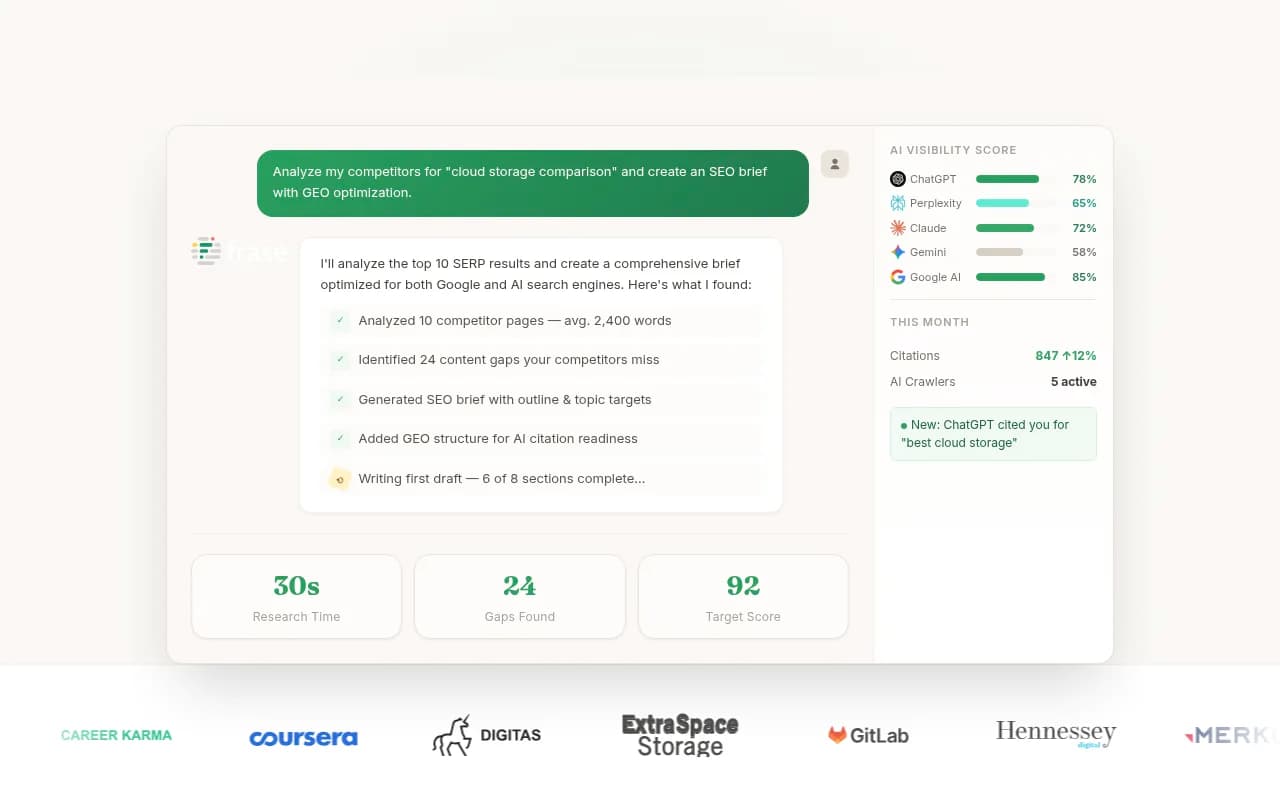
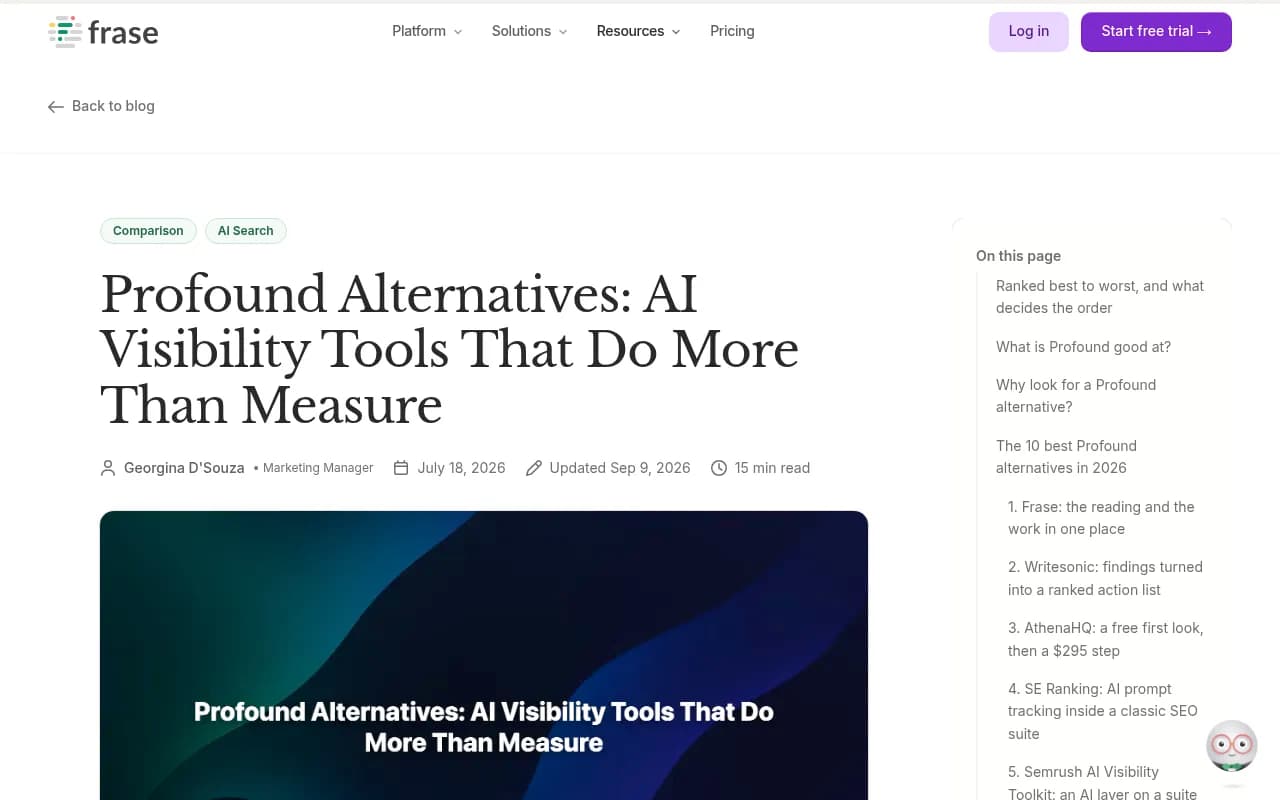
Both lean on turning findings into content. Frase's own roundup says it "does the work in one place", and it ranks itself first. Omnia does the same with its pricing and Profound claims. Useful tools, but read their rankings as marketing.
Enterprise suites worth a look
Large banks with existing SEO platforms may prefer BrightEdge, Conductor, Botify or seoClarity, which fold AI search into an enterprise stack. Yext Scout is relevant for institutions with many branches and verified location data.
Yext Scout
The GEO software directory at bestgeosoftware.com lists many more if your shortlist needs widening.
Matching tools to team type
| Team | Likely fit | Why |
|---|---|---|
| Series A to C fintech, small marketing team | Promptwatch, Omnia | Action and content help without analysts |
| Bank or insurer with procurement gates | Promptwatch, Profound Enterprise, BrightEdge | Security certifications and SSO |
| Multi-country neobank | Promptwatch, Profound, Omnia | Country and language coverage |
| Agency serving financial clients | Promptwatch Agencies plans, Profound Agency | Workspaces and client reporting |
| Team with budget under $100/mo | Otterly, LLM Pulse | Basic monitoring only |
| Already deep in Semrush or Ahrefs | Their AI add-ons | Lowest switching cost |
How to run a fair 7-day test
Vendor roundups will not settle this, so test.
- Build 40 to 60 prompts from real customer questions: "best business credit card for startups", "is [your brand] safe", "[your brand] vs [competitor] fees". Mix organic, branded and comparison prompts, since Promptwatch's data shows they behave differently.
- Run the same set in two or three tools. Compare whether each captured the same answers.
- Check accuracy by hand on 10 responses. Are your fees, limits and licences described correctly?
- Look at the sources. Which third-party listicles and review sites do the AIs cite, and are you on them?
- Ask each vendor for the Enterprise scope in writing: engines, countries, languages, prompts, seats, exports.
- Send the security questionnaire early. It is the step that most often delays a finance purchase.
Fixing what you find
Monitoring only matters if something changes afterward. For finance, the fixes are usually unglamorous: complete, factual product and fee pages, public documentation and help-centre pages that crawlers can read, comparison pages, and presence on the review sites ChatGPT already trusts. Keep compliance review in the loop for anything the AI may quote, and set a refresh cadence for rate-sensitive pages.
If you would rather hand part of this to specialists, an SEO and GEO agency such as 1001 SEO Media can run the audit, content and digital PR side while your compliance team keeps final sign-off.
For ongoing market data on what AI actually cites, Promptwatch Data publishes regularly updated reports you can check against your own tracking.
Bottom line
Profound is still a serious option if you can get an Enterprise quote that covers the countries and engines you need. For most fintech and financial services teams, the better question is what you will do with the data. Shortlist two or three tools, run the same prompts through each, verify the accuracy of how you are described, and get the security paperwork moving in week one. Pick the one your team will still be using in month three.