Key takeaways
- Agencies need different things from brands: one workspace per client with real data isolation, white-label output, and pricing that doesn't multiply by client count.
- White-label comes in different depths: a full platform on your own domain, a branded client portal, branded PDF exports, or a connector you brand yourself. Check which one a vendor means.
- Pricing models vary a lot. Some tools charge per client or brand, others pool a prompt or response allowance across unlimited projects. Do the math for your actual client count.
- Most rankings of these tools are written by vendors who rank themselves first, so verify prices and features on official pages before you commit.
- Tracking alone doesn't win retainers. Tools that also help produce the fix (content, crawler diagnostics, traffic attribution) give you more billable work.
What agencies need that brands don't
A brand buys one workspace for one company. An agency buys a delivery model. That difference is why a tool that looks great in a single-brand comparison can be a headache at ten clients.
Six things matter most when you run prompt tracking across a client roster:
- Separate workspaces where client A's competitor set and prompts never show up in client B's dashboard.
- Client access without exposing anything else, ideally read-only logins at no extra seat cost.
- White-label or branded reporting, so the deliverable looks like yours.
- Pricing that doesn't punish you for adding client number eleven.
- Pitch tooling: a way to run a quick audit on a prospect before they sign.
- A route from "you're invisible here" to "here's what we'll publish to fix it."
That last one is where I think most agency buying guides go soft. The reporting layer is becoming a commodity. Clients can often buy a basic tracker themselves for under $100 a month. What they can't easily buy is the work that moves the numbers.
How white-label actually differs between tools
When a vendor says "white-label," ask what exactly gets your logo. From the vendor pages reviewed for this guide, there are roughly four depths:
- The whole platform on your own domain (LLM Pulse offers this on its Partner plans).
- A branded client portal or read-only dashboard link (Promptwatch, Rankability, ZeroRank on higher plans).
- Branded exported reports, usually PDF or DOCX (Geoptie, Ayzeo on its Pro plan at $149/month).
- A connector or API you brand yourself, such as Looker Studio (Otterly's route, according to a competitor's study, so confirm with Otterly directly).
None of these is wrong. If your clients log in rarely and mostly read a monthly PDF, branded exports are plenty. If you want clients to live in a dashboard you can call your own, you need a portal or a fully white-labeled platform.
Comparison table: prompt tracking tools for agencies
Prices and details come from vendor pages and vendor-authored roundups (several of them ranking their own product first), so treat them as a starting point and confirm on each pricing page.
| Tool | Multi-client model | White-label depth | Pricing basis | Best for |
|---|---|---|---|---|
| Promptwatch | Unlimited projects and pitch projects on all agency plans | Client access and PDF reports; full white-label portal on Enterprise | Flat plans, metered by responses ($199 / $399 / $799 per month) | Agencies that want tracking plus execution |
| Peec AI | Client projects, free pitch projects | White-label reporting listed | Tiered by prompts and models | Mid-market agencies, simple onboarding |
| Otterly.AI | Unlimited workspaces on Standard (~$189) | Via Looker Studio connector | Pooled plan | Budget-conscious agencies |
| Geoptie | Multi-client from one workspace | Branded exported reports | $99 Professional holds 10 brands | Small agencies on a budget |
| ZeroRank | Separate client workspaces | White-label dashboards on Growth, Agency and Enterprise | From $39/month | Pitching and light execution |
| AI Peekaboo | Per-brand tracking | White-label from $100/month | Per brand | Straightforward branded reports |
| Profound | Agency mode with brand configurations and pitch environments | Enterprise-grade | Custom | Larger agencies with technical teams |
| LLM Pulse | Multi-client | Whole platform on your domain (Partner plans) | Plan-based | Agencies that want full rebranding |
Promptwatch: tracking plus the fix
Promptwatch is the one on this list built around the full loop rather than only the dashboard. It tracks how ChatGPT, Gemini, Claude, Perplexity, Google AI Overviews, AI Mode, Copilot and others mention and cite a brand, then shows where the gaps are and helps close them. For an agency, that means a tracking report can turn straight into a scope of work.

The agency plans are what matter here. All three include unlimited projects, unlimited pitch projects, unlimited prompts and unlimited team seats, plus every AI model, Agent Chat, Brand Narrative, crawler logs, visitor analytics, site audits, content gap analysis, custom reports, and MCP and API access. You pay by response volume rather than by client:
| Plan | Price | Responses | Agent Credits | Notable extras |
|---|---|---|---|---|
| Kick-off | $199/mo | 10,000 | 1,000 | Unlimited projects, 500K visitor events, 10M crawler logs |
| Growth | $399/mo | 25,000 | 2,500 | 2M visitor events, 25M crawler logs |
| Scale | $799/mo | 65,000 | 6,500 | Tracking every 12, 6 or 1 hours, local GEO/SEO targeting, Fact Check, audit log |
Confirm current numbers at promptwatch.com/pricing. Two caveats worth knowing: agency plans don't include the Content Agent, the Knowledge Base or AEO articles, and the fully white-label dashboard and client portal sits on Enterprise. If you need content generation and full white-label, you're talking to sales.
Where it pulls ahead of pure trackers is the evidence you can show clients. IP-verified AI crawler logs tell you whether bots can even read a client's pages. Visitor analytics show AI-referred traffic and conversions. That lets you answer the question clients actually ask, which is "is this making us money?" Monks, for instance, uses the Answer Gap Report and Visibility Score to build content roadmaps for enterprise clients (case study).
See the agency solutions page and the GEO for agencies guide for how teams structure this. There is a 7-day free trial on monthly billing for Kick-off, Growth and Scale.
Peec AI
Peec AI is often named the mid-market economics pick. It's clean, quick to onboard, and lists white-label reporting plus free pitch projects. It's a tracker, though: no crawler logs, no visitor analytics, no content generation. One vendor study estimated that covering ten clients at 50 prompts on 3 models daily pushes you toward Peec's $795 Scale tier, so the per-client cost climbs faster than on pooled plans.

Here is the head-to-head: Promptwatch vs Peec.
Otterly.AI
Otterly is cheap and gives you unlimited workspaces on its Standard plan, which is attractive if you have many small clients with light tracking. Its help center reportedly says there is no native white-label, pointing agencies to the Looker Studio connector instead. That works if you already build client dashboards in Looker Studio. If you want a branded PDF at the click of a button, look elsewhere.

Geoptie
Geoptie is the budget option for smaller agencies. Prompts run daily, and you get multi-client tracking and branded exported reports from one workspace. The tradeoff, per a competitor's review, is that it covers fewer AI platforms than broader tools, so check engine coverage against what your clients care about.
ZeroRank
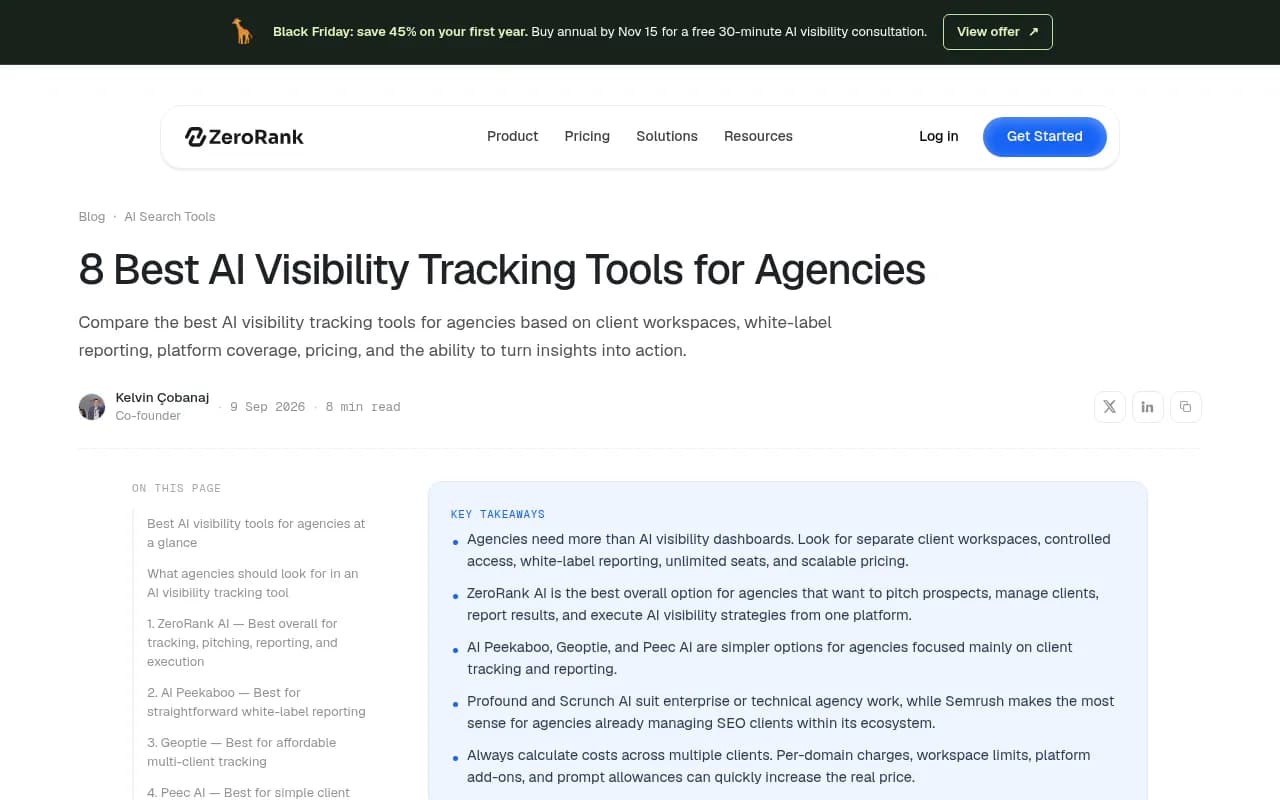
ZeroRank pitches itself as a tracking, pitching, reporting and execution platform. Each client gets a separate workspace with its own prompts, competitors and markets, and white-label dashboards arrive on Growth, Agency and Enterprise tiers. Starting at $39/month is low, but note that the roundup naming it "best overall" is published by ZeroRank itself.
Profound, Scrunch and the enterprise tier
Profound is the usual pick for larger agencies with formal security requirements and technical delivery teams. Its agency mode includes brand configurations and pitch environments. Scrunch is similar in spirit and, per a vendor roundup, handles branding through its API. Both cost more than the trackers above, and neither includes the Reddit tracking, ChatGPT Shopping insights or agentic execution that Promptwatch does.


Other agency-friendly options worth a look
A few more tools appear on agency shortlists and are worth checking against your own needs:
- AI Peekaboo for plain white-label client reports, with white-label from $100/month.
- LLM Pulse if you want the entire platform on your own domain.
- Rankability for a branded shared dashboard link.
- Search Party, which is built with agencies in mind.
- Semrush's AI visibility toolkit, if your clients already live in that ecosystem.

For wider browsing, the GEO software directory at bestgeosoftware.com lists many more options.
The pricing trap: calculate per client
Every vendor guide agrees on one thing, and it's the one that bites people later: price per client, not per plan. Three pricing shapes show up:
- Per brand or per client. Predictable but climbs steadily as the roster grows.
- Pooled allowance (prompts or responses) across unlimited clients. Cheap at small scale, but one heavy client can drain the pool.
- Flat fee for a fixed client cap. Simple to quote, rigid when you hit the cap.
A vendor-written study noted that pooled tools like Promptwatch's $199 Kick-off, Geoptie's $99 Professional and Otterly's $189 Standard suit many clients with light tracking, as long as you divide the pool honestly. That caveat is the whole game. Ten clients on 10,000 responses is about 1,000 responses each per month. If a client needs 100 prompts across several models and countries, you'll burn through that quickly.
A simple way to check: multiply prompts by models by tracking frequency by 30 days, per client, then add them up and compare to the plan's response limit.
Don't forget to explain how engines differ
A practical reporting tip from Promptwatch Data's sources-per-response report: engines hand out different numbers of citation slots. ChatGPT cites about 5 sources per web-search answer, Google AI Overviews about 10, and Perplexity almost exactly 10 every day. Microsoft Copilot swung from under 2 to nearly 17 within a few weeks.
For your client reports, that means:
- Report each engine separately rather than blending into one score.
- Use Perplexity as a stable baseline when showing the effect of a change.
- Add a note when Copilot moves sharply, since it's more likely a retrieval change on Microsoft's side than anything the client did.
Promptwatch's ChatGPT data also shows how fast things shift. Reddit's share of ChatGPT citations fell from about 4% to 0.5% on August 14, 2026, which is the kind of change you want to be able to explain to a client before they ask.
Using the tool to win new clients
Pitch features are underrated. Running a live AI visibility check for a prospect, with their brand against their competitors, is a cheap way to open a conversation. Look for free or unlimited pitch projects (Promptwatch and Peec AI both have them), or branded prospect scanners such as the one Ayzeo includes. Promptwatch also offers a free AI visibility report you can run without a login to get a first look at a prospect.
Which tool for which agency
| Your situation | Likely fit |
|---|---|
| Solo or small agency, a handful of clients, tight budget | Geoptie, ZeroRank or Otterly |
| Mid-size agency wanting tracking plus crawler and traffic data | Promptwatch Growth or Scale |
| You want the whole platform branded as yours | LLM Pulse Partner plans, or Promptwatch Enterprise |
| Many small clients, light tracking, Looker Studio shop | Otterly |
| Large agency, enterprise clients, strict security reviews | Profound, or Promptwatch Enterprise (ISO/IEC 27001 certified) |
| Already deep in an SEO suite | Semrush or similar add-on |
A note on the vendor-written listicles
It's worth saying plainly: most of the roundups used to research this guide were published by tool vendors who rank themselves first (Prefer, ZeroRank and Brandlight all do, and Prefer discloses that it hasn't used the rival tools). Their data is useful, but treat prices and claims as leads to verify. Before you commit, do three things:
- Open each vendor's pricing page and confirm the numbers.
- Start a trial and set up two real clients, including one with a messy competitor set.
- Export a report and check what actually carries your branding.
If you're also weighing whether to hire help rather than build the capability in-house, agencies like 1001 SEO Media run GEO programs for clients, and the same tool-selection logic applies. For other categories, browse AI rank tracking tools.
FAQ
Do I need white-label if my clients rarely log in?
Probably not full white-label. Branded PDF exports or a branded read-only link cover most retainers. Save the heavier options for clients who want a dashboard.
How many prompts per client should I track?
There's no universal number. Start with 20 to 50 prompts per client across the buying journey, then expand where there's budget. Divide your plan's allowance by client count before promising anything.
Is tracking enough to justify a retainer?
Usually not on its own. Reporting is cheap and clients can buy it themselves. The retainer is the work: content, fixing crawler access, getting cited on third-party pages. Pick a tool that shows you what to do next, not just a score.
Can I try before I buy?
Most of these tools offer trials or free audits. Promptwatch has a 7-day free trial on monthly billing, and you can book a demo to talk through agency setups.