Key takeaways
- A perception gap is the distance between how real customers feel about your brand and how ChatGPT, Gemini, or Claude describe it. In a BERA.ai webinar, Levi's sat in the 94th percentile for brand love among human consumers, while Gemini, Claude, and ChatGPT all scored it lower on the same survey framework.
- LLMs have no emotional attachment to a brand. They rebuild its reputation from verifiable pages, third-party coverage, reviews, and structured data, so vague marketing claims get flattened.
- ChatGPT cites only about 5 sources per web-search answer, so the way those few sources describe you matters as much as whether you appear.
- You can measure the gap by tracking what AI says about you, comparing it to your own customer data, and tracing each claim back to the page it came from.
- Fixes are mostly unglamorous: clear product and pricing pages, consistent facts everywhere, reviews on trusted sites, and structured data.
What a brand perception gap actually is
Picture a loyal customer talking about a brand they have bought for fifteen years. Their answer is shaped by memories, habit, and a lot of marketing they absorbed without noticing. Now ask ChatGPT the same question. The answer tends to be flatter, more hedged, and sometimes noticeably colder.
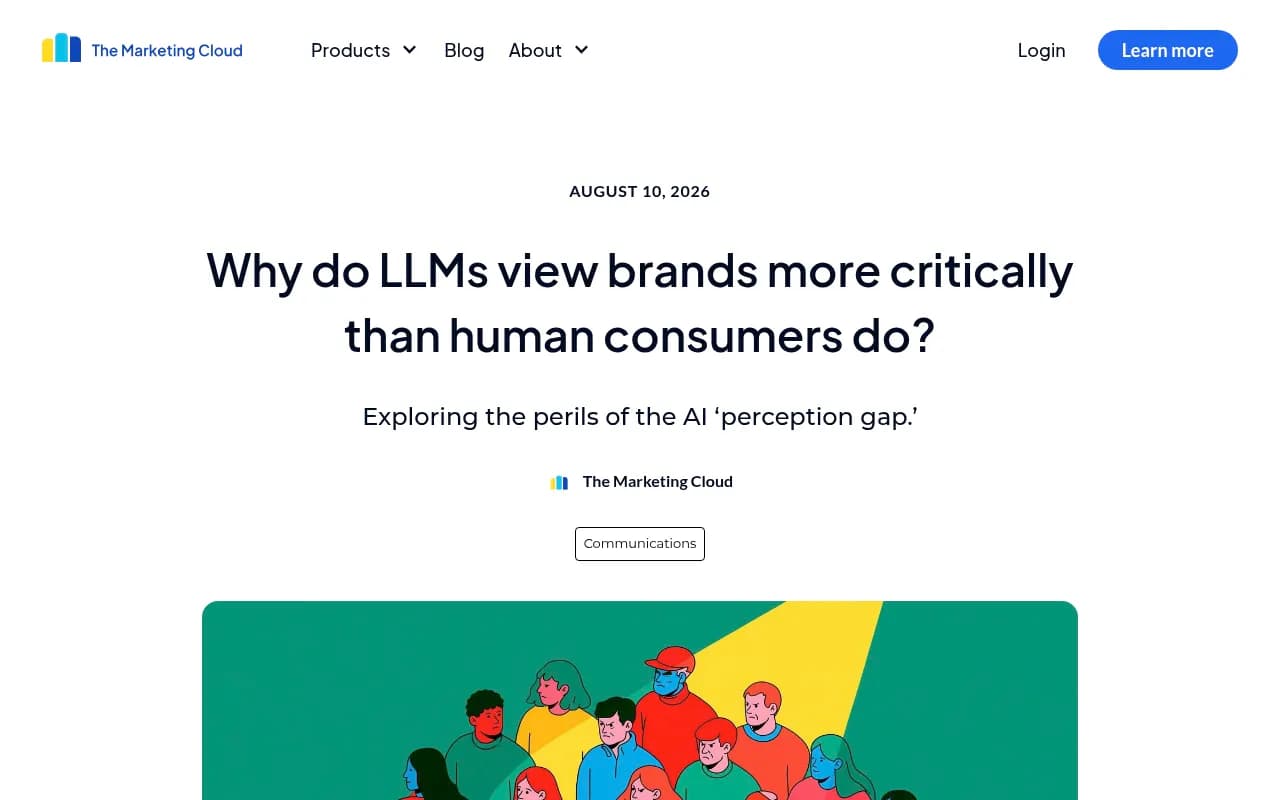
That difference is the perception gap. The Marketing Cloud's write-up of a BERA.ai webinar describes it as the divide between how human consumers evaluate brand equity and how generative models reconstruct it. The example they use is Levi's. Human respondents placed it in the 94th percentile for overall brand love. When the same survey framework was fielded to Gemini, Claude, and ChatGPT, all three ranked it substantially lower.
Two caveats before you panic. The source is a vendor webinar, and the write-up gives no actual LLM scores, only the direction of the gap. Treat it as a strong hypothesis, not a settled law. Still, BERA's Janu Lakshmanan said the pattern held for over a dozen brands they had examined, and it matches what a lot of marketers see when they start reading AI answers about their own company.
Why this matters more than it did two years ago
Showing up in an AI answer is only half of it. The other half is the sentence attached to your name. A shopper who asks "is brand X worth the price?" gets one synthesized paragraph, not ten blue links to judge for themselves.
Promptwatch Data's sources-per-response tracker shows how tight the window is. ChatGPT cites about 5 sources per web-search answer, Google AI Overviews and Perplexity cite about 10. With roughly five slots in ChatGPT, whatever those five pages say about you effectively becomes your reputation for that query.
Branded prompts are where this bites hardest. In Promptwatch's ChatGPT content-type data (Sep 28 to Oct 4, 2026), prompts that name a company, like "is HubSpot good for startups," cite product pages 23.3% of the time and landing pages 22.8%. Reviews make up 5.6% of those citations, more than three times their share across all prompts, and social posts reach 3.0%, almost four times their overall share. So for branded questions, AI reads your own pages first, then goes looking for outside opinions to check them against.
Why AI is harsher than your customers
None of this is malicious. The causes are structural, and understanding them tells you what to fix.
No emotional bias, a lot of appetite for evidence
Customers forgive a lot. A brand that was there for their first apartment gets credit that never shows up in a data table. A reasoning model evaluating price-to-value does a cold comparison against cheaper alternatives. Loyalty, nostalgia, and habit are invisible to it. Only what is written down counts.
Over-weighting third-party coverage
Models lean on pages that look independent: reviews, comparison posts, forum threads, news. If the loudest independent voices are complaints from three years ago, those become the reference material. Your happy customers, meanwhile, may never have written anything public. Satisfaction that isn't published doesn't exist as far as a model is concerned.
Unverifiable marketing language
According to the same Marketing Cloud piece, content without clear, verifiable proof points gets stripped of its polish. "Cutting-edge technology that surpasses the competition" tells a model nothing it can check. The result is what they call brand drift or narrative flattening: you end up described in generic category language, indistinguishable from competitors.
Inconsistency across sources
When a crawler meets slogans with no structured, consistent backing (standardized JSON-LD schema, data tables, clear technical documentation), its verification treats the claims as unverified copy. If your pricing page says one thing, a review site another, and an old press release a third, the model hedges or picks the wrong one.
Not every gap runs this direction
It would be tidy to say AI is simply the harsh critic. The wider research on AI and perception is messier, and worth knowing so you don't over-fit to one pattern.
In January 2026, IAB and Sonata Insights published The AI Ad Gap Widens, surveying more than 500 Gen Z and Millennial consumers and 100 ad executives. 83% of ad executives said their company now uses AI in the creative process, up from 60% in 2024, yet consumers still felt less positive about AI-generated ads than executives believed. Disclosure helped: many consumers said knowing an ad was made with AI would raise their purchase likelihood.
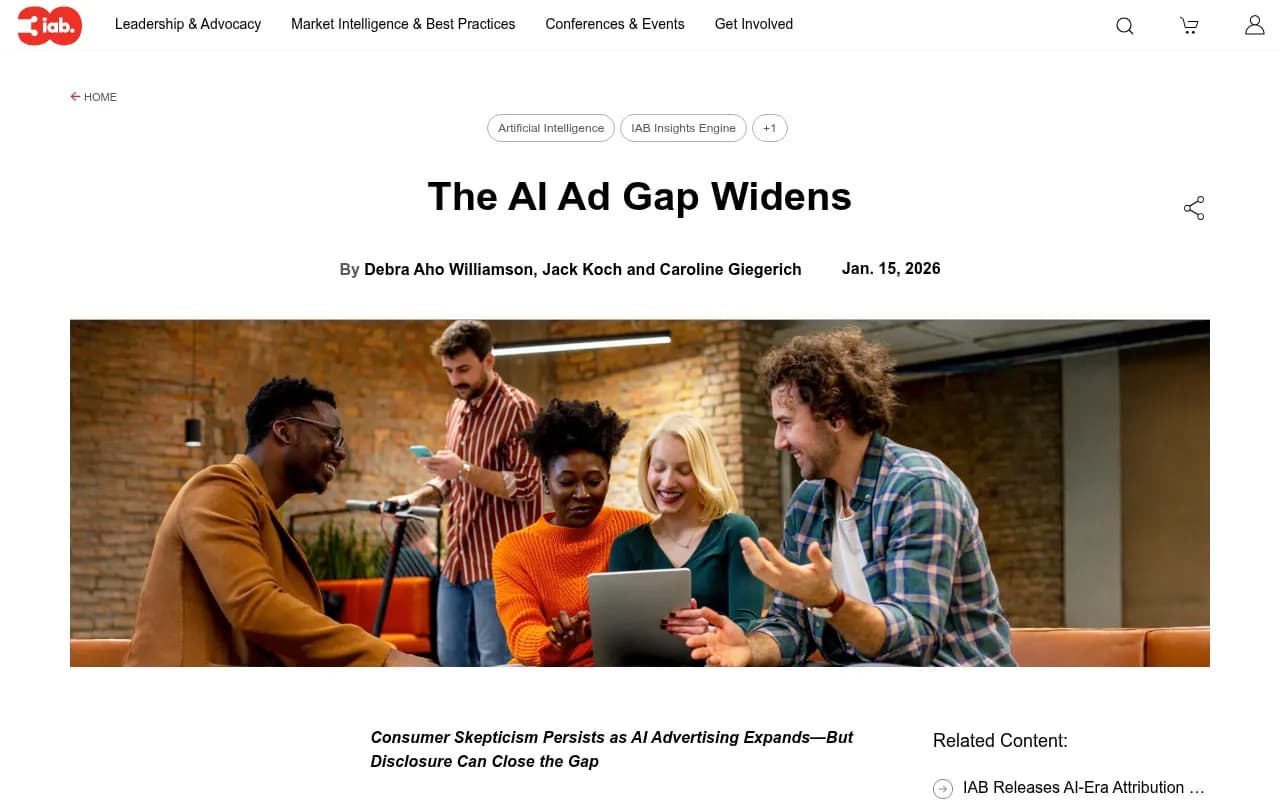
That is a different gap (advertisers versus consumers, about AI-made ads), but it shares a root with the LLM version: two groups looking at the same brand with different information and different incentives. A 2026 paper in the Marketing Management Journal, The AI Trust Gap by Wehr Holt and Nguyen, covers consumer trust in AI-powered marketing, including privacy, transparency, and algorithm aversion. Worth a read if your brand uses AI in customer-facing work, because it affects the human side of the equation too.
The practical takeaway: audit both directions. Check what AI says about you, and check how customers react when your own marketing uses AI.
How to measure your own gap
You need three inputs: what customers say, what AI says, and where AI got it. Here is a process that works without any special tooling to begin with.
- Collect your human baseline. NPS, review scores, brand tracking surveys, support themes. Write down the five or six attributes customers consistently praise (price, quality, support, ease of use).
- Build a prompt set that mirrors real buying questions. Include branded prompts ("is X any good"), comparison prompts ("X vs Y"), and category prompts ("best tool for Z"). Vary the persona: a first-time buyer asks differently than a procurement lead.
- Run them across models. ChatGPT, Gemini, Claude, Perplexity, and Google AI Overviews can all say different things. Repeat weekly, since answers drift.
- Extract the claims. Not just "was I mentioned," but what exactly was said. "Affordable for small teams" and "its mobile app lacks features" are different problems.
- Score the gap per attribute. Where customers rate you highly and AI is lukewarm, you have a gap. Where both are negative, you have a product problem, not an AI problem.
- Trace each weak claim to its source page. This is the step most teams skip, and it is the one that tells you what to fix.
Tools that help
Doing this by hand works for a dozen prompts. Past that you want software. Promptwatch is the one I would start with here, because it covers the full loop: its Brand Narrative feature pulls the individual claims AI makes about you and your competitors out of every tracked response and files them under themes like pricing, features, support, and reputation, each scored 0 to 100 so you can compare against competitors. Fact Check (Business plan and up) lets you mark a claim accurate or inaccurate, then finds the pages on your own site that state it or its opposite. It also tracks sentiment separately from visibility, so a brand can be mentioned often and still be described poorly.

Other tools in this space lean toward brand perception specifically. Peec AI has a brand perception feature, though I have not verified its details. Waikay positions itself as an AI brand perception and visibility tracker, and LLM Pulse pitches visibility plus reputation.



If you are already in a larger SEO suite, the add-ons are an option, though they tend to run fixed prompt sets and shallower AI-specific data.
For a wider survey of options, the directories at bestgeosoftware.com and ai-rank-tools.com list dozens of trackers.
| Approach | What it tells you | Weak spot | Good for |
|---|---|---|---|
| Manual prompt checks | Rough tone of answers | Doesn't scale, no history | First look, under 20 prompts |
| Mention trackers | Whether you appear, how often | Often silent on what is said | Share-of-voice reporting |
| Sentiment and narrative tools | Claims, themes, scores | Varies on source tracing | Finding the perception gap |
| Full GEO platforms | Claims, sources, crawlers, content actions | Higher cost, more setup | Teams who intend to fix it |
Fixing the gap: what to change
Once you know which claims are wrong or weak, work backwards from the source.
Make your own pages answer the question directly
Product pages and landing pages together account for roughly 39% of ChatGPT citations, per Promptwatch's content-type report, and for branded prompts it is closer to 46%. Your homepage, product pages, and docs should state plainly what people ask about: pricing, features, who it is for. Replace adjectives with numbers. "Used by 4,000 clinics, 99.9% uptime over the last 12 months" survives a model's scrutiny. "Industry-leading reliability" does not.
Add a plain-language FAQ
FAQ pages are 4.8% of branded-prompt citations. It is a small share, but cheap to produce and exactly the format models can lift a clean answer from. Write the questions the way customers type them, including the awkward ones about price and limitations.
Collect reviews where models look
Reviews are overweighted for branded prompts. If your satisfied customers have never reviewed you on the sites that matter in your category, the only reviews AI sees are from people with a reason to complain. Ask for them on the sources your category actually uses, not only the one that is easiest to automate.
Keep facts consistent everywhere
Audit pricing, plan names, founding dates, headcount, and feature lists across your site, partner pages, directory listings, and press boilerplate. Add structured data (JSON-LD for organization, product, and FAQ) so the claims are machine-checkable. If you manage listings across many locations, Yext is built around keeping verified brand data consistent across channels.
Fix what is stale
News pages lose half their citations in about five weeks, according to Promptwatch's content half-life report, while landing pages and docs keep most of theirs for months. So an old negative story fades quickly, but an outdated pricing page can mislead models for a long time. Prioritize refreshing the durable page types.
Check that AI can actually read your site
Sometimes the gap is a crawling problem. If bots are blocked or erroring, the model never sees your best proof and relies on whatever third parties wrote. IP-verified crawler logs, like those in Promptwatch's AI crawler analytics, show which pages bots read and where they fail. The free Agentic Readiness Check is a fast first test.
Earn the independent mentions
Because models over-index on third-party content, digital PR and genuine community presence matter more than they used to. That means being included in comparison and listicle pages (13.6% of ChatGPT citations are listicles) and getting honest coverage from sources your buyers read. Be careful here: one report found 42% of people who spot AI-generated marketing content say it left them with a negative perception of the brand. That figure came from a social post and I could not verify the original, so do not lean on it, but the direction fits the IAB findings. Do not flood forums with machine-written replies.
A realistic timeline
Expect lag. The Marketing Cloud piece mentions a roughly 12-week performance lag between making changes and seeing movement in AI answers. That is one source and your mileage will vary, but plan in quarters, not days. Re-run your prompt set weekly, so you can tell a real shift from the noise of model updates. Perplexity tends to be a cleaner test bench than most, since it cites almost exactly 10 sources every day, so changes there more likely reflect your content than engine variance.
A short checklist
- Write down five customer-loved attributes and test each in AI answers.
- Extract the specific claims AI makes, not just mention counts.
- Mark each claim accurate or inaccurate, and find the page behind it.
- Rewrite product, pricing, and FAQ pages with checkable facts.
- Make facts identical across your site and third-party listings.
- Seek reviews and independent coverage on category-trusted sites.
- Verify crawler access, then re-measure every week for a quarter.
When to bring in help
If this reads like a lot of coordinated work across content, technical SEO, and PR, it is. Agencies that cover GEO and digital PR together can compress it. 1001 SEO Media, which publishes this site, does this kind of AI visibility work and uses Promptwatch for tracking. For more depth on how AI models cite sources, browse the research hub at Promptwatch Data.
The bottom line
The gap exists because customers carry feelings and models carry only what is written down. You cannot argue with a model, but you can change what it reads. Find the claims, trace the sources, publish checkable facts, and measure again next week.