Key takeaways
- Elmo is MIT-licensed and self-hostable, but "free" still means paying for LLM API calls, scraper fees and answer judging. Its cloud plan starts at $29/mo.
- Otterly.AI is a closed, hosted tracker. It starts at $29/mo (Lite, 15 prompts) and jumps to $189/mo (Standard, 100 prompts).
- AI Monitor is an open-source brand mention tracker for AI answers. I could not verify its pricing or feature depth, so test it yourself before committing.
- Open source buys you auditable metrics, data ownership and a safety net if a vendor disappears. Paid tools buy you zero setup, audits, alerts and support.
- None of the three is an optimization platform. If you also need to fix visibility, you will eventually look beyond all of them.
Why this comparison is harder than it looks
Most "best AI visibility tools" lists compare five paid dashboards that all do roughly the same thing. This one is different because it sets two open-source projects against a paid tool, and the trade-off is not really about features. It is about who carries the operational burden.
A caveat up front. Almost everything written about Elmo and Otterly.AI comes from Elmo or Otterly.AI themselves. Elmo's comparison pages favor Elmo, and Otterly's "best tools" lists favor Otterly. I have tried to mark which claims are vendor-authored and where the sources disagree.
Another caveat: AI Monitor is the least documented of the three. I found no independently verified pricing or feature list for it, so I treat it more cautiously below.
The three tools in brief
Elmo
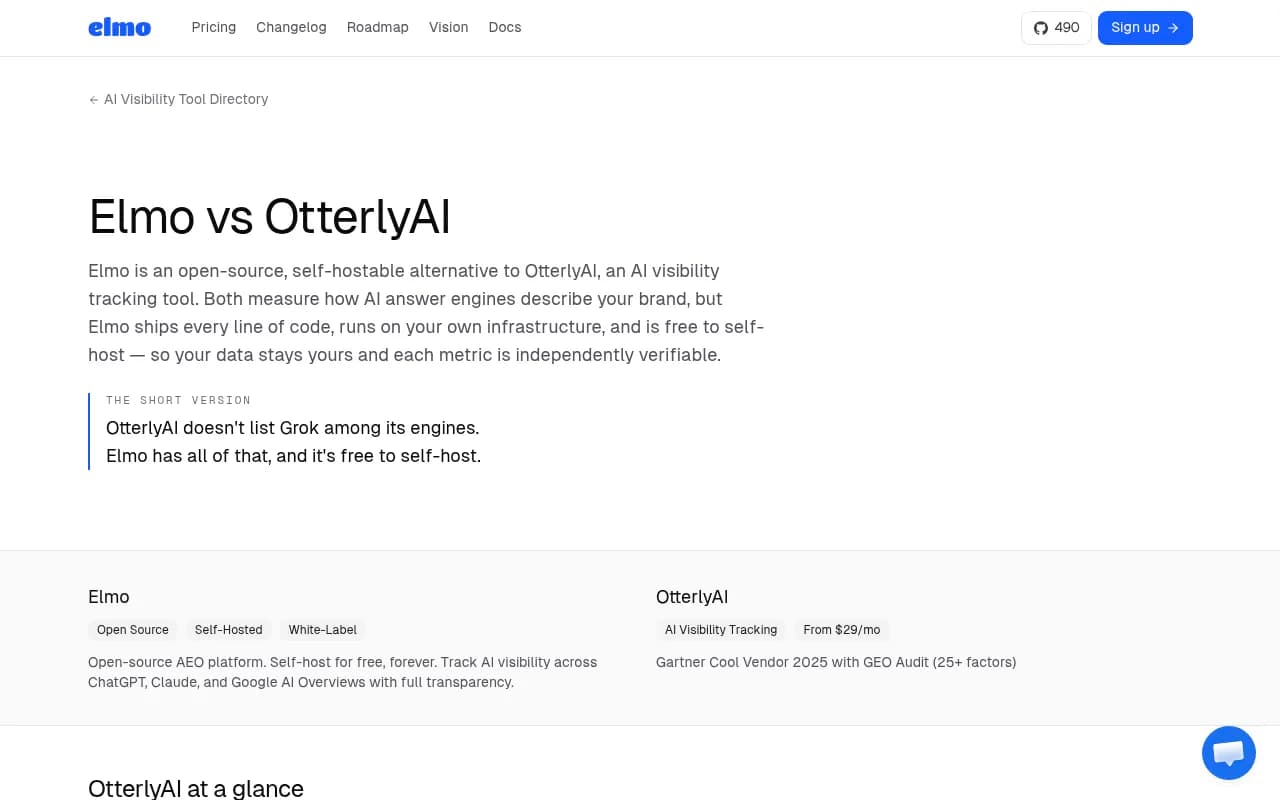
Elmo is an open-source AEO/GEO platform. According to its GitHub repo, it tracks ChatGPT, Claude, Perplexity, Gemini, Copilot, Grok and Google AI Overviews. It is MIT-licensed, every metric is auditable in code, and it is still pre-1.0. The most recent commit I saw was a version bump to 0.7.4 on Oct 23, 2026, and the repo shows more than 1,100 commits, so it is actively developed.

Recent work includes a Cursor Marketplace plugin for a cloud MCP server, a Query Fan-Out page showing query availability by engine, and Meta AI support through OpenRouter's Llama models. Elmo's site lists pricing as free to self-host, with a cloud option from $29/mo.
Otterly.AI
Otterly.AI is a hosted, closed-source tracker founded in Vienna in 2024 by the team that previously sold Usersnap. It was named a Gartner Cool Vendor in AI in Marketing 2025 and has the strongest brand recognition of the three. Its user counts vary by page (15,000, 30,000+ and 40,000+), so treat those as marketing numbers.

It covers ChatGPT, Perplexity, Google AI Overviews and Copilot, with Gemini, AI Mode and Claude as paid add-ons on the entry plan according to Zapier and Elmo's comparison. Otterly's own blog lists six or seven engines depending on the article, so check the live plan page for what your tier includes.
AI Monitor
AI Monitor (getaimonitor.com) is described as an open-source brand mention tracker for AI answers.
That is about all I can state with confidence. Elmo has no comparison page against it (that URL returns a 404), and I found no third-party reviews with pricing. If you are considering it, read the repo, check the commit history and run it against a small prompt set before trusting it with anything a client will see.
Side-by-side comparison
| Elmo | AI Monitor | Otterly.AI | |
|---|---|---|---|
| Model | Open source (MIT), self-host or cloud | Open source | Closed, hosted SaaS |
| Entry cost | Free to self-host, cloud from $29/mo | Not verified | $29/mo (Lite, 15 prompts) |
| Setup | Docker, Node, API keys | Not verified | Sign up and go |
| Engines | ChatGPT, Claude, Perplexity, Gemini, Copilot, Grok, AI Overviews, Meta AI via OpenRouter | Not verified | ChatGPT, Perplexity, AI Overviews, Copilot, plus add-ons |
| Auditable metrics | Yes | Yes (open code) | No |
| Maturity | Pre-1.0, very active | Unclear | Established, Gartner Cool Vendor |
| Support | Community and docs | Community | Vendor support |
What "free" really costs with Elmo
This is the part that gets glossed over. Self-hosting Elmo means you own the infrastructure and the bills.
From the getting started docs, you need Docker Engine 24+ with Compose v2, Node 18+ and at least one provider key (OpenAI, Anthropic or OpenRouter). Install is three commands:
npm install -g @elmohq/cli
elmo init
elmo compose up -d
The dashboard then runs on localhost:1515. The architecture is a web app and REST API, a scheduler worker, Postgres as both database and job queue, LLM APIs, and an LLM scraper. The docs claim setup takes under five minutes, and for someone comfortable with Docker that sounds plausible.
Then the costs show up:
- Mention judging, which decides whether an answer mentions your brand and with what sentiment, runs about $0.15 to $0.35 per 1,000 answers. The docs estimate $2 to $4 a month for 25 daily prompts across 3 platforms.
- Direct model APIs are not the same as what a user sees in the ChatGPT or Google AI Mode interface. The docs recommend a scraping provider such as Bright Data, Oxylabs, SearchApi, Olostep or DataForSEO to capture real UI answers. Those fees can easily dwarf the judging cost.
- Your time. Postgres backups, upgrades on a pre-1.0 project and debugging a failed scraper are on you.
If you already run a web scraping stack, tools like Bright Data are worth a look as the data layer.

So the honest comparison is not $0 versus $29. It is roughly $5 to a few hundred dollars of variable cost plus engineering time, versus a flat subscription.
What Otterly.AI costs and where it stops
Otterly's pricing page (monthly, USD, ex-tax) shows $29 for Lite, $189 for Standard and a third tier at $489. One third-party article lists a Pro tier at $989 for 1,000 prompts, which conflicts with the $489 I found, so re-check before you budget. Extra 100 prompts cost $99, annual billing takes 15% off, and there is a 14-day trial with no card.
The jump from Lite (15 prompts) to Standard (100 prompts) is where most teams feel it. Zapier notes that crawler traffic analysis and unlimited optimization recommendations are also gated behind Standard and above.
What you get for that money is real, though:
- A GEO Audit that checks 25+ on-page factors for AI readability
- AI crawler analytics and AI site audits
- Geographic tracking and multi-language support
- Email alerts and BI connectors including Looker Studio
- MCP and API access
Elmo's own feature table marks several of those (crawler analytics, geographic tracking, email alerts, BI connectors, site audits) as missing from Elmo. That table is vendor-authored, but it is Elmo admitting its own gaps, which makes it more believable.
Otterly's stated gap is that it has no native GA4 attribution dashboard. You correlate AI visibility with traffic yourself.
Where each one wins
Elmo wins on transparency and engine breadth
Elmo supports any model through bring-your-own-keys, which covers Grok, DeepSeek and Meta AI, none of which Otterly lists. It also shows query fan-out availability by engine and content gap analysis. For developers, it ships TypeScript and Python SDKs.
That query fan-out angle matters because the behavior keeps shifting. Promptwatch's ChatGPT query fanout data shows average fanouts per response falling from 2.15 in early December to about 1.84 in early March, then returning in April at exactly 1.0 per response, with average query length dropping from roughly 117 characters to about 53. A fan-out feature that was accurate in January may be misleading by April, and with open code you can at least see how it is computed.
Otterly wins on time to value
If you are a marketer with no engineering support, the question is simple. Can you be tracking 15 prompts today without opening a terminal? With Otterly, yes. The reports are clean, exportable and aimed at marketers.
AI Monitor wins on simplicity, probably
A narrowly scoped open-source mention tracker is attractive if all you want is a count of brand mentions and you do not need a full platform. But I cannot confirm that from evidence, so I will not pretend to.
Engine coverage matters more than the engine count
Each engine cites a different number of sources. Promptwatch's average sources per response data shows ChatGPT averaging about 5 cited sources per answer, Google AI Overviews about 10, and Perplexity almost exactly 10 every day. Copilot swung from under 2 to nearly 17 sources per response within a few weeks before settling at the low end, which Promptwatch reads as unstable retrieval.
Two practical consequences:
- A 15-prompt tracker has very few data points on a five-citation engine. Visibility percentages will be noisy.
- Judge Copilot on monthly trends, not weekly snapshots, whichever tool you use.
The broader question of how much to trust any tracker also applies to API versus real-UI collection. Elmo's docs openly say you need scrapers for real answers. Check what your paid vendor does too.
Vendor-survival risk is a real argument for open source
The AI visibility market is churning. Elmo's "AEO Graveyard" page lists retired tools, and marks Scrunch as acquired. A third-party Otterly article instead says Scrunch raised a $15M Series A in 2026, so those two claims conflict and I would not rely on either one. Still, it is a reasonable reminder that a closed tool can change pricing, get acquired or shut down, while an MIT-licensed codebase and your Postgres database stay with you.
That said, an abandoned open-source repo is not much of a safety net either. Check commit recency and issue responses before you bet on one.
Which one should you pick?
| Your situation | Pick |
|---|---|
| Solo marketer or small team, no engineers, under 20 prompts | Otterly.AI Lite |
| Agency needing white-label reports, alerts and Looker Studio | Otterly.AI Standard or agency plan |
| Dev-heavy team that wants auditable data and wide model coverage | Elmo (self-hosted) |
| Want open source without running infrastructure | Elmo cloud from $29/mo |
| Need only brand mention counts and like minimal tooling | Trial AI Monitor, verify first |
| Need real UI data across many countries | Check scraper costs for Elmo, or Otterly's geographic tracking |
Other trackers worth a look
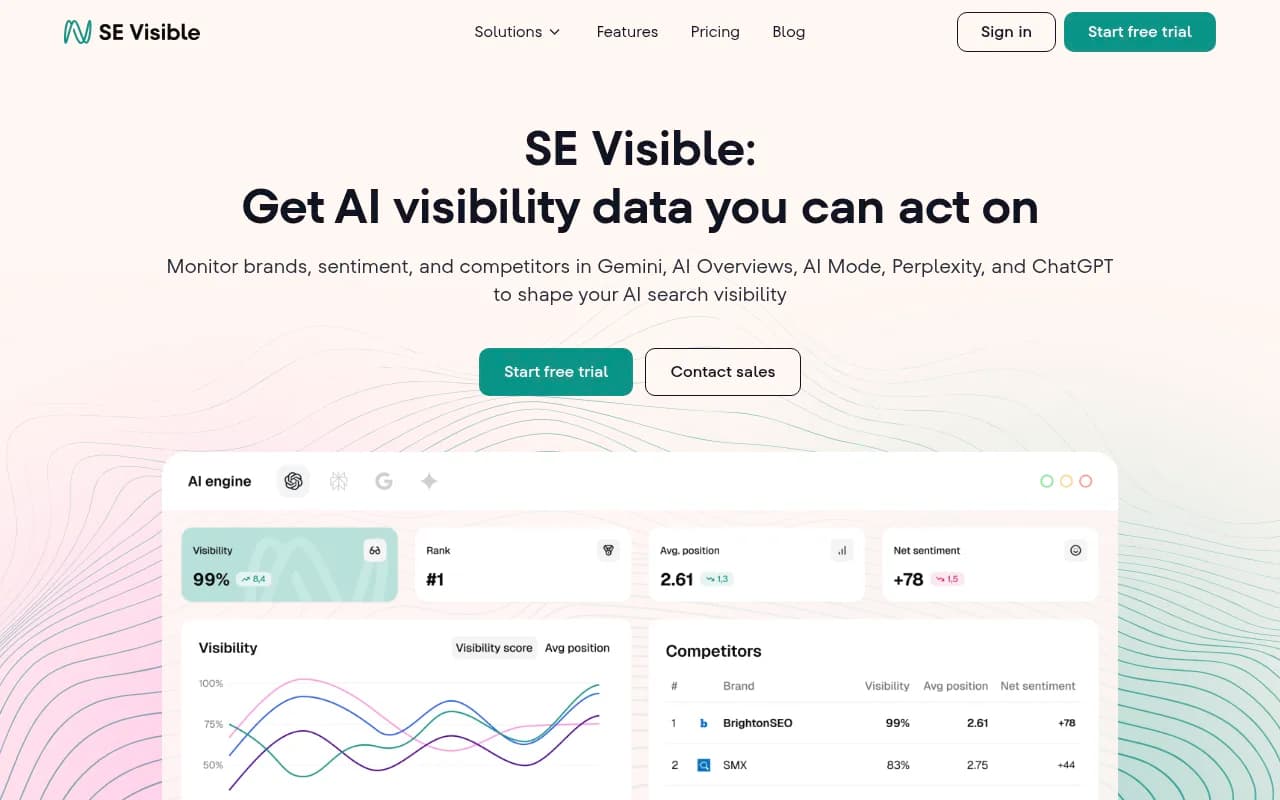
If neither model fits, the market in 2026 has plenty of paid options around the same price range. Peec AI starts around $95/mo, and Rankscale and Keyword.com sit lower on entry price according to Rankability's October 2026 survey. SE Visible runs about $99/mo for 200 prompts and 5 engines.

For a broader directory of trackers, the GEO software directory at bestgeosoftware.com and the AI rank tracking directory are good places to browse.
When a tracker is not enough
All three tools in this guide are fundamentally monitors. They tell you whether your brand showed up. They do not tell you why a page was ignored, whether AI crawlers can even read your site, or what traffic AI actually sent you.
If you need that second half, a platform like Promptwatch covers it. It adds IP-verified AI crawler logs, visitor analytics for AI traffic, content gap analysis and a Content Agent that writes and publishes fixes, then tracks whether the new pages get cited. Its Essential plan is $95/mo for 50 prompts, so it costs more than Otterly Lite, but it is aimed at the optimization work rather than only the dashboard.

A sensible path for many teams is to start with a cheap tracker to find out whether AI visibility matters for them, then move up once you have a reason to act on what you see.
Checklist before you commit
- Add up the real monthly cost: subscription or API keys, scraper fees, judging and hosting.
- Confirm which engines are included in your tier and which are add-ons.
- Ask whether answers come from real UIs or raw model APIs.
- Check the repo's last commit and open issues for any open-source tool, and note that Elmo is pre-1.0.
- Run a two-week trial with the same 15 prompts in two tools and compare the numbers. Differences will tell you more than any feature table.
- Re-verify pricing on the vendor's own page. Several figures in third-party roundups here conflict.
Bottom line
Otterly.AI is the easy choice if you want something working this afternoon and can live with a closed system. Elmo is the better choice if you value auditable data, broader model support and independence, and have someone who can run Docker and manage API spend. AI Monitor deserves a look only after you have verified what it actually does. And if tracking is only step one, plan for the optimization layer early.