Key takeaways
- Gauge is not a monitoring-only tool. Its Growth plan is $599/month and covers 600 daily prompts and 18 articles a month, but per its own pricing page it tracks only 3 platforms on that tier: ChatGPT, Google AI Mode, and Microsoft Copilot.
- Several comparison articles say Gauge's Growth plan covers 6 or 7 platforms. Gauge's pricing page says otherwise, so check plan-level coverage before you sign anything.
- Gauge publishes to Webflow, Framer, Sanity, and GitHub. There is no native WordPress publishing.
- An article-only engine covers only part of what ChatGPT cites. Promptwatch Data shows product and landing pages make up 39% of ChatGPT citations, so you need a platform that handles more than blog posts.
- Most alternatives are either monitoring-only (Otterly, Peec, Scrunch, Profound) or content-first. Promptwatch is the one in this comparison that does both and checks whether the published page got crawled, cited, and clicked.
What Gauge actually does
Gauge deserves a fair description before anyone shops for replacements. It tracks AI answers, competitors, citations, organic search data, and referral traffic. Ask Gauge, its chat layer, analyzes the combined dataset, and a content engine writes publish-ready articles.

Per the official pricing page (withgauge.com/pricing), here is the Growth tier:
- $599/month
- 600 prompts run daily, about 54,000 answers a month
- ChatGPT, Google AI Mode, and Microsoft Copilot only
- 18 publish-ready articles a month
- 3 seats, a single location, unlimited domains and competitors
- GA4, Search Console, and DataForSEO integrations
- CMS publishing to Webflow, Framer, Sanity, and GitHub
- Slack and MCP access
Enterprise is custom and covers six core platforms: ChatGPT, AI Mode, Copilot, Google AI Overviews, Gemini, and Perplexity. Claude and Grok tracking is optional on any plan, but you bring your own Anthropic or xAI API key and pay the provider directly. Gauge frames the economics as roughly a penny per answer.
The gap that matters: third-party roundups, including the Dageno article and a pricing comparison from AI Growth Agent, list Growth as covering 6 or 7 engines. That conflicts with Gauge's own page. If Gemini, Perplexity, or AI Overviews are mandatory for you, you are looking at Enterprise pricing, not $599.
One more thing to avoid mixing up: Gauge also sells Gauge Agents, a separate product for coding-agent evaluations. It has nothing to do with the GEO platform.
Why people look for alternatives
From what I can tell, the reasons fall into four buckets.
- Platform coverage. Three engines on the self-serve tier is thin if your buyers use Gemini or Perplexity.
- CMS fit. No native WordPress path is a dealbreaker for a lot of marketing teams.
- Content format. Eighteen articles a month is a blog cadence. It is not a landing page, comparison, and docs cadence.
- Price. $599 is a real number for a tool that is one of the few self-serve options in its category. Cheap monitors start around $29 a month.
The content format point is the one people underrate, so let me spend some time on it.
What the citation data says about content engines
Before comparing tools, look at what AI actually cites. Promptwatch Data analyzed ChatGPT citations from Sep 28 to Oct 4, 2026 and found product pages were the most cited type at 22.4%, followed by landing pages at 16.8% and listicles at 13.6%. Product and landing pages together are 39% of classified citations. The full breakdown is in the ChatGPT content type report.
Commercial prompts lean even harder on this. Product pages (26.0%), landing pages (20.6%), listicles (15.0%), and comparisons (7.9%) account for almost 70% of commercial citations. Branded prompts show product pages at 23.3% and landing pages at 22.8%.
So a tool that outputs 18 blog posts a month covers a slice of the picture. Blog-style how-tos are 8.7% of citations overall. That does not make articles useless, but it does mean you should ask any platform whether it can produce and update comparisons, landing pages, FAQs, and docs, not just posts.
Refresh cadence matters as well. In Promptwatch's content half-life study, pages ChatGPT cited on July 6, 2026 were tracked for 90 days:
- After 30 days, ChatGPT still cited 78% of landing pages, 76% of docs, and 72% of comparisons.
- Product pages, reviews, and how-tos sat around 55% after 60 days, with half-lives of 74 to 77 days.
- News lost half its pages in 36 days, and almost a quarter were never cited again.
If an agentic tool leans on news-style posts, expect bursts, not durable visibility. Comparisons and landing pages last longer, and you want a platform that tells you when to refresh them.
One more filter for vendor claims. Be skeptical of any pitch built around .md mirrors for LLMs. Promptwatch Data found HTML makes up 99.94% of AI search citations and markdown files just 0.05%. Spend effort on parseable HTML and pages that do not depend on client-side JavaScript.
Gauge alternatives compared
The category splits into tools that monitor and tools that act. Pricing for competitors below comes largely from a vendor-authored comparison, so treat figures as starting points and confirm on each vendor's site.
| Platform | Type | Starting price (approx.) | Publishes content? | Notable limits |
|---|---|---|---|---|
| Gauge | Tracking + content engine | $599/mo | Yes, 18 articles/mo; Webflow, Framer, Sanity, GitHub | 3 platforms on Growth, no native WordPress |
| Promptwatch | Tracking + agents + attribution | $95/mo Essential; Content Agent from $579/mo Business | Yes, Content Agent to WordPress, Webflow, Framer | Content Agent starts at Business |
| Dageno AI | Tracking + strategy + content | $49/mo | Yes | Vendor-authored comparisons rank it first |
| Profound | Enterprise monitoring | ~$99/mo yearly (ChatGPT only starter) | Mostly no | Starter is single-engine |
| Scrunch AI | Monitoring + agent-ready pages | ~$250/mo | Limited | 4 LLMs on Core |
| Peec AI | Monitoring | ~EUR 85/mo | No | Credit-based |
| Otterly.AI | Low-cost monitoring | ~$29/mo | No | Prompt caps (15/100/400) |
| AthenaHQ | Monitoring | ~$295/mo | Limited | Monitoring-focused |
The alternatives in more detail
Promptwatch
Promptwatch is the option here that closes the whole loop instead of stopping at a dashboard. It monitors ChatGPT, Gemini, Claude, Perplexity, Google AI Overviews, AI Mode, Copilot, Meta AI, and others from the real interfaces, in the countries and languages you pick. Then it acts. The Content Agent plans, writes, and publishes against your visibility gaps, with a review inbox if you want a human in the loop or hands-off if you do not.

Three differences from Gauge are worth pointing out:
- More publishing targets. The Content Agent publishes to WordPress through an official plugin, plus Webflow and Framer. Gauge lists Webflow, Framer, Sanity, and GitHub.
- Content beyond new articles. Content Refresh gives git-diff-style updates for existing pages, and content gap analysis maps your pages against the prompts AI answers. That matches the citation data above, where refreshing comparisons and landing pages beats posting more news.
- Measurement of the published page. IP-verified AI crawler logs show whether GPTBot, ClaudeBot, or PerplexityBot actually read it, Page Tracker shows whether it gets cited, and visitor analytics show traffic and conversions. A page that underperforms comes back as an action.
Some concrete numbers: Crisp reported 2x higher conversion rates from AI traffic than traditional channels and scaled to 5 to 10 articles a day (see the Crisp case study). TreeHouse, the company behind Pararius, grew AI search to roughly 25% of organic conversions, per the TreeHouse case study.
Pricing is $95/month for Essential, $245/month for Professional, and $579/month for Business, which is the first plan with the automated Content Agent, hourly tracking options, Fact Check, and local targeting. Every plan tracks all supported AI models. Confirm at promptwatch.com/pricing. There is a 7-day free trial on monthly billing and a free AI visibility report. For a head-to-head view of the field, see Promptwatch's 2026 GEO platform comparison.
Dageno AI
Dageno starts at $49/month and lists 10 platforms, including ChatGPT, Perplexity, Gemini, AI Overviews, AI Mode, Grok, Copilot, Dola, Brave, and Alexa (Alexa on a custom plan), across 86+ countries. Its pitch is that picking which GEO opportunity deserves investment is harder than producing content, so it focuses on strategy and attribution as well as content generation.
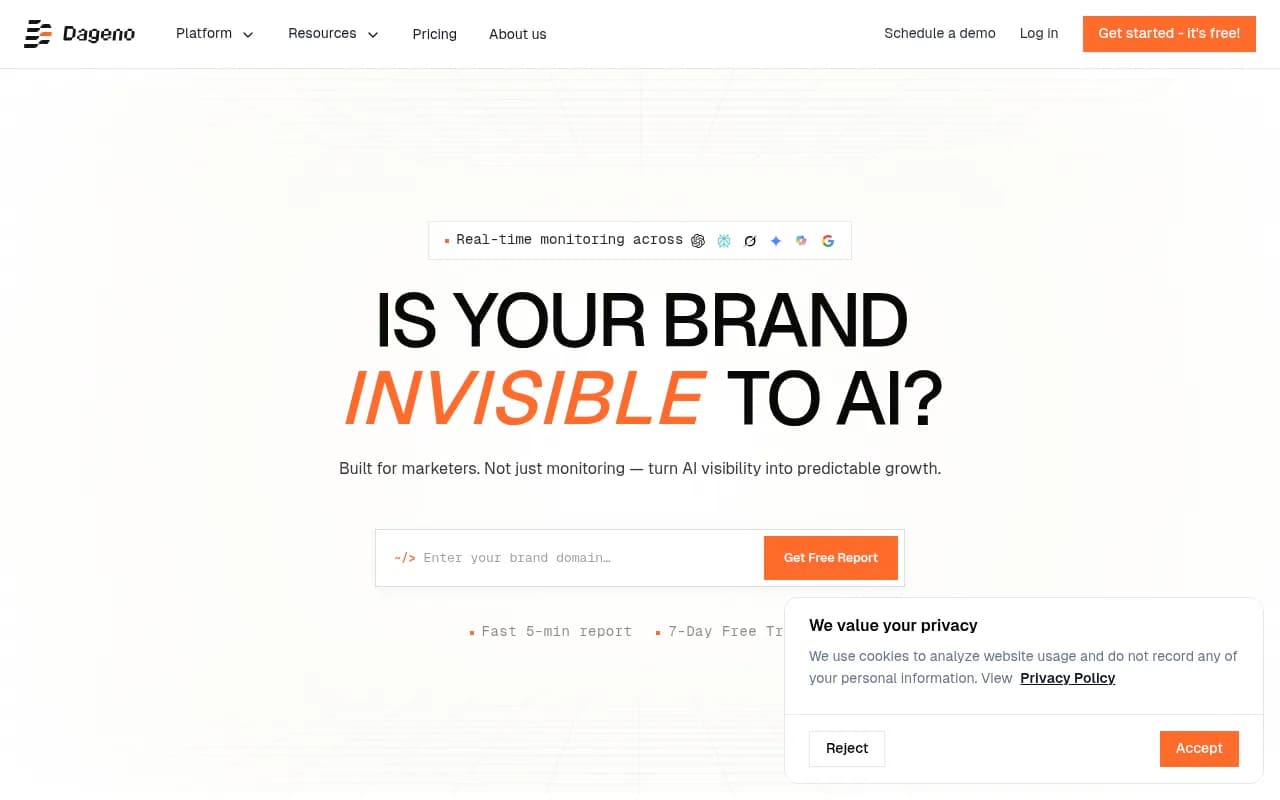
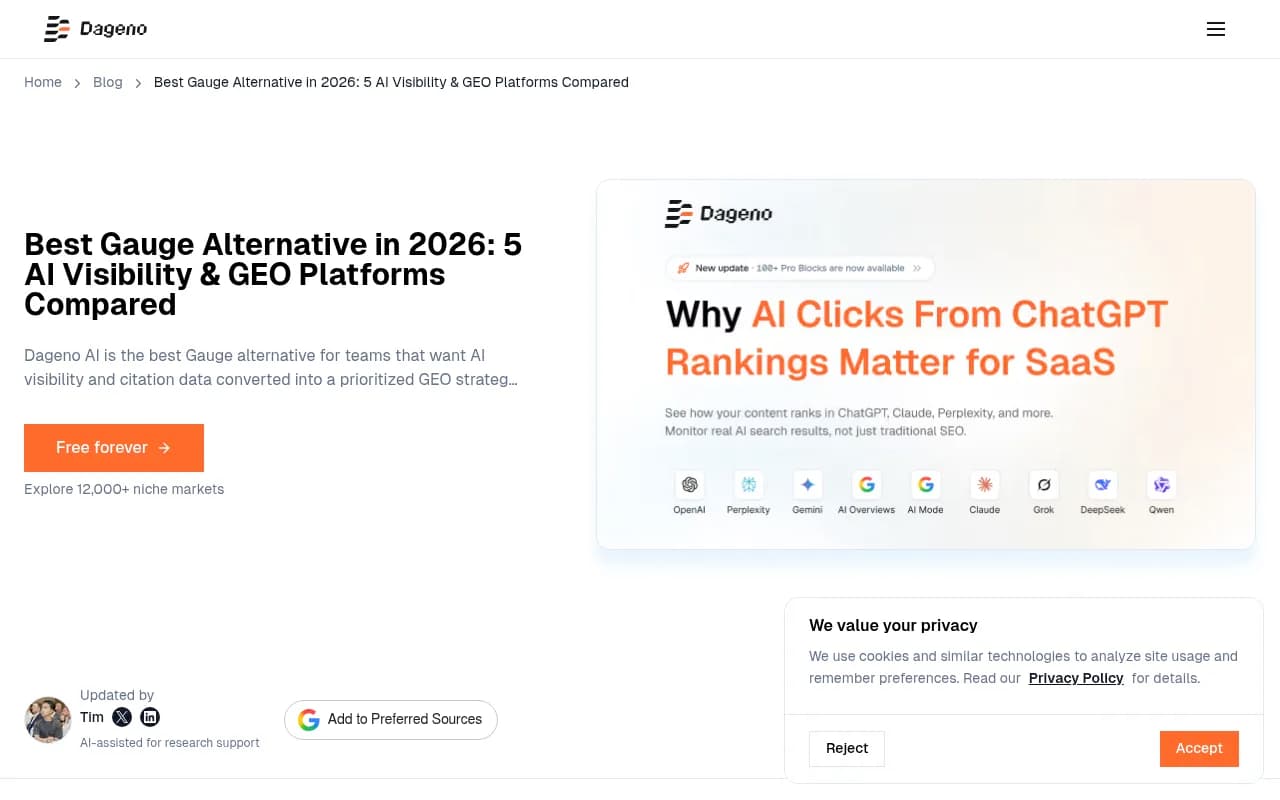
The caveat: the most-cited comparison article about Gauge alternatives is Dageno's own blog, and it ranks Dageno first. Read it as a vendor view. The platform may be a good fit, but I would run a trial before believing the framing.
Profound
Profound is the enterprise AEO name most buyers already know. Lower tiers are narrow (the starter is ChatGPT only per the secondary pricing source), and broader coverage sits in enterprise. It is monitoring-first, so if you want articles published, expect to add another tool. A Promptwatch vs Profound page covers the differences.

Scrunch AI
Scrunch pairs monitoring with agent-ready pages for your site, which is a different take on action: serve AI crawlers a cleaner version of your content. Core is about $250/month with 125 prompts and 4 LLMs.

Peec AI and Otterly.AI
Both are focused monitors. Peec is around EUR 85/month on a credit model, and Otterly starts near $29/month with 15, 100, or 400 prompts depending on tier. They are good if you only need to measure and you already have a content team. They do not write or publish anything.


OptimizeGEO and other agentic options
OptimizeGEO describes itself as an AI Discovery Growth Platform that deploys agents to research, draft, and publish content with human review built in. It claims brands using closed-loop execution grew share of voice 22% in three months. That figure is the vendor's own, and its "top 8" list mixes in marketing tools like Salesforce Marketing Cloud Next that are not GEO platforms, so ignore those entries.

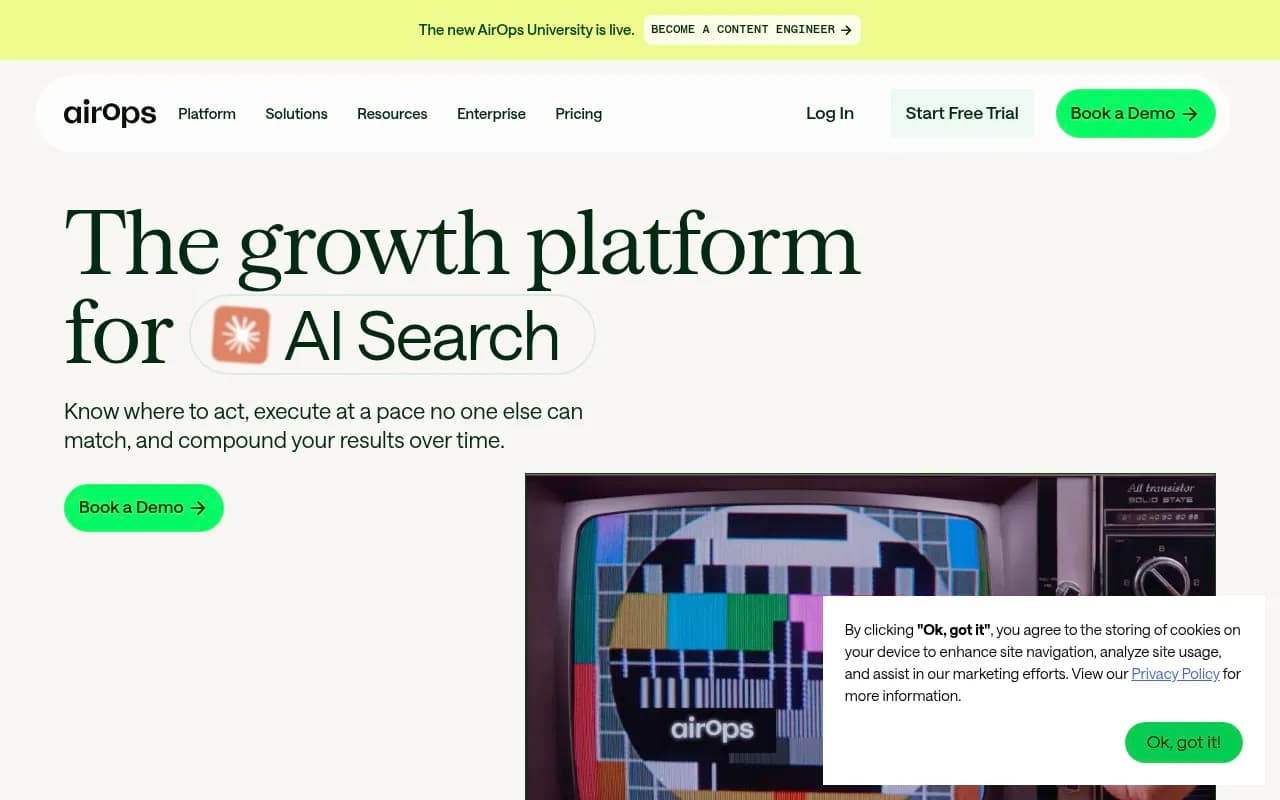
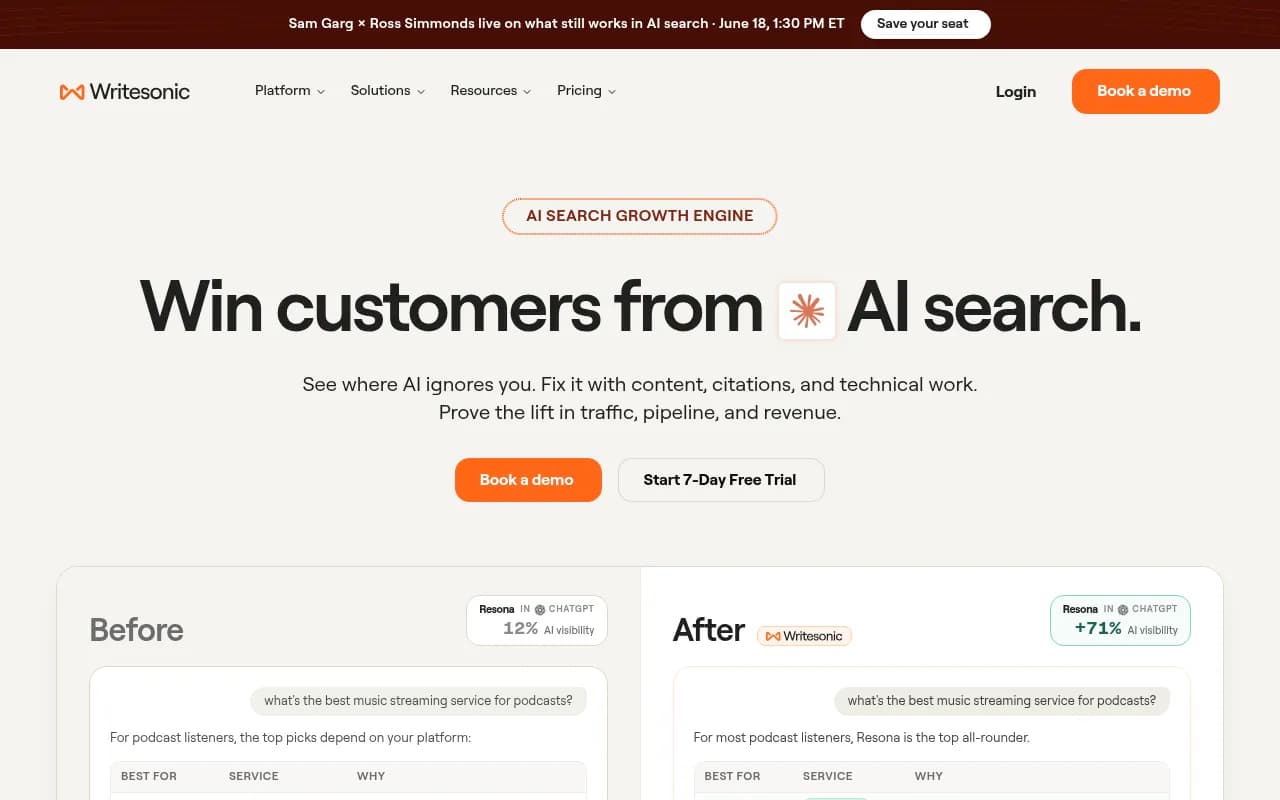
Other content-first tools in the catalog worth a look if your priority is article production:
A note on G2: its alternatives list for Gauge (Birdeye, Semrush, Meltwater, Writesonic, SE Ranking, Similarweb, Profound, Yext) is a generic mix, and Gauge has only 4 reviews. Do not read it as a head-to-head GEO ranking.
Choosing the right platform
If you want publishing plus proof it worked
Pick a platform with a measurement loop, not just a generation step. Ask whether it shows crawler access, citations, and traffic for each published page. That is where Promptwatch is strongest, and where most content engines stop.
If you are on WordPress
Gauge does not publish there natively. Check the CMS list for every vendor on your shortlist, and ask whether pushing a draft is supported or only live publishing.
If you only need monitoring
Otterly and Peec are cheaper and fine for measurement. Be honest with yourself about whether anyone on the team will act on the dashboard. Many teams buy a monitor and then stall for six months.
If you need strict platform coverage
Write down which engines your buyers use. Then ask each vendor for plan-level coverage in writing. The Gauge discrepancy above is exactly the kind of thing that bites.
Questions to ask before you buy
- Which AI platforms are included at the exact plan I will pay for?
- What is the cost per answer once prompt caps, credits, and overages are counted?
- Does the tool publish autonomously, or does a human approve each piece?
- Which CMSs are supported natively?
- Can it produce comparisons, landing pages, and FAQs, or only blog posts?
- How does it handle refreshes of existing pages?
- Does it show whether bots crawled the published page and whether AI cited it?
I could not find an independent head-to-head test of output quality or citation lift for any of these content engines. Everything published so far comes from the vendors themselves, so run a trial on a few real prompts and check citations yourself after a few weeks.
Trial plan
Shortlist two or three tools and run the same experiment on each:
- Pick 20 to 30 commercial prompts your buyers really ask.
- Let each platform draft content for the same gaps.
- Publish a small batch and watch crawl logs and citations for 30 to 60 days.
- Compare cost per cited page, not cost per article.
For more tools in this category, the GEO software directory at bestgeosoftware.com lists dozens of options with reviews.
Bottom line
Gauge is a real agentic platform, but the Growth plan covers three engines and 18 articles, and it skips WordPress. If you need wider coverage, more content formats, or proof that published pages get crawled and cited, Promptwatch is the strongest fit in this comparison. If budget is the constraint, Dageno or a monitor like Otterly gets you started for less, with the trade-offs above."}