Key takeaways
- Start with a manual check: ask ChatGPT, Perplexity and Google the questions your customers ask, in your city, and write down which businesses and sources show up.
- A citation can mean four different things: your brand is named, your website is linked, a specific page is cited, or a third-party page that mentions you is cited. Track all four.
- One prompt tells you almost nothing. Run 10 to 15 prompts, more than once, and look at patterns.
- Local citations come from directories, review sites and your own service pages. Fixing inconsistent listings is often the fastest win.
- Once manual checks get tedious, a tracker (BrightLocal for local listings, Promptwatch for deeper AI citation analysis) takes over the repetition.
What an AI citation actually is for a local business
When someone asks ChatGPT for "the best plumber near me" or Google shows an AI Overview for a local query, the answer usually names a few businesses and links to a handful of sources. Those links are citations. They are the pages the AI leaned on to build its answer.
For a local business, this gets a little messy. The page that gets cited is often not your website. It might be a Yelp listing, a trade directory, a local news roundup or a Facebook page. So "checking AI citations for your website" really means checking two things: whether your own pages get cited, and whether the third-party pages that talk about you are the ones doing the work.
A useful way to split it up, borrowed from how AIsearchflow frames citation frequency:
- Your brand is mentioned in the answer
- Your website is cited as a source
- A specific page on your site is cited
- A third-party page that mentions you is cited
A business can hit the first one and miss the other three. That usually means the AI knows you exist but doesn't trust your site enough to point at it.
Why local is different from other AI search
Local intent behaves differently. According to the Search Engine Journal piece on local AI visibility (sponsored by Reviewly.ai, so read it with that in mind), AI Overviews still trigger on only a single-digit percentage of searches with clear local intent, far below the roughly 48% average across all query types. For something like "emergency electrician open now," Google still leans on the map pack.
But people are clearly using AI for this. BrightLocal's 2026 consumer survey (n=1,164) found 58% of consumers have used AI to find or get a recommendation for a local business, and that 75% of those who contact a recommended business still go to Google to verify first. Treat these as vendor-reported numbers, but the direction is hard to argue with: AI is a discovery step, Google is the confirmation step. You need to show up in both.
Step 1: run a manual check
This costs nothing and takes about 30 minutes. ZDNET's guidance is the same: go to ChatGPT, Perplexity or Google AI Mode and ask 10 to 15 questions you'd expect your content to appear for.
Build your prompt list
Write prompts the way a customer would type them, not the way an SEO would. Mix these types:
- Category plus city: "best HVAC contractor in Phoenix"
- Urgent or specific: "who can fix a burst pipe tonight in Tampa"
- Service plus qualifier: "affordable roof repair near Waco with good reviews"
- Brand check: "what do people say about [your business name]"
- Comparison: "[your business] vs [top competitor]"
Run them across engines
Use at least ChatGPT with search turned on, Perplexity, and Google (look for an AI Overview or switch to AI Mode). Results differ by engine, so don't assume one tells you about the others.
Log what you see
A spreadsheet is enough. For each prompt and engine, record:
| Column | What to write down |
|---|---|
| Prompt | The exact wording you used |
| Engine | ChatGPT, Perplexity, AI Overviews, AI Mode |
| Were you named? | Yes, no, or mentioned with wrong details |
| Position | First, middle, last in the list |
| Your site cited? | Which URL, if any |
| Other sources cited | Every domain in the source list |
| Competitors named | Who showed up instead |
The last two columns are where the value is. The list of cited domains is your to-do list.
Repeat it
AI answers shift. Run the same prompts a few times, on different days, ideally in a logged-out or private window so personal history doesn't skew things. Promptwatch's data shows why: in the Sep 28 to Oct 4, 2026 window, 47.6% of ChatGPT responses with citations cited 10 or more unique domains. Expect to share every answer with other sites, and don't read much into a single run.
Step 2: read the cited sources like a detective
Once you have a list of cited domains, sort them into buckets:
- Directories and listings (Yelp, BBB, Angi, Yellow Pages, trade associations)
- Review platforms and Google Business Profile
- Local news and "best of" roundups
- Social profiles (Facebook, Instagram, YouTube, LinkedIn)
- Competitor websites
- Your own website
Then ask a plain question for each bucket: am I on this site, is my information right, and how do I compare to the businesses that are?
Social deserves a note, because the picture changed this year. In Promptwatch's October 2026 data, social platforms were only 0.46% of ChatGPT's citations, while they were 12.2% of Google AI Overviews citations. Facebook was 2.38% of AI Overviews citations. So for a local shop, a maintained Facebook or Instagram page matters more for Google's AI answers than for ChatGPT. And Reddit stopped being a reliable way into ChatGPT after its share of ChatGPT citations collapsed in August 2026.
Check what the AI says about you
Search your exact business name in ChatGPT and Perplexity. Read the answer slowly. Wrong hours, an old address, a closed location or a service you don't offer all point to a source somewhere that has bad data. Find the cited page and fix it there.
Step 3: audit the listings that feed the answers
AI systems cross-check. If your Google Business Profile says one thing, Yelp says another and your site says a third, the model has less reason to trust any of them.
The Search Engine Journal article suggests a simple exercise: search your business name, phone number and address on Google and click through the first 20 results. Every listing with an old phone number, previous address or misspelled name is working against you. Put them in a spreadsheet and fix them one by one.
Before you start, confirm your Google Business Profile basics:
- Categories are accurate
- Hours are current
- Service area lists every location you really serve
- Description names specific services ("residential HVAC repair, installation and maintenance," not "home services")
Quality beats volume here. A legitimate trade directory or respected local source can be worth more than dozens of low-quality listings.
Step 4: check your own website as a source
If your site is never cited, look at whether it gives an AI clean, quotable facts. Sparse homepages with no service pages hurt you. Work through this list:
- One page per service, with the service name in the H1, the cities or neighborhoods you serve, and a real paragraph on what the work involves and who it's for.
- LocalBusiness schema on the homepage: name, address, phone, hours, service area and review rating. Validate it with Google's Rich Results Test.
- An FAQ section answering the questions customers actually ask you on the phone.
- Matching name, address and phone details everywhere on the site.
- Crawlable pages. Check that robots.txt isn't blocking AI crawlers you want reading your content.
The content-type data is a useful nudge. In Promptwatch's Sep 28 to Oct 4, 2026 numbers, product pages made up 22.4% of ChatGPT citations and landing pages 16.8%, with FAQ pages at 3.3%. Most of those examples are software prompts, and I found no local-specific report, so treat this as directional. Still, the lesson for a local business is that clear service pages beat vague blog posts.
For schema, a tool like InLinks can automate some of it.
Step 5: try a free local check
Before paying for anything, a few free or trial options will do the prompt-running for you.
BaaDigi's free AI Citation Finder is built for contractors and local service businesses. You enter your business name, trade, city and an optional service phrase, and it checks OpenAI web search, Google AI Overviews and Perplexity, showing recommended businesses and cited source URLs. It's a quick way to see who gets named in your city and where the citations come from.
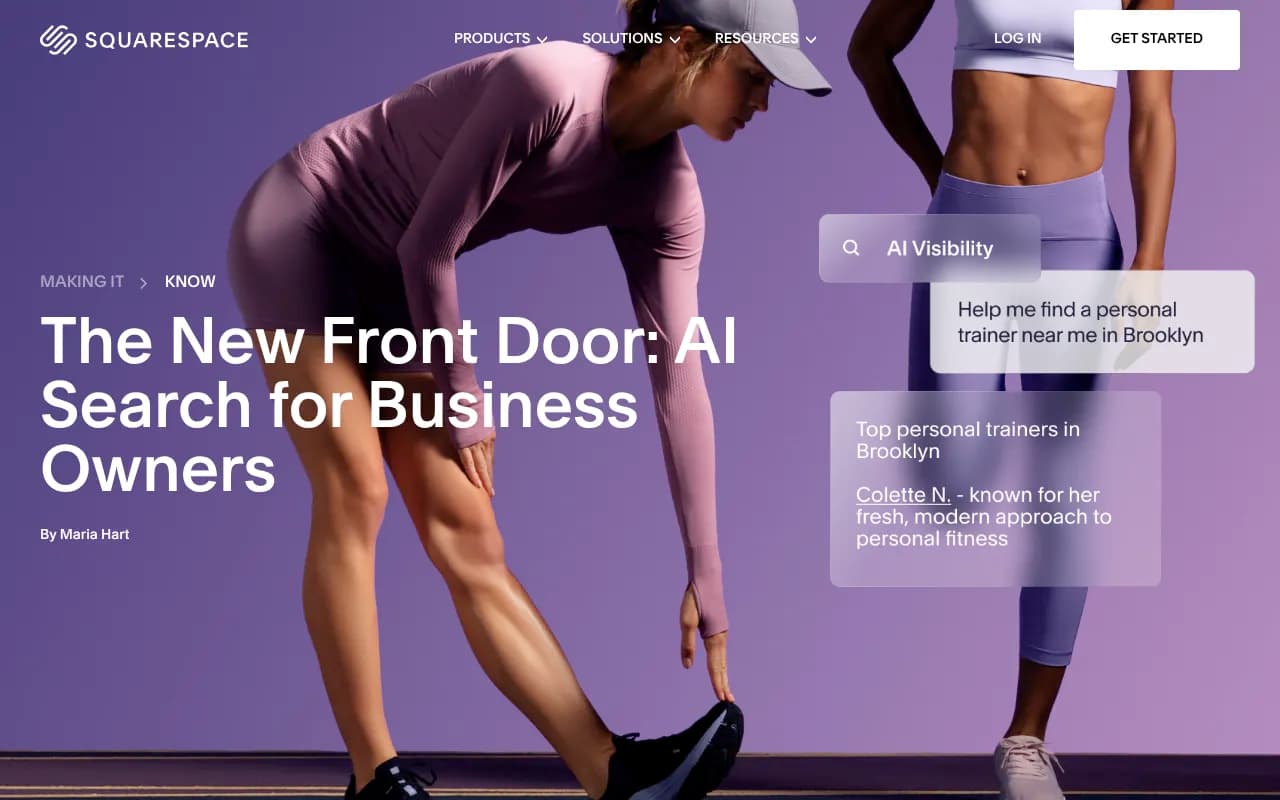
Squarespace also launched an AI Visibility tool alongside a study with Peec AI of 1.3 million citations across ChatGPT, Google AI Mode and Perplexity, focused on service-based businesses. The report is worth reading even if you don't use Squarespace. One stat from it: nearly 6 in 10 small businesses say they don't know where to start with AI search, and over two-thirds haven't looked at how they show up in AI answers.
Peec AI itself is also in the tracker category.

Step 6: pick a tracker when manual checks stop scaling
Manual checking breaks down fast. Two engines, fifteen prompts, three runs each and you're already at 90 data points a month, and that's for one location. Multi-location businesses and agencies hit the wall sooner.
The tools below split into two camps. Local-first platforms tie AI visibility to listings and reviews. General AI visibility platforms go deeper on citations, crawlers and content, and you'd configure city-level prompts yourself. Check current pricing on each vendor's site before you decide.
| Tool | Type | Good for | Watch out for |
|---|---|---|---|
| BrightLocal | Local-first | Checking if ChatGPT, AI Mode and AI Overviews recommend you, and routing listing gaps into citation building | Focused on local SEO workflows |
| Birdeye Search AI | Local-first | Location-level AI visibility for multi-location brands | Aimed at larger setups |
| Yext Scout | Enterprise | Competitive intelligence for enterprise brands | Likely overkill for one location |
| Promptwatch | General GEO platform | Citation analysis, crawler logs, content gaps, fixing what you find | More depth than a single-location shop may need |
| Peec AI | Tracker | Prompt-level tracking across engines | Monitoring-focused |
| Otterly.AI | Tracker | Affordable brand monitoring | Basic feature set |
| SE Ranking Visible | Tracker | Teams already using SE Ranking | Not local-specific |
Local-first options
BrightLocal now includes a Local AI Visibility tool. Its pitch is that you can see which directories AI cites for your category, whether you're listed on them, and send any gaps straight into its Citation Builder. It offers a 14-day free trial per its site.
Birdeye Search AI does location-level tracking, which matters if you run several branches.
Synup and Chatmeter sit nearby in the listings and reviews space, and Yext Scout targets enterprise brands.
Yext Scout
Deeper citation tracking
If you want to see which of your pages get cited, how AI crawlers hit your site and what to fix, Promptwatch goes further than most trackers. It monitors real AI interfaces rather than just APIs, shows which sources are cited for prompts in your category, logs AI crawler visits, and has a content agent for filling gaps. Tracking by country comes on every paid plan, and state and city tracking starts on the Business plan, which matters for local work. Confirm plans at promptwatch.com/pricing.

For a lighter touch, Otterly.AI and Peec AI are common starting points for small teams.

If you want to compare more options, the GEO software directory at bestgeosoftware.com and the AI rank tracking directory at ai-rank-tools.com list a lot more.
Step 7: set a monthly routine
A one-time check tells you where you stand. A routine tells you whether anything you did worked. Keep it small:
- Re-run your 10 to 15 core prompts monthly, same wording, same engines.
- Note changes in who is named, where you land in the list, and which sources get cited.
- Check every new cited domain. Is it a directory you should join or a review site you should ask customers to use?
- Spot-check your business name for wrong facts.
- Fix one or two source problems per month instead of ten at once.
This lines up with Promptwatch's advice from its unique-domains report: measure across many prompts, track where you appear and how you're described, not only whether you're cited, and check which review sites and forums come up for prompts about your brand.
Common mistakes
- Judging results from one prompt. Answers vary run to run.
- Only checking ChatGPT. Google's AI surfaces cite different sources.
- Ignoring third-party citations. For local, the cited page is often a directory, not you.
- Using generic prompts without a city. Local answers depend on location.
- Fixing the website while the listings still carry old data.
- Treating AI visibility as separate from Google. Most AI-using consumers verify on Google, so you need both.
When to get help
If you manage many locations or clients, the workload grows quickly. Agencies like 1001 SEO Media handle this kind of AI citation auditing alongside local and technical SEO, and they use Promptwatch for the tracking side. For a single-location business, the manual process above plus a free trial of one tracker is enough to learn where you stand.
Bottom line
Start with 15 prompts, three engines and a spreadsheet. Read the cited domains, fix the listings that carry wrong data, tighten your service pages and schema, then hand the repetition to a tracker once you've proven the checks are worth running. The first month usually turns up a handful of specific, fixable gaps.