Key takeaways
- Most AI search visibility platforms are monitoring-only dashboards -- they show you where you're invisible but don't help you fix it
- The market has fragmented fast; there are now 30+ tools claiming AI visibility, with wildly different capabilities
- Before buying, you need to verify which AI models a platform actually tracks (not just claims to track), how it collects data, and whether it can help you act on what it finds
- Crawler log access, content gap analysis, and prompt volume data separate serious platforms from dashboards
- Price alone is a poor signal -- a $99/mo tool that drives action beats a $500/mo dashboard that just reports
The AI search visibility software market has exploded. In early 2025, there were maybe a dozen tools worth considering. By mid-2026, there are well over 30, and most of them look nearly identical on a features page. They all track "brand mentions across AI models." They all have dashboards. They all promise to show you where you rank in ChatGPT and Perplexity.
What they don't all do is help you actually improve.
A LinkedIn post from Lari Numminen, who tested 12+ AI visibility tools, put it bluntly: almost every one had a critical flaw that could waste 30-40% of customer budget. That's not a minor quibble -- that's the difference between a tool that earns its subscription and one that becomes shelfware by month three.
This checklist is designed to help you avoid that outcome. Run any platform you're evaluating through these 12 questions before you sign up.
The 12-question checklist
Question 1: Which AI models does it actually track -- and how?
This sounds obvious, but the answer is rarely what the marketing page implies. Most platforms claim to monitor ChatGPT, Perplexity, Gemini, Claude, and a handful of others. The real question is whether they're querying the user-facing product or just hitting the API.
This matters because the answers can differ. ChatGPT's web interface with browsing enabled behaves differently from the API. Google AI Overviews and Google AI Mode are only accessible through the actual search interface -- there's no API for them. A platform that only uses API calls will miss these entirely, or simulate them in ways that don't reflect what your customers actually see.
Ask vendors directly: "How do you collect responses from each model?" If they can't give you a specific answer, that's a red flag.
The models worth tracking in 2026: ChatGPT, Perplexity, Google AI Overviews, Google AI Mode, Claude, Gemini, Meta AI, DeepSeek, Grok, Copilot, and Mistral. If a platform covers fewer than six of these, you're getting a partial picture.
Question 2: Does it track prompt volume and difficulty?
Knowing that you're invisible for a prompt is only useful if that prompt matters. A platform that shows you 200 prompts where competitors outrank you is useless if it can't tell you which ones drive actual search behavior.
Look for:
- Volume estimates per prompt (how often real users ask this)
- Difficulty scores (how competitive is this prompt to win)
- Query fan-outs (how one prompt branches into related sub-queries)
Without these, you're essentially optimizing blind. You might spend three months creating content for a prompt that 40 people ask per month while ignoring one that 40,000 people ask.
Question 3: Can it identify content gaps -- not just visibility gaps?
There's a meaningful difference between "you're not mentioned here" and "here's exactly what content you need to create to get mentioned."
Monitoring-only platforms stop at the first one. They tell you where you're losing. The more useful question is why -- and what to do about it.
A proper answer gap analysis should show you:
- Which specific prompts competitors appear for that you don't
- What topics, angles, and questions are driving those citations
- Which pages on your site (if any) are close to ranking but missing something
This is the difference between a dashboard and a tool that actually earns its keep.
Question 4: Does it help you create content, or just identify gaps?
This is where the market really splits. Most platforms identify gaps and then... stop. They hand you a list of problems and leave you to solve them yourself.
A smaller number of platforms go further and generate content directly from that gap data -- articles, comparison pages, listicles, and briefs grounded in real prompt data, citation patterns, and competitor analysis.
If you're evaluating a platform that includes content generation, ask:
- Is the content generated from actual prompt and citation data, or is it generic AI writing?
- Can you provide brand guidelines, tone of voice, and uploaded knowledge-base files?
- Does it track whether the content it generates actually gets cited after publication?
That last point is the one most vendors can't answer. Content generation without a feedback loop is just an AI writing tool with a GEO label on it.
Promptwatch is one of the few platforms that closes this loop -- it generates content from real gap data, then tracks whether that content moves your citation rates over time.

Question 5: Does it track AI crawler activity on your site?
This is a capability most buyers don't think to ask about, and most platforms don't have it.
AI crawlers -- the bots that ChatGPT, Perplexity, Claude, and others send to index your content -- leave traces in your server logs. A platform with crawler log integration can tell you:
- Which pages AI crawlers are reading
- How often they return
- Whether they're hitting errors (404s, blocked pages, slow load times)
- How long it takes from crawl to citation
This data is genuinely useful for diagnosing why content isn't getting cited. If Perplexity's crawler visits a page but never cites it, that's a different problem than if it never visits at all. Without crawler log access, you're guessing at the cause.
Ask vendors: "Do you integrate with server logs, Cloudflare, Vercel, or similar infrastructure to track AI crawler behavior?"
Question 6: Does it track offsite citations and third-party sources?
Your AI visibility isn't just determined by your own website. Reddit threads, YouTube videos, industry publications, listicles, and review sites all influence what AI models recommend.
A platform that only monitors your own domain is missing a significant portion of the picture. If Perplexity is citing a Reddit thread that describes your product negatively, you need to know that -- and you can't fix what you can't see.
Look for:
- Tracking of which external sources AI models cite in responses about your category
- Reddit and YouTube monitoring specifically (these are heavily weighted by several models)
- Offsite brand mention tracking across third-party domains
Question 7: How does it handle multi-region and multi-language tracking?
AI models don't give the same answers in every country or language. ChatGPT's response to "best project management software" in German is different from its response in English, and different again in Japanese.
If you operate in multiple markets, a platform that only tracks English-language responses in the US is giving you a false sense of your global position.
Ask:
- Can it run prompts in any language?
- Can it simulate queries from specific countries or regions?
- Can it use different personas to match how different customer segments actually prompt?
Question 8: How does it attribute AI visibility to actual traffic and revenue?
This is the question that separates platforms built for marketers from platforms built for analysts.
Tracking citation rates is useful. Connecting those citations to website visits and conversions is what justifies the budget. Without attribution, you're reporting on a vanity metric.
Look for:
- AI traffic attribution (which pages are getting visits from AI referrals)
- Integration with Google Search Console or analytics platforms
- Page-level tracking that shows citation rate alongside traffic and conversion data
A platform that can show you "this page went from 0 citations to 12 citations after we published this content, and traffic from Perplexity increased by 34%" is telling a story that finance understands.
Question 9: What does the prompt tracking interface actually look like?
This sounds superficial, but it's not. The way a platform structures prompt tracking determines whether your team will actually use it.
Things to evaluate in a demo or trial:
- Can you organize prompts by topic, funnel stage, or persona?
- Can you see historical trends for each prompt over time?
- Can you compare your visibility against specific competitors for each prompt?
- Is the data exportable for custom reporting?
A platform with 500 features and a confusing interface will get used less than a simpler one that your team actually opens every week.
Question 10: How fresh is the data?
AI search is moving fast. A platform that updates citation data weekly is significantly less useful than one that updates daily. If a competitor launches a new campaign and starts dominating AI responses, you want to know within days, not at the end of the month.
Ask vendors:
- How often are prompts re-run?
- How quickly does new content you publish show up in the tracking?
- Is there a way to manually trigger a re-run for specific prompts?
Question 11: What does the pricing model actually include?
AI visibility platform pricing is genuinely confusing right now. Most vendors charge based on some combination of: number of sites, number of prompts tracked, number of AI models covered, number of content pieces generated, and number of users.
The sticker price rarely tells the full story. A platform at $99/mo that limits you to 50 prompts across 1 site might cost $579/mo by the time you have the coverage you actually need.
Before signing anything, map out:
- How many prompts you realistically need to track
- How many sites or brands you're managing
- Whether content generation is included or an add-on
- What happens to your data if you cancel
| Platform tier | Typical prompt limit | Sites | Content generation | Crawler logs |
|---|---|---|---|---|
| Entry-level ($50-150/mo) | 25-100 | 1 | No | No |
| Mid-tier ($200-350/mo) | 100-200 | 2-3 | Sometimes | Sometimes |
| Business ($400-600/mo) | 250-500 | 3-5 | Yes | Yes |
| Enterprise (custom) | Unlimited | Unlimited | Yes | Yes |
Question 12: Can you see results from a free trial before committing?
Any platform worth buying should let you run a real trial. Not a demo. Not a sales call with screenshots. An actual account where you can enter your domain, set up prompts for your category, and see what the data looks like for your specific situation.
If a vendor won't give you a trial, ask why. The most common reason is that the data quality doesn't hold up under scrutiny for every vertical.
A good trial should let you:
- Run at least 10-20 prompts relevant to your business
- See competitor comparisons
- Export or review at least one content gap report
- Evaluate the interface your team will actually use
How to score platforms against this checklist
Not every question carries equal weight. Here's a rough prioritization based on what actually drives ROI:
High priority (deal-breakers if missing):
- Real model coverage, not just API simulation (Q1)
- Content gap analysis, not just monitoring (Q3)
- Traffic and revenue attribution (Q8)
- Free trial availability (Q12)
Medium priority (significant differentiators):
- Prompt volume and difficulty data (Q2)
- Content generation from gap data (Q4)
- Offsite citation tracking (Q6)
- Data freshness (Q10)
Lower priority (nice to have, but not blockers):
- Crawler log integration (Q5)
- Multi-region tracking (Q7)
- Interface quality (Q9)
- Pricing transparency (Q11)
A quick look at how some platforms stack up
The market has a few distinct tiers right now.
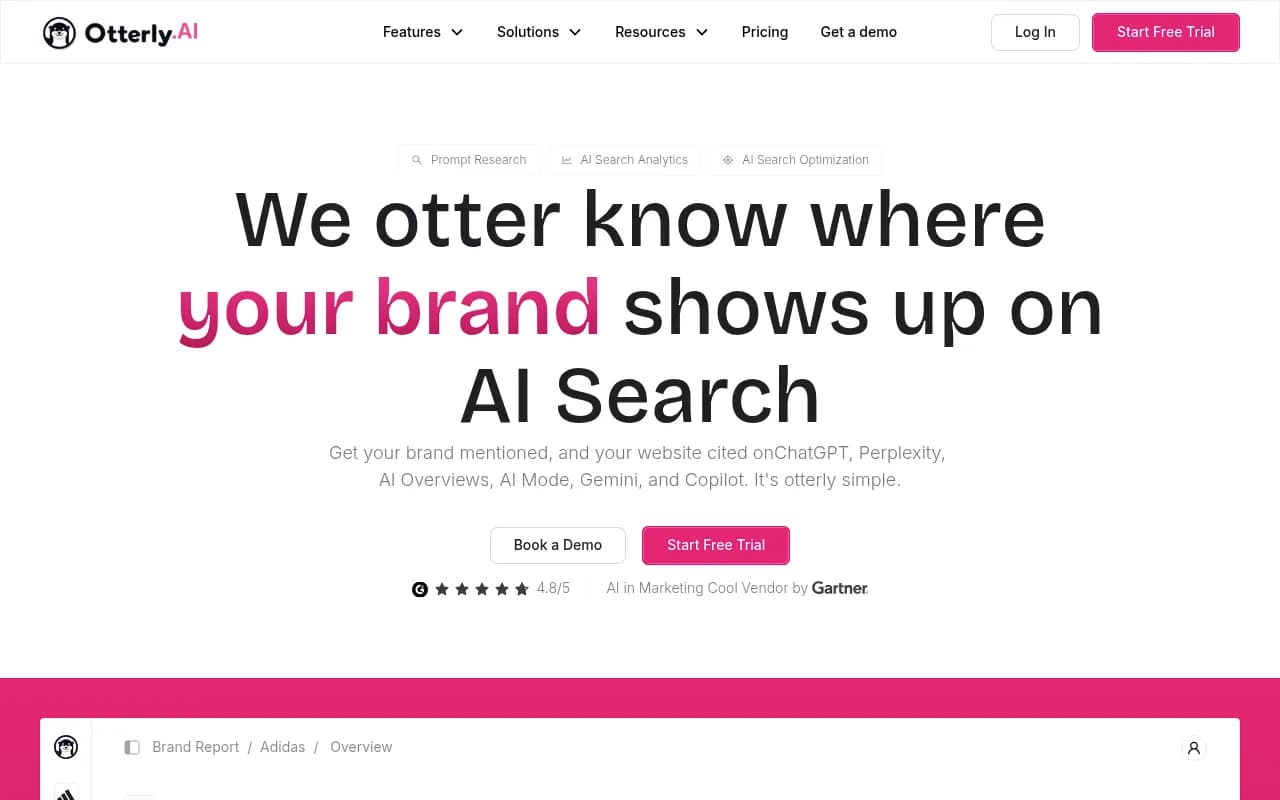
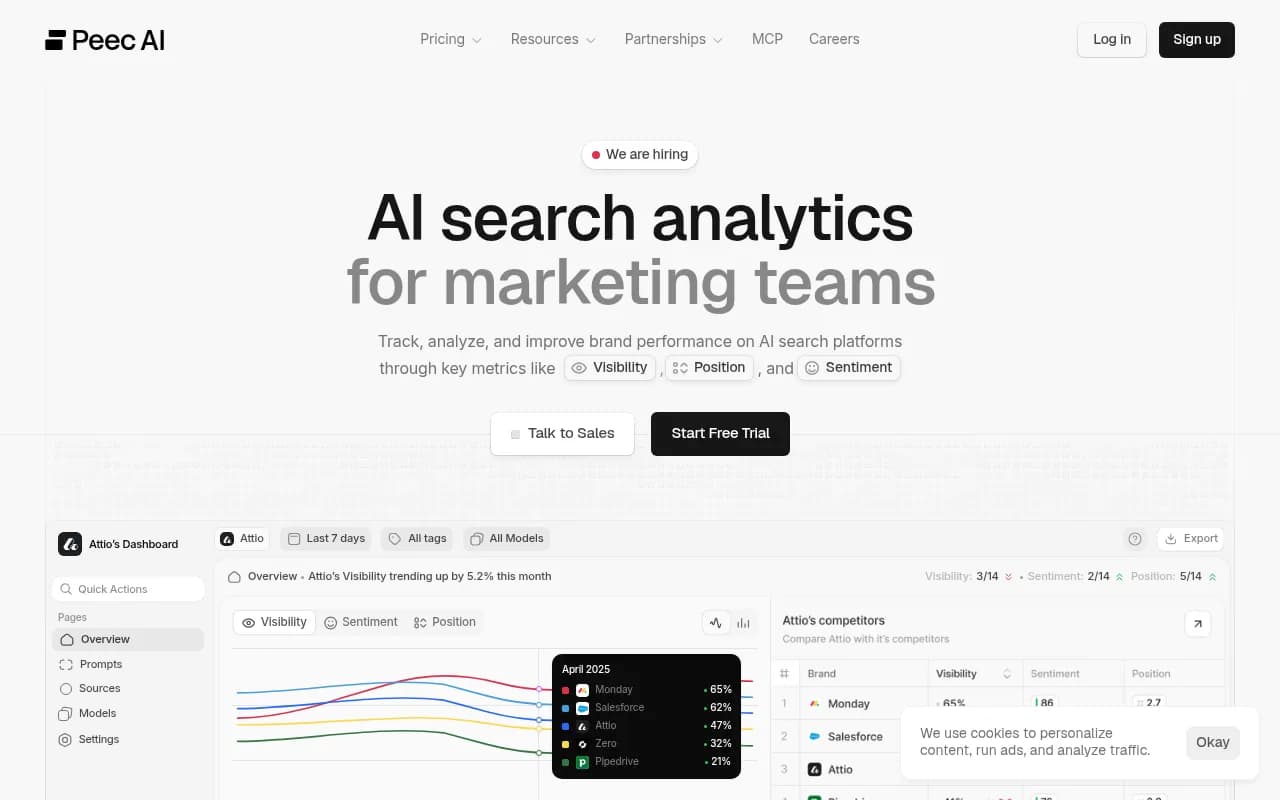
Monitoring-only tools like Otterly.AI and Peec.ai are affordable and useful for basic brand tracking, but they stop at showing you the problem. If you're just getting started and want to understand your baseline, they're fine. If you want to improve, you'll outgrow them quickly.
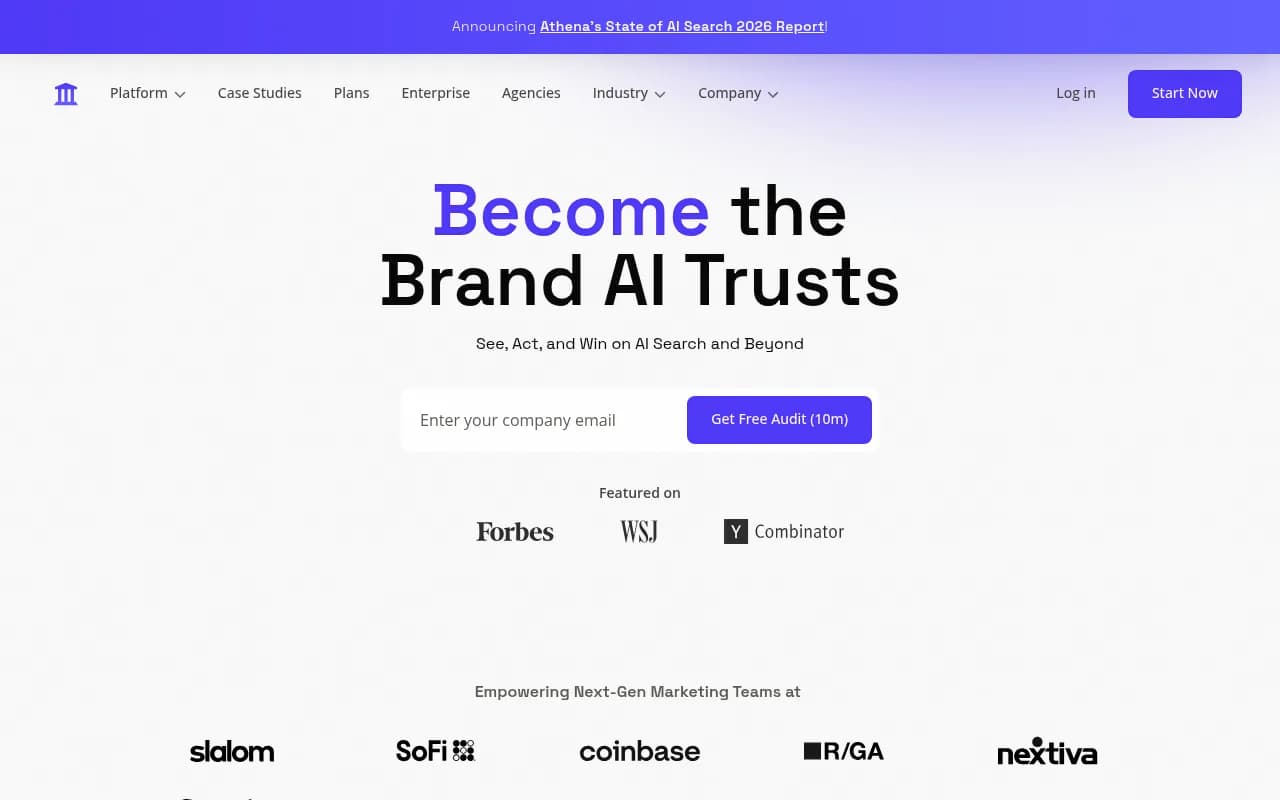
Mid-tier platforms like AthenaHQ and Search Party add more depth -- better competitor comparisons, more models covered -- but still lean toward reporting over action.
Enterprise tools like Profound and Scrunch AI have strong feature sets and are well-suited to large brands with dedicated analytics teams, though they come at a price point that's hard to justify for smaller teams.
Platforms that cover the full loop -- gap identification, content creation, and result tracking -- are rarer. Promptwatch is the clearest example: it runs prompts across 10+ AI models using real user-facing interfaces (not just APIs), identifies gaps with prompt volume data, generates content from those gaps, and then tracks whether that content gets cited. The crawler log integration is particularly useful for diagnosing why content isn't being picked up.
For teams that want to actually move their AI visibility numbers rather than just report on them, that end-to-end capability is what to look for.
A note on the research process itself
One thing worth doing before you even start evaluating platforms: run a manual test. Open ChatGPT, Claude, Gemini, and Perplexity. Type in 5-10 queries a real customer would use to find your product or service. See who shows up.
This takes 20 minutes and gives you a baseline that's completely independent of any vendor's data. When you then evaluate platforms, you can cross-check their findings against what you saw manually. If a platform claims you're highly visible for a prompt where you manually confirmed you're not mentioned, that's a data quality problem worth knowing about before you pay.
Aleyda Solis's AI Search Optimization Checklist (updated May 2026) is a useful companion resource for thinking through the optimization workflow once you've chosen a platform.
The G2 data cited by The Final Code is worth keeping in mind throughout this process: 51% of B2B buyers now start their research in an AI chatbot more often than Google, and 69% chose a different vendor than they originally planned because of what an AI chatbot recommended. The stakes for getting your AI visibility right are real, and so is the cost of paying for a platform that doesn't actually help you get there.
The bottom line
The question isn't whether you need an AI search visibility platform in 2026. You do. The question is whether the one you're evaluating will actually change your visibility or just measure it.
Run every vendor through these 12 questions. Insist on a real trial. Cross-check their data against your own manual tests. And pay close attention to whether the platform helps you act on what it finds -- because that's the part most of them still can't do.