Key takeaways
- Local-intent prompts behave like organic prompts in ChatGPT: they pull from a wide pool of competing domains rather than a narrow brand-specific set, which is exactly why a single national dashboard misses what's happening city by city.
- Google AI Overviews places far less weight on proximity than the classic local pack. A business slightly closer to the searcher is modestly more likely to show up, but once included, distance barely moves its position in the answer.
- Service-and-location pages, not homepages, carry the weight in AI answers for local categories like plumbing and roofing. One large citation study found 48% of contractor citations pointed to service+location pages, against 43% to homepages.
- Legacy geo-grid tools (think Local Falcon, Local Dominator) are bolting AI-engine tracking onto map-pack infrastructure they already had. National AI-visibility platforms are bolting location filters onto prompt sets built for brand-level tracking. Neither camp started where the other camp is strongest.
- If you operate in more than three or four distinct metro areas, you need per-city prompt clusters, not a single "average visibility score." Below that, a national-style setup with a few localized prompts usually covers you.
Why "local SEO" and "local GEO" aren't the same muscle
Traditional local SEO ran on three levers: proximity, relevance, prominence. Google decided how close you were, how well your listing matched the query, and how trusted you looked, and the local pack did the rest. GEO breaks that model because the thing doing the ranking now is also doing the writing.
That distinction matters more than it sounds. In the old model, a searcher in Austin typing "plumber near me" got a map with pins sorted largely by distance. In 2026, that same searcher might get an AI Overview or a ChatGPT answer that synthesizes a paragraph, names two or three businesses, and never shows a map at all. The sorting logic behind that paragraph isn't the same sorting logic behind the pins.
According to Local Falcon's whitepaper analyzing 4,423 businesses across 20 countries (with a 430-business U.S. subset tested at the geo-grid level), Google AI Overviews place noticeably less weight on proximity than the local pack does. A business slightly closer to the searcher is modestly more likely to appear in the summary, but once it's in, distance has little effect on where it lands in the answer. Local Falcon puts it bluntly: "Distance doesn't affect AI Overview rankings, contrary to local packs."
That's a real shift in mechanics. It means the old playbook of stacking proximity signals (embedding a Google Map, stuffing the city name into every H2) does less work than it used to. What moves the needle instead is whether your content, structure, and third-party mentions give the model enough confidence to name you at all.
When local prompt tracking actually matters
Not every business needs city-by-city prompt monitoring. The deciding factor isn't revenue or headcount, it's query shape. Ask yourself whether your customers search with location baked into the question, or whether location is incidental.
A national SaaS company answering "best project management software for remote teams" doesn't need five city-specific prompt clusters. A five-location dental group answering "emergency dentist open now" absolutely does, because the answer the AI gives is going to differ materially by metro.
Search Engine Land's 2026 field study is useful here because it breaks AI Overview appearance down by intent rather than treating "local search" as one bucket. AI Overviews showed up in only 15% of simple local-intent queries like "tacos san francisco," where the classic local pack still dominates over 90% of the time. But AI Overviews appeared in 92% of informational-intent local queries ("how long does an eye exam take near me?") and 97% of hybrid-intent queries ("average cost of dental implants in phoenix"). The practical read: if your customers mostly ask simple "X near me" questions, you're still fighting the local pack battle. If they ask cost, duration, or comparison questions with a location folded in, you're fighting a generative-answer battle, and that's where location-specific prompt tracking earns its keep.
The competition problem nobody mentions
Here's something that gets lost in most GEO advice: local-intent prompts are crowded in a specific way. Promptwatch's data on unique domains per ChatGPT response (gathered September 28 to October 4, 2026) shows that organic, non-branded prompts cite 10 or more different domains 52.5% of the time, while brand-specific prompts cite that many domains only 21.3% of the time. A "near me" or city-plus-service query behaves like an organic prompt, not a brand prompt. That means your single location page in Tampa isn't just competing against three other plumbers in Tampa, it's competing against directories, review aggregators, and local news round-ups all pulling from the same wide source pool the model draws on.

This is also why Promptwatch and similar platforms track prompt-level citation rates rather than a single "visibility score." A national average can hide the fact that you're winning in Denver and getting erased in Phoenix, and you'd never know which market needs the content fix without breaking the data down by location.
What actually gets cited in local AI answers
An independent analysis of over 9,400 ChatGPT answers across local business categories found huge variance by vertical. In plumbing, the plumber's own site was cited in 53.7% of answers. In roofing, that number dropped to just 17.8%, with Expertise.com picked up 40% of the time instead. That gap alone tells you something: category-level aggregator trust varies, and a generic "optimize your Google Business Profile" strategy doesn't account for it.
When a contractor's own site did get cited, the page type mattered. The homepage got the nod 37.4% of the time, a plain service page 24.1%, a page combining service and city 17.4%, and a dedicated, narrowly scoped location page only 10.7% of the time. A separate, larger citation sort of nearly 75,000 AI citations to contractor sites found service-and-location pages taking 48% of citations against 43% for homepages, with blog content barely registering at 1.5%.
Put those two findings together and the direction is clear: invest in solid service+location pages before you invest in blog content aimed at AI visibility. It's the opposite of what most content calendars assume.
Review platforms are data sources, not citation sources
One more wrinkle worth flagging. The same local-citation study found that 34% of rated business cards shown on ChatGPT's map interface link to a Yelp business page, and 98% of answers showing a business under 4.0 stars involved a Yelp-linked card. But Yelp rarely shows up as a cited text source in the written answer itself. It's feeding the map card's rating data, not the prose. Worth knowing before you spend a budget cycle chasing Yelp reviews expecting a citation bump in the written answer; you'll move the star rating shown on the card, not necessarily your odds of being named in the paragraph.
There's also a quiet discrepancy between platforms: the same businesses averaged 4.3 stars on ChatGPT's Yelp-linked cards versus 4.9 stars on Google AI Mode. If your ratings look worse in ChatGPT than in Google, that's likely the source feed talking, not your actual reputation.
Local GEO vs national GEO: the practical fork
Here's where most teams get stuck. The tooling landscape splits into two lineages that started from opposite ends of the same problem.
| Approach | Where it started | Location handling | Strongest at | Weakest at |
|---|---|---|---|---|
| Geo-grid local SEO tools (Local Falcon, Local Dominator) | Map-pack rank tracking | Location is the primary axis; AI tracking is the add-on | Visual neighborhood-level coverage, multi-location franchises | Depth of citation analysis, content-gap tooling, cross-model prompt libraries |
| National AI-visibility platforms (Profound, Peec AI, Semrush AI Visibility Toolkit) | Brand-level prompt tracking | Location is a filter or tag, often gated to top-tier pricing | Cross-model coverage, citation analytics, content generation | Hyperlocal granularity, map-card data, per-metro competitive sets |
| End-to-end GEO platforms (Promptwatch) | Prompt tracking plus execution | State/city-level tracking built in, with crawler logs and content agents tied to it | Turning gaps into published fixes, not just dashboards | Not purpose-built for geo-grid map visuals |
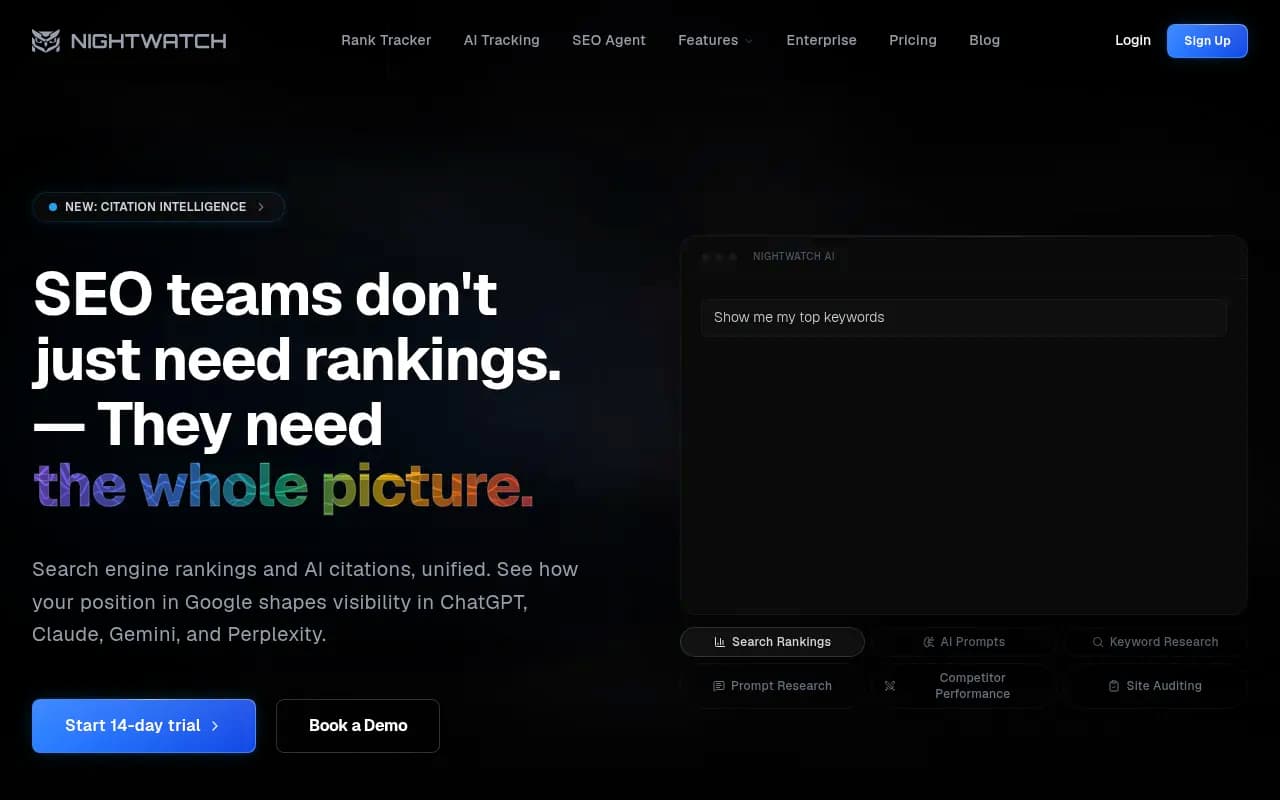

Nightwatch's five-layer tracking model is a good mental framework even if you don't use their product: geo-grid map-pack scans, ZIP-level organic rankings, city-level organic with modifiers, strict country/language isolation, and AI-surface citations by location cluster, checked monthly rather than daily since AI answers don't churn as fast as organic rankings. The key principle, worth stealing regardless of tool: build one prompt cluster per city or region and track the citation rate for that cluster, rather than averaging everything into a single national number that tells you nothing about any one market.
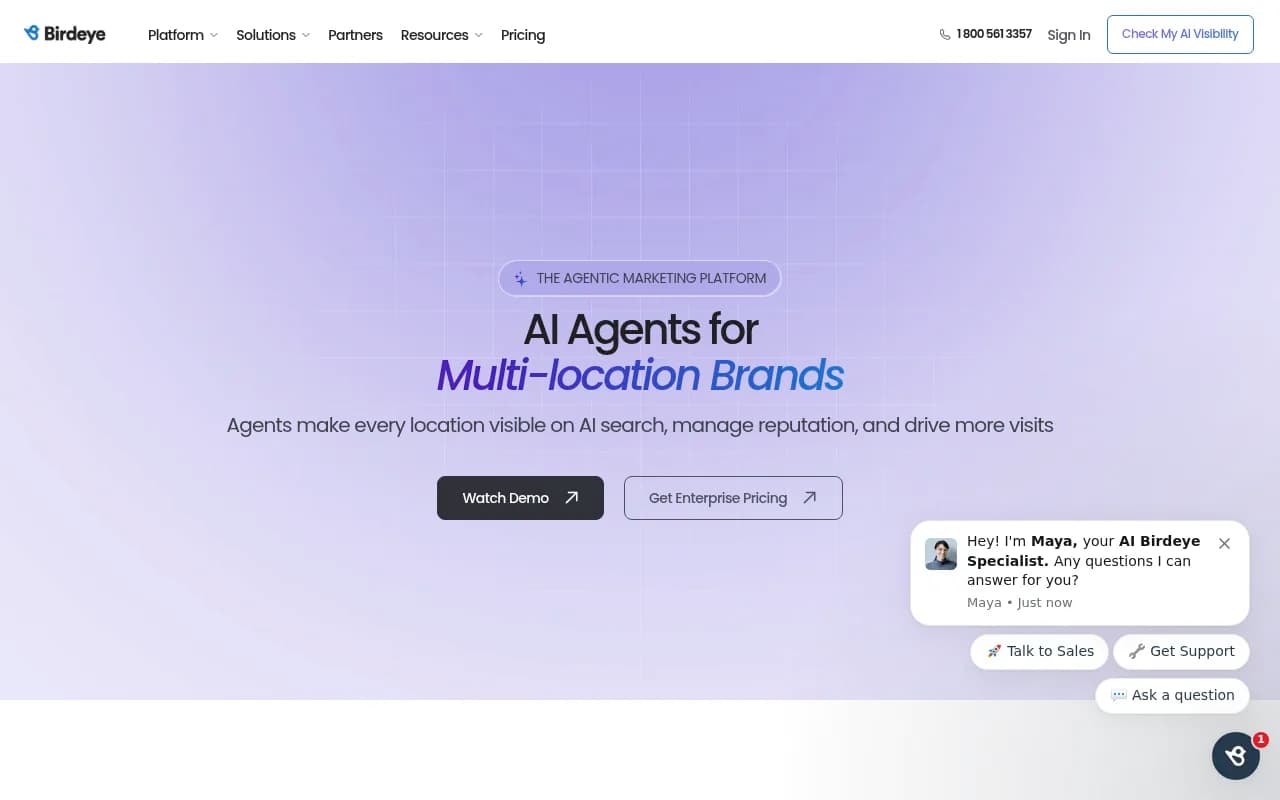
Birdeye Search AI is built specifically around location-level tracking if you're running a multi-location brand and want that baked in rather than bolted on.
A decision framework
If you're trying to decide how granular to go, run through this:
- One location, one service area: a national-style setup is fine. Track 10-20 prompts covering your core services plus a handful of "near me" and comparison variants. You don't need geo-grid software.
- Three to ten locations in the same metro or region: you likely need city-level prompt clusters but can probably run them inside a single project in a platform like Promptwatch or Peec AI, tagging prompts by location rather than spinning up separate accounts per city.
- Ten-plus locations or a franchise model spread across states: this is where dedicated geo-grid tooling earns its cost, because you need both map-pack visibility and AI citation data at a granularity that generic national dashboards don't offer without upgrading to their most expensive tier (Peec AI, for instance, reserves multi-country tracking for its top plan).
- Multi-country operations: check whether your platform does true locale isolation (strict language and country parameters) rather than just translating the same ten prompts. A mistranslated prompt set will quietly skew your results.
Building the actual content, once you know where the gaps are
Tracking tells you where you're missing. Fixing it is a separate job, and this is where a lot of local GEO efforts stall out: teams get a dashboard full of red numbers and no clear next step. Given how much weight service-and-location pages carry in citation data, the highest-leverage move for most multi-location businesses is auditing and rebuilding those pages city by city before touching the blog.
If you want this to scale past a handful of markets, the manual route (brief, write, publish, check citation rate, repeat for every city) doesn't hold up. Platforms with content-gap analysis and automated publishing, including Promptwatch's content agents, exist precisely to close that loop: they flag which location pages are thin relative to what AI models are citing for that query, draft the fix, and push it to your CMS on a schedule instead of waiting for a writer to get to city number forty.
For a broader look at GEO platforms built for this kind of execution rather than pure monitoring, the directory at bestgeosoftware.com is a reasonable starting point, and if you want to compare rank-tracking tools that have added AI layers on top of their existing local infrastructure, ai-rank-tools.com covers that specific lineage.
The bottom line
Local GEO isn't a scaled-down version of national GEO, and national GEO isn't local GEO with the city names stripped out. They're different problems because the query intent behind them is different: one is fighting a crowded, organic-style source pool where you're one of dozens of competing local pages, the other is usually fighting a narrower, brand-aware set of sources. Decide which fight you're actually in before you pick a tool, and the rest of the strategy gets a lot easier to scope.