Key takeaways
- Most small local businesses can handle the recurring basics (listings, reviews, review replies, lead tracking) with software. Google's own hiring guidance says a small local business can probably do much of the work itself.
- An agency earns its fee on strategy, technical problems, content with real expertise, and multi-location complexity. It does not earn it on tasks a listings tool does automatically.
- AI search adds a new job: checking whether ChatGPT, Gemini, Perplexity and Google AI Overviews actually name your business. Software can measure that. Agencies still have to prove they can move it.
- Google's May 2026 guidance says SEO best practices still apply to AI features, so you probably do not need a separate "AI SEO" agency on top of a good local one.
- The hybrid is often the best answer: software for the recurring work, a small agency or consultant for strategy and the hard parts.
The short version of the decision
I'll be blunt. The question "agency or software" is slightly the wrong frame. What you are really choosing is who does three kinds of work: the recurring maintenance, the one-time technical and strategic work, and the measurement. Software is good at the first and the third. People are better at the second.
If you run a single-location business with a clean website, software plus a few hours a month of your own time often covers it. If you run twelve locations, sit in a competitive market, or have a site that is technically broken, you will probably want people involved.
AI search tilts this a little. It makes the basics more important, because the same listing, review and website signals feed both Google and AI assistants. It also adds a measurement problem that did not exist two years ago.
What AI search actually changes for local businesses
People are using AI tools to find local businesses. BrightLocal research, as cited by Thryv, puts it at 45% of consumers in 2026, up from 6% a year earlier. I could not open the BrightLocal source directly, so treat that number as directional and check the BrightLocal research yourself before quoting it.
The Pew Research figure that about one in five Google searches in its March 2025 study produced an AI summary is also dated now. The direction is clear even if the exact share has moved.
What matters more is how AI answers get built. Promptwatch's data from Sep 28 to Oct 4, 2026 found that 47.6% of ChatGPT responses with citations cite 10 or more unique domains. For unbranded prompts, 52.5% cite 10 or more. One caveat: that report covers general prompts, mostly software and brands, not local queries specifically. Still, the lesson carries. Your business shares every answer with many other sites, and third-party listings, reviews and roundups are often how a small brand gets in.
For brand-name queries the picture flips. Only 21.3% of brand-specific prompts cite 10 or more domains, and the most common count is five. So when someone asks about you by name, your own site and the few review sites cited for you shape the answer.
Content types AI cites
In the same period, product pages were the most cited content type in ChatGPT at 22.4%, with landing pages at 16.8%. For a local business, that translates to clear service pages. Branded prompts also lift reviews to 5.6% of citations, more than triple their overall share, and FAQ pages to 4.8%. The report's own advice is to collect reviews on trusted sites, add an FAQ page, make pricing clear, and get into "best of" roundups.
Social is a weaker lever than people think
A lot of local AI advice says to be active on Reddit. Promptwatch's social citation data for Sep 28 to Oct 4, 2026 says otherwise for ChatGPT: all seven tracked social platforms together made up 0.46% of its citations, and Reddit's share collapsed in August. Google AI Overviews is different, drawing 12.2% of citations from social, with YouTube leading at 4.28% and Facebook at 2.38%. So if your customers search on Google, YouTube and complete Facebook and Instagram profiles are worth more effort than Reddit threads.
What Google itself says
In May 2026 Google published its guide to optimizing for generative AI features. AI Overviews and AI Mode sit on top of its core ranking systems, and Google says SEO best practices still apply. It also says you do not need llms.txt files, content chunking, or AI-only rewrites for Google Search. That is worth remembering the next time a pitch deck sells you those.
What software does well
Software wins at work that is repetitive, rule-based and measurable.
- Keeping your name, address and phone number consistent across dozens of directories.
- Sending review requests automatically after a job and drafting replies.
- Tracking calls, form fills and booked jobs back to a source.
- Monitoring rankings by location and, now, AI mentions.
Marketing 360's walkthrough of the five-part local system makes the same point: centralize listings across 50+ directories, automate review requests, respond to every review, answer real customer questions on your site, and track every lead with fast follow-up. Four of those five are mostly tooling. The fifth, the website content, needs a human with something to say.
Listings and local rank tracking
BrightLocal covers local rankings, listings and reviews, with AI visibility now added.
Synup positions itself as a local marketing agent that fixes listings and replies to reviews.
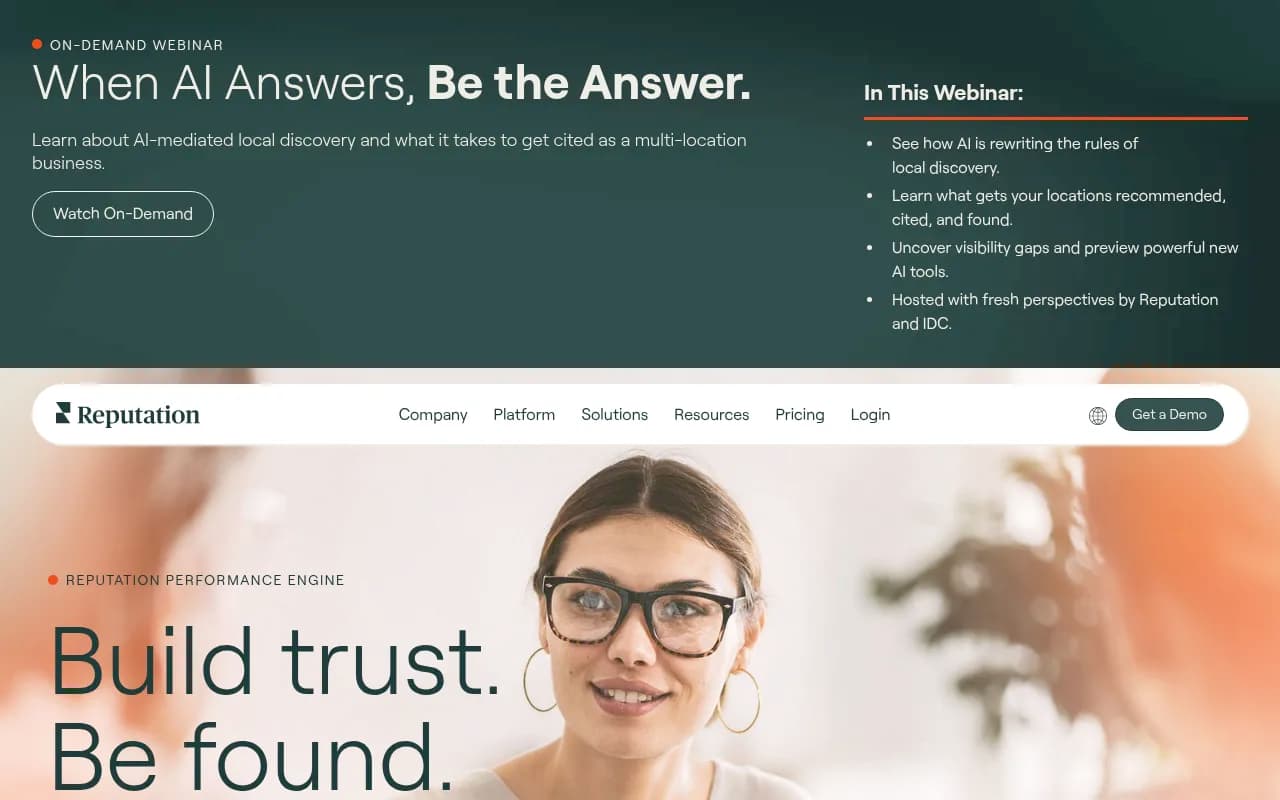
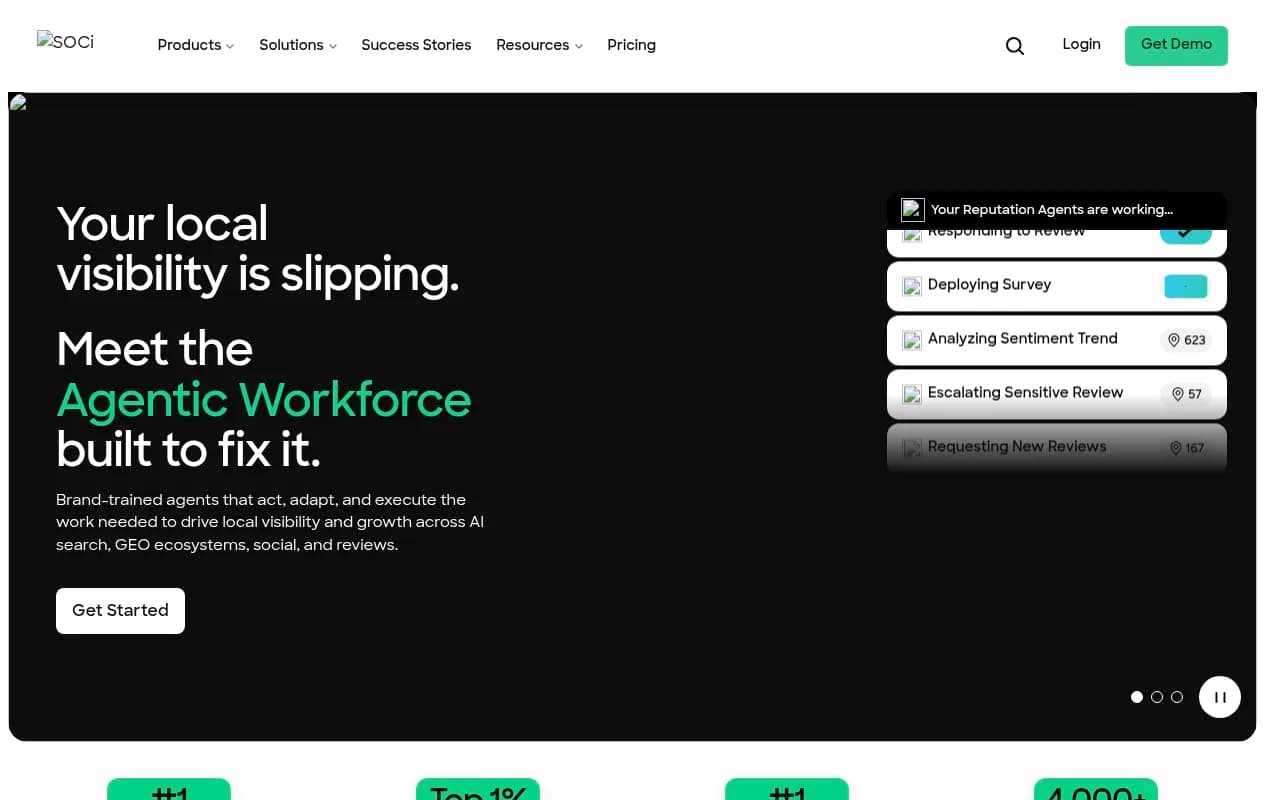
For multi-location brands, Chatmeter and Reputation.com bundle reviews, listings and local pages, and SOCi runs local search, reviews and social across locations.
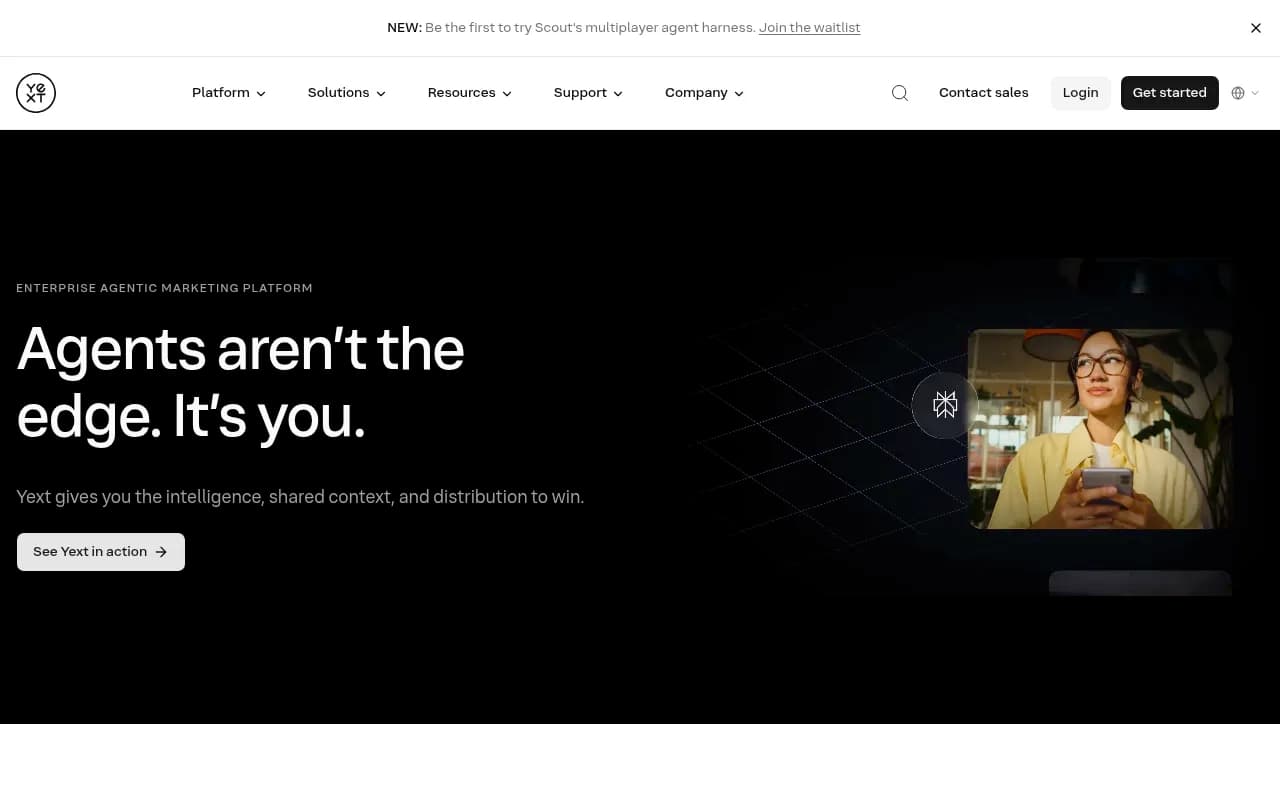
Yext is the enterprise option for verified brand data pushed to search and AI channels.
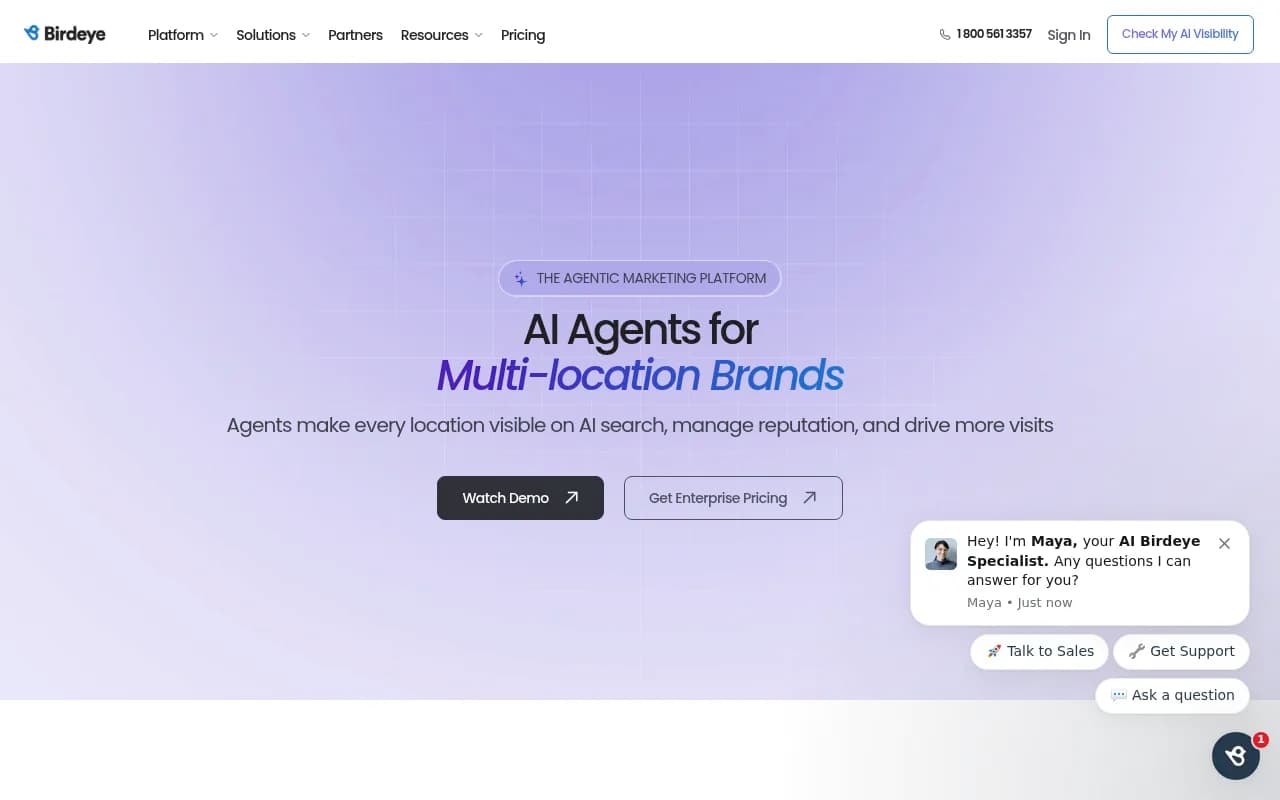
Podium and Birdeye lean toward reviews and customer messaging. Birdeye Search AI adds location-level AI visibility tracking.
Measuring AI visibility
This is the new software category. These tools run prompts across ChatGPT, Gemini, Perplexity and others and tell you whether you are named. Promptwatch goes a step past monitoring: it logs which AI crawlers hit your site, shows which pages get cited, tracks AI-referred traffic, and has a content agent that can draft and publish pages against the gaps it finds. It also supports pinning a monitor to exact coordinates so ChatGPT and Google's AI surfaces answer as if asked from that spot, which suits "near me" queries.

If you only want lightweight monitoring on a budget, Otterly.AI and Peec AI are simpler trackers.


More options are listed in the GEO software directory at bestgeosoftware.com.
What an agency does that software cannot
A good agency is not a person clicking through a dashboard for you. Here is where the fee makes sense.
- Diagnosing why you are stuck. A tool will tell you that you rank 9th in the map pack. It will not tell you that your category choice is wrong or that a competitor has three suspended duplicate listings stealing your reviews.
- Fixing real technical debt: a JavaScript-heavy site that does not render server-side, a botched migration, duplicate location pages.
- Writing content with firsthand experience. AI systems and Google both reward real case studies and specific local detail. Generic output does not cut it.
- Earning links and mentions locally: sponsorships, press, partnerships, community sites.
- Running multi-location rollouts where each page needs unique, accurate content.
Business.com's guide to hiring an AI SEO agency lands somewhere sensible. A dedicated AI SEO retainer is hard to justify for most small businesses, with a few exceptions: nobody owns search at your company, the site has real technical problems, you are in a regulated field where AI misstating your credentials is a liability, or the economics support it. Their rule of thumb is that if one customer is worth tens of thousands of dollars, a few thousand a month can make sense, and if a typical sale is a few hundred dollars, it does not.
I agree with the last piece of that advice in particular. If your current agency cannot answer basic questions about AI search, replace them rather than adding a second one.
Side by side comparison
| Factor | Software only | Local SEO agency | Hybrid |
|---|---|---|---|
| Typical cost shape | Monthly subscription, often tens to a few hundred dollars per location or tool | Monthly retainer, usually the largest line item | Software plus a smaller retainer or project fee |
| Your time needed | Several hours a month | Low, but reporting reviews still take time | Moderate |
| Best at | Listings, reviews, rank and AI tracking, lead attribution | Strategy, technical fixes, content, links | Both |
| Weak at | Judgment calls, writing with real expertise | Cheap repetitive work, unless they just resell tools | Needs coordination |
| AI search | Measures it well, fixes only what you can do yourself | Can fix it if they have a documented method | Measure with tools, fix with a specialist |
| Best for | Single location, clean site, hands-on owner | Competitive market, broken site, many locations | Most growing local businesses |
I deliberately left out exact prices. I did not find reliable agency retainer or software pricing benchmarks while researching this, and quoting invented ranges would not help you. Get three quotes and compare them against the table above.
How to decide: a short checklist
Go software-first if
- You have one or two locations and a working website.
- You or someone on your team can spend a few hours a month on reviews and listings.
- Your biggest gaps are consistency and review volume, not strategy.
- A typical sale is modest and a retainer would eat your margin.
Hire an agency if
- You are stuck despite doing the basics.
- Your site has structural problems: slow, not rendering, duplicated, migrated badly.
- You have many locations and need unique, accurate pages at scale.
- Nobody on your team has the time or the interest to own search.
- Each customer is worth enough to justify the retainer.
Go hybrid if
You are somewhere between those, which describes most businesses. Buy a listings and reviews tool, add an AI visibility monitor, and pay a consultant or small agency for a quarterly strategy review and the technical and content work.
If you do end up wanting agency help with local SEO and AI search together, 1001 SEO Media works across technical SEO, content, local SEO and generative engine optimization with no long-term contracts, which is the type of flexible arrangement worth asking any agency about.
How to vet an agency in the AI era
Google's guidance on hiring an SEO transfers almost intact to AI search. Ask these.
- Can you show previous work and results, specifically in my industry?
- Do you follow Google Search Essentials?
- What results do you expect, in what timeframe, and how do you measure them?
- Will you share every change you make and why?
- If you offer AI optimization, does your advice match Google's own guidance on generative AI features, and can you cite it?
Two more red flags. Anyone selling llms.txt files or rewriting your pages into AI-only chunks as a core deliverable is ignoring what Google has said. And a free audit should only need read-only access to your Search Console.
Also ask what they will report on for AI search. A credible answer includes prompt-level visibility, which pages get cited, and traffic from AI platforms, not just "we got you mentioned once."
A sensible 90-day plan
Here is how I would approach it if I were starting from scratch with one location.
Weeks 1 to 2: baseline
Audit your Google Business Profile, fix name, address and phone inconsistencies, and claim your Bing Places listing too. Microsoft's Copilot draws on Bing data, and ChatGPT's search layer has leaned on Bing's index, so Bing Webmaster Tools is a free check that Search Console will not give you. Run 20 to 30 realistic prompts, like "who is a well-reviewed roofer near me that handles storm damage," across ChatGPT, Gemini and Perplexity, and record whether you appear.
Weeks 3 to 6: fix the basics
Set up automated review requests and reply to every review. Add or tighten service pages with clear location information, an FAQ, and pricing or price guidance. Add local business schema. Keep claims specific and backed by your own work.
Weeks 7 to 12: measure and decide
Compare your AI and map-pack visibility against the baseline, and look at calls and booked jobs, not rankings alone. If the numbers moved, keep going on software. If they did not, that is your signal to bring in an agency, and you now have a baseline to hold them to.
Common mistakes
- Paying an agency for work a listings tool does automatically.
- Buying software and never looking at it. A tool nobody reads is a subscription, not a strategy.
- Treating AI visibility as separate from local SEO. The foundations are the same.
- Measuring one prompt once. AI answers vary, so measure across many prompts over time.
- Chasing Reddit for ChatGPT visibility, when the data shows it barely cites social now.
Bottom line
Start with software for the recurring work and a baseline of where you stand in both Google and AI answers. Bring in an agency when the baseline shows a problem that software cannot fix, or when your time is worth more than the retainer. Browse more options in the software directory at surferstack.com, and confirm any tool's current pricing on its own site before you commit.