Key takeaways
- Country and language are two separate settings. A platform that only offers one of them will blur your markets together.
- Real interface data and API data can differ. If you report visibility per market to a board, ask vendors which one they collect.
- Keep one country and one language per prompt set. Mixed sets let a gain in Germany hide a loss in France.
- Extra markets are often locked behind higher tiers or paid add-ons, so price the full footprint, not the entry plan.
- Vendor country counts conflict across sources. Verify them on the vendor's own documentation before you sign anything.
Why multi-country GEO tracking is its own problem
Single-market tracking is easy to reason about. You pick a language, a country, a set of prompts, and you watch how ChatGPT, Gemini or Google AI Overviews mention you. Multi-market tracking breaks that simplicity in several ways at once.
AI engines answer from localized retrieval pools. A French buyer asking about project management software gets different sources, different competitors and sometimes a different shortlist than a German buyer asking the same thing. Local brand names, local review sites and local regulators all shift what gets cited.
So the real question for an enterprise is not "does this tool support 50 countries?" It is "does this tool show me what a real user in that country sees, in that user's language, and can I compare markets without the numbers bleeding into each other?"
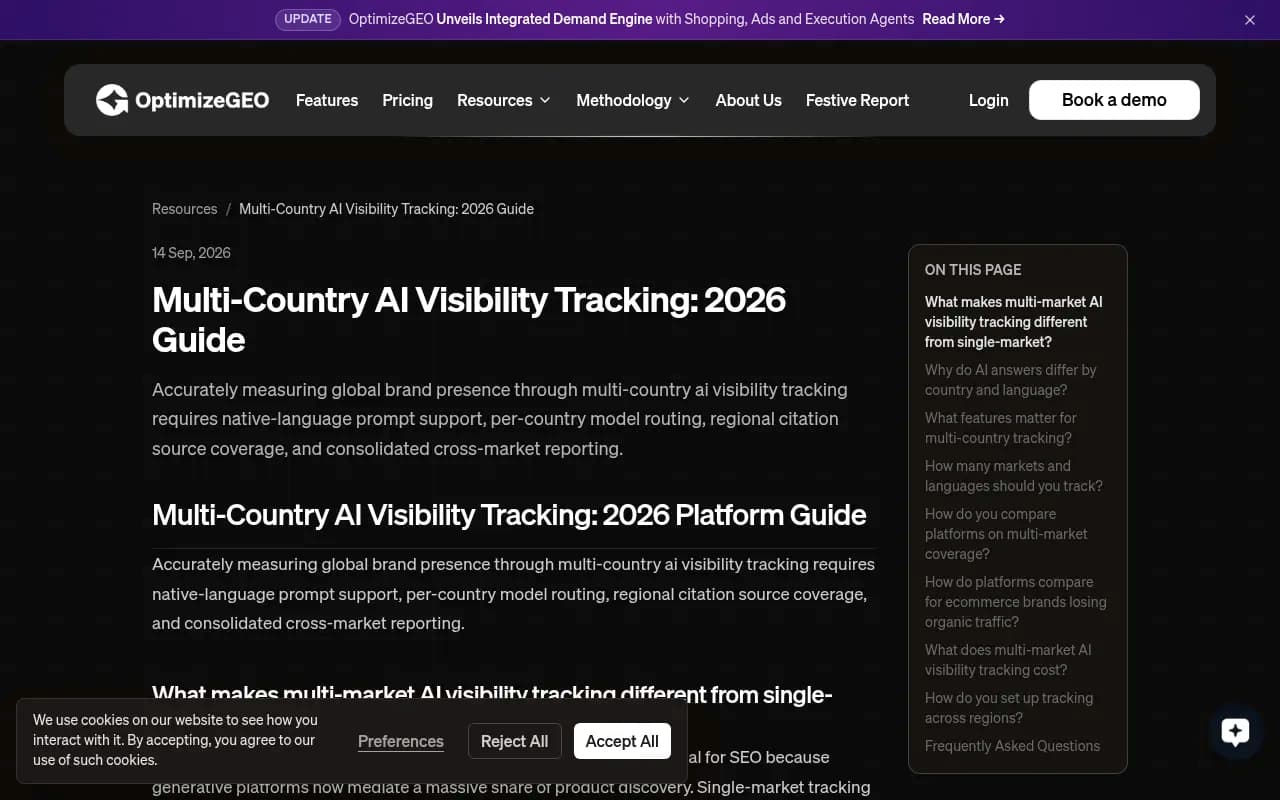
OptimizeGEO's guide makes a similar argument: accurate global measurement needs native-language prompt support, per-country routing, regional citation coverage and consolidated reporting. I would add one more requirement, which is transparency about how the location is set.
Country and language are different settings
This is the most common source of confusion when comparing vendors.
Country controls where the engine believes the user is. Tools do this through servers or residential IPs, a matched browser locale and timezone, or a location parameter. Language is the language of the prompt itself, and the engine usually answers and cites sources in that language.
You need both. A Belgian brand might need French (Belgium), Dutch (Belgium) and German variants, all tracked from Belgium. A Spanish-language prompt tracked from Spain returns different results than the same prompt tracked from Mexico or the US.
Do not just translate your English prompts
Word-for-word translation is a weak start. Each market phrases questions differently, uses local brand names, and compares you against local competitors that your English set never mentions. Build local prompt sets with in-market input, then use a tracker to validate them. Prompt volume and difficulty data helps here, since it shows which local phrasings people actually use.
One country, one language, one prompt set
The cleanest setup is one monitor per country and language pair. When you mix markets in one monitor, your visibility score becomes an average that hides everything interesting. A gain in Germany can cancel a loss in France and you will see a flat line.
Real interface data vs API data
Some platforms collect answers by calling the model API. Others scrape or drive the actual user interface of each engine. The difference matters more for multi-country work than for single-market work, because location handling in an API is not the same as location handling in a consumer product.
The claim from the vendors that scrape the UI is that API answers can differ from what a real user sees, including the citations and shopping results. That is a vendor claim, and I have not seen an independent study that quantifies the gap. But it is easy to test yourself: run ten of your own prompts manually from a clean browser in two countries, then compare to what a tool reports. If the tool matches the UI and not the API, you have your answer.
Promptwatch collects data from the live interfaces of ChatGPT, Google AI Overviews, Google AI Mode, Gemini, Perplexity, Copilot, Meta AI and Amazon Alexa in each country and language you choose, and tracks API models such as Claude, DeepSeek and Mistral alongside them to show what models believe from training data. Several other tools in the catalog also position themselves around real interfaces, including Superlines.

Superlines
What the engines do differently per answer
Citation slots vary by engine, which affects how you read cross-market numbers. Promptwatch's report How Many Sources Do AI Search Engines Actually Cite?, based on 26B+ data points from real AI interfaces and dated September 2025, found ChatGPT cites about 5 sources per web-search answer, Google AI Overviews about 10, and Perplexity almost exactly 10 every day. Copilot swung from under 2 to nearly 17 within a few weeks before settling at the low end.
The practical rule: compare markets within one engine, not across engines. A 5-citation engine and a 10-citation engine will produce different citation shares for the same content even in the same country.
That report does not break results down by country, and no report in Promptwatch's catalog does, so independent evidence on how much answers differ by market is thin. Run your own test before you build a business case on it. You can browse the broader research hub at Promptwatch Data.
The criteria that matter for enterprise buyers
Here is the checklist I would use when shortlisting platforms.
- How is the country set? Residential proxies, servers, browser locale, or a parameter. Vendors rarely document this, so ask directly.
- Is language independent of country? You should be able to run French from Belgium and French from Canada.
- Can you go below country level? City or state monitors matter for multi-location brands.
- Are extra markets priced separately? Some vendors charge per additional location.
- Can you compare markets side by side? Per-market visibility, share of voice and sentiment, in one view.
- Do you get the cited URLs and query fan-outs per market? Without them you cannot diagnose why a market is weak.
- Is there an access and compliance story? SSO, audit logs, role-based access, and a clear data handling position. Procurement will ask about GDPR and certifications.
- Can you act on the data? Monitoring alone leaves the work to you.
How the main platforms compare
The table below mixes vendor documentation and vendor-authored comparisons. Promptwatch's own guide checked pricing pages and docs on October 12, 2026, and it is a vendor-authored comparison, so treat it with care. One conflict: OptimizeGEO lists Semrush at 38 countries and 28 languages, while Promptwatch's check lists 220+ countries and territories for Semrush Prompt Tracking. Verify on Semrush's own page before quoting either number.
| Platform | Countries | Languages | Multi-market plan notes |
|---|---|---|---|
| Promptwatch | One monitor per country and language, optional city in any country or US state | Per monitor, including variants like French (Belgium) | Country tracking on every plan from $95/mo; state and city tracking on Business and up |
| Profound | 80+ via servers and proxy networks | Not specified | Enterprise with custom regions; trial includes one region |
| Scrunch | 88 for primary country, any country per prompt | Any language | Plans start at $250/mo |
| Semrush AI Visibility Toolkit | 220+ per Promptwatch's check, 38 per OptimizeGEO (conflict) | Not specified, 28 per OptimizeGEO | $99/mo for 25 prompts; each extra Brand Performance location is $99/mo |
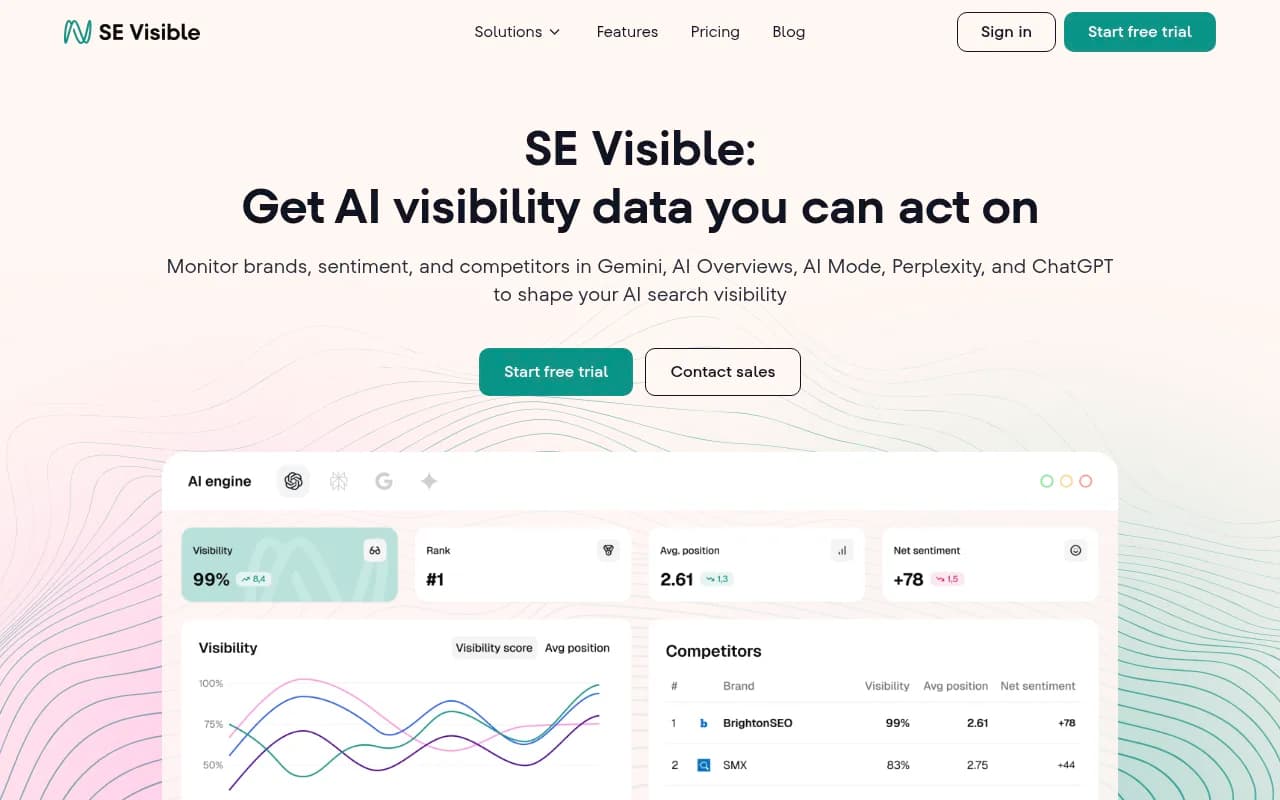
| SE Ranking (SE Visible) | 7 | 5 | From $99/mo |
| AthenaHQ | One region on Starter, multiple on Enterprise | One language on Starter, multiple on Enterprise | Enterprise is custom priced |
| Evertune | 140+ (vendor claim, unverified) | 33 (vendor claim) | Not specified |
Two patterns stand out. First, the headline country counts are not comparable, because they measure different things: countries for the primary location, countries per prompt, countries for one module. Second, the entry plans of several tools cover one region, and the economics change quickly when you add markets. A $99 plan with $99 per extra location becomes a very different line item at 12 markets.
Platform notes by buyer type
Teams that want tracking and execution in one place
If your goal is to find the gaps in each market and then close them, look for a platform that moves from monitoring to action. Promptwatch is built that way: it traces which pages and third-party sources AI cites per monitor, runs content gap analysis, and the Content Agent writes and publishes in the prompt's language to WordPress, Webflow or Framer. IP-verified AI crawler logs and visitor analytics then show whether the local pages get read, cited and clicked. Business adds state and city tracking, local targeting at exact coordinates, and hourly tracking, which is useful for franchise and "near me" work. Its "Visibility by Country" world map on the dashboard gives executives a fast read on the markets that lag. It is ISO/IEC 27001 certified and GDPR compliant with an EU-based entity, which tends to help in procurement. You can also run the free AI visibility report before committing, or start the 7-day trial on a monthly plan.
For agencies running many client markets, the agency plans start at $199/mo with unlimited projects and country, state and city tracking; see the agencies page.
Large enterprises with a heavy monitoring need
Profound is the usual name on enterprise shortlists, with prompt volume data and custom regions on enterprise plans. Scrunch adds citation intelligence and an approach to serving AI-ready content. Both are strong at monitoring, though neither does Reddit tracking or ChatGPT Shopping, according to Promptwatch's positioning, and pricing for enterprise tiers is not public, so budget for a sales conversation.

AthenaHQ combines monitoring with content agents, but multi-region and multi-language support sits in the enterprise tier.
Teams already in an SEO suite
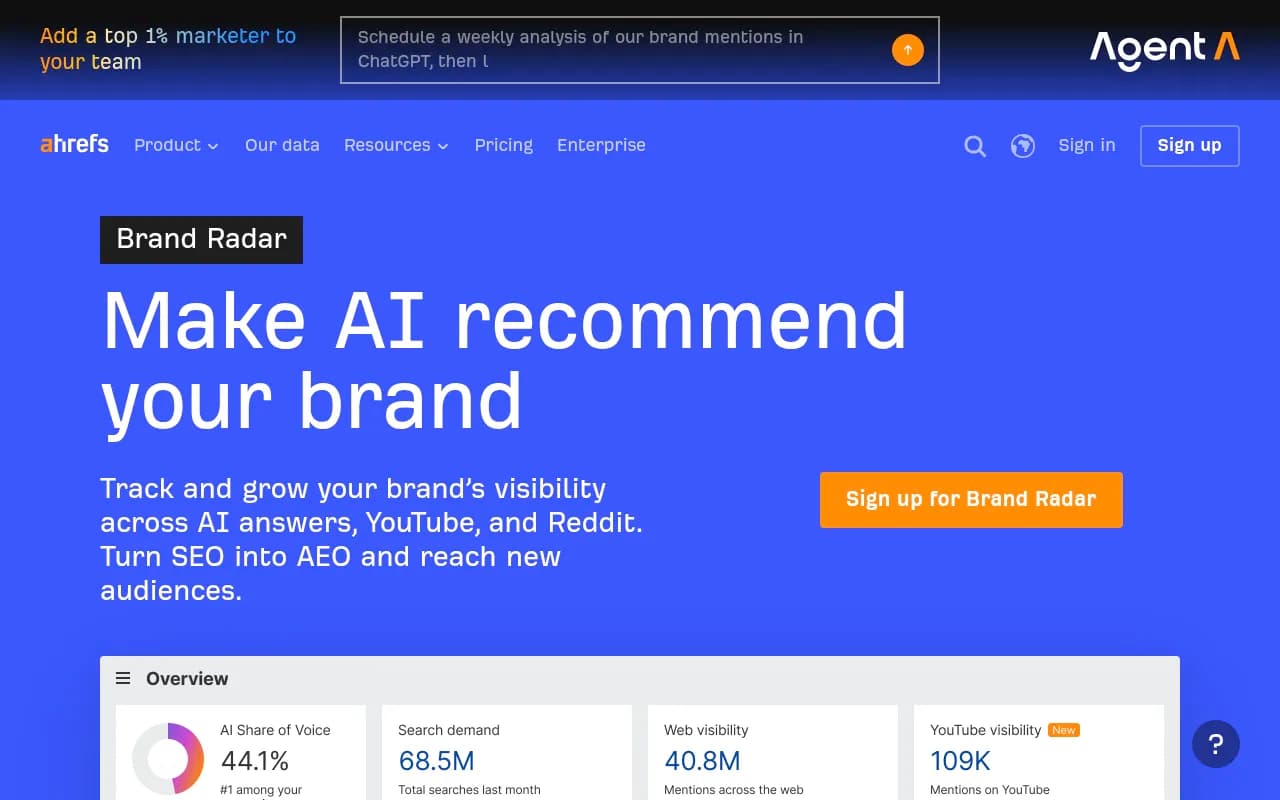
Semrush and Ahrefs Brand Radar are the easy additions if you already pay for the suite. The trade-off is that the AI data tends to be shallower than at specialist platforms, and country coverage and per-location pricing need careful reading.
SE Ranking's SE Visible is cheap but covers 7 countries and 5 languages, which is fine for a regional footprint and not for a global one.
Enterprise suites with AI modules
BrightEdge, Conductor, seoClarity, Botify and Adobe LLM Optimizer sell GEO as part of a broader enterprise platform. If your SEO team already lives in one of them, evaluate the AI module there first, but ask the same questions about how location is set.
Budget and lighter monitoring
Otterly.AI is described in Meikai's buyer guide as offering accessible multi-country monitoring, audits and optimization tooling. Peec AI keeps analytics, source tracking and reporting focused. Both are monitors rather than execution platforms.


Evertune claims 140+ countries and 33 languages and analyzes AI responses at scale; I could not verify those figures independently.

Local and multi-location brands
If the market question is really a city question, look at tools built for location-level tracking, such as Birdeye Search AI, or check whether your GEO platform supports city-level monitors.
A rollout plan that works
Step 1: pick markets by revenue, not by ambition
Start with the three to five markets that carry the most revenue or have the most strategic risk. Every extra market is both a pricing line and an analysis burden.
Step 2: build local prompt sets
For each market, draft 30 to 50 prompts with local input. Include branded, competitor comparison and unbranded category prompts. Tag them by market so reporting stays clean.
Step 3: validate against the real interface
Before you trust any dashboard, run a small sample manually from a clean browser in each country and compare. Do this once per vendor during the trial.
Step 4: read metrics together
Low share of voice is a coverage problem. Late position is a prominence problem. Mentions without citations to your own domain point to a content or crawlability problem. Weak sentiment is a reputation problem. Per-market, those diagnoses often differ, which is exactly why you split them. The metrics overview explains each one.
Step 5: check crawler access per market
If a local subdomain or ccTLD blocks AI bots, no content investment will help. IP-verified crawler logs tell you whether the bots actually reach each market's pages, and the free Agentic Readiness Check is a quick first pass.
Step 6: close gaps and re-measure
Publish local content, then track whether the pages are crawled, cited and clicked in that market. Repeat monthly.
Questions to ask every vendor
- How exactly do you set the country for each query, and can you show me?
- Is your data from the real interface or from an API, and for which engines?
- Can I run the same language from two different countries?
- What does the 10th market cost, including add-ons?
- Can I see cited URLs and query fan-outs per market?
- What are your data residency, SSO, audit log and certification positions?
- Can you help me act on gaps, or only report them?
Be careful with the statistics
Several guides in this space repeat unsourced claims, like AI answers appearing in almost half of Google results or 40%+ of B2B discovery coming from AI engines. I would not put those in a board deck without a primary source. Also note that most of the comparisons you will find, including the one in the table above, are written by vendors, including Meikai, OptimizeGEO and Promptwatch. Use them to build your question list, then verify.
Where to find more options
The field is crowded. For a wider scan, the GEO software directory at bestgeosoftware.com lists dozens of platforms, and Promptwatch's 2026 platform comparison covers feature-level differences.
Bottom line
For multi-country work, the deciding factors are how location is set, whether you get real-interface answers, whether language is independent of country, and what the tenth market costs. If you want tracking and execution in one product with country tracking on every plan, shortlist Promptwatch. If you are an enterprise that wants a heavyweight monitoring specialist, put Profound and Scrunch next to it. Run the same ten prompts in two countries through each trial, and let the results decide.