Key takeaways
- SEO Writing AI is the best of the three for ranking-focused articles. Its $14/mo Starter plan includes SERP data, content scoring, internal linking, and WordPress publishing.
- Article Forge is the pick for bulk long-form output on a budget: 25,000 words per month for $13/mo billed annually ($27 monthly), plus auto-posting and API access.
- Rytr has changed. Its current pricing page leans toward relationship and communication features, so check that it still fits an article workflow before you pay.
- The three tools bill differently (characters, words, articles), so compare cost per finished article, not headline price.
- None of them replaces an editor. Budget tools give you drafts, and you still need to fact-check, add original detail, and edit.
Why these three get compared
Budget AI writers get lumped together, but they solve different problems. Rytr started as a cheap drafting assistant with dozens of templates. Article Forge is an older bulk generator built for people who want hundreds of long articles with minimal clicking. SEO Writing AI sits in between: one-click articles with SEO features layered on.
All three come in under $30 a month at entry level, which is why they show up in the same "cheap AI writer" searches. Beyond that, they diverge quickly. I'll go through each, then compare them directly.
Rytr: still cheap, but check the pitch

Rytr has long been the default answer to "what's the cheapest AI writer?" Review sites still call it the budget champion, with a free-forever tier and 40+ use-case templates. That reputation is earned, but some of the details floating around are out of date.
Current pricing
On Rytr's own pricing page, the plans are:
- Free: $0, 10,000 characters per month
- Lite: $9/mo, unlimited characters
- Personal: $19/mo, marked most popular
- Pro: $49/mo
Yearly billing saves 20%. Older reviews quote a $7.50 Unlimited plan and a $24.16 Premium plan with custom tones. Those are gone, and so is the tone-matching upgrade pitch that many reviews still lead with.
The positioning shift
This is the part that surprised me. The higher tiers on the current pricing page talk about connected sources, active relationships, Engage actions, person research runs, and a daily briefing. The footer reads "Built for relationships worth remembering." The writing features (40+ use cases, 30+ languages) are still listed on the Free plan, but they are no longer the headline.
If you want an article generator, the Free and Lite plans are what matter. The Personal and Pro upgrades mostly buy you relationship features you probably don't need.
What the output is like
Rytr is good at short things: outlines, intros, meta descriptions, rewrites, simple blog drafts. The consistent complaint is SEO depth. One Reddit user, quoted by eesel, said the content "often felt generic and lacked SEO depth." Another roundup rates the output as average and the feature set as basic, and gives it 3 out of 5.
There is no SERP analysis, no internal linking, and no content scoring. You get text, and you bring the strategy.
Best for: solo creators and small businesses who need cheap first drafts, rewrites, and short copy.
Article Forge: bulk long-form on a budget

Article Forge has been around for a long time, and its pitch hasn't changed much: type a keyword, get a 1,500+ word article, skip the outline approval step. It also offers bulk generation and auto-posting to your blog.
Current pricing
- Standard: $27/mo billed monthly, or $13/mo billed annually. Includes 25,000 words per month and 1 user.
- Business: custom words and users, 500,000+ words, a dedicated account manager. Sales-only.
- Trial: 5 days free. A 30-day money-back guarantee exists, but only if you have generated fewer than 10 articles, so test fast.
The Standard plan includes the AI writer, auto-posting, bulk generation, API access, and content that the vendor says passes Copyscape.
What 25,000 words actually means
At 1,500 words per article, 25,000 words is roughly 16 articles a month. At the annual rate that is about 80 cents per article. That is cheap, and it is why affiliate site owners and small agencies keep using it.
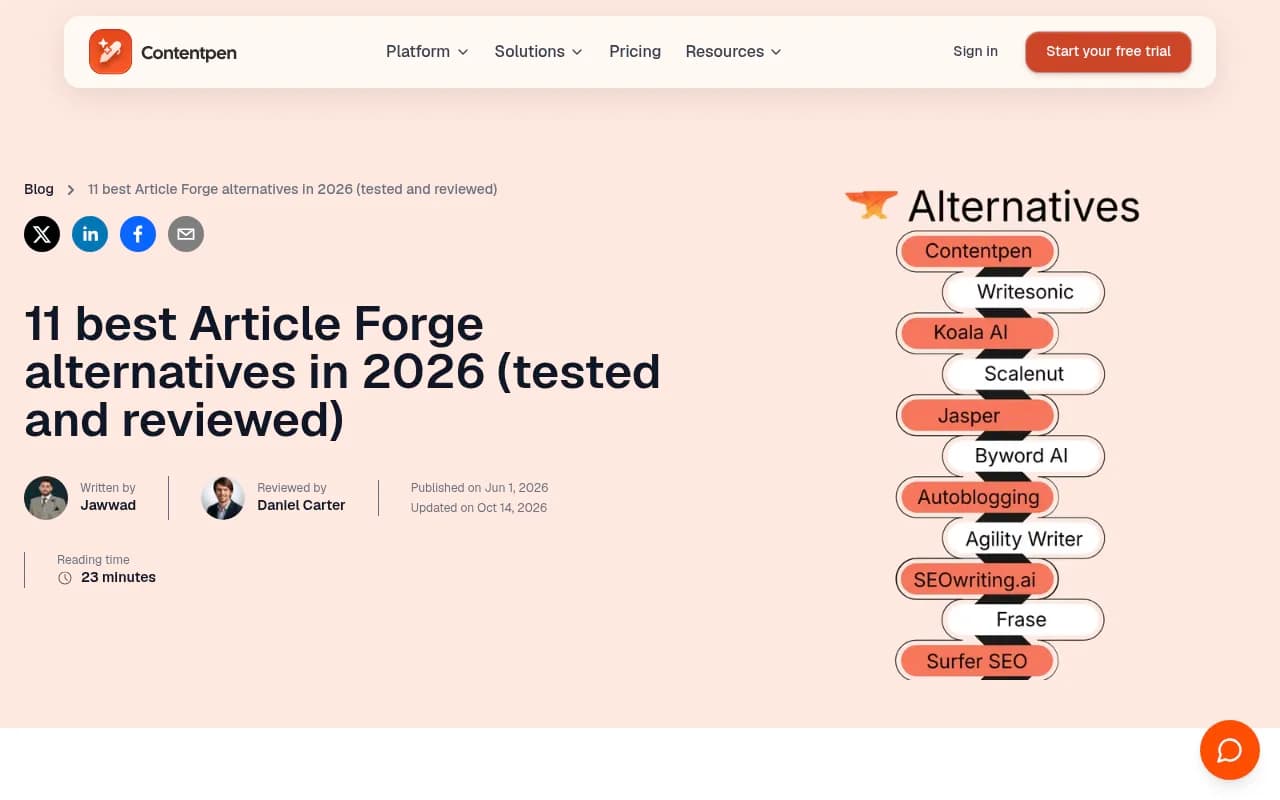
The flip side is the quality bar. Contentpen's 2026 review of Article Forge alternatives argues the pitch made sense in 2021 but not now. Its main complaints are missing brand voice training, no GEO optimization, no integrated SEO data, and thin templated writing that readers bounce from faster in an era of AI Overviews. That is a competitor talking, so take the tone with a grain of salt, but the gaps it lists are real: Article Forge's feature list has no SERP research or content scoring.
Best for: high-volume, low-stakes content where publishing speed matters more than polish, such as long-tail affiliate pages or support-style content you will edit heavily.
SEO Writing AI: the most SEO-ready of the three

SEO Writing AI (seowriting.ai) is built around one-click SEO articles with bulk generation. It prices by article rather than by word or character, with roughly one credit per article.
Current pricing
Monthly prices, with yearly billing saving 25%:
- Free: 3 articles, 25,000-word limit, no card needed
- Starter: $14/mo, up to 50 articles
- Professional: $59/mo, up to 250 articles
- Professional Plus 1: $119/mo, up to 500 articles (marked most popular)
- Professional Plus 2: $230/mo, up to 1,000 articles
What you get for the money
The Starter plan is where it gets interesting. For $14 you get 1 brand voice, bulk generation, WordPress integration, a Shopify app, internal linking across 500 URLs per site, external linking, real-time SERP data, a content score, an AI editor, and a rewriter. Moving to Professional adds 5 brand voices, internal linking across 5,000 URLs, and an unlimited humanizer tool.
The vendor claims 50,000+ users, a 4.7 on Trustpilot, 4.6 on G2, and 4.9 in the WordPress plugin directory. Those are the company's own claims on its pricing page, so treat them as a starting point and read some reviews yourself.
At 50 articles for $14, the cost per article is about 28 cents on the monthly Starter plan. That undercuts Article Forge per piece, though article length and quality vary, so the comparison is not perfectly clean.
Best for: bloggers, niche site owners, and small agencies who want drafts that already include SERP-informed structure and internal links.
Side-by-side comparison
| Rytr | Article Forge | SEO Writing AI | |
|---|---|---|---|
| Free option | Yes, 10,000 characters/mo | 5-day trial | Yes, 3 articles |
| Entry paid price | $9/mo (Lite) | $13/mo annual, $27/mo monthly | $14/mo (Starter) |
| Billing unit | Characters (unlimited on paid) | Words (25,000/mo) | Articles (50/mo) |
| SERP data | No | No | Yes |
| Content scoring | No | No | Yes |
| Internal linking | No | No | Yes, 500 URLs on Starter |
| Bulk generation | No | Yes | Yes |
| CMS publishing | No | Auto-posting to blogs | WordPress and Shopify |
| Brand voice | Limited | No | 1 on Starter, up to 25 higher up |
| Best use | Short drafts, rewrites | Volume long-form | SEO-oriented articles |
Cost per article, worked out
Headline prices hide the real comparison. Here is a rough version using each plan's entry tier:
| Tool | Plan | Output | Approx. cost per article |
|---|---|---|---|
| Article Forge | $13/mo annual | ~16 articles at 1,500 words | ~$0.80 |
| Article Forge | $27/mo monthly | ~16 articles at 1,500 words | ~$1.70 |
| SEO Writing AI | $14/mo monthly | Up to 50 articles | ~$0.28 |
| Rytr | $9/mo Lite | Unlimited characters | Depends on your editing time |
Rytr doesn't fit neatly because it is not built to produce a finished article in one pass. You assemble sections, so your own time is the real cost.
Which one should you pick
- You publish a lot of long-tail content and want volume: Article Forge, ideally on the annual plan. Use the 5-day trial and generate fewer than 10 articles if you want the refund option.
- You care about ranking and want SEO features included: SEO Writing AI. It is the only one of the three with SERP data, content scoring, and internal linking at the entry tier.
- You mainly need short copy, outlines, and rewrites: Rytr's Free or Lite plan still works for that. Skip the higher tiers unless you want the relationship features.
- You care about quality above price: none of these is the right answer. Look at tools with stronger research and optimization workflows, covered below.
Budget alternatives worth a look
If none of the three fits, several other low-cost options came up repeatedly in the 2026 roundups.
KoalaWriter starts at $9/mo for 15,000 words and pulls live SERP data.

Agility Writer generates long-form articles up to 7,000 words and handles bulk runs of up to 200 articles, with a $1 trial.
Contentpen positions itself as an Article Forge alternative aimed at SEO and GEO-optimized blog production.
Contentpen
RightBlogger offers unlimited use at $49/mo billed annually, which its own review calls one of the most affordable options for generating posts up to 2,500 words.

For a wider look at tools in this category, the directory at SurferStack lists reviews, alternatives, and comparisons.
Getting better output from any budget generator
Cheap tools produce cheap-looking text unless you intervene. A few habits make a large difference:
- Feed it a specific angle, not just a keyword. "Best budget AI writers for solo bloggers" beats "AI writers."
- Edit the intro and conclusion by hand. These are the most generic parts of any AI draft.
- Add something the model can't invent: a screenshot, your own numbers, a quote, a first-hand test.
- Fact-check every claim, price, and statistic. Generators will confidently state things that are wrong.
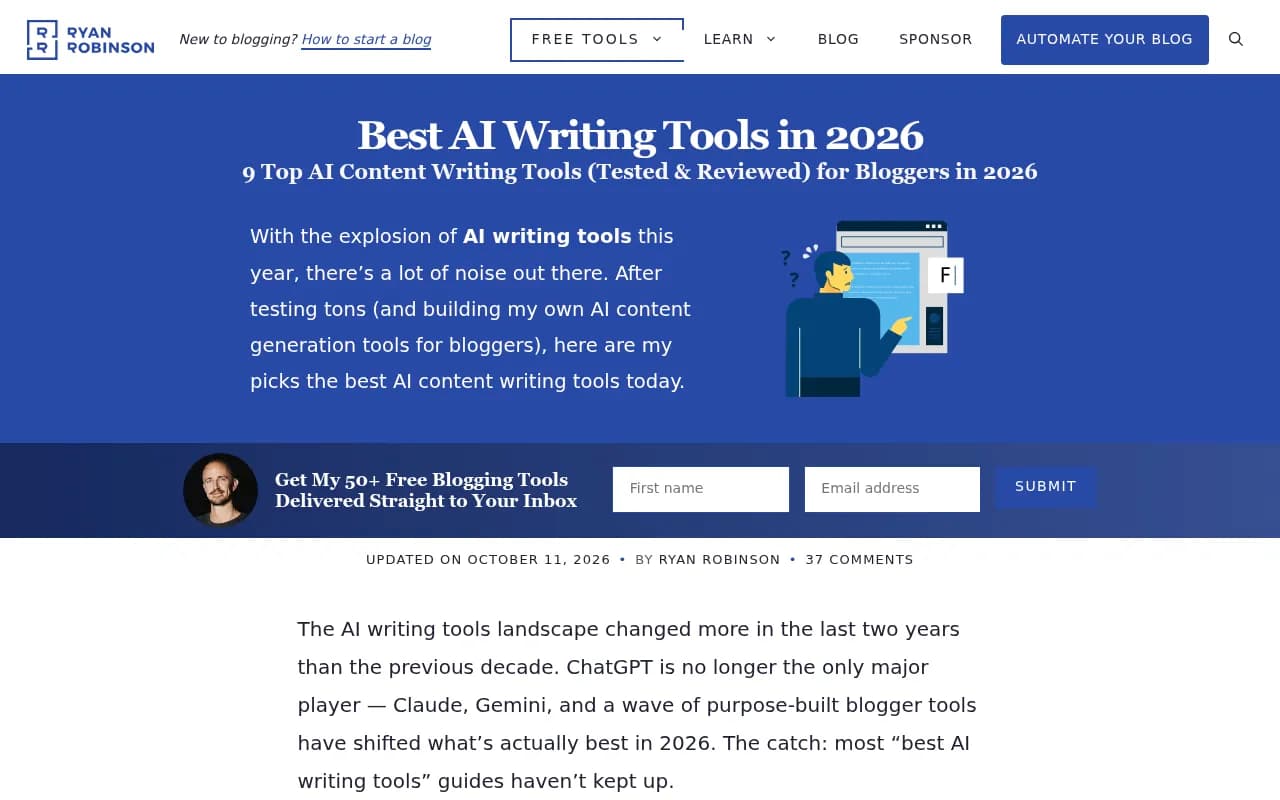
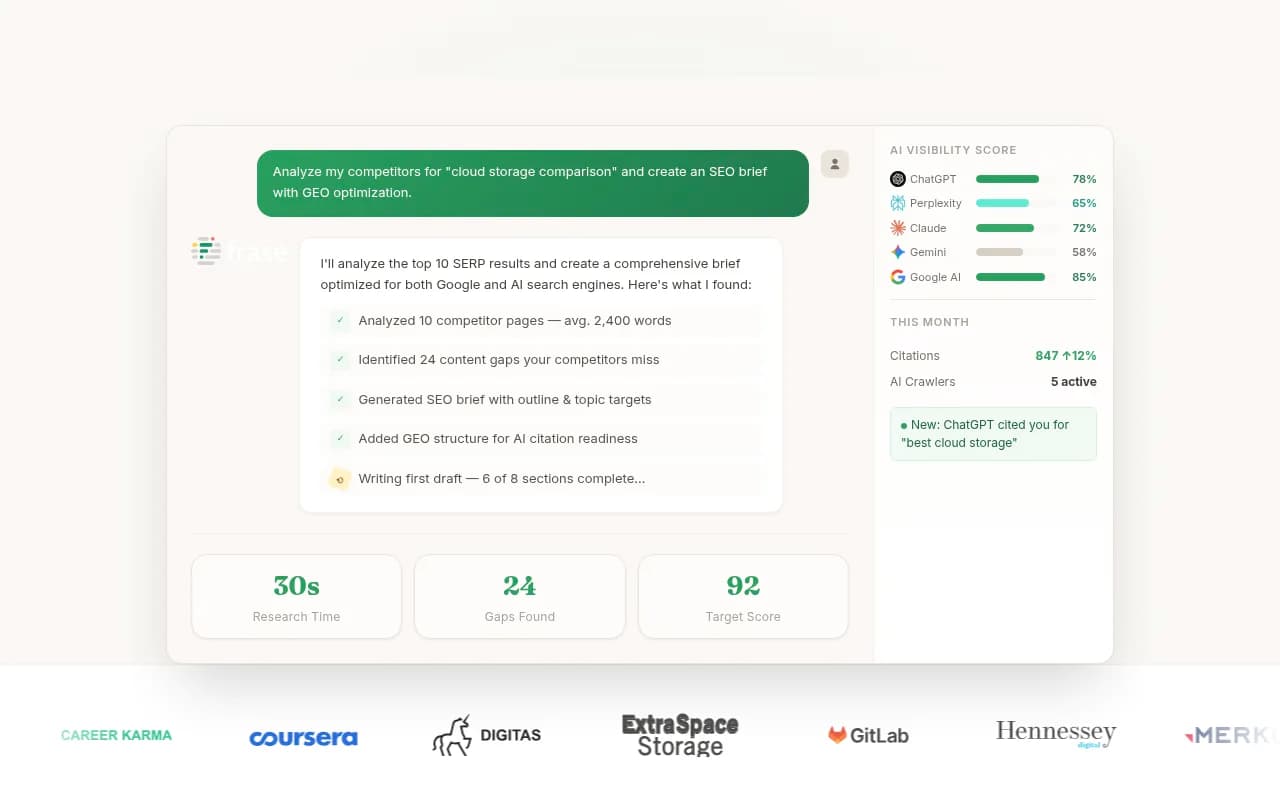
- Run the draft through a content optimizer if ranking matters. Tools like Surfer SEO or Frase compare your draft against what already ranks.

Do you need to think about AI search too
Articles written for Google now also get read by ChatGPT, Perplexity, and AI Overviews. Promptwatch's data shows that product pages are the most cited content type in ChatGPT, at 22.4% of citations from Sep 28 to Oct 4, 2026, and that news pages lost half their citations within 36 days in a July 2026 sample. The practical read: thin, templated blog posts are the format least likely to hold a citation, which is a reason to edit budget drafts rather than publish them raw.
If you want to see whether your published articles are getting cited at all, tools like Promptwatch can track that.

Final verdict
SEO Writing AI wins this comparison for most people. It costs about the same as the others, bills per article, and includes the SEO features the other two lack. Article Forge is a reasonable pick if raw volume is the goal and you will edit. Rytr is a fine free or $9 helper for short copy, but verify that its current direction still suits you, because the product has moved well beyond article writing.
Prices and plan limits change often. Confirm everything on each vendor's pricing page before you subscribe, and use the free tiers and trials first.