Key takeaways
- Yes, pitch GEO. But the premise needs a correction: I found no confirmed shutdown, acquisition, or collapse at AthenaHQ. It was still selling in autumn 2026. What is real is a crowded tool market, shifting prices, and credit-based billing that makes costs hard to predict.
- Tools are the measurement layer. Your retainer is the execution: page rewrites, structure, technical fixes, and refresh work.
- Never build a client deliverable that only works inside one vendor's dashboard. Keep exports, prompt lists, and baselines in your own hands.
- Price on work shipped and outcomes tracked, not on dashboard access. Month-to-month retainers in the $3,000 to $10,000 range are common, and annual terms give compounding work room to pay off.
- Pick one tracking tool for the pitch, keep a second as a fallback, and budget credits per client before you sign anyone.
First, what actually happened with AthenaHQ?
The phrase "AthenaHQ shakeout" is floating around, and I want to be careful with it. My research turned up no source confirming a shutdown, an acquisition, layoffs, or a pricing collapse. AthenaHQ is listed in our directory as an AI search visibility monitoring platform, and it was running an active agency program in the autumn of 2026, with case studies from Cozy Earth, Rootly, and Lago.
So if a client or a colleague tells you the vendor is gone, check before repeating it. What is true is quieter and, honestly, more useful to an agency:
- The category is crowded. Dozens of AI visibility trackers now compete on price, from entry plans under $30 a month to enterprise quotes.
- Pricing is unsettled. AthenaHQ's Self-Serve tier has been reported at $295+ a month with 3,600 credits, where one credit equals one AI response. Capterra lists a lower promotional starting point, and reviewers disagree on the details, so confirm on the vendor's pricing page.
- Metered credits make agency costs hard to forecast. A setup that tracks more than 3,600 responses a month needs add-on pricing, and that price is not always published.
None of that says "stop selling GEO." It says "stop tying your service to one tool's pricing model."
Why the demand for GEO is real
Clients are asking about ChatGPT, Gemini, Perplexity, and Google AI Overviews now, and most of them have no idea what those engines say about them. That gap is a pitch.
Promptwatch's data on what ChatGPT cites gives you something concrete to bring to the table. In Promptwatch Data's report on ChatGPT citations by content type (Sep 28 to Oct 4, 2026), product pages made up 22.4% of classified citations and landing pages 16.8%. That is 39% of citations going to pages that describe what a company sells. For commercial prompts, product pages, landing pages, listicles, and comparisons together were almost 70% of citations.
That is a very agency-friendly finding. The pages most likely to be cited are the ones a client already owns and probably neglects: service pages, product pages, pricing pages, and comparison content. Fixing those is work, and work is what you bill for.
One more number matters for retainer design. In Promptwatch's content half-life study, which tracked pages ChatGPT cited on July 6, 2026 for 90 days, 78% of landing pages and 76% of docs were still cited after 30 days, and 69% and 67% after 60. News was the outlier: half its pages dropped out within 36 days. So ongoing refresh work on landing pages, docs, and pricing pages holds up over time, while press-style content produces short bursts.
Tools measure, agencies execute
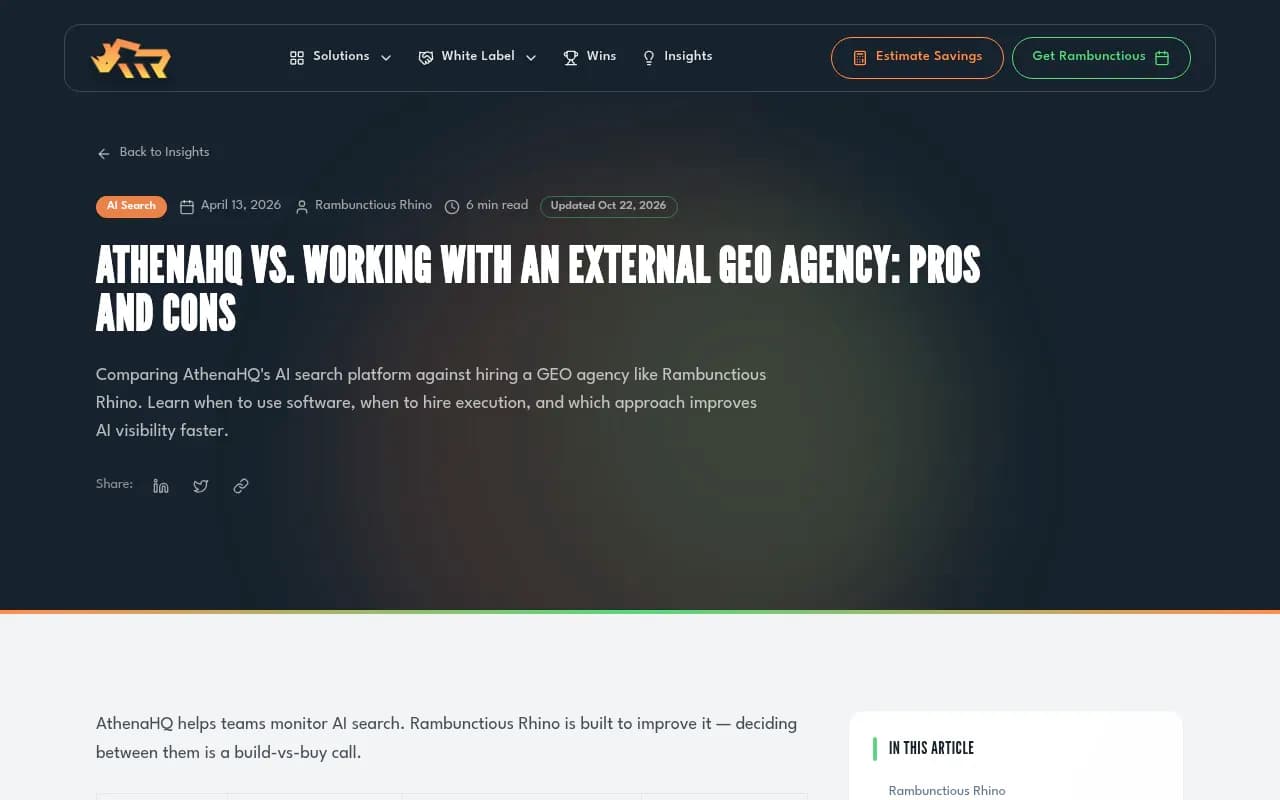
The cleanest framing I found comes from a build-versus-buy comparison published by Rambunctious Rhino, a GEO agency (so read it as a vendor with a view). Their argument: AthenaHQ can tell you where the brand is weak, which prompts matter, and where competitors win share of voice. It cannot rewrite weak pages, restructure comparison content, fix internal linking, or clean up technical issues. That belongs to a team.
I think that is mostly right, and it is the reason the "shakeout" worry is overblown for agencies. If your value were the dashboard, a vendor wobble would sink you. If your value is shipped work, the dashboard is replaceable.
It also means you should be skeptical of any pitch that sells the tool as the solution. Plenty of in-house teams buy a visibility platform and then watch it feed a backlog nobody clears. You can sell against that.
Should you pitch GEO? A quick decision test
Pitch it if most of these are true:
- You already do content, technical SEO, or digital PR for clients.
- You can staff page rewrites and technical fixes, or you can white-label fulfillment.
- You are willing to report honestly, including on weeks when nothing moved.
- Your clients have commercial prompts where competitors currently get recommended instead of them.
Wait, or partner, if:
- You would only be reselling a dashboard with no execution behind it.
- You cannot yet explain the difference between a mention and a citation.
- Your clients are in categories where AI answers almost never include brands.
There is also a sensible middle path. White-label GEO fulfillment exists, so you can resell audits, content and structured data work, and monthly AI visibility reporting without hiring a team first. Use it to test demand, then bring the work in-house once two or three clients are paying.
How to pitch GEO to a client
Start with an audit they can see
The most effective pitch I know is simple. Run 50 to 100 buyer-intent prompts across ChatGPT, Gemini, Perplexity, and Google AI, and capture side-by-side screenshots of the prospect versus two or three competitors. Seeing a rival recommended where you are absent does more than any slide about market size.
Free starting points help here. Promptwatch offers a free AI visibility report that scans how ChatGPT, Gemini, and Perplexity talk about a brand, and AthenaHQ's agency program advertises pre-built pitch workspaces. Use whichever suits your process, but keep the screenshots and prompt lists yourself.
Tie it to money, not scores
Visibility scores mean little to a CFO. Translate them:
- Which commercial prompts does the client lose, and to whom?
- What traffic and conversions does AI search already send? Some published figures put AI-referred clicks converting several times better than traditional organic clicks, but treat those as directional and measure the client's own numbers.
- What narrative errors does AI repeat about the brand? For enterprise clients, an AI repeating the wrong pricing or features is a risk conversation, not a marketing one.
Be honest about uncertainty
One source I read recommends not abandoning proven SEO to chase unproven GEO tactics. I agree. Good content structure, clear entities, and authoritative sourcing help both. Tell clients that GEO is mostly SEO fundamentals plus citation work, with new measurement on top. It makes you more credible, not less.
What to put in a GEO retainer
A workable package has four parts:
- Baseline and tracking. A fixed prompt set per market and language, competitor set, and monthly reporting.
- Page work. Rewrites of service, product, and landing pages so they answer buyer questions near the top. Comparison pages and FAQ pages where gaps exist.
- Technical work. Crawl access for AI bots, structure, internal linking, schema, and fixes found in audits.
- Off-site work. Digital PR, reviews, and getting into the roundups and directories AI already cites.
For pricing, one agency pricing guide cites month-to-month GEO retainers at roughly $3,000 to $10,000 a month, with annual commitments often discounted 10% to 20%. I would lean toward the annual option when the scope includes PR and citation building, since those take months to show. For a first-time client, a three-month pilot with a clear audit deliverable works better than a long contract they are nervous about.
Choosing tracking tools without betting the farm
The real lesson from all the "is AthenaHQ okay?" chatter is about your own risk. Here is how I would approach it.
Budget credits per client
Credit-metered tools charge by AI response. Multiply prompts by models by tracking frequency by markets, then compare against the plan's allowance before you quote a fee. If a vendor will not put add-on pricing in writing, factor in a buffer.
Keep your data portable
Export prompt lists, baseline responses, and citation data on a schedule. If you ever need to switch vendors, you should lose a login, not a year of client history.
Run one primary tool and one fallback
The main trackers differ in what they emphasize. This table is a starting point, not a verdict. Prices come from vendor pages and third-party reviews, some of them from competitors, so confirm before quoting.
| Tool | Positioning | Pricing signal | Agency angle |
|---|---|---|---|
| Promptwatch | Monitoring plus content creation, crawler logs, and visitor analytics | Agency plans from $199/mo (Kick-off), $399/mo (Growth), $799/mo (Scale) | Unlimited projects and seats, pitch projects |
| AthenaHQ | Monitoring, action center, agency program | Self-Serve $295+/mo with credits; enterprise custom | Multi-brand management, referred leads, pitch workspaces |
| Peec AI | Prompt tracking with simple setup | From about $95/mo (per Trakkr's review) | Unlimited users |
| Otterly.AI | Low-cost monitoring | From about $29/mo (per Trakkr's review) | Cheap entry for small clients |
| Scrunch | Monitoring plus agent-ready pages | Core about $250/mo per brand (per Trakkr's review) | Brand and agency plans |
| Profound | Enterprise analytics | Custom quote | Enterprise accounts |
Tool listings for the ones above:




A broader set of agency-friendly options includes Search Party, built for agencies, plus trackers like Trakkr and Rankscale. See the GEO software directory at bestgeosoftware.com if you want to compare more.
Where Promptwatch fits
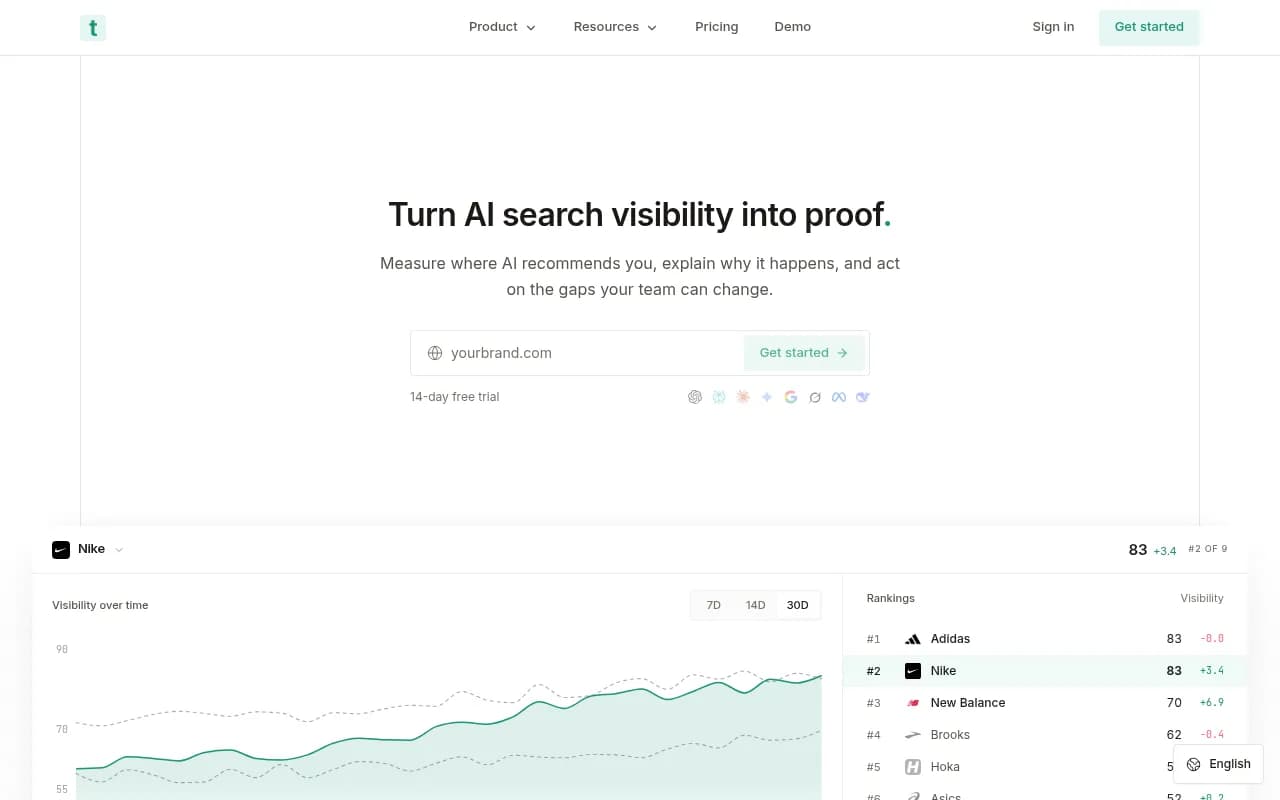
If your retainer includes execution, a platform that goes past tracking saves you a lot of manual stitching. Promptwatch tracks how ChatGPT, Gemini, Perplexity, Google AI Overviews, and others mention and cite a brand, then connects that to content gaps, a Content Agent that writes and publishes to WordPress, Webflow, or Framer, IP-verified AI crawler logs, and visitor analytics that show whether AI sends traffic. Its agency plans include unlimited projects and team seats. Note that agency plans do not include the Content Agent or white-label client portal; agencies that need those go to Enterprise. Pricing is at promptwatch.com/pricing, and there is a 7-day free trial on monthly billing.

The Promptwatch vs AthenaHQ comparison lays out the differences if you are choosing between the two.
Mistakes agencies make when they enter GEO
- Selling a score. Visibility scores move for reasons nobody can explain to a client. Sell the pages fixed and the prompts won.
- Promising rankings. AI answers vary by model, location, and day. Promise a process and a measured baseline.
- Ignoring crawler access. If AI bots cannot read a page, no rewrite helps. Check access first. Promptwatch's free Agentic Readiness Check is a quick way to test it.
- Over-investing in news. As the half-life data shows, news citations fade fast. Weight the budget toward landing pages, docs, and comparisons.
- Hiding the tool bill. Credit-metered tools can eat margin quietly. Track cost per client monthly.
A simple 30-day plan to get started
- Week 1: Pick one tracker and one fallback. Confirm pricing in writing, including credit add-ons.
- Week 2: Build an audit template with 50 to 100 prompts across your best-fit client categories. Test it on yourself first.
- Week 3: Pitch two existing clients with a free audit. Offer a three-month pilot.
- Week 4: Define the retainer menu, set cost-per-client targets, and decide whether to build or white-label fulfillment.
If you would rather not build the capability alone, an SEO and GEO partner can fill gaps. 1001 SEO Media publishes this directory and works with brands on technical SEO, content, and AI search visibility, and it uses Promptwatch for its own GEO tracking.
The bottom line
Do not skip GEO because a vendor name is in the headlines. Verify the rumor, spread your tool risk, and sell the work. The agencies that struggle will be the ones whose whole offer was a login. If your offer is better pages, cleaner structure, and measured results, the next vendor change is a line item, not a crisis.
For more tools in this space, browse the AI rank tracking directory at ai-rank-tools.com.