Key takeaways
- Bloomreach announced the AthenaHQ acquisition on November 16, 2026. The price was not disclosed. AthenaHQ says accounts, contracts and support stay as they are, and the founders and the whole team are joining Bloomreach.
- Nothing forces a move today. The first combined use cases are due in early 2027, so the real risk is roadmap drift, not an outage.
- Staying makes the most sense if you run ecommerce on Shopify or already use Bloomreach. Moving makes more sense if you want a vendor-neutral tool or a platform that also fixes problems.
- Whatever you choose, check that it tracks each AI engine separately, exports your data, and lets you out of contract on reasonable terms.
- The sensible default for most teams is to stay for now, run a 30-day parallel test, and set a review date for early 2027.
What actually happened
On November 16, 2026, Bloomreach said it had acquired AthenaHQ, a Y Combinator-backed answer engine optimization platform. Forbes reported the price as undisclosed. AthenaHQ was founded by Andrew Yan (ex-Google) and Alan Yao (ex-ServiceNow), and reported customers include Coinbase, Cozy Earth, Nuvadermis and Datmos.
Bloomreach's pitch is a three-step shopper journey: get discovered (AthenaHQ), convert (a personalized site) and build loyalty (marketing). Its own AI, Loomi, serves more than 1,400 brands. AthenaHQ's Athena Citation Engine (ACE) forecasts how likely a piece of content is to be cited by AI, and the product connects to Shopify, Google Analytics 4, and to Claude and ChatGPT via MCP.
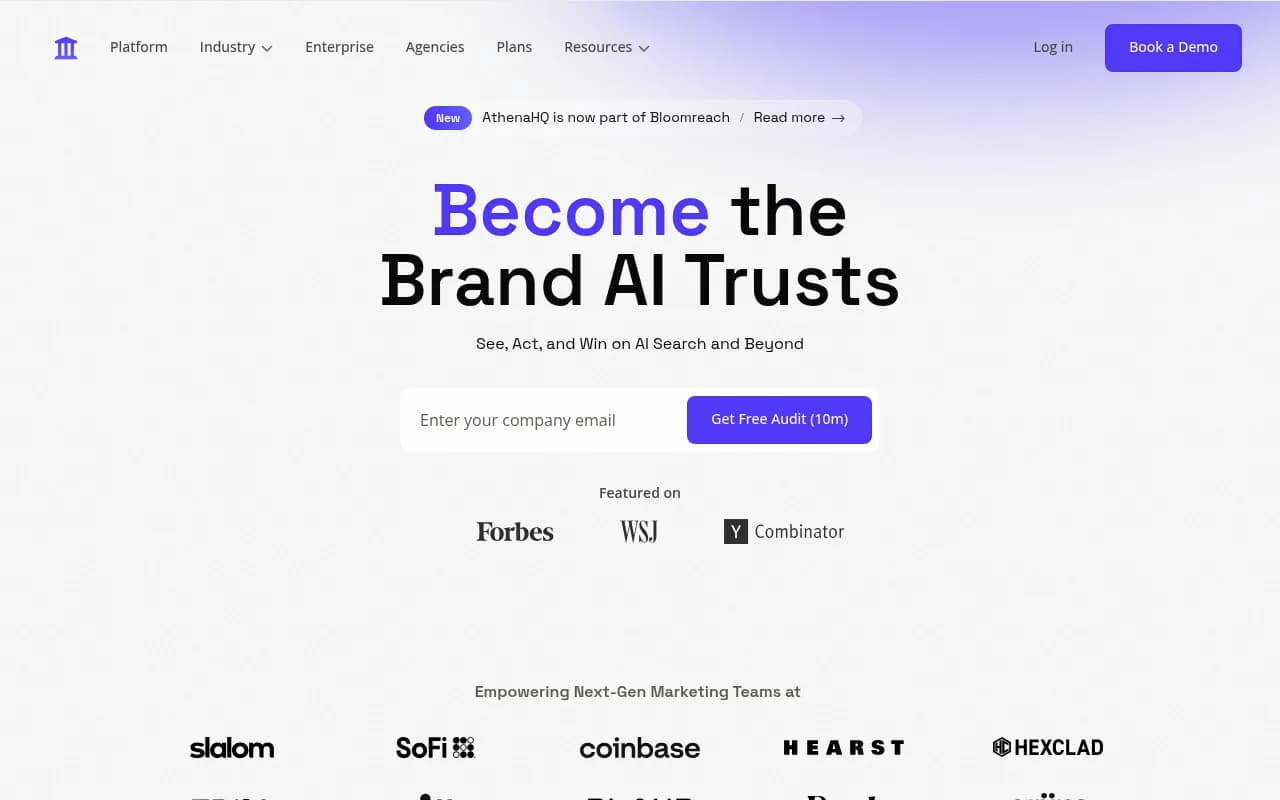
The AthenaHQ FAQ is the document to read closely. It says your account, contracts and support stay exactly as they are, that you keep working with the same team, and that Bloomreach will invest more in the team and product. The first new use cases combining the two companies launch in early 2027.

What we do not know
I looked for the boring details and could not find them. There is no public word on bundling with Bloomreach products, a product roadmap, data portability terms, or renewal terms after the deal. I also found no independent reviews of AthenaHQ written after the acquisition. The pricing page showed no changes tied to the deal.
MarTech asked the right open question: can the combined platform prove that AI citations drive actual sales? It compared the deal to Adobe's acquisition of Semrush. One disclosure: MarTech is owned by Semrush, so read that comparison with that in mind.
Why acquisitions change the risk, even when nothing changes
I have watched enough software deals to know the pattern. The first six months are quiet. Support is the same, the logo gets a new line underneath it, and everyone says nothing will change. Then the roadmap bends toward the parent company's priorities.
For AthenaHQ, that bend is predictable. Bloomreach sells to ecommerce and retail brands. Expect the product to get deeper on product content, shopping visibility and the Bloomreach stack. That is good if you are that customer. It is less good if you are a B2B SaaS company, an agency or a publisher who wanted a neutral monitoring tool.
None of this is a reason to panic. It is a reason to decide on purpose instead of by inertia.
The decision framework
Work through these six questions in order. Each one pushes you toward staying, hedging or moving.
1. Are you an ecommerce or retail brand?
If yes, and especially if you are on Shopify, the acquisition is closer to a tailwind. The Forbes piece frames the deal around AI agents shopping on behalf of consumers and helping brands decide which products to put on the shelf. That is your use case.
If you are B2B, a services business or an agency, the product direction may drift away from you. Lean toward hedging.
2. Do you already use Bloomreach?
Bloomreach started in search in 2012, bought Exponea (CDP and marketing automation) in 2021, and launched Loomi Connect in January 2026 to bring product discovery into ChatGPT apps via MCP. If you already run any of that, the integrated story could save you real work. Stay, and ask your account team what the early-2027 use cases cover.
If you do not use Bloomreach, you gain nothing from the bundle and carry the roadmap risk. That tilts toward hedging.
3. Does your current contract protect you?
Check three things in your contract: the renewal date, the notice period, and whether you can export your prompts, responses and citation history. AthenaHQ says contracts stay as they are, which is useful. Ask for that in writing, specifically that a change of control does not alter your terms.
An annual contract renewing in Q1 2027 is the awkward case. You will be deciding right as the new product direction becomes visible, with little time to test alternatives. Start the parallel test early.
4. Do you need monitoring, or do you need the work done?
AthenaHQ positions itself as more than a dashboard. Its plans include content recommendations, a content optimization agent and on-page and off-page actions. Many tools in this category are still mostly reporting.
Be honest about what your team does with the data. If you already have writers, an SEO lead and a publishing workflow, monitoring plus recommendations is enough. If your bottleneck is producing and publishing pages, weigh platforms that run the whole loop.
5. Does the tool separate AI engines?
This matters more than most buyers expect. Promptwatch's November 2026 domain rank report (data from Nov 3 to 16, 2026) shows how differently the engines behave. Domains at DR 91 and above earn 17.9% of AI Overviews citations but only 3.0% of ChatGPT's. Domains at DR 61 to 90 earn 41.2% of ChatGPT's citations against 25.6% for AI Overviews. Social platforms earned 13.16% of AI Overviews citations from Oct 11 to Nov 9, 2026, against 0.64% for ChatGPT, and YouTube alone took 6.71% in AI Overviews.
A blended visibility number hides all of that. Source: Promptwatch Data's domain rank distribution report. Whatever you keep, confirm it reports ChatGPT, Perplexity, AI Overviews and AI Mode individually.
6. Can you tie visibility to revenue?
Bloomreach's whole argument is measurable revenue. That is the right test to apply to any vendor, including this one. Ask whether the tool shows AI-referred sessions and conversions, not only mentions. AthenaHQ connects to GA4 and Shopify, which is a reasonable start. Tools that also read your server-side crawler logs give you a second angle on whether AI bots can even reach your pages.
Scoring it
| Your situation | Likely call |
|---|---|
| Shopify or ecommerce brand, already on Bloomreach | Stay, and engage with the roadmap |
| Ecommerce brand, not on Bloomreach | Stay for now, run a parallel test |
| B2B SaaS or services company | Hedge: test two alternatives before renewal |
| Agency managing multiple clients | Check agency pricing and white-label options elsewhere |
| Need content produced and published, not just recommended | Evaluate execution-focused platforms |
| Contract renews in Q1 2027 | Start testing now |
What staying costs
AthenaHQ's pricing page showed three tiers at the time of research. Confirm the current numbers on the vendor's site before you decide.
| Plan | Price | What you get |
|---|---|---|
| Essential | Free ($25 credit, 300 credits) | ChatGPT, Perplexity, AI Overviews, Gemini, Copilot, unlimited users, content recommendations |
| Starter | $295 per month | 3,600 credits (1 credit equals 1 AI response), 11 models, unlimited topics and prompts, country-level support, CSV export, content optimization agent |
| Enterprise | Custom | ACE, Knowledge Base and claim review, SSO, audit log, multi-region, persona targeting, BI dashboards, API access |
Two notes. ACE, multiple countries in the comparison table and the advanced content agent appear only in the Enterprise column, so the headline forecasting model is not on the self-serve plan. And credits are consumed per AI response, so heavy prompt sets burn through 3,600 quickly. Do the math on your prompt count times the number of engines times how often you want to refresh.
Alternatives worth testing
If the framework tells you to hedge, you do not need to test twenty tools. Pick two that match your problem. The GEO software directory at bestgeosoftware.com lists far more if you want the full field.
If you want monitoring plus execution
Promptwatch is the one I would put in the test first when the problem is closing gaps, not just seeing them. It monitors the real interfaces of ChatGPT, Google AI Overviews, AI Mode, Gemini, Perplexity, Copilot and others by country and language, then helps fix what it finds. The Content Agent writes and publishes to WordPress, Webflow or Framer, IP-verified AI crawler logs show whether bots can read your pages, and visitor analytics measure the traffic and conversions AI sends back. Brand Narrative breaks out the individual claims AI makes about you. Pricing starts at $95 per month (Essential) and the Content Agent arrives on Business at $579 per month, so confirm the details at promptwatch.com/pricing. There is a 7-day free trial on monthly billing, and a free AI visibility report needs no login.

The direct comparison is at Promptwatch vs AthenaHQ. It is Promptwatch's own page, so read it as a vendor's view and verify the claims in a trial.
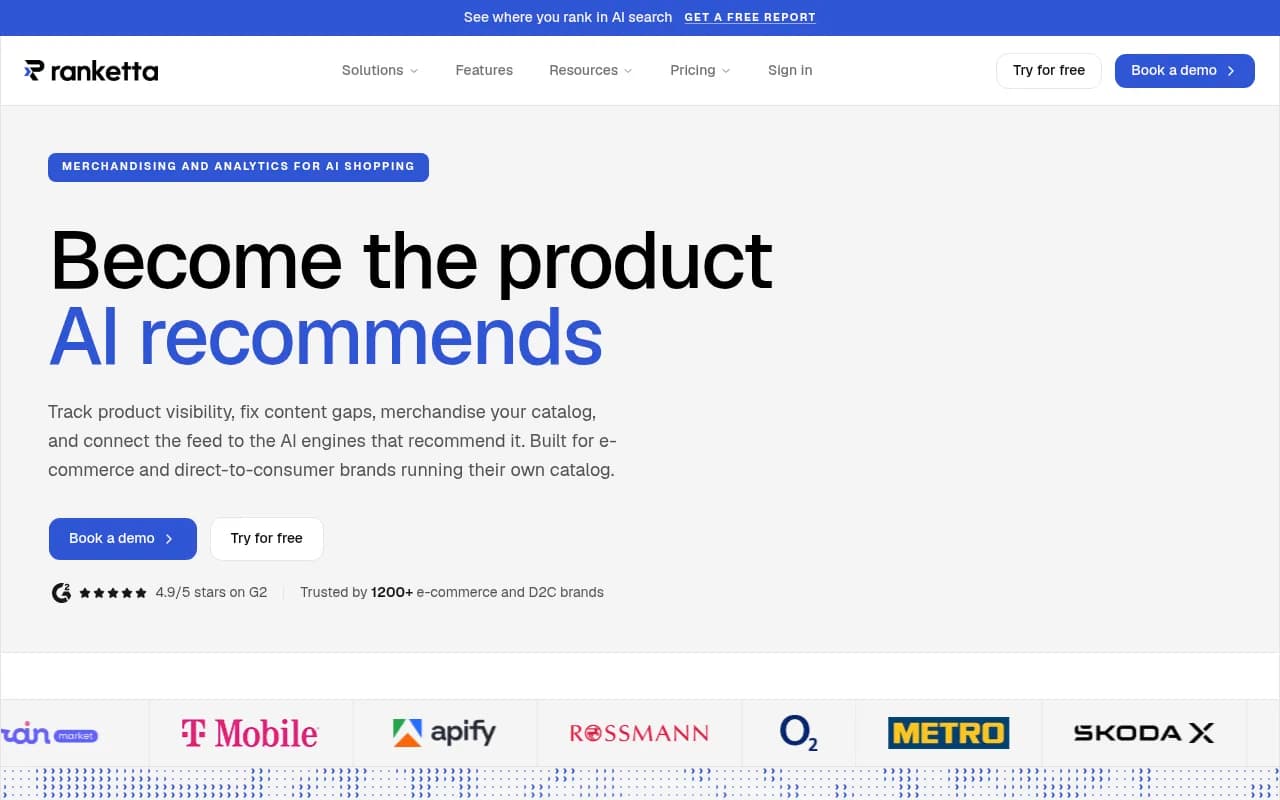
If you are ecommerce and want product-level tracking
A few catalog tools are built around products instead of brand mentions. They are the closest like-for-like if you stay in retail.
Yotpo Discover
If you are an enterprise with an existing suite
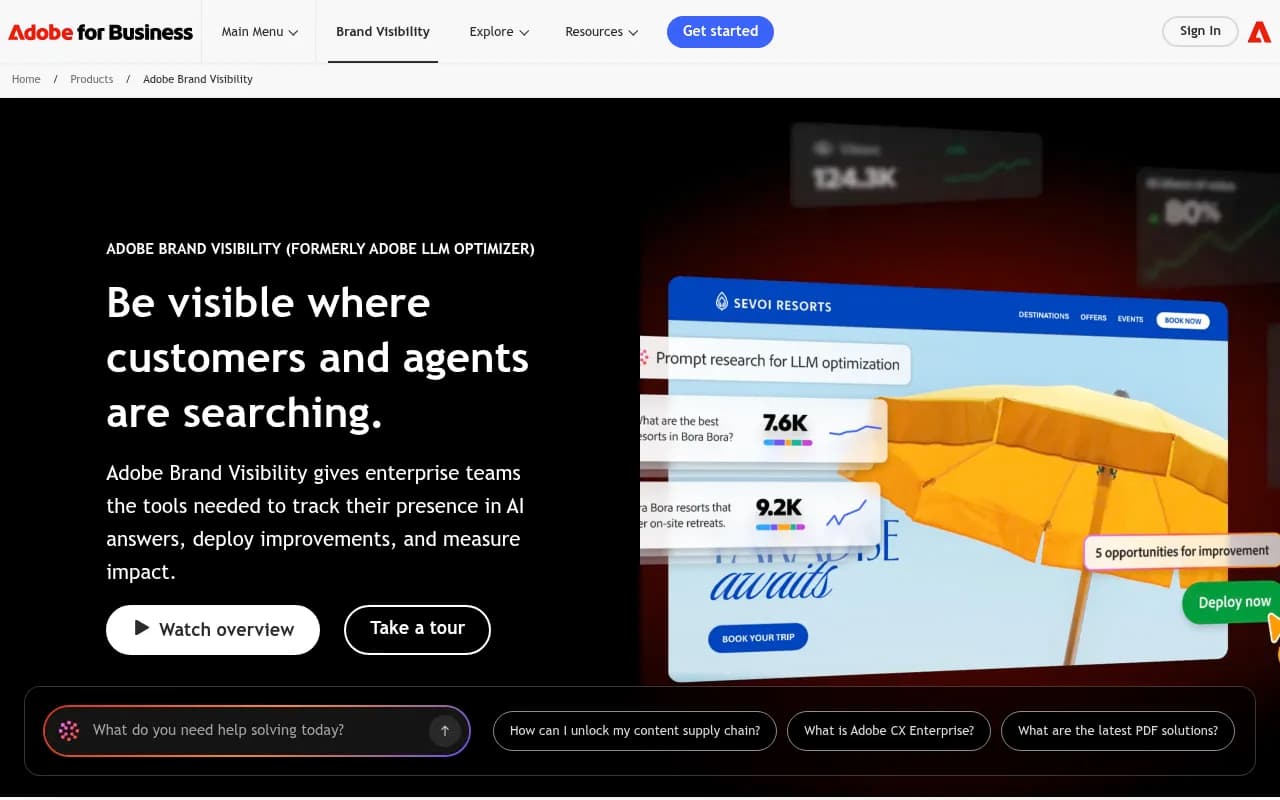
If you already pay for an enterprise SEO platform, check whether its AI module covers enough before adding a standalone tool.


If you want cheap monitoring only


These track prompts and mentions at lower prices. They will not publish content or read crawler logs, so only choose them if you already have the execution side covered.
Quick comparison
| Tool | Best for | Executes content work | Crawler logs |
|---|---|---|---|
| AthenaHQ | Ecommerce, Bloomreach customers | Recommendations and agent | Not confirmed |
| Promptwatch | Teams that want to track and fix | Yes, with CMS publishing | Yes, IP-verified |
| Profound | Enterprise monitoring | Limited | Not a core feature |
| Peec AI | Budget prompt tracking | No | No |
| Otterly.AI | Budget brand monitoring | No | No |
| Alhena AI | Catalog-level ecommerce tracking | Product focus | Not confirmed |
For more rank-tracking options, the AI rank tracking directory is a good second stop.
A 30-day parallel test
Hedging does not mean leaving. It means collecting evidence while your current tool keeps running.
- Export your current prompt list, competitor set and citation history from AthenaHQ. If export is awkward, that is itself a data point.
- Load the same 50 to 100 prompts into one alternative. Use the same countries and languages.
- Run both for 30 days. Compare coverage, how often the two tools disagree on whether you were mentioned, and how clear the recommended actions are.
- Check the engines separately. Look at ChatGPT and AI Overviews on their own, since citation behavior differs sharply between them.
- Pick one page, fix it using each tool's advice, and see which one shows a measurable change in citations or AI-referred visits.
- Ask AthenaHQ's team three questions in writing: what the early-2027 launches include, whether bundling changes your price, and what your data export rights are.
If you want a human to run this evaluation, an agency can do it. 1001 SEO Media does AI search and GEO work and uses Promptwatch internally, so factor that bias in if you ask them.
Red flags that should make you move
- Your account manager changes and your tickets slow down.
- The pricing page drops the self-serve tier or raises credit costs without notice.
- Features you rely on, such as a specific model or country, disappear from your plan.
- Renewal terms get rewritten to bundle Bloomreach products you do not use.
- The roadmap shifts toward retail features and your B2B needs go unanswered for two quarters.
Any single one of these is a conversation. Two or three together is your answer.
Green flags that justify staying
- The team keeps shipping, and the early-2027 integrations land on time.
- You can show a revenue number from GA4 and Shopify that ties to AI visibility.
- Your contract and data export terms are confirmed in writing.
- You are already a Bloomreach customer and the integration saves you manual work.
Verdict
For most teams, stay for now and test on the side. The AthenaHQ FAQ is reassuring, and acquisitions rarely break a product in their first quarter. The risk lives in 2027, when the roadmap becomes clear and your renewal likely arrives.
Ecommerce brands on Shopify, and anyone already running Bloomreach, have the strongest reason to stay. B2B teams, agencies and anyone who needs the platform to publish and measure, not only advise, should run a real trial of at least one alternative before the next renewal. Put a date on the calendar for February 2027, and decide then with data instead of announcements.