Key takeaways
- Semrush and Ahrefs are SEO suites with AI tracking attached. Slate is an AI-search-first content operations platform with tracking and agent workflows built in.
- Third-party figures put Semrush's AI Visibility Toolkit at about $99/month per domain and Ahrefs Brand Radar at $199 per platform or $699 for all six, on top of an Ahrefs plan. We did not verify these ourselves, so confirm on the vendor sites.
- Slate's official pricing page lists Growth at $499/month, Scale at $999, Agency at $2,000, and Enterprise as custom. Older articles that call Slate "free to start" look stale.
- Agencies should test all three with the same prompts, markets, and reporting tasks before buying. A single visibility score proves little.
- If you also need crawler logs, AI traffic attribution, and content that gets published for you, a dedicated platform like Promptwatch covers ground none of these three do.
Why this comparison is harder than it looks
These three tools are not the same kind of product, and that is the first thing to get straight. Semrush and Ahrefs built their businesses on keyword and backlink data, then added AI visibility modules as the market shifted. Slate started from the other direction: AI search first, with content production and agent workflows wrapped around the tracking.
For an agency, that difference shows up in daily work. Do you want AI tracking sitting next to the client projects you already run in Semrush or Ahrefs? Or do you want a system that tracks, decides what to fix, and produces the fix? Most of this guide is about that question.
One caveat before we go further. AI visibility products change quickly, and some of the pricing in public comparison articles is already out of date. I flag below which numbers come from vendor pages and which come from third parties.
What you are actually measuring
Before comparing dashboards, agree on what a number means. Percepture's October 2026 buyer guide makes a point I agree with: keep a brand mention, a linked citation, and an explicit recommendation as three separate measures. An answer that names your client is not the same as one that recommends them.
Its practical advice is to run the same brands, questions, markets, and reporting tasks through each vendor, then record the answer date, the question, the market, and the source links. That is a good agency procurement process, and it applies to Slate too.
Engine differences matter as well. According to Promptwatch's average sources per response data, ChatGPT cites roughly 5 sources per web-search answer, while Google AI Overviews and Perplexity cite about 10. Copilot swung from under 2 to nearly 17 within a few weeks. A tool that blends these into one number hides real differences, so look for per-engine reporting.
Semrush AI Visibility Toolkit
Semrush is the default SEO suite for many agencies, which is why its AI module gets considered first.
Per third-party reviews, the toolkit combines AI visibility tracking, prompt research, competitor analysis, brand performance monitoring, and AI-search auditing. Arobis lists the standalone AI Visibility price at $99/month per domain on annual billing. The xSeek comparison puts Pro plus the AI Toolkit at $238.95/month at monthly billing. Both figures are unverified by us.
What stands out:
- Brand perception and sentiment analysis. Style Factory's testing found Semrush went further than Ahrefs here, describing how AI tools represent a brand rather than just whether they mention it.
- AI-search technical auditing. Arobis scores Semrush ahead of Ahrefs for checking whether your site blocks answer engine crawlers.
- Workflow continuity. Existing client projects, reports, and logins stay where they are.
The limits: Arobis notes that Copilot, Grok, and Claude are Enterprise AIO only (custom pricing) in Semrush. Ahrefs, by comparison, tracks Copilot in its standard index. If a client cares about Copilot, check this early.
For the core suite, see the Semrush listing on this site.
Ahrefs Brand Radar

Brand Radar is strongest as a research tool. Arobis describes an AI Visibility Index of more than 449 million prompts across six AI platforms, plus custom prompt tracking that also covers Claude. It connects cited URLs back into Ahrefs' backlink data, which is a real advantage if you do link-driven client work.
Recent product updates, per Industry Lens, include entity extraction for AI response tracking (September 30, 2026) and social mention tracking and bot analytics in the July releases.
The issues are mostly cost and gaps:
- Cost. The xSeek comparison puts the minimum at $828/month for full six-platform coverage ($129 base plus $699 bundle). Style Factory says at least $199 extra per month for Brand Radar AI. Slate's own agency guide, by contrast, claims Brand Radar is available at no extra cost to existing paid users. Those claims conflict, so ask Ahrefs for a written quote.
- Grok is paused. Arobis says Ahrefs is temporarily unable to gather new Grok data.
- Sentiment is thinner. Style Factory found Brand Radar good at surfacing associated topics but not sentiment.
On the plus side, Ahrefs supports unlimited verified domains, which Style Factory calls the better fit for agencies managing many sites.
Slate

Slate calls itself an AI-search-first content operations platform. Tracking is one part. Agent work such as workflows, content production, refreshes, and outreach (LinkedIn and email) draws on a separate credit allowance.
From Slate's official pricing page:
| Plan | Price/mo | AI answers/mo | Daily prompts (1 platform) | Pages monitored | Credits |
|---|---|---|---|---|---|
| Growth | $499 | 10,000 | 333 | 1,000 | 15,000 |
| Scale | $999 | 20,000 | 667 | 5,000 | 50,000 |
| Agency | $2,000 | 50,000 | 1,667 | 10,000 | 100,000 |
| Enterprise | Custom | Custom | Custom | Custom | Custom |
Annual billing saves 20%. Every plan tracks ChatGPT, Perplexity, Google AI Overviews, and Google AI Mode. Claude and Gemini come from a separate pool, sold in 1,000-answer packs. Enterprise includes all six platforms.
One detail worth understanding: an "AI answer" is one response from one platform for one prompt in one location. Run 333 prompts daily on one platform and you burn about 10,000 answers, the full Growth allowance. Run the same prompts weekly and it is about 1,450. For an agency with many clients, that math decides your plan, so model it before you sign.
The xSeek article describes free Solo and Pro tiers. The current pricing page says plans start at $499/month with a free trial, so treat the free-tier claims as outdated.
Slate also lists bring-your-own API key, an MCP server, an API, and CMS, SEO, social, CRM, and project-management integrations. Scale and above add custom users and workspaces plus a dedicated account manager, which matters for multi-client work. I could not verify white-label reporting for any of the three, so ask each vendor directly.
Side-by-side comparison
| Factor | Semrush AI Visibility | Ahrefs Brand Radar | Slate |
|---|---|---|---|
| Core identity | SEO suite with AI add-on | SEO suite with AI research module | AI-search-first content ops |
| Reported entry price | ~$99/mo per domain (unverified) | ~$199/platform or $699 bundle plus Ahrefs plan (unverified) | $499/mo (official) |
| ChatGPT, AIO, AI Mode, Perplexity | Yes | Yes | Yes, all plans |
| Gemini | Yes | Yes | Add-on pack or Enterprise |
| Claude | Enterprise only | Custom prompts only | Add-on pack or Enterprise |
| Copilot | Enterprise only | Yes | Not listed |
| Strongest at | Sentiment, site audits, workflow continuity | Citation research, discovery, backlink link-up | Tracking plus agent-driven content work |
| Weak spot | Narrower engine coverage on standard plans | Cost, Grok paused, thin sentiment | Higher entry price, answer allowances to budget |
Which one fits which agency
Agencies already living in Semrush
Start with the AI Visibility Toolkit. Slate's own agency guide says the same about native modules: operational continuity is worth more than small feature differences. Set a baseline, then see if clients start asking for citation attribution or cross-model detail you cannot deliver.
Agencies built on Ahrefs and backlinks
Brand Radar is the natural extension, especially when you want to see which third-party pages AI cites and then pursue those pages for links or mentions. Get the pricing in writing first, given the conflicting reports.
Agencies that want execution, not just reporting
Slate makes more sense when the question is less "are we visible?" and more "produce the fixes at scale." The credit model for agents means you should estimate how many content pieces and workflow runs your clients need per month.
Where a dedicated GEO platform fits
All three options sit somewhere between monitoring and execution. If an agency needs the full loop, it is worth looking at a platform built for it. Promptwatch tracks real ChatGPT, AI Overviews, Gemini, Perplexity, and Copilot interfaces, shows IP-verified AI crawler logs and AI traffic, and its Content Agent can write and publish to WordPress, Webflow, or Framer, then check whether the page got crawled and cited. Agency plans start at $199/month with unlimited projects and a white-label client portal, so confirm current terms at promptwatch.com/pricing.

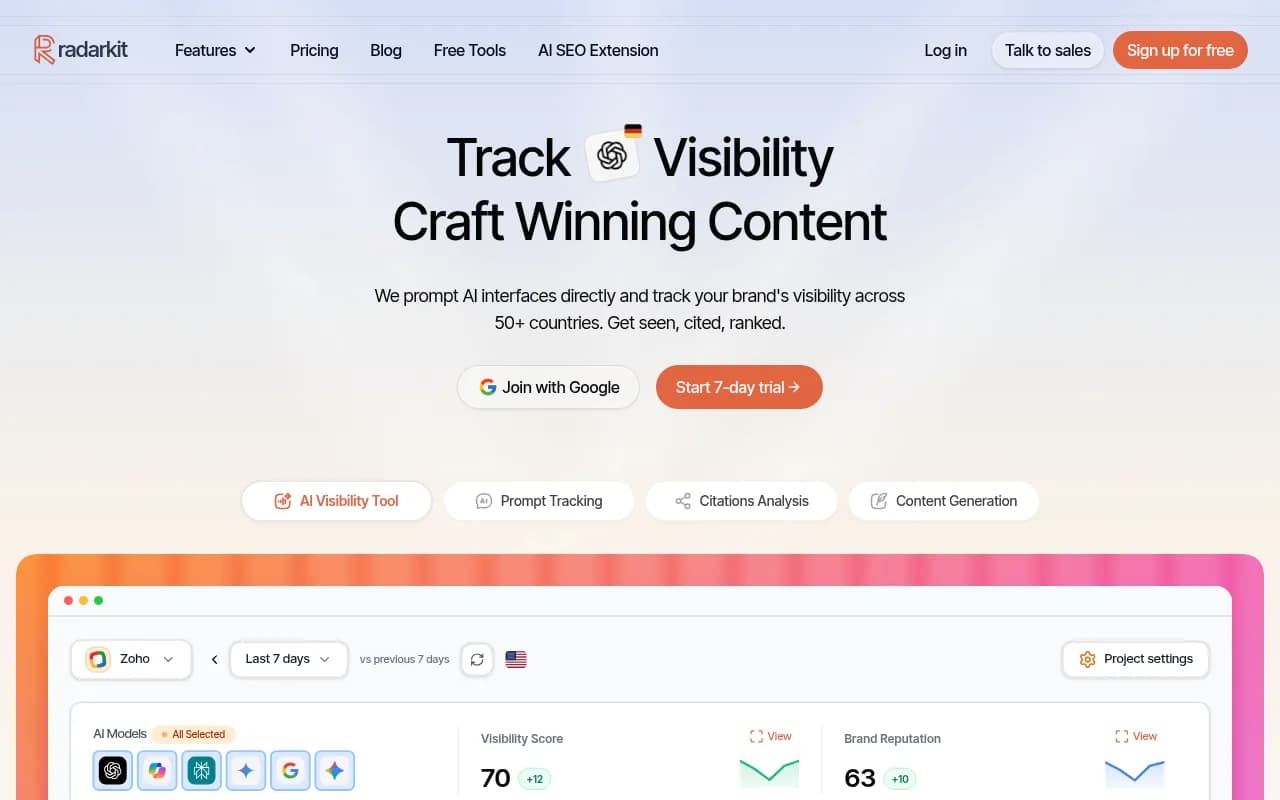
If you want to compare more options, the GEO software directory and the AI rank tracking directory list many alternatives. Radarkit, Peec AI, and Profound also come up often in agency comparisons.

How to run a fair agency trial
- Pick two real clients and 30 to 50 prompts per client, mixing branded, comparison, and purchase-intent questions.
- Use the same markets and languages in every tool.
- Check the engines that matter to each client. If Copilot or Claude matters, confirm it is included at your plan level.
- Compare raw answers, not just scores. Can you open the actual response and the cited sources?
- Test one client-ready report end to end. Is it exportable, branded, and scheduled?
- Calculate total monthly cost at your real prompt volume, including answer packs, add-ons, and the base SEO plan.
- Review after a month. Did any tool tell you what to do next, or only what happened?
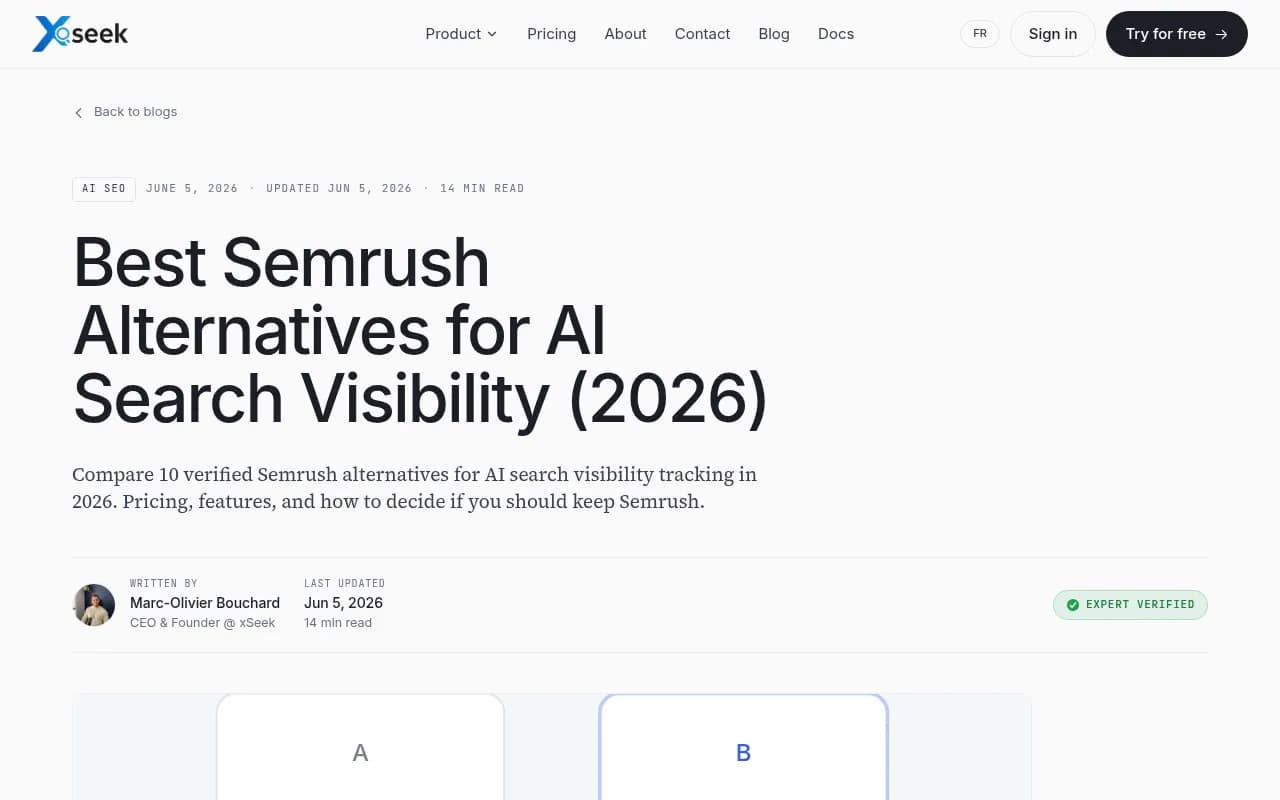
Treat vendor-written comparisons like the one above with care. Several of the sources in this guide are published by competing vendors, including Slate itself, so each one has a reason to favor its own product.
The bottom line
Semrush is the easiest add-on for agencies already standardized on it, with better sentiment and auditing. Ahrefs Brand Radar is better for research and citation discovery, though cost and Grok coverage need checking. Slate costs more to start, but it is the only one of the three built around producing the work as well as measuring it. Run the same trial across all three, count your answer volume honestly, and let your own client data decide.