Key takeaways
- Surfer and Clearscope are per-article optimizers. Frase is a faster, cheaper research-to-publish workflow. MarketMuse plans at the site level and stops before the draft.
- All four now claim some AI search angle, but their depth varies. Check each vendor's current plan details before you buy, because pricing and modules keep shifting.
- None of them replaces measurement. An editor score tells you a draft matches the SERP. It does not tell you whether ChatGPT or AI Overviews cite you.
- Content type and freshness matter for AI citations. Promptwatch Data shows product and landing pages dominate ChatGPT citations, and news decays fastest.
- Most teams do best with one planning layer, one editing layer and one AI visibility layer, not a single tool.
Why revisit these four tools now
The classic content optimization pitch was simple: pick a keyword, look at what the top ten results do, and match it. Surfer, Clearscope, Frase and MarketMuse all grew up on that idea. It still works for Google's blue links.
But a growing share of discovery happens inside answer engines, where the question is not "do I rank?" but "does the model name and cite me?" That changes what a content team needs from its tooling. A green content score is a fine quality gate. It is a weak proxy for AI citations.
So this guide revisits the four incumbents with that lens. What does each still do well, what have they added for AI search, and what is left for you to cover elsewhere?
A caveat before we start: pricing and feature claims below come from vendor pages and third-party reviews gathered in mid-2026. Frase's comparison page, for instance, is vendor-written and treats MarketMuse harshly. Verify numbers on each official site before you commit budget.
The four tools at a glance
| Tool | Core job | AI search angle | Approx. starting price | Best for |
|---|---|---|---|---|
| Surfer SEO | Real-time scoring against the SERP | AI Tracker module, AI signals in editor | Around $89-$99/mo, higher with add-ons | Teams publishing 20+ articles a month |
| Clearscope | Term recommendations and A-F grading | AI prompt tracking, Content Inventory | $129/mo Essentials, $399/mo Business | Editorial teams living in Google Docs |
| Frase | Research, briefs, writing, publishing | Dual SEO and GEO scoring, AI visibility tracking | $49/mo, $129/mo, $299/mo tiers | Small teams wanting speed and low cost |
| MarketMuse | Site-level planning and topic authority | None native per Frase's comparison | Free tier, paid via demo | Large libraries needing prioritization |
Surfer SEO: the production-line standard
Surfer SEO analyzes the pages ranking for a keyword, extracts signals like term frequency, structure and topical coverage, and turns them into a live Content Score as you write. Surfer's own Content Editor page says it looks at 500+ web and AI signals.
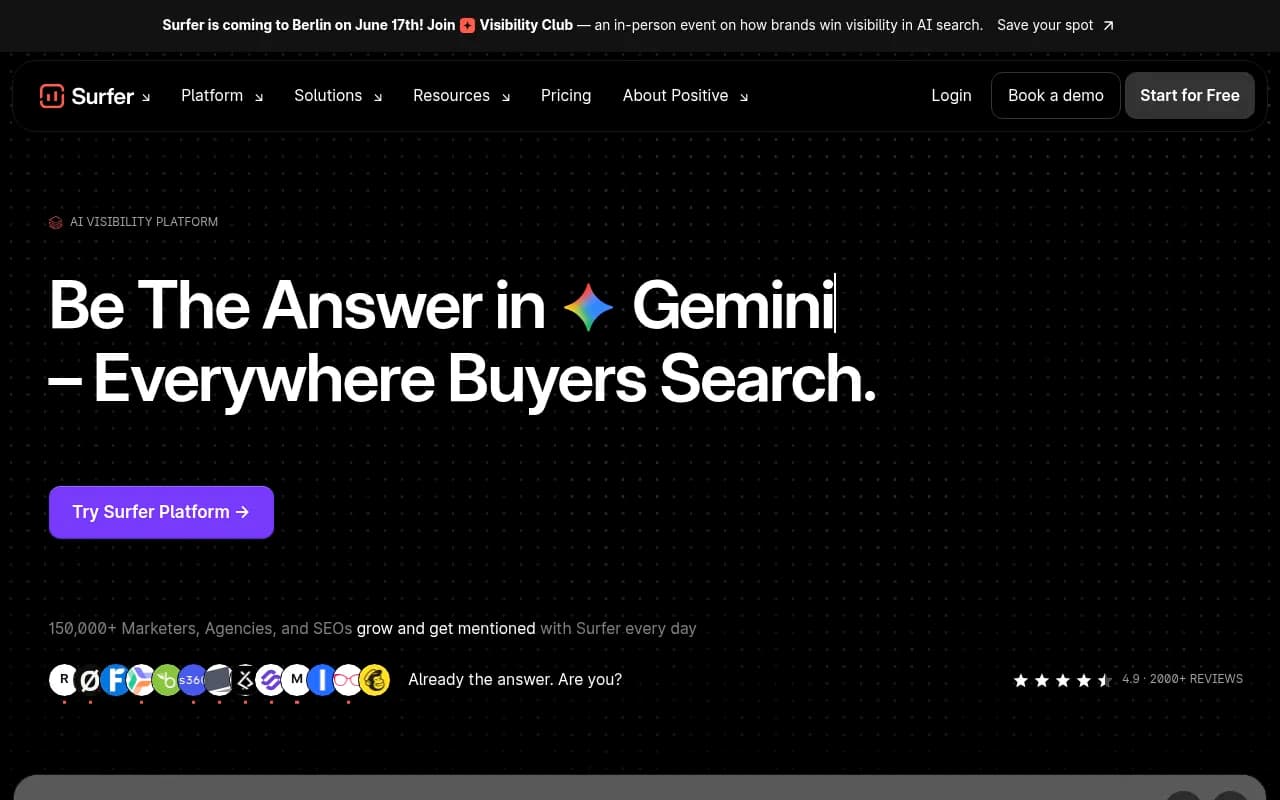
The appeal is consistency. A team with decent writers but no shared quality bar gets one fast. The score goes green, the editor signs off, the article ships.
The limits are just as clear. Surfer is not a full SEO suite, so you still need something like Ahrefs or Semrush for backlinks and technical audits. And its method is per-article: it can tell you what a page needs to compete for a keyword, but it has nothing to say about whether the keyword was worth chasing. Budget-wise, the base plan is not the whole story. Reviewers report that adding the SERP Analyzer and AI Tracker modules can push monthly spend toward $220.
On AI search, Surfer now offers an AI Tracker for monitoring whether your content shows up in AI answers. Treat it as a useful add-on, not a replacement for a dedicated tracker.
Clearscope: the editorial finishing station
Clearscope is the narrowest tool here, and that is its selling point. It uses NLP to produce a list of terms and subtopics, then grades your draft A through F as you cover them. Practitioners frequently describe its term suggestions as the most trustworthy of the group.
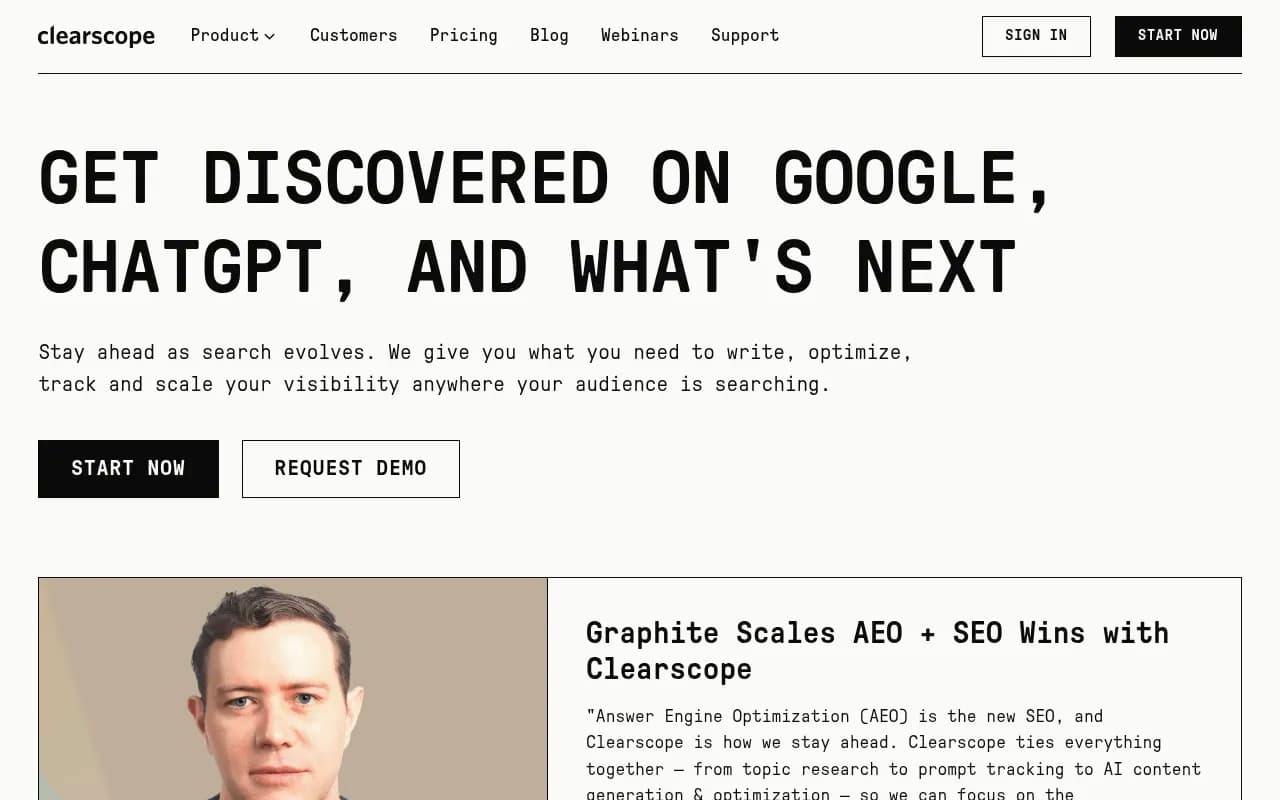
Two things stand out in the current product. First, the Google Docs integration is deep, so writers and editors never leave Workspace. Second, Content Inventory connects to Google Search Console and tracks published pages over time, flagging slipping rankings and dated content. For a team with hundreds of existing articles, refresh alerts can be worth more than any drafting feature.
The pricing page lists Essentials at $129 a month and Business at $399, with tracked topics, pages and drafts varying by tier. Clearscope does not write for you (it has assisted outlining only), so it assumes professional writers. It also now advertises AI search visibility and prompt tracking, though it is a smaller part of the product than the editor.
Frase: the speed-first challenger
Frase rebuilt its product in 2026 around a dual score: an SEO score for Google and a GEO score for how likely AI engines are to cite the page. It automates briefs from SERP analysis, writes drafts, tracks AI visibility, audits sites and publishes to a CMS.
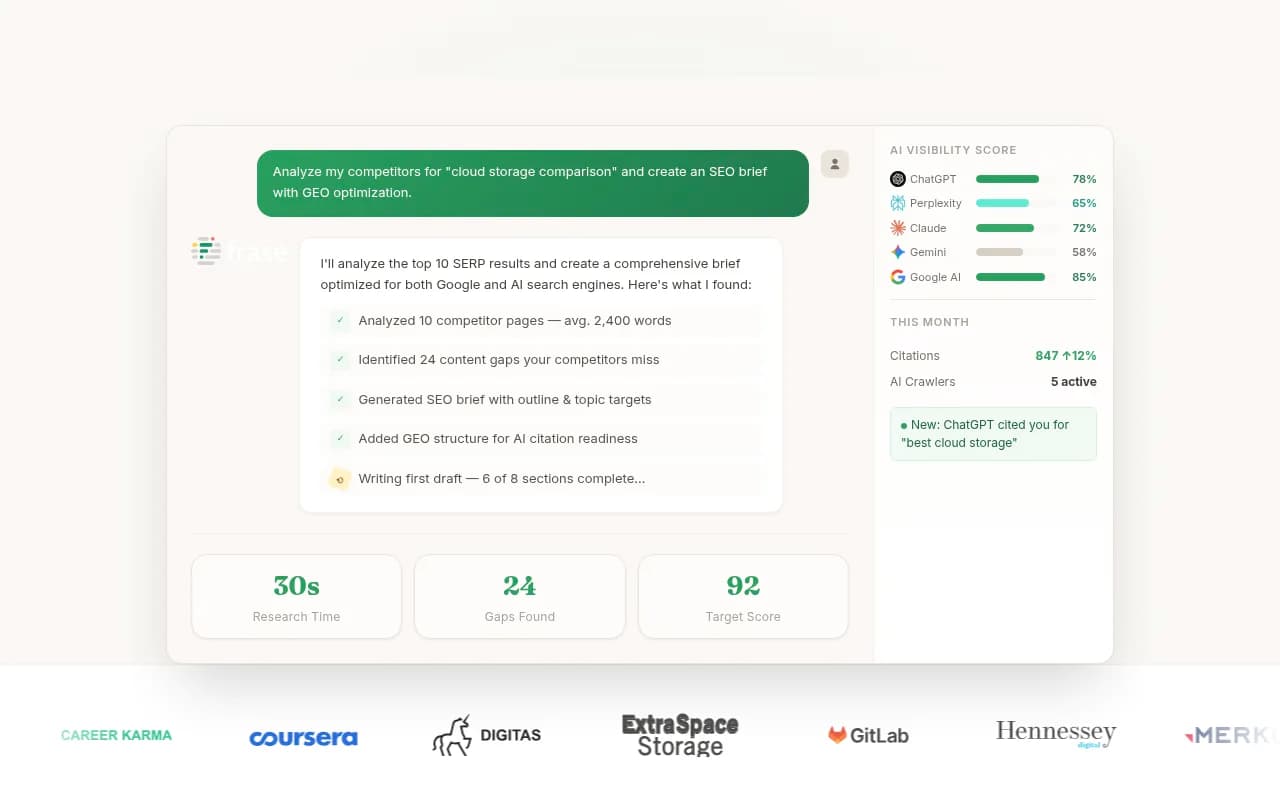
The vendor's page lists plans at $49, $129 and $299 a month with a free trial. Even if you discount the marketing, it is the cheapest route into a combined SEO and AI workflow. Third-party reviewers are blunter about the tradeoff: SERP analysis granularity and term precision still trail Surfer and Clearscope. Frase is best when the goal is medium-to-high quality at high frequency, and less ideal for a flagship long-form piece that needs maximum polish.
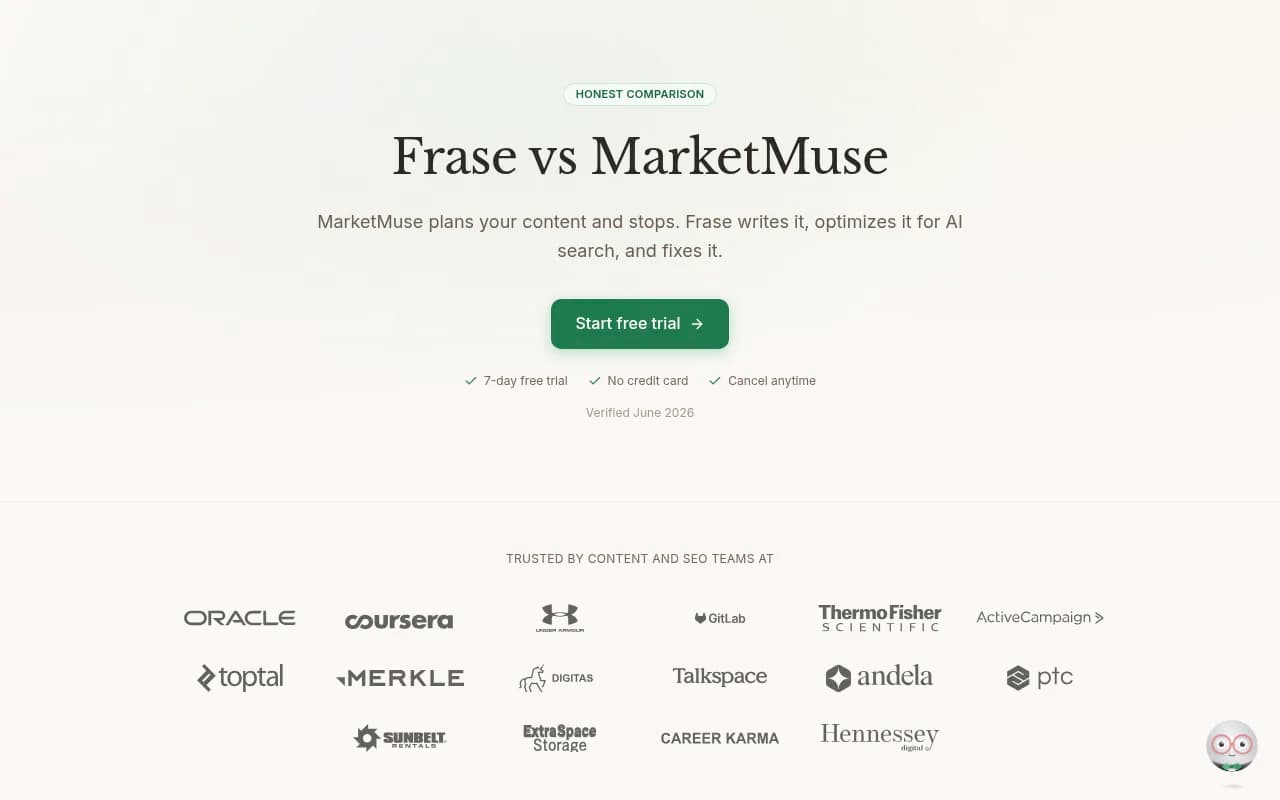
Frase's own pitch is a closed loop: research, write, optimize, track citations and fix decaying pages through Content Guard, which watches Search Console for decay and drafts fixes for approval. Remember that this framing comes from Frase's comparison page, so read it as positioning rather than neutral review.
MarketMuse: the strategist's map
MarketMuse answers a different question. Surfer, Clearscope and Frase optimize single articles. MarketMuse looks at your whole content inventory, scores how well you cover a topic, and gives you a personalized difficulty measure so you know which topics you can realistically win.
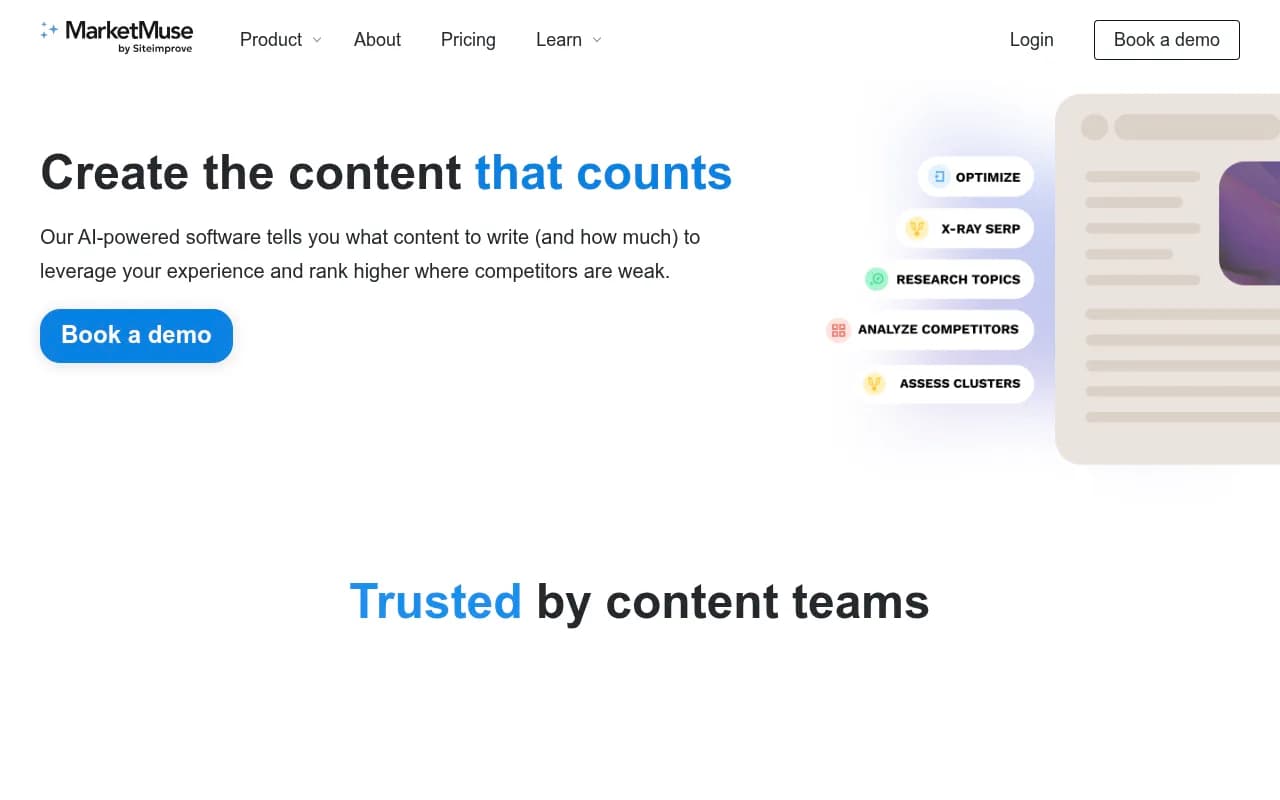
That matters because the same keyword is easy for an established finance site and brutal for a new blog. The tool also produces detailed briefs and inventory audits for large libraries. What it does not do is give real-time guidance while a writer drafts. Per Frase's comparison, it also lacks AI visibility tracking and GEO scoring, and paid tiers now go through a demo request after MarketMuse became part of Siteimprove. Check that on MarketMuse's own site.
If your problem is deciding what to write and refresh next across hundreds of pages, MarketMuse is a serious option. If your problem is making each draft better, it is the wrong tool.
What AI search changes about content work
The uncomfortable truth is that none of these tools was designed around how answer engines choose sources. That does not make them useless. It means you should use the data on AI citations to decide what they are for.
Promptwatch's analysis of ChatGPT citations from Sep 28 to Oct 4, 2026 found product pages were the most cited type at 22.4%, followed by landing pages at 16.8%. Together, pages describing what a company sells took about 39% of citations. Listicles got 13.6%, how-tos 8.7% and comparisons 5.9%. See the full Promptwatch Data report on ChatGPT content types.
For commercial prompts the skew is stronger: product pages 26.0%, landing pages 20.6%, listicles 15.0% and comparisons 7.9%. If your editorial calendar is mostly blog posts, you are playing for roughly 43% of the citation pool.
Freshness matters too. In Promptwatch's ChatGPT content half-life data, tracking pages cited on July 6, 2026 for 90 days, landing pages (78% still cited at 30 days) and docs (76%) held up best, while news lost half its pages within 36 days. Product pages, reviews and how-tos reached their half-life after about 74 to 77 days.
Three practical consequences follow:
- Use the editor tools for what they are good at, matching depth and coverage, but do not assume a high score earns a citation.
- Put refresh effort where decay is fastest. Product pages with stale prices and specs fall off about as quickly as how-tos.
- Write headings like short search queries and build focused pages for sub-questions such as "X vs Y", pricing and alternatives. Promptwatch's query fanout data suggests ChatGPT's searches got shorter through early 2026.
Which tool for which team
| Situation | Start with | Why |
|---|---|---|
| Writers are fine, quality is inconsistent, volume is high | Surfer SEO | Live score creates a shared standard |
| Editorial workflow lives in Google Docs, refreshes matter | Clearscope | Deep Docs integration plus Content Inventory |
| Small team, tight budget, needs to care about AI search | Frase | Cheapest, dual scoring, brief-to-publish |
| Hundreds of pages, unclear priorities | MarketMuse | Site-level difficulty and gap analysis |
| Planning and writing both matter | MarketMuse plus Surfer | Plan quarterly, optimize daily |
| Fast drafts that need a final polish | Frase plus Clearscope | Speed up front, precision at the end |
These pairings come from reviewers who have run the tools side by side, and they match my own sense of how the tools divide labor. One team's reported setup is typical: Surfer for daily production because the team is large and needs standardization, plus Frase for topic research because it is quick and cheap.
Add a measurement layer
Here is the gap. Every tool above scores a page against what already ranks. None of them is built to show you which prompts mention your brand, which pages AI crawlers actually read, or how much traffic comes from AI answers. Surfer's AI Tracker and Clearscope's prompt tracking are a start, but they are secondary to their editors.
A dedicated AI visibility platform fills that role. Promptwatch tracks brand visibility across ChatGPT, Google AI Overviews, Perplexity, Gemini and others, and its crawler logs and citation analytics show whether the pages you optimized are being read and cited. That feedback is what tells you whether your Surfer or Clearscope workflow is producing results.

If you want to compare options, the GEO software directory lists the category in one place.
A workable stack for a content team
Here is a lean setup I would recommend to most teams, depending on size.
Small team (1 to 4 people)
- Frase for research, briefs, drafts and a GEO score.
- A free or entry-level AI visibility check to see whether anything you publish gets cited.
- A monthly refresh pass on product and how-to pages.
Mid-sized team (5 to 20 people)
- Surfer or Clearscope as the editor, chosen by whether your team lives in a standalone editor or Google Docs.
- Frase or a spreadsheet brief process for research.
- A real AI visibility platform, so reporting does not depend on editor add-ons.
Large content library
- MarketMuse for quarterly planning and inventory prioritization.
- Surfer or Clearscope for daily optimization.
- AI visibility tracking plus crawler data, so planning decisions respond to what AI engines cite.
How to run a fair trial
The common mistake is opening three trials, typing the same keyword into each and picking the one that gives your draft the best score. That measures scoring generosity, not value. Try this instead:
- Pick five real articles: two new, two refreshes, one comparison page.
- Run each through the candidate tools with the same writer.
- Track time to publish, editor revisions needed and Search Console movement after 30 and 60 days.
- Check AI citations for the target prompts before and after.
- Pay for the tool that shortens the loop, not the one with the prettiest score.
Watch the true cost too. Surfer's add-ons, Clearscope's tier limits on tracked topics and Frase's plan caps all change the real monthly price once your volume grows.
Bottom line
The four incumbents are still good at what they were built for. Surfer standardizes production, Clearscope polishes and monitors, Frase moves quickly and cheaply, and MarketMuse decides where to aim. AI search adds a fifth job: finding out whether any of it gets cited. Pick the editor that matches your workflow, plan at the site level if your library is big, and measure AI visibility separately.
For broader tool research, the SurferStack directory has reviews and alternatives across the category.