Key takeaways
- Only 12% of URLs cited by ChatGPT, Gemini, and Copilot rank in Google's top 10 for the same prompt -- ranking and getting cited are now two separate problems.
- Long-form guides fail in AI search not because of length, but because AI models can't extract clean, self-contained answers from dense prose.
- The fix isn't rewriting your guide -- it's restructuring it so AI can pull discrete answers from specific sections.
- Answer-first formatting, standalone H2s, and embedded FAQs are the three changes that move the needle fastest.
- Tracking which pages actually get cited (and which don't) is the only way to know if your changes are working.
You spent three weeks on that guide. Researched every angle. Hit 4,200 words. Got it to page one. And then watched ChatGPT answer the exact question your guide covers -- without citing you once.
That's not bad luck. It's a structural problem, and it's fixable.
Why AI search and Google search are now completely different games
Here's the uncomfortable truth: ranking on Google no longer predicts whether AI models will cite you. An Ahrefs analysis of 15,000 prompts found that only 12% of URLs cited by ChatGPT, Gemini, and Copilot rank in Google's top 10 for the same query. That's not a rounding error -- it means 88% of AI citations come from pages that aren't even in Google's top 10.
AI engines don't crawl results and pick the top-ranked page. They retrieve content based on how well it answers a specific question, how cleanly that answer is structured, and whether the source appears trustworthy in the context of that particular query. A page that's great for humans to read linearly can be completely useless to an AI model trying to extract a precise answer.
This is the citation gap. And long-form guides fall into it more than almost any other content type.

The actual reason long-form guides get ignored
Long-form guides are written for humans who read from top to bottom. They build context gradually, use transitions, and assume the reader is following along. That's good writing. It's also exactly what makes them hard for AI to use.
When an AI model processes your guide, it's not reading it like a person. It's scanning for chunks of content that directly answer a query. It needs to find a self-contained answer -- something it can extract, paraphrase, and cite -- without needing to read the 800 words of context that came before it.
Most long-form guides fail this test for a few specific reasons:
The answer is buried. You spend three paragraphs setting up the problem before you state the solution. An AI retrieval system may never get to the solution, or may not recognize it as the answer because it's surrounded by framing language.
Sections aren't self-contained. Each section of your guide assumes the reader has read everything before it. Phrases like "as we discussed above" or "building on that framework" make sections dependent on each other. AI models often retrieve individual sections, not the whole document -- and a section that references earlier context becomes incoherent on its own.
Headings describe topics instead of answering questions. A heading like "Content Structure" tells an AI what the section is about. A heading like "What content structure gets cited by AI?" tells it what question the section answers. That difference matters more than it sounds.
No explicit Q&A layer. AI models are trained on question-answer pairs. Content that's written in that format -- a question, then a direct answer -- is significantly easier for them to match to user queries and extract as a citation.
A piece from TechTimes in August 2026 put it plainly: an AI engine may retrieve a guide once when a broad query matches it, cite it once, and then replace it with more precisely structured content the next time a similar query comes in. Long-form guides that aren't structured for extraction get one shot, then get replaced by comparison pages or FAQ-style content that's easier to parse.
The four mechanics AI engines use to pick sources
Before getting into the fix, it helps to understand what AI models are actually optimizing for when they choose citations.
Extractability. Can the model pull a clean, complete answer from a specific section of your page? If the answer requires reading the whole document to make sense, it's not extractable.
Query match. Does your content use the same language as the user's query? Not just keywords -- the actual phrasing of the question. AI models are sensitive to this because they're matching queries to training data and retrieved content simultaneously.
Source authority signals. This isn't just domain authority. It includes whether your content is cited by other sources, whether your brand appears in discussions on Reddit or YouTube, and whether AI crawlers have successfully indexed your pages without errors.
Freshness and specificity. Generic content that could have been written two years ago gets deprioritized. Content that references specific data, recent events, or precise use cases gets treated as more reliable.
Most long-form guides score well on query match (they cover the topic) but poorly on extractability and specificity. That's the gap.
The afternoon fix: restructuring for AI extraction
This isn't about rewriting your guide from scratch. It's about layering in structural changes that make existing content citable without changing what it says. Here's what to do, in order of impact.
1. Add a direct answer at the top of every major section
Take each H2 section and add a 2-3 sentence direct answer immediately after the heading, before any context or explanation. This is sometimes called "answer-first" formatting, and it's the single highest-impact change you can make.
Before:
Why does content structure matter? When we think about how search engines have evolved over the past decade, it becomes clear that the relationship between content and ranking has grown increasingly complex...
After:
Why does content structure matter? Content structure determines whether AI models can extract your answer and cite it. Pages with clear, self-contained sections get cited more often than pages that require sequential reading. The rest of this section explains why.
The second version gives an AI model a complete, citable answer in the first two sentences. Everything after it is supporting detail.
2. Rewrite your H2 headings as questions (or explicit statements)
Go through every H2 in your guide and ask: does this heading tell an AI what question this section answers? If not, rewrite it.
"Content structure" becomes "What content structure gets cited by AI?" "Common mistakes" becomes "What mistakes stop pages from getting cited?" "Implementation steps" becomes "How do you restructure a guide for AI citations in one afternoon?"
This isn't just cosmetic. AI models use headings to understand what a section is about and whether it matches a query. Question-format headings make that matching much more direct.
3. Add a standalone FAQ section at the bottom
This is the fastest win in the whole process. Take the five to eight most specific questions your guide answers and write them out explicitly as a Q&A block at the bottom of the page. Each answer should be two to four sentences -- complete enough to stand alone, short enough to be extracted cleanly.
These FAQ entries become highly citable on their own. They're formatted exactly the way AI models are trained to process question-answer pairs, and they cover the specific queries that might not match your main headings perfectly.
Don't write generic FAQs. Write the questions your actual readers are asking -- the ones that appear in "People also ask" boxes, in Reddit threads about your topic, or in the queries you're tracking in your AI visibility monitoring.
4. Break dependent sections into standalone modules
Go through your guide and find every section that references earlier content. Rewrite those sections so they can be understood without reading anything that came before. This usually means:
- Adding a one-sentence context statement at the start of the section ("This section covers X, which is part of a broader approach to Y")
- Replacing phrases like "as mentioned above" with the actual information
- Making sure each section has a clear conclusion that doesn't depend on what comes next
This feels redundant when you're writing it. That's fine. AI models retrieve sections, not documents -- redundancy at the section level is a feature, not a flaw.
5. Add specific data points and named examples
Generic claims ("content structure matters for AI citations") are less citable than specific ones ("only 12% of URLs cited by ChatGPT rank in Google's top 10 for the same query, according to Ahrefs' 15,000-prompt analysis"). AI models prefer specificity because it signals that the content is grounded in real information rather than general knowledge they already have.
Go through your guide and find every claim that could be made more specific. Add numbers, dates, named tools, named studies, or concrete examples. If you don't have data to cite, describe a specific scenario instead of a general pattern.

What to prioritize if you only have one afternoon
If you're doing this in a single session, here's the order:
- Add answer-first paragraphs to every H2 section (30-45 minutes for a 4,000-word guide)
- Rewrite H2 headings as questions (15 minutes)
- Write a 6-question FAQ section at the bottom (20-30 minutes)
- Check for dependent sections and add context statements (15-20 minutes)
That's roughly three hours of focused editing. You don't need to rewrite anything -- you're adding structure on top of existing content.
How to know if it's working
This is where most teams fall down. They make the structural changes and then wait to see if traffic improves. But AI citation visibility doesn't show up in Google Analytics in any obvious way, and organic traffic changes can take weeks to attribute.
You need to track which of your pages are being cited by which AI models, and how that changes after you make edits. Tools like Promptwatch track page-level citations across ChatGPT, Perplexity, Claude, Gemini, and other AI engines -- so you can see exactly which pages are being cited, how often, and whether your restructured guide starts appearing after the changes go live.
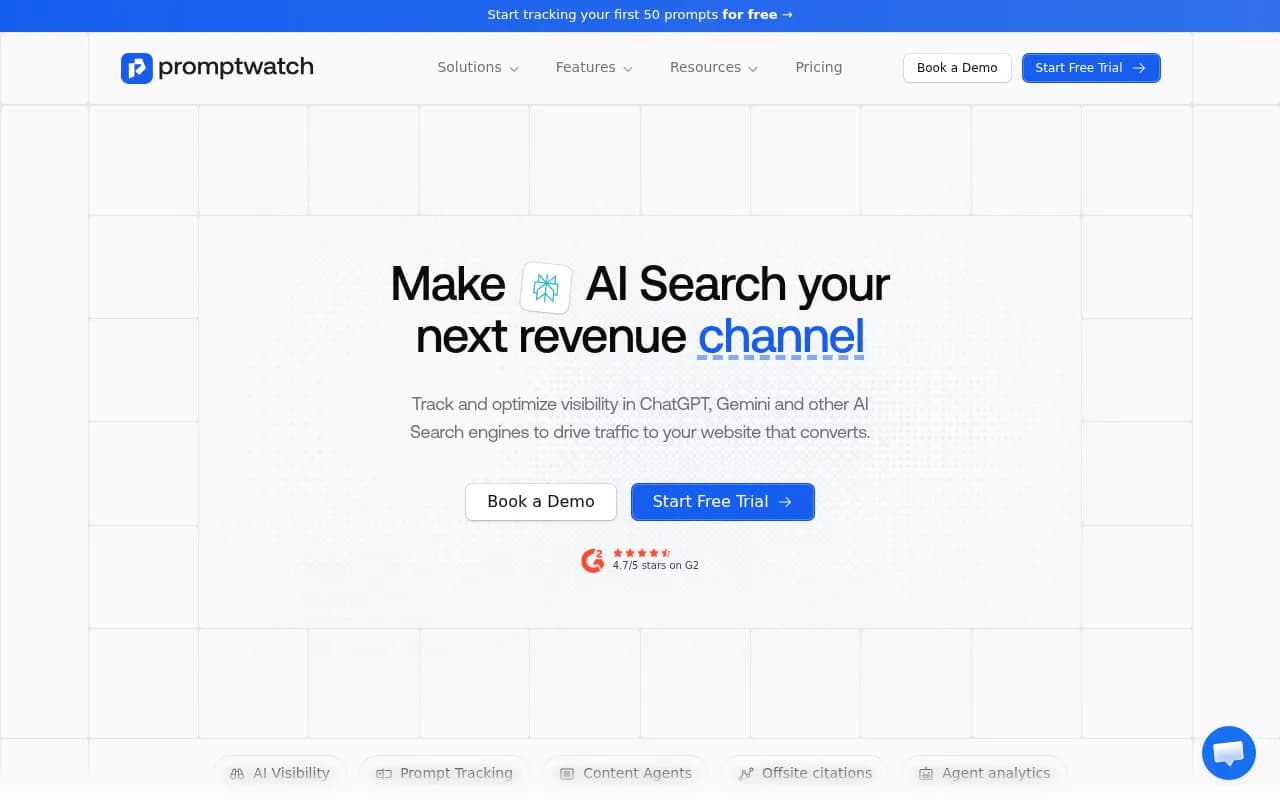
The AI crawler logs are particularly useful here. They show when AI crawlers visit your page after you publish changes, which tells you how long it takes for the new structure to be indexed and whether there are any crawl errors blocking the process.
Without this kind of tracking, you're making changes based on intuition and hoping for the best. With it, you can see the timeline from "published the FAQ section" to "Perplexity started citing this page" -- and use that data to prioritize which other guides to restructure next.
Tools that help with the structural work
A few tools are worth knowing about for different parts of this process.
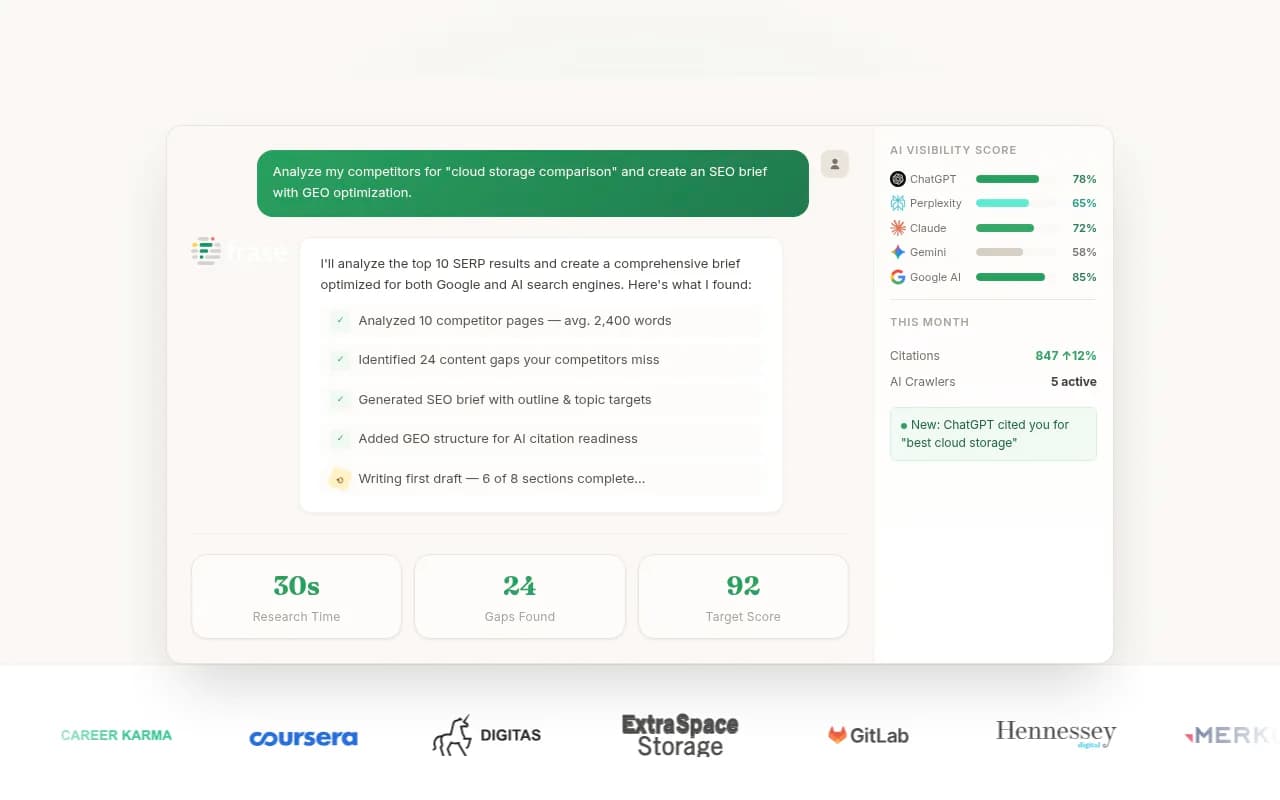
For content optimization and gap analysis, Frase helps map your existing content against AI responses and identify what's missing.
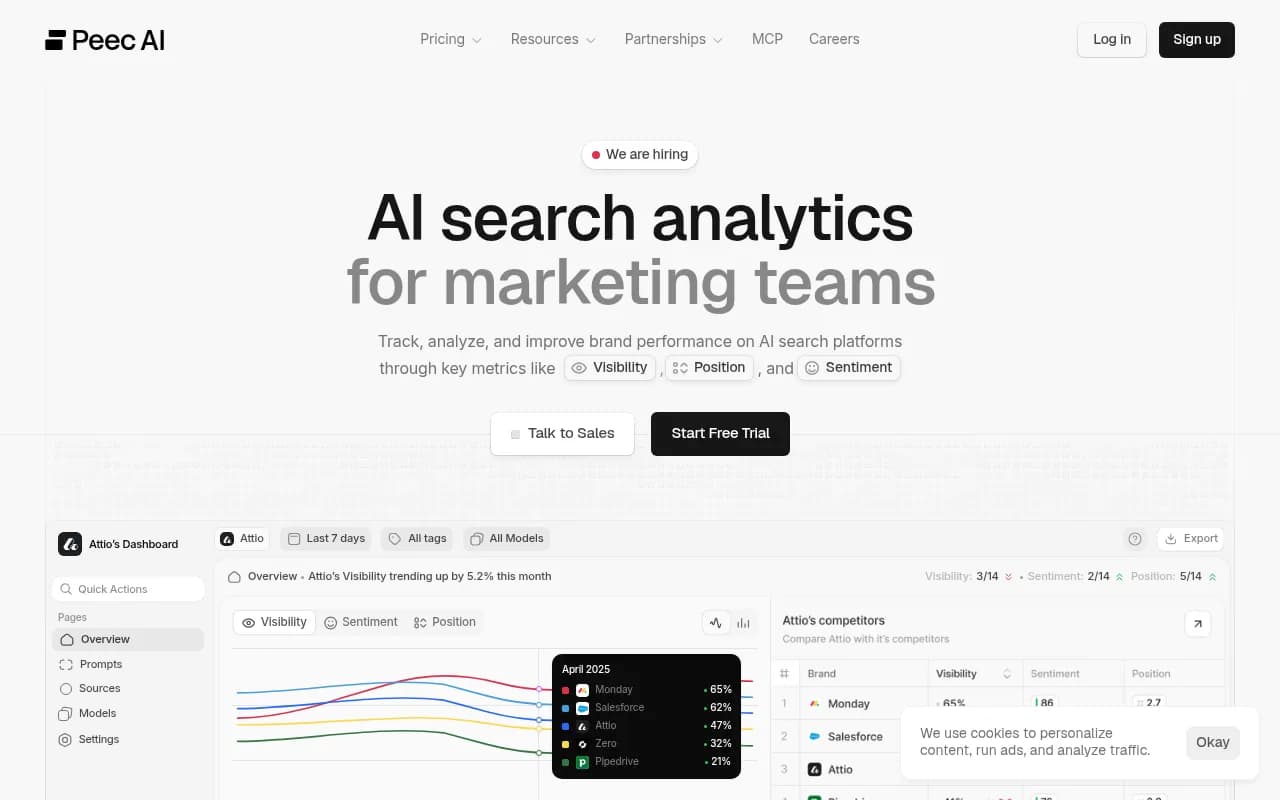
For tracking which prompts your competitors are getting cited for (but you're not), Peec AI and Promptwatch both surface answer gaps you can target.
For the content writing itself, Clearscope helps make sure your restructured sections use the right language to match real queries.

A comparison of what changes and what doesn't
Here's a quick reference for the structural differences between a guide that gets ignored by AI and one that gets cited:
| Element | Gets ignored | Gets cited |
|---|---|---|
| Section openings | Context-first, builds to the answer | Answer-first, then supporting detail |
| H2 headings | Topic labels ("Content structure") | Questions or explicit statements ("What content structure gets AI citations?") |
| Section dependencies | References earlier sections | Self-contained, can be read independently |
| FAQ coverage | None, or generic | Specific questions, 2-4 sentence answers |
| Data and examples | General claims | Specific numbers, named studies, concrete scenarios |
| Headings hierarchy | Decorative or organizational | Query-matching, descriptive |
The right column isn't harder to write. It's just a different habit -- one that takes a few hours to retrofit onto an existing guide, and then becomes natural to build in from the start.
One thing worth being honest about
Restructuring your guide for AI citations doesn't guarantee you'll get cited. AI models make retrieval decisions based on dozens of signals, and some of them -- like how often your brand is mentioned in external sources, Reddit discussions, or YouTube content -- are harder to control through on-page changes alone.
What the structural changes do is remove the barriers that are definitely stopping you from being cited. A guide that's not structured for extraction can't get cited even if everything else is right. A guide that is structured for extraction at least has a chance -- and that chance improves as you build more external authority over time.
Start with the structure. Track the results. Then figure out what else needs to change.
FAQ
Why do long-form guides get cited less than shorter pages? Long-form guides are written for sequential reading, which makes it hard for AI models to extract self-contained answers from individual sections. Shorter comparison pages and FAQ-style content are structured around discrete questions and answers, which is exactly what AI retrieval systems are optimized to find and cite.
Does restructuring a guide hurt its Google ranking? No. Answer-first formatting, question-format headings, and FAQ sections are all compatible with Google's quality guidelines and tend to improve featured snippet performance. You're not trading Google visibility for AI visibility -- you're improving both.
How long does it take for AI models to cite a restructured page? It varies by model. Perplexity tends to update citations faster than ChatGPT. Based on crawler log data, pages typically move from crawl to citation within one to three weeks after a significant structural update, assuming there are no crawl errors blocking the process.
What's the most important single change to make? Answer-first formatting -- putting a direct 2-3 sentence answer at the top of every major section -- has the highest impact per hour of effort. If you only do one thing, do that.
How do I know which of my guides to restructure first? Start with guides that rank in Google's top 5 for high-volume queries but don't appear in AI citations for the same queries. That gap is the clearest signal that the content is relevant but structurally uncitable. AI visibility tracking tools can surface this comparison automatically.