Key takeaways
- ChatGPT and Google AI Mode don't return ranked lists, so "rank tracking" means measuring mentions, citations, position inside the answer and share of voice across a set of shopping prompts.
- For ecommerce, the useful questions are product-level: which SKUs get named, which competitors fill the slot, and whether shopping cards appear at all.
- Most tools monitor. Fewer tell you what to fix, and even fewer show whether AI traffic converts. Decide which of those three you need before you compare prices.
- Product pages are the single most cited content type in ChatGPT, so your catalog pages, schema and feed matter more than your blog.
- Vendor "best of" lists are mostly self-ranked. Trial two or three tools on the same 30 prompts before you commit.
Why Google rank tracking doesn't translate
Your product can sit in position three on Google and never get named when someone asks ChatGPT for "the best running shoes for flat feet under $150." ChatGPT doesn't return ten blue links. It breaks the question into sub-searches, pulls sources, writes one answer, and names a handful of products. If you're not in that handful, you're invisible for that moment.
That changes what you measure. A classic rank tracker gives you one number per keyword. An AI rank tracker runs a set of prompts repeatedly, because answers vary from run to run, and reports on:
- Mention rate: how often your brand or product is named.
- Citation rate: how often your own pages are listed as a source.
- Position: where in the answer you appear (first recommendation or fifth).
- Share of voice against named competitors.
- Sentiment: how the answer describes you.
For ecommerce there's a sixth layer: product-level data. Brand-level awareness is fine for a DTC brand with ten products. A retailer with 5,000 SKUs needs to know which items get recommended and which get skipped.
What ecommerce teams should know about ChatGPT shopping
Two patterns from first-party data are worth knowing before you buy anything.
First, shopping cards are rare. Promptwatch Data's ChatGPT shopping report shows product cards and price comparisons attach to only a low single-digit percentage of web-search responses. The rate moves in steps, not smoothly. It roughly doubled overnight in late May, then fell back weeks later, which looks like OpenAI tuning when cards appear. Cards concentrate on commercial and transactional prompts, where trigger rates run far higher than the average.
Second, product pages carry the most weight. In Promptwatch's data on ChatGPT citations by content type (Sep 28 to Oct 4, 2026), product pages were 22.4% of classified citations, landing pages 16.8%, listicles 13.6% and comparisons 5.9%. On commercial prompts specifically, product pages hit 26.0% and landing pages 20.6%. Those four types made up almost 70% of commercial citations.
For branded prompts, reviews matter more than usual: 5.6%, more than three times their overall share. So review collection on trusted sites is part of the job.
A third wrinkle: ads. Promptwatch's ChatGPT ads data found ads in an average of 20.1% of web-search responses between May 20 and August 17, 2026, with none before May 27 and a daily peak of 43.9%. If you sell products, someone is probably bidding on your prompts. Check across several days, since a single run can land on an outlier.
A framework for choosing a tool
Rank Monster's ecommerce write-up splits the decision into three dimensions, and I think that's the cleanest way to cut through feature lists: monitoring depth, action capability and revenue attribution. Most tools are strong at one or two.
Monitoring depth
Does it cover ChatGPT, AI Mode, AI Overviews, Perplexity, Gemini and Copilot? Does it query the real consumer interface or only the API? Shopping answers can differ between the two, which matters when you're trying to see product carousels. Can it track at the SKU level, and can you sync a catalog without manual uploads?
Action capability
Seeing that a competitor owns your category prompt is half the work. The other half is knowing why: which pages AI cites, what your product pages lack, which listicles you're missing from. Tools differ a lot here.
Revenue attribution
A mention is not a sale. Look for AI referral traffic and conversion tracking, plus crawler logs so you can tell whether AI bots can even read your product pages. If a CDN or robots rule blocks them, no amount of content work helps.
The best tools for ecommerce AI rank tracking in 2026
A caveat on the research behind this list: many of the "best tools" roundups online are written by vendors who rank themselves first. KIME, Ranketta, Leapd and Geoptie each do this in their own posts. Treat their claims accordingly, and note that prices below come from vendor pages and roundups and change often. Confirm before buying.
Promptwatch: tracking plus the fix
Promptwatch is the one I'd start with if you want more than a dashboard. It monitors the real interfaces of ChatGPT, Google AI Overviews, Google AI Mode, Gemini, Perplexity, Copilot and Amazon Alexa, by country and language. For shopping specifically it tracks product visibility in ChatGPT shopping carousels and Alexa product results (you can upload your catalog to track your own products) and has an Ads Radar showing which advertisers bid on your prompts, with their copy and landing pages.
Where it separates from pure trackers is the rest of the stack. IP-verified AI crawler logs show whether GPTBot, OAI-SearchBot and ChatGPT-User can read your product pages and where they hit errors. Visitor analytics connect AI referrals to conversions. Content gap analysis maps your pages against the prompts AI answers, and the Content Agent can draft and publish to WordPress, Webflow or Framer, then track whether each page gets crawled, cited and clicked. Local targeting at exact coordinates helps multi-location retailers with "near me" prompts.
Pricing starts with a free Explore plan (ChatGPT only, 10 prompts). Essential is $95/mo for 50 prompts and all models; Business at $579/mo adds shopping insights, Ads Radar and the automated Content Agent. Check promptwatch.com/pricing for current numbers.

If you want to compare it with the rest of the field, the GEO software directory at bestgeosoftware.com lists dozens of alternatives.
Ranketta: product-level tracking
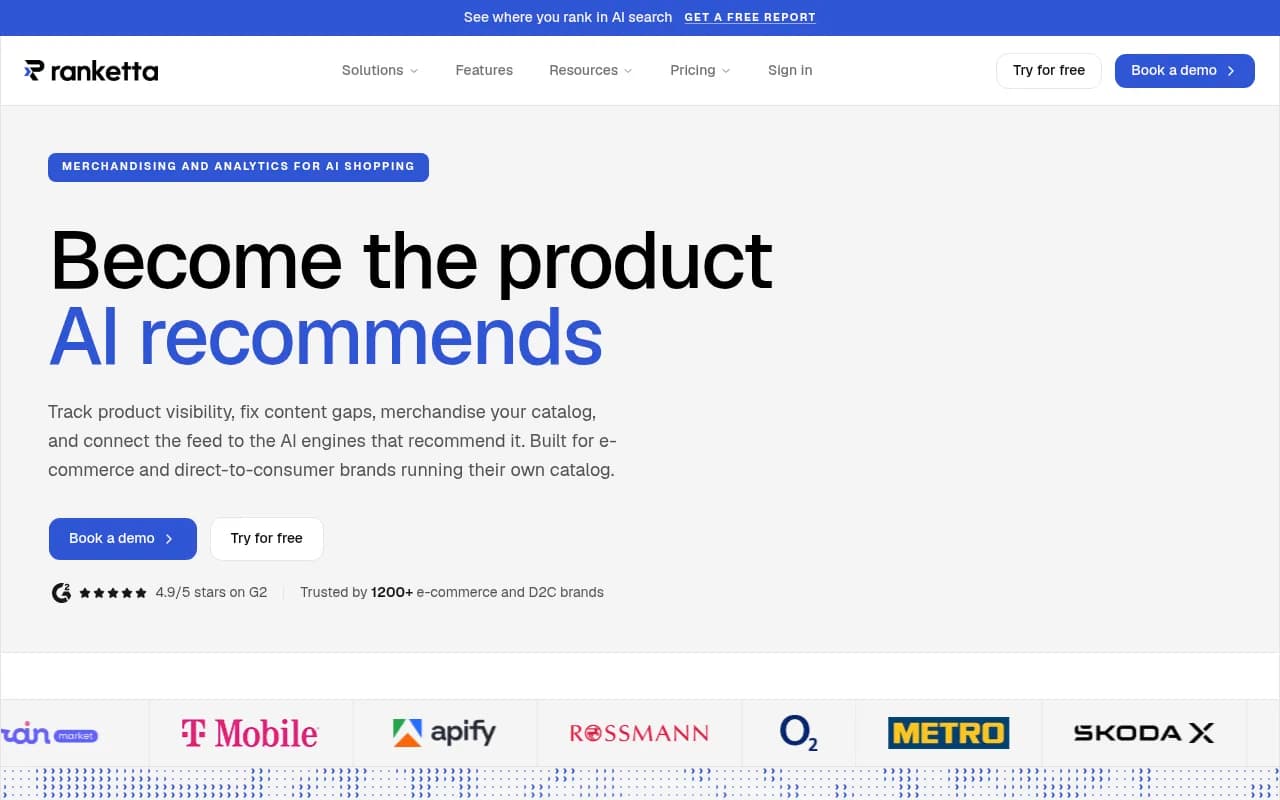
Ranketta is built around SKUs. Its Best Sellers view shows which products AI recommends most often in your topics, ranked by share of voice, and it covers ChatGPT, AI Overviews, AI Mode, Gemini, Perplexity and Copilot. It also leans into feed enrichment for agentic commerce. Its own blog ranks it first for ecommerce, so weigh that, but the product-level angle is real and worth a trial if you have a large catalog.
Yotpo Discover and Alhena AI: built for catalogs and reviews
Yotpo Discover ties AI visibility to ecommerce catalogs and reviews, which is useful if reviews already live in Yotpo. Alhena AI also targets ecommerce catalogs directly.
Yotpo Discover
Azoma and Naridon: agentic commerce and Shopify
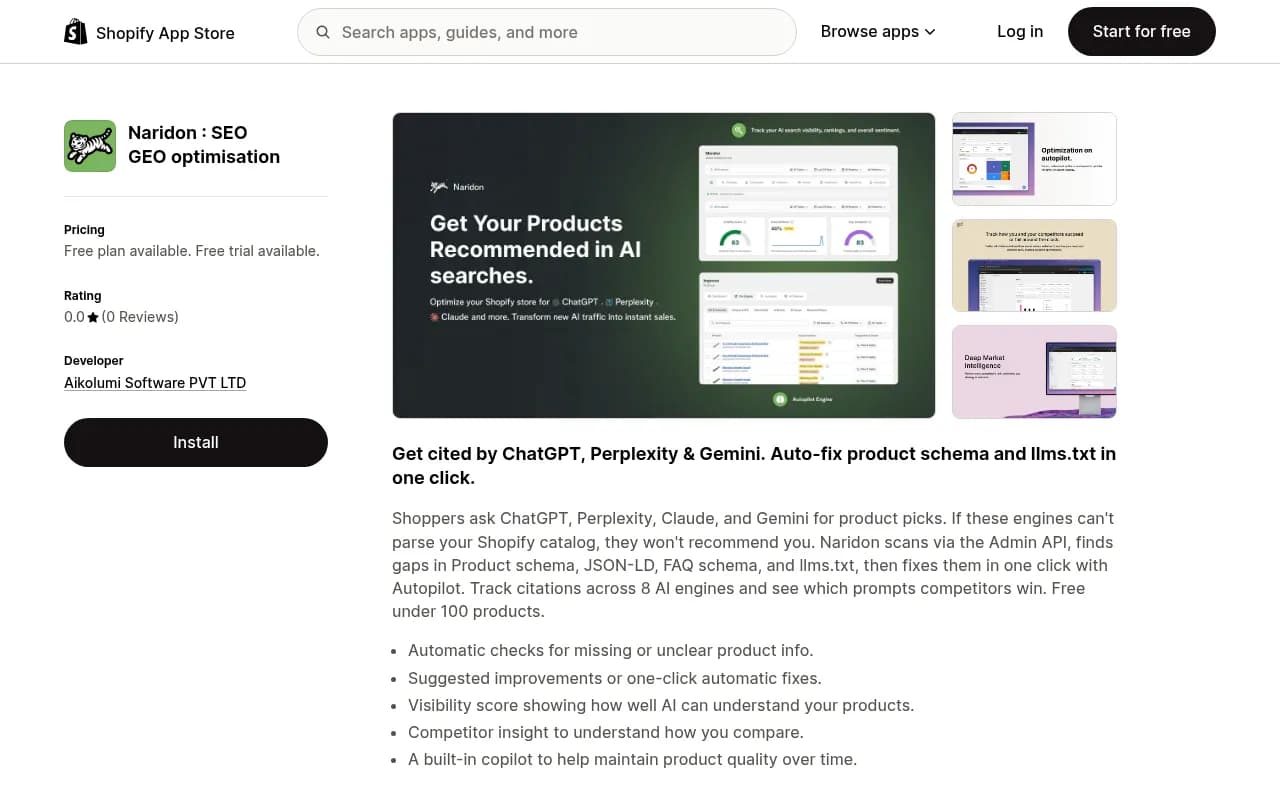
Azoma focuses on GEO for AI shopping agents. Naridon is Shopify-native, which makes it the lowest-friction option for small Shopify merchants who don't want to configure anything.

Profound: enterprise scale
Profound targets large brands with dedicated AI visibility budgets, and one roundup lists it as the strongest AI Mode option for companies moving toward AI-driven commerce. Entry pricing in roundups is around $99/mo, but enterprise use costs considerably more. It's monitoring-heavy, without the agentic publishing side.

Peec AI: simple benchmarks
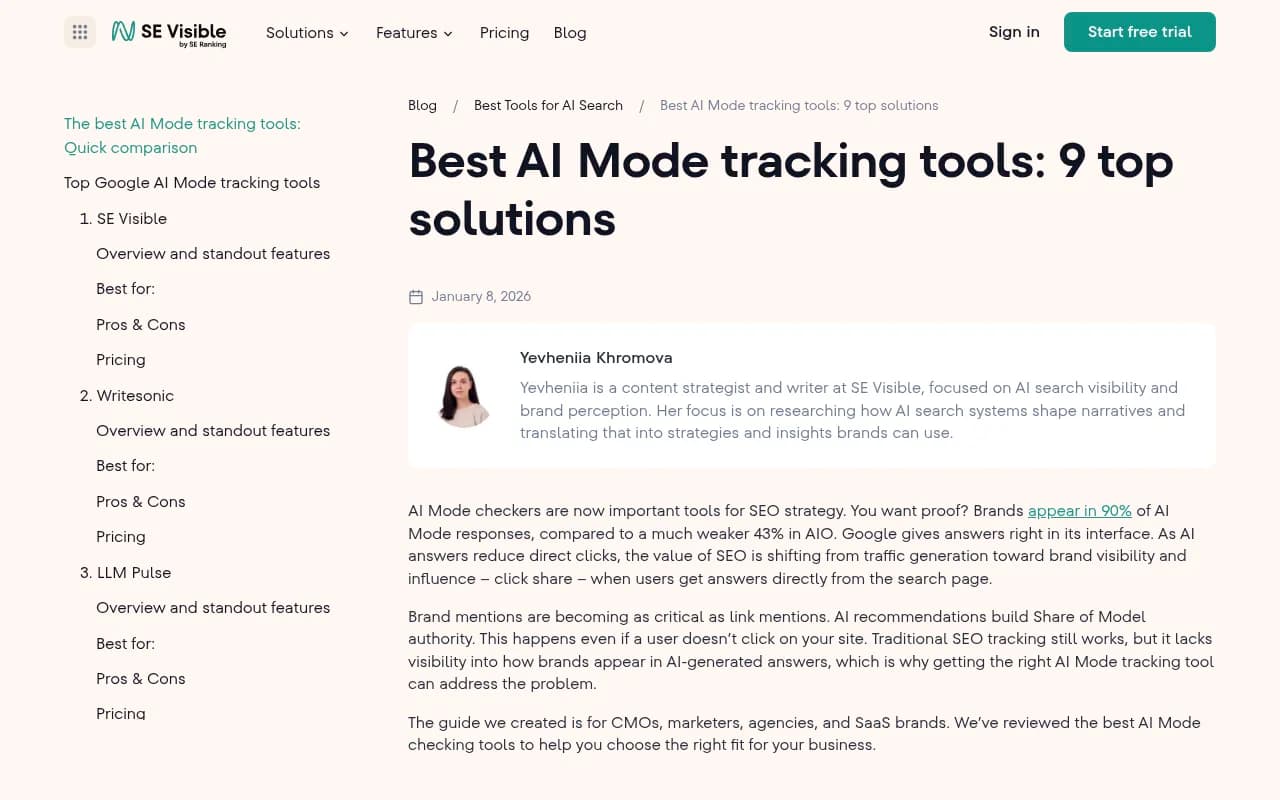
Peec AI has a clean dashboard and competitor benchmarks. SE Visible's AI Mode guide recommends it for ecommerce brands monitoring product visibility in charts. Roundups list it from about €89/mo. It's a tracker, so you'll need other tools for crawler logs or content.

Otterly.AI and ZipTie: affordable monitoring
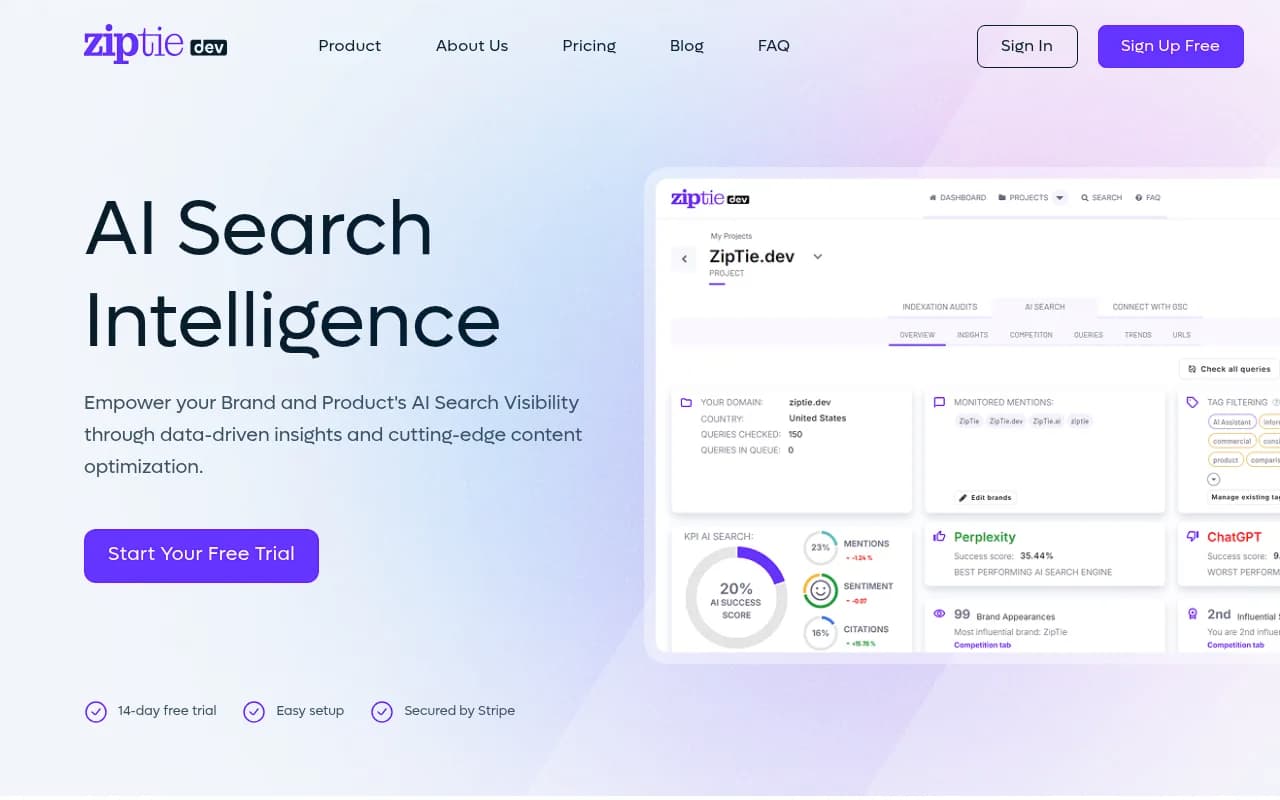
Otterly.AI (from about $29/mo in roundups) automates prompt checks across ChatGPT, AI Overviews, Perplexity and Copilot, and includes GEO audits covering 25+ technical and content factors. ZipTie (from about $69/mo) leans toward actionable recommendations. Both suit small teams testing the waters.

SE Ranking and Nightwatch: hybrid SEO plus AI
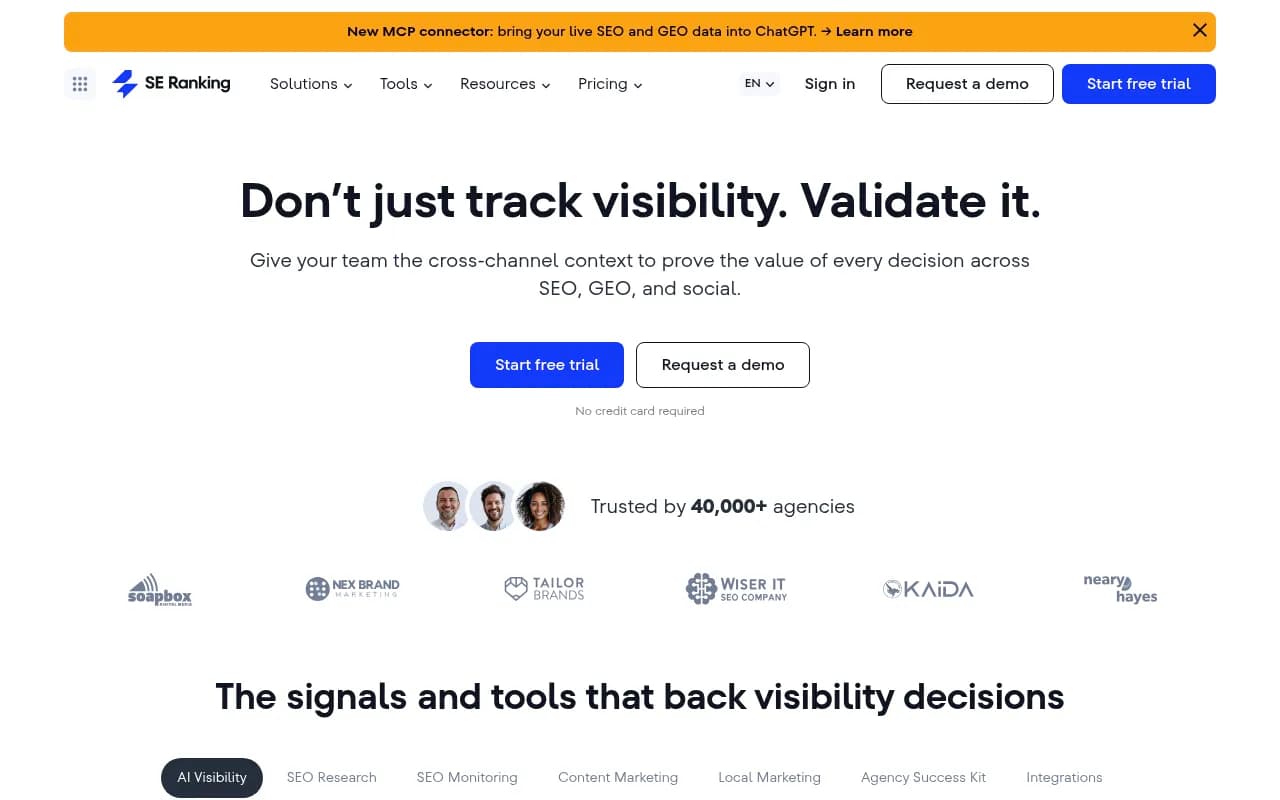
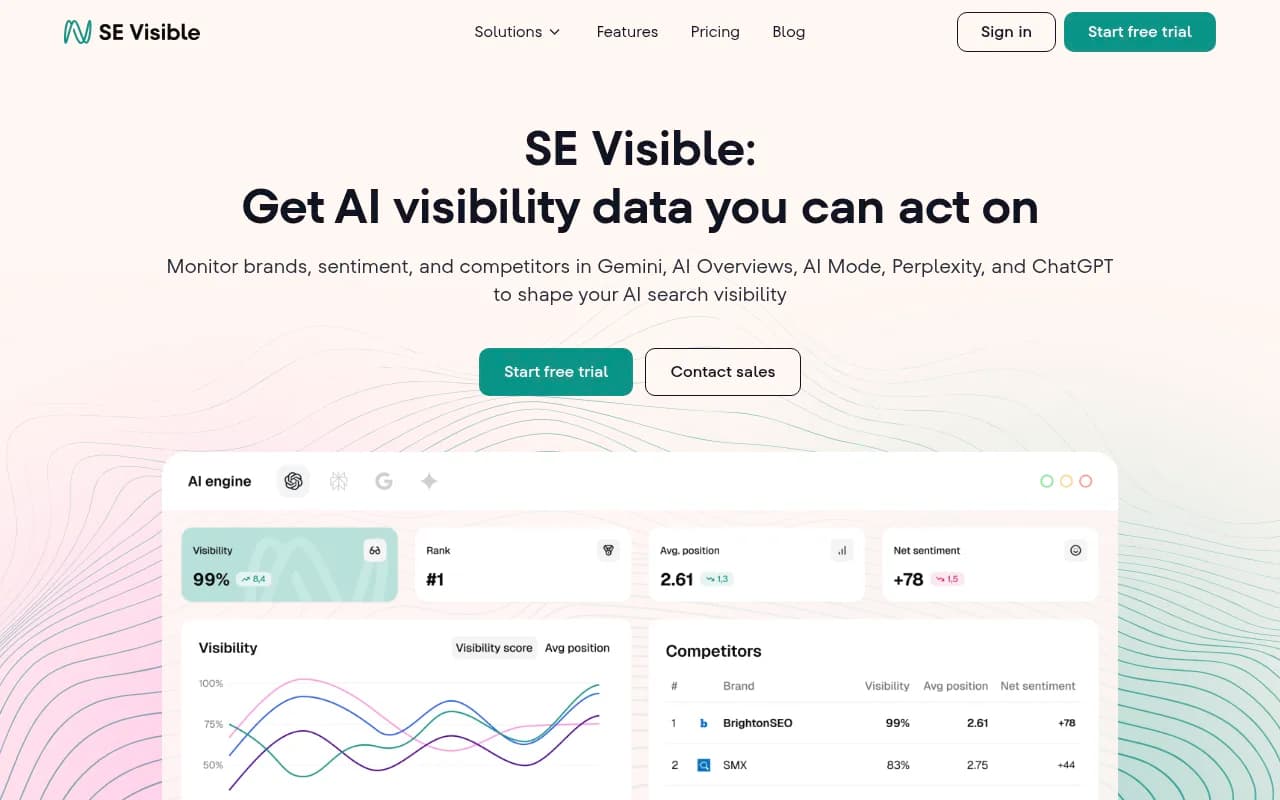
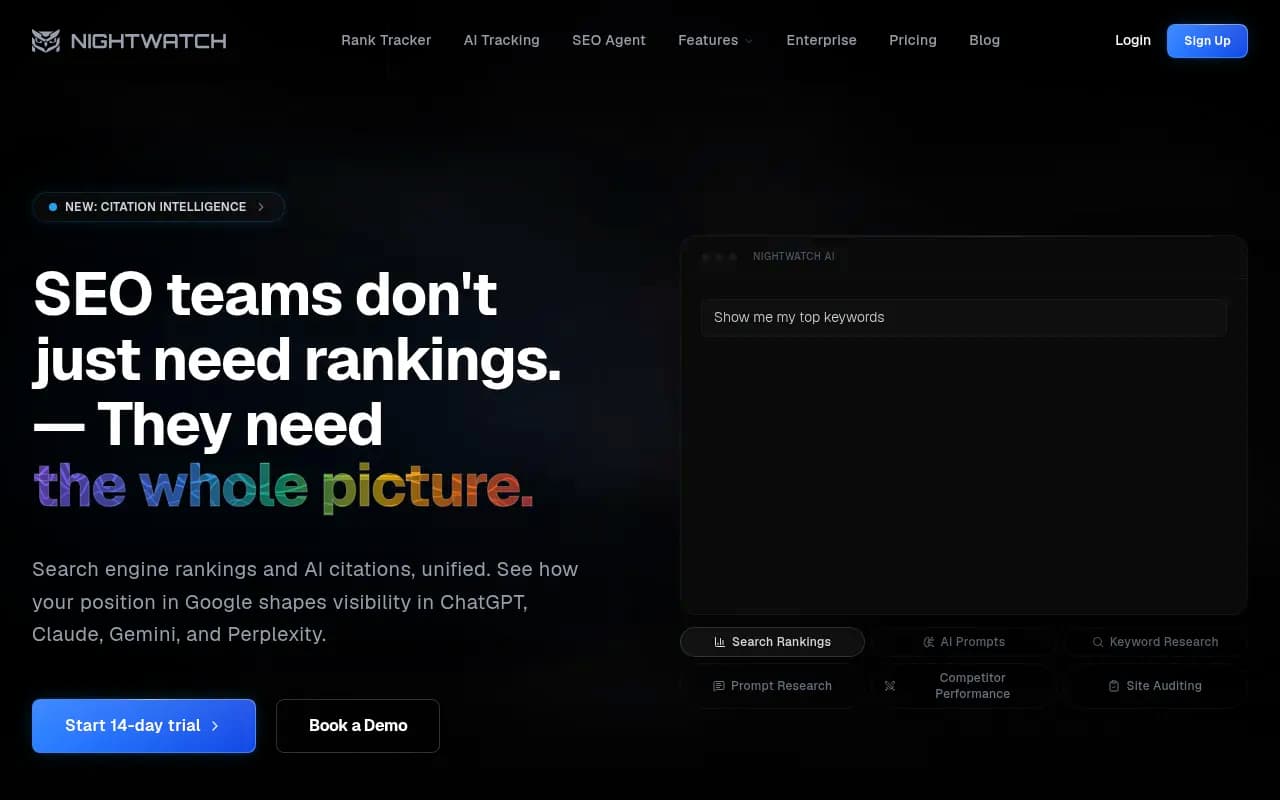
If you already track Google rankings, adding AI tracking to the same tool keeps reporting in one place. SE Ranking's AI Search add-on covers ChatGPT, AI Overviews, AI Mode and Perplexity; a combined plan with Core was listed at $218/mo. SE Visible is its standalone AI product, starting around $189/mo. Nightwatch starts near $39/mo plus an AI add-on and suits agencies that want classic rankings and AI side by side with unlimited seats.
Semrush and Ahrefs: for existing subscribers
Semrush's AI Visibility Toolkit and Ahrefs Brand Radar make sense if you already pay for the suite. Expect fixed prompt sets and shallower AI-specific data than dedicated platforms.

KIME and Trakkr: other options worth a look
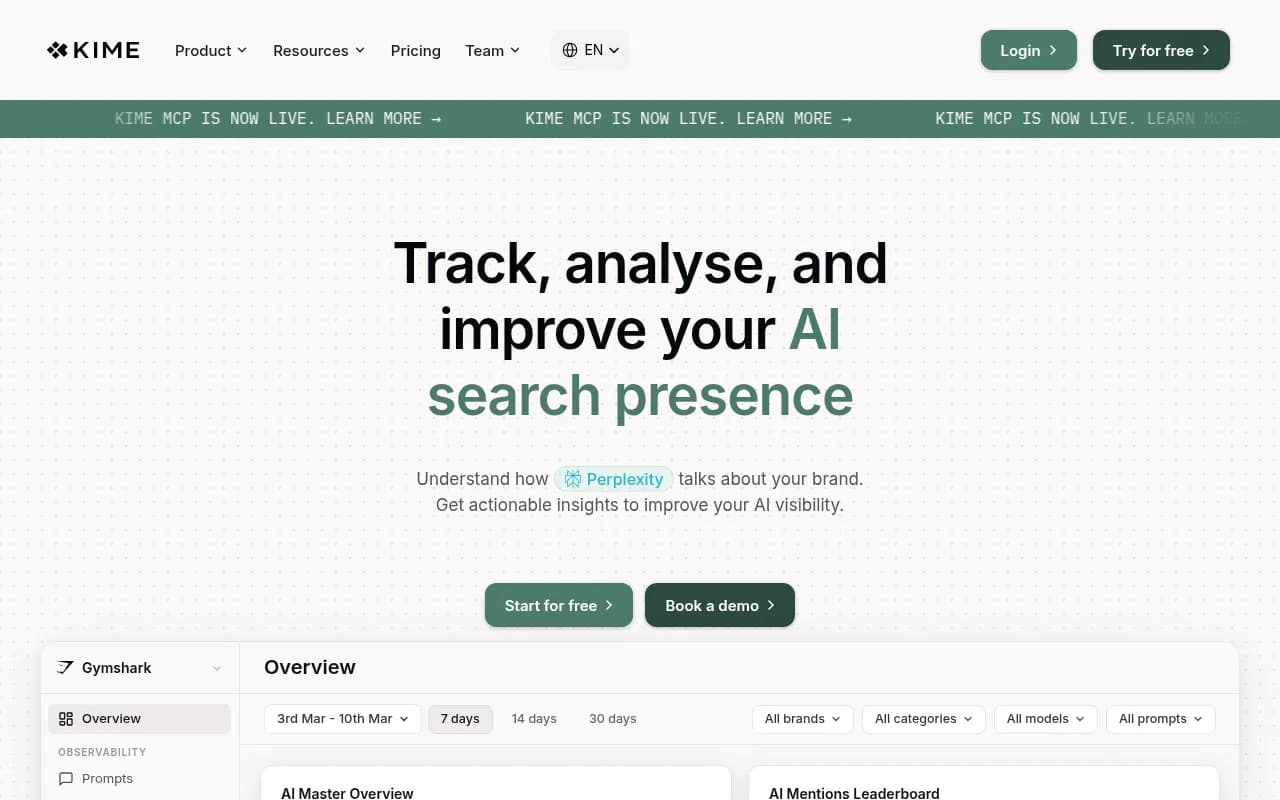
KIME tracks nine AI engines with an action centre and multi-seat access from €99/mo, and it lists clients like Gymshark. Trakkr positions itself around tracing AI visitors to revenue.
Comparison table
| Tool | Product/SKU focus | Real-UI tracking | Crawler logs | Content and fix workflow | Rough entry price |
|---|---|---|---|---|---|
| Promptwatch | Shopping carousels, Alexa products, catalog upload | Yes | Yes, IP-verified | Content Agent, Action Board, CMS publishing | Free tier; $95/mo |
| Ranketta | SKU-level, Best Sellers view | Not verified | Not verified | Feed enrichment | Check vendor |
| Yotpo Discover | Catalog and reviews | Not verified | Not verified | Limited | Check vendor |
| Profound | Brand and enterprise | Not verified | Not verified | Content ops | ~$99/mo |
| Peec AI | Brand, charts | Not verified | No | No | ~€89/mo |
| Otterly.AI | Brand, prompt checks | Not verified | No | GEO audits | ~$29/mo |
| SE Ranking / SE Visible | Brand | Not verified | No | Limited | $189 to $218/mo |
| Nightwatch | Brand plus classic rank | Not verified | No | No | ~$39/mo + add-on |
Prices come from vendor pages and third-party roundups and weren't independently verified. Treat "not verified" as a question to ask on a demo.
How to set up an ecommerce AI tracking program
Build a prompt set that mirrors shopping behavior
Start with 30 to 50 prompts. Mix commercial prompts ("best standing desk for small apartments"), comparison prompts ("X vs Y"), brand prompts and a handful of informational ones. Commercial and transactional prompts matter most because that's where shopping features trigger.
Tools that show query fan-outs help here. ChatGPT runs several web searches per answer, and Promptwatch's query fanout data tracks how many. On August 8, 2026 it started using the site: operator at scale, rising from about 0.4% to about 17% of fanout queries, per Promptwatch Data. Which means answers increasingly pull from specific domains, so your own site structure counts.
Track AI Mode separately
AI Mode and ChatGPT cite different things. One study cited in SE Visible's guide found brands appear in about 90% of AI Mode responses versus 43% in AI Overviews, so presence alone is a weak signal there. Watch position and citation rank instead. Promptwatch publishes monthly domain-level data, such as its Google AI Mode citation share for June 2026, which shows who owns your category sources.
Run each prompt more than once
Answers vary. A single check is an anecdote. Run daily or at least several times a week and look at trends, not individual runs.
Fix the basics first
Promptwatch's own recommendations from the shopping data are plain but effective: complete Product schema, accurate prices and availability, and a clean merchant feed. Then make product pages easy to compare, with clear pricing, specs and audience. Get into the best-of roundups that ChatGPT cites. Collect reviews on trusted sites. Add an FAQ page.
Also check that AI crawlers can fetch your pages at all. Promptwatch's AI crawler traffic data shows how much verified bot traffic comes from OpenAI, Anthropic, Google, Perplexity and Mistral, which is a decent reality check against your own server logs.
Watch content half-life
News pages lose half their ChatGPT citations in about 36 days, while landing pages and docs keep most of theirs for months, per Promptwatch's content half-life report. Put your effort into evergreen product and category pages rather than chasing news hooks.
Which tool for which team
- Small Shopify store, tight budget: Naridon, Otterly.AI or Promptwatch's free Explore plan to get a baseline.
- Mid-size DTC brand that wants to fix things, not just watch: Promptwatch, because crawler logs, content gaps and publishing live in one place.
- Large catalog, SKU-level questions: Ranketta or Yotpo Discover, alongside a broader tracker.
- Agency with many clients: Promptwatch's agency plans, Otterly.AI or Nightwatch for white-label style reporting.
- Already deep in an SEO suite: add the AI module from SE Ranking, Semrush or Ahrefs and upgrade when it runs out of depth.
- Enterprise with budget: Profound or Promptwatch Business and Enterprise.
For more options, the AI rank tracking directory at ai-rank-tools.com is a reasonable place to browse.
Mistakes I see ecommerce teams make
- Tracking brand terms only. Nobody asks ChatGPT for your brand name until they already know you. Category prompts are where growth is.
- Trusting one run. See above.
- Ignoring ads. If paid slots eat your prompts, organic effort has a lower ceiling there.
- Buying a tracker with no plan to act. A dashboard that nobody opens is a monthly donation.
- Repeating unsourced stats. One vendor claims roughly 60% of organic traffic now originates from AI responses. I couldn't find support for that, and I wouldn't put it in a deck.
Bottom line
Pick based on what you'll do with the data. If you only need a baseline, a cheap tracker is fine. If you need to improve product visibility in ChatGPT and AI Mode and prove it pays, favor a platform with crawler logs, visitor analytics and content workflows. Run a two-week trial of two tools on the same prompt set, compare what each one finds, and keep the one whose recommendations you'd actually act on.