Key takeaways
- Ecommerce AI SEO is three jobs, not one: fix the catalog data AI reads, track whether products get recommended, and keep classic SEO (schema, faceted URLs, duplicates) healthy.
- Per Promptwatch Data (Sep 28 to Oct 4, 2026), product pages are the most cited content type in ChatGPT at 22.4% of citations, and landing pages add another 16.8%. Your product pages are your main AI asset.
- Brand-level trackers answer "was I mentioned?" Ecommerce teams also need product, variant and category-level answers, plus a way to push cleaner data back into feeds.
- Most vendor "best of" lists in this space rank the vendor first. Treat them as a source of feature ideas, not a verdict.
- A realistic stack: one SEO suite, one AI visibility platform, one catalog or feed tool, and an on-site search tool if discovery is your bottleneck.
What "AI SEO for ecommerce" actually means
A blog can get away with one keyword tool and a content editor. A store can't. You have thousands of templated product and collection pages, product and merchant listing schema, faceted and variant URLs, out-of-stock pages, and duplicate content generated by filters. Then AI answers show up on top of all that and start recommending products using data you may not have looked at in years.
In practice the work splits into three layers:
- Catalog and content layer. Accurate titles, specs, attributes, descriptions and feeds. Akeneo found that two-thirds of shoppers abandoned a purchase in the past year because product information was missing or inaccurate, according to the Width.ai review of ecommerce agents. That is a conversion problem and an AI problem at the same time, because models quote what is on the page.
- Visibility layer. Are your products and brand appearing in ChatGPT, Google AI Overviews, AI Mode, Gemini and Perplexity answers for buying prompts, and which sources do those answers cite?
- Classic SEO layer. Crawlability, schema, internal linking, indexation, site speed. None of this went away. It is still how the pages get found in the first place.
Most tools only cover one of these. Picking a stack is mostly about knowing which gap hurts most.
What the data says about product pages
Before choosing tools, it helps to know what AI engines actually cite for shopping-style prompts. Promptwatch Data's content type report (Sep 28 to Oct 4, 2026) breaks down ChatGPT citations:
| Content type | Share of ChatGPT citations |
|---|---|
| Product pages | 22.4% |
| Landing pages | 16.8% |
| Listicles | 13.6% |
| How-tos | 8.7% |
| Documentation | 7.5% |
| Comparisons | 5.9% |
| Reviews | 1.7% |
For commercial prompts, where people compare options before buying, product pages rise to 26.0%, landing pages to 20.6%, listicles to 15.0% and comparisons to 7.9%. Those four types make up almost 70% of commercial citations. For branded prompts, reviews climb to 5.6%, more than three times their share across all prompts.
The takeaways for a store are fairly plain:
- Keep specs, prices and positioning complete and factual. ChatGPT quotes them directly.
- Make products easy to compare: clear pricing, specs and target buyer.
- Get into the "best of" roundups AI cites for your category (listicles are the third biggest type).
- Collect reviews on trusted third-party sites.
- Add an FAQ page. FAQ pages are 4.8% of branded citations.
One more caution on AI shopping carousels. Promptwatch's ChatGPT shopping usage data shows product cards and price comparisons appear in only a low single-digit percentage of web-search responses overall, concentrated in commercial and transactional prompts. The rate moves in steps: it roughly doubled overnight in late May, then fell back weeks later, which looks like OpenAI tuning when cards appear. That page is dated November 2025, so treat the exact levels as a snapshot. The advice holds: complete Product schema, accurate prices and availability, and a clean merchant feed.
Ads are the other moving part. Promptwatch's ChatGPT ads data shows ads in an average of 20.1% of web-search responses between May 20 and August 17, 2026, starting from none until May 27 and passing 30% on July 1. If you sell products, expect paid placement to start competing with organic recommendations.
How to evaluate an ecommerce AI SEO tool
A few questions cut through the marketing quickly:
- Does it work at SKU level? Brand mentions are not enough. You want product, variant and category-level visibility.
- Does it act or only report? Some tools produce shippable output (rewritten titles, fixed feeds). Others hand you a dashboard.
- Does it connect to your real catalog? Tools grounded in your feed or your vendor sources make fewer mistakes than ones guessing from a URL.
- Does it show crawler access? If AI bots get blocked or hit errors on product pages, nothing else matters.
- Is it honest about its source of data? Real interface tracking versus API outputs can differ.
A note on sources: the vendor listicles I read while researching this (Ranketta, WorkDuo, Width.ai, Ryze) each rank themselves or their own category first, and their prices are unverified. Check current pricing on each vendor's site.
Catalog and product-level AI visibility tools
This is the category that is genuinely new for ecommerce. These tools track which products AI recommends, not just whether your brand name appears.
Ranketta
Ranketta's Shopping module tracks which products AI answers when a buyer asks for a recommendation in your category. It also audits a product feed (XML, CSV or JSON) against what AI shopping models need, then exports cleaned data as Google Merchant, Shopify, generic XML or JSON. Good for DTC brands and retailers that want to fix the catalog and not only watch it.
Azoma
Azoma is built around agentic commerce: product ranking, share of voice and citation tracking across AI shopping agents. It is very commerce-specific, which is the point. Pricing is custom.
Alhena AI
Alhena AI positions itself as AI visibility tracking built for ecommerce catalogs, a reasonable fit if your pain is large product ranges rather than a handful of hero SKUs.
Yotpo Discover
Yotpo's pitch is that reviews and catalog data feed AI visibility. Brands like Beekman 1802 and David Protein use Discover to capture emerging AI search demand, per Yotpo. If you already run Yotpo for reviews, it is worth a look, since reviews matter for branded prompts.
Yotpo Discover
Naridon
Naridon is a Shopify-native GEO monitor that runs on autopilot. Lightweight and aimed at smaller Shopify stores that do not want another enterprise platform.

Bluefish AI
Bluefish AI targets enterprise teams with an AI visibility and agentic commerce platform. It is more of an enterprise suite than a quick-start tool.

Full-stack AI visibility platforms for stores
If you sell across many categories and want tracking tied to traffic and action, a general AI visibility platform is a strong base. The key questions are whether it tracks real AI interfaces, shows crawler activity, and tells you what to fix.
Promptwatch is the one I would put first on this list for stores that want to go beyond tracking. It monitors the real interfaces of ChatGPT, Google AI Overviews, AI Mode, Gemini, Perplexity and others, and includes ChatGPT Shopping and Amazon Alexa product visibility (you can upload your catalog to track your own products). It also covers Ads Radar, which shows which advertisers bid on your prompts. IP-verified AI crawler logs show whether GPTBot, OAI-SearchBot or ChatGPT-User are reading your product pages or hitting errors, and visitor analytics tie AI traffic to conversions. When there are gaps, the Action Board and Content Agent help plan and publish content to WordPress, Webflow or Framer. Crisp reported 2x higher conversion rates from AI traffic versus traditional channels, and TreeHouse (behind Pararius) reached roughly 25% of organic conversions from AI search after fixing crawler access and publishing proprietary data. Plans start at $95/mo (Essential), with a free Explore tier; confirm on promptwatch.com/pricing.

Other options worth comparing:

Profound is enterprise-focused with strong prompt analysis and product visibility tracking. Expect a higher price point.
The Semrush AI Visibility Toolkit tracks 25 custom prompts with daily rankings across ChatGPT, AI Overviews, Gemini and Perplexity, and adds an AI site audit. It tracks brand presence, not product-level recommendations, so it is better as an add-on to an SEO suite than a commerce tool.

Peec AI is a straightforward prompt tracker with suggestions. Fine for monitoring, lighter on execution.
Botify suits large catalogs where technical SEO and AI crawler access are the bottleneck.
For more options beyond this shortlist, the GEO software directory at bestgeosoftware.com lists many more tools.
Traditional ecommerce SEO suites
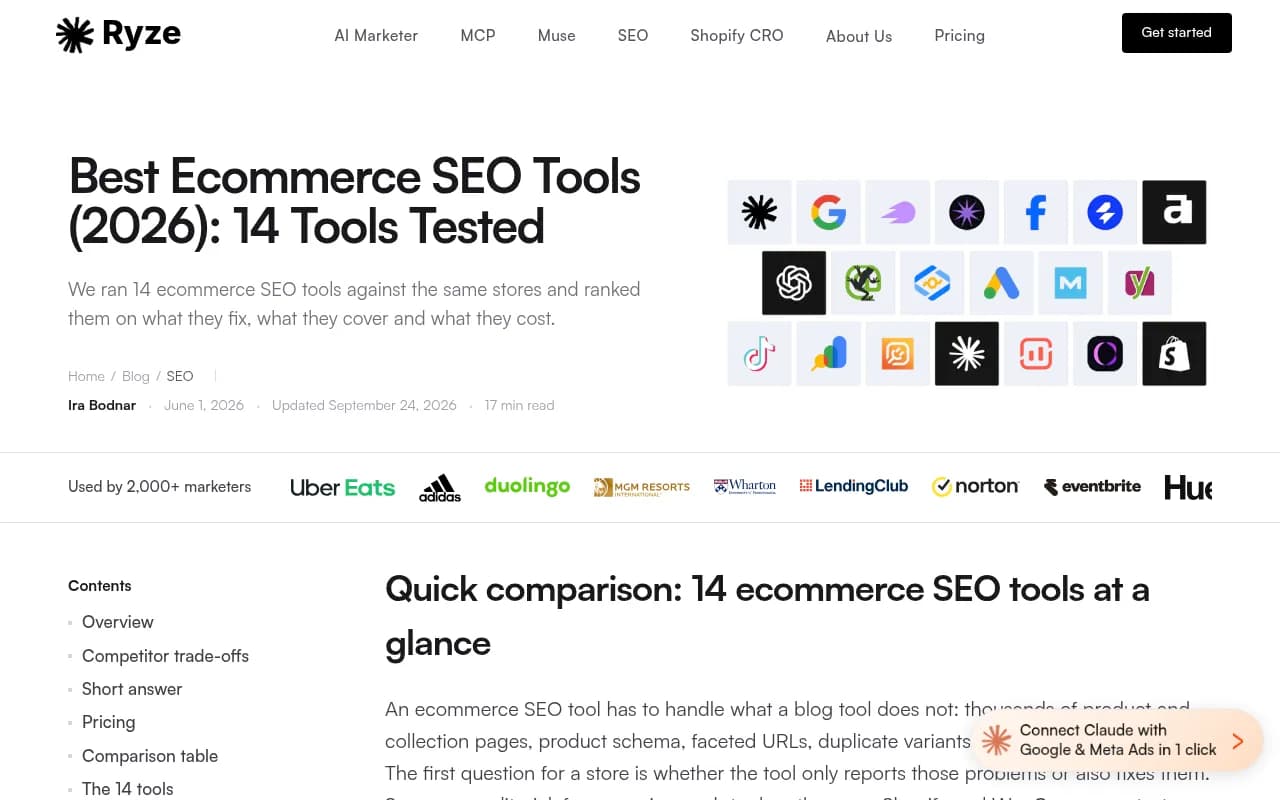
AI visibility does not replace the basics. Product pages still need to be crawled, indexed and structured. Ryze's test of 14 ecommerce SEO tools ran each against the same Shopify and WooCommerce stores, scoring them on what they fix as well as what they report.
Semrush is the research workhorse across SEO, content and ads. It also publishes guidance on ecommerce AI SEO, including auditing AI crawler access, and its Enterprise Site Intelligence includes Bot Analytics for very large catalogs.
Search Atlas deploys on-page fixes through its OTTO pixel, which is handy when you cannot get dev time for title and meta changes across thousands of pages.
Ahrefs is strongest on backlinks and competitor research, and it has Brand Radar for AI tracking.
SE Ranking is the all-in-one pick on a smaller budget.
BrightEdge covers enterprise SEO and AI search intelligence. Its data reports AI Overviews on 48% of tracked queries, but only 16.7% of sources cited there also rank in the organic top ten (figures quoted by Yotpo). That gap is why ranking well alone is not enough.
Content, enrichment and on-site discovery
Some of the highest-value AI work for stores is not SEO software at all.
For catalog enrichment, Width.ai highlights Pumice.ai's merchandising pipeline as a fit for wholesalers, distributors and marketplaces with large catalogs and a steady flow of new vendor products. It handles batch processing across thousands of SKUs and marketplace-specific outputs such as Amazon titles and item highlights.
For AI-assisted product copy at scale, Hypotenuse AI is built for ecommerce content and imagery.
Hypotenuse AI
For on-site discovery, Zoovu offers guided product finders and shopping assistants, and Algolia (not in our catalog) is a common pick for search and recommendations. If shoppers cannot find the product, no amount of SEO saves the sale.
For schema and internal linking automation, InLinks handles entity-based linking and schema at scale.
Comparison table
| Tool | Best for | Product-level tracking | Fixes or ships changes | Notes |
|---|---|---|---|---|
| Promptwatch | Tracking plus action across AI engines | Yes (Shopping, catalog upload) | Content Agent, Action Board | Crawler logs, traffic attribution |
| Ranketta | Feed audit and AI product tracking | Yes | Exports cleaned feeds | Commerce-focused |
| Azoma | Agentic commerce | Yes | Optimization guidance | Custom pricing |
| Yotpo Discover | Review-led brands | Catalog and reviews | Partly | Fits Yotpo users |
| Naridon | Small Shopify stores | Monitoring | Limited | Shopify-native |
| Profound | Enterprise prompt analysis | Yes | Limited | Higher price |
| Semrush | Broad SEO research | No (brand-level) | Audit flags | Add-on AI toolkit |
| Search Atlas | Fast on-page fixes | No | Yes (OTTO) | Classic SEO |
| Botify | Large-catalog technical SEO | Limited | Technical fixes | Enterprise |
| Zoovu | On-site discovery | n/a | Guided selling | Not an SEO tool |
Suggested stacks by store type
Small Shopify or WooCommerce store
Start with free checks: make sure AI crawlers are not blocked in robots.txt, add complete Product schema, and fix titles and specs on your top 20 products. Add Naridon or a low-tier Promptwatch plan to see where you show up. Use a classic SEO suite you already pay for.
Mid-size DTC brand
Pair an SEO suite (Semrush, Ahrefs or SE Ranking) with an AI visibility platform that shows crawler logs and traffic. Add a feed or catalog tool such as Ranketta if your Merchant Center data is messy. Publish comparison and FAQ content aimed at commercial prompts.
Large catalog or marketplace
You need catalog-scale enrichment (Pumice-style pipelines), technical SEO tooling like Botify, and product-level AI tracking such as Azoma, Ranketta or Promptwatch's Shopping module. On-site search such as Algolia or Zoovu pays off here too.
A practical 30-day plan
- Week 1, access. Check that GPTBot, OAI-SearchBot, ChatGPT-User, PerplexityBot and Google's crawlers can reach product pages. Review crawler logs if your tool provides them.
- Week 2, data. Audit your top products for missing specs, prices, availability and schema. Fix feed errors in Merchant Center.
- Week 3, prompts. Build a list of 30 to 50 commercial prompts your buyers use ("best X for Y", "X vs Z"). Record which brands and sources appear.
- Week 4, content and mentions. Publish comparison pages and FAQs, and pursue placement in the roundups and review sites AI keeps citing. Then re-check.
The honest limit: AI shopping behavior shifts month to month. The data above is a snapshot, and tools that measure your own prompts will tell you more than any general report.
Final thoughts
Buy for the gap you have. If AI cannot read your pages, fix crawl access first. If your product data is thin, enrich the catalog before paying for another dashboard. If you already have both and cannot tell whether AI recommends you, add a visibility platform that reaches SKU level and ties traffic to revenue. Product pages carry the largest share of ChatGPT citations, so that is where the first hour of work belongs.