Key takeaways
- Profound's public self-serve tiers are gone. Its pricing page now lists a free 7-day trial and a custom Enterprise plan, so "cheaper alternative" mostly means "a tool with a published price."
- ChatGPT Shopping tracking is the reason many ecommerce teams look at Profound. Its Shopping feature analyzes individual SKUs and their related citations and keywords.
- For product-level tracking, the realistic options are Promptwatch, Alhena, ShopMentions (Shopify only), Peec AI (SKU metrics) and Ranketta. Each has a different scope, so check the trade-offs below.
- Shopping cards are still a small slice of ChatGPT answers, so pair product tracking with citation, crawler and traffic data.
- Vendor pricing below comes from the vendors' own pages and third-party roundups. Confirm it before you buy.
What Profound does for ecommerce, and why people leave
Profound is the enterprise name in this category. Its home page promises that you can track how visible your products are in ChatGPT Shopping with SKU-level granularity across merchants and retailers. Its Shopping page says you can "analyze individual SKUs to see related citations and keywords." That is a real capability, and for a large retailer with budget it earns its price.

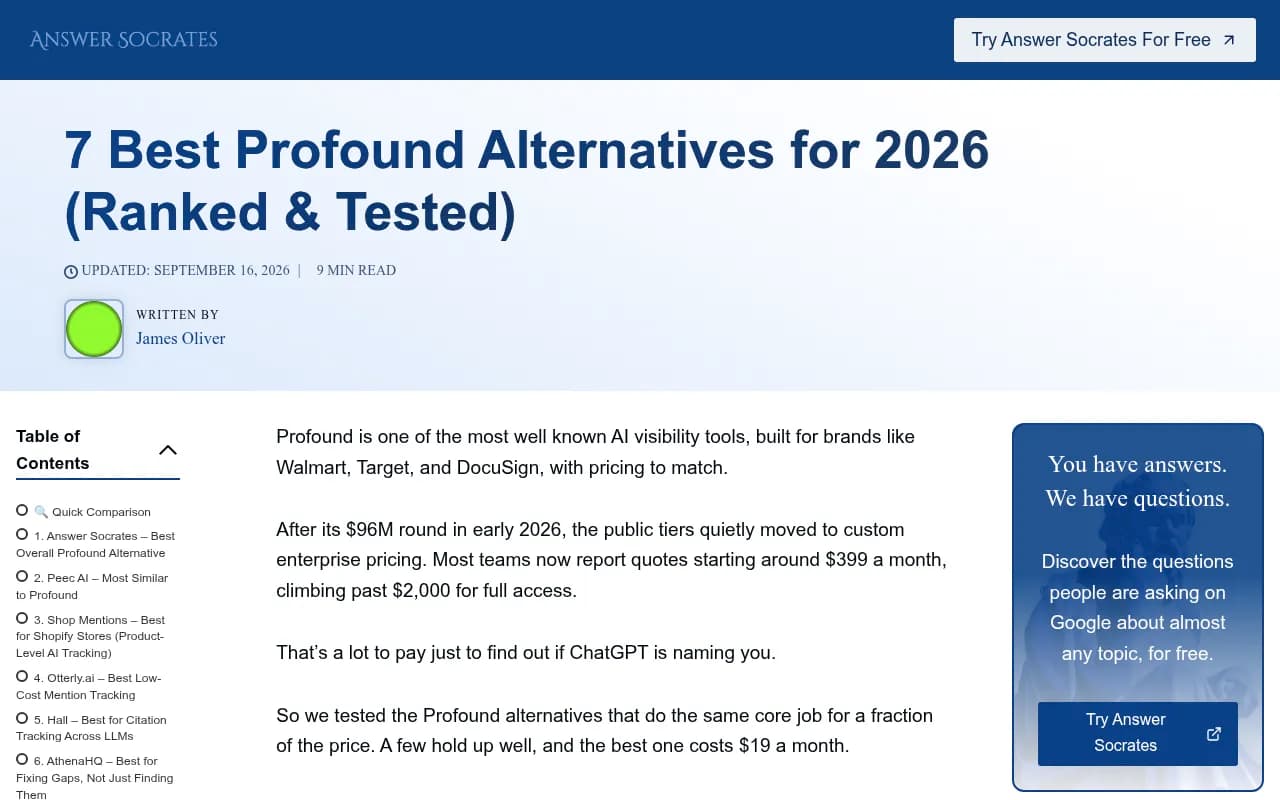
The problem is access. According to the Alhena roundup (pricing verified July 2026), Profound's pricing page lists only a free 7-day Trial and a custom Enterprise plan. The old $99 and $399 self-serve plans are gone. The Answer Socrates roundup reports that teams now see quotes starting around $399 a month and climbing past $2,000 for full access. Treat those figures as reported, not official, since Profound does not publish them.
If you are a mid-market store, a Shopify brand or an agency running several shops, that opaque pricing is the main reason to shop around.
How much does ChatGPT Shopping actually matter?
Before paying for product-level tracking, it helps to know how often shopping features show up at all. Promptwatch Data's ChatGPT shopping feature usage report measures the share of ChatGPT web-search responses that include product cards, shopping recommendations and price comparisons. Across all prompt types the share is a low single-digit percentage. It moves in steps, not smoothly: in the report window it roughly doubled overnight in late May and then fell back weeks later, which looks like OpenAI tuning when cards appear.
The all-prompt average understates things for stores. Shopping features concentrate on commercial and transactional prompts, so those are the ones to track. The practical read: shopping cards are a modest channel today, and a tool that only counts cards will miss most of how ChatGPT influences a purchase. Product pages are also the most cited content type in ChatGPT, at 22.4% of citations from Sep 28 to Oct 4, 2026, per Promptwatch's content type data. Your product pages matter even when no card appears.
One more wrinkle: ChatGPT now runs ads. Promptwatch's ChatGPT ads data shows ads in an average of 20.1% of web-search responses between May 20 and Aug 17, 2026, with daily peaks of 43.9%. For commercial prompts, you may be competing with paid placements as well as organic cards.
Comparison table
| Tool | Product-level tracking | Best for | Starting price (as reported) | Main caveat |
|---|---|---|---|---|
| Promptwatch | ChatGPT Shopping tracking, Alexa product results, catalog upload | Tracking plus fixing, with crawler and traffic data | $95/mo (free tier available) | Agency plans exclude the Content Agent |
| Alhena | SKU mapping, stale price flags, orders attribution | Revenue attribution for stores | Free, then $199/mo billed annually | Less suited to non-commerce brands |
| ShopMentions | Per-product scorecards | Shopify stores on a budget | Free trial to $29/mo | Shopify only |
| Peec AI | SKU-level visibility, position, win rate | Agencies | About EUR 85/mo | Less focus on shopping cards specifically |
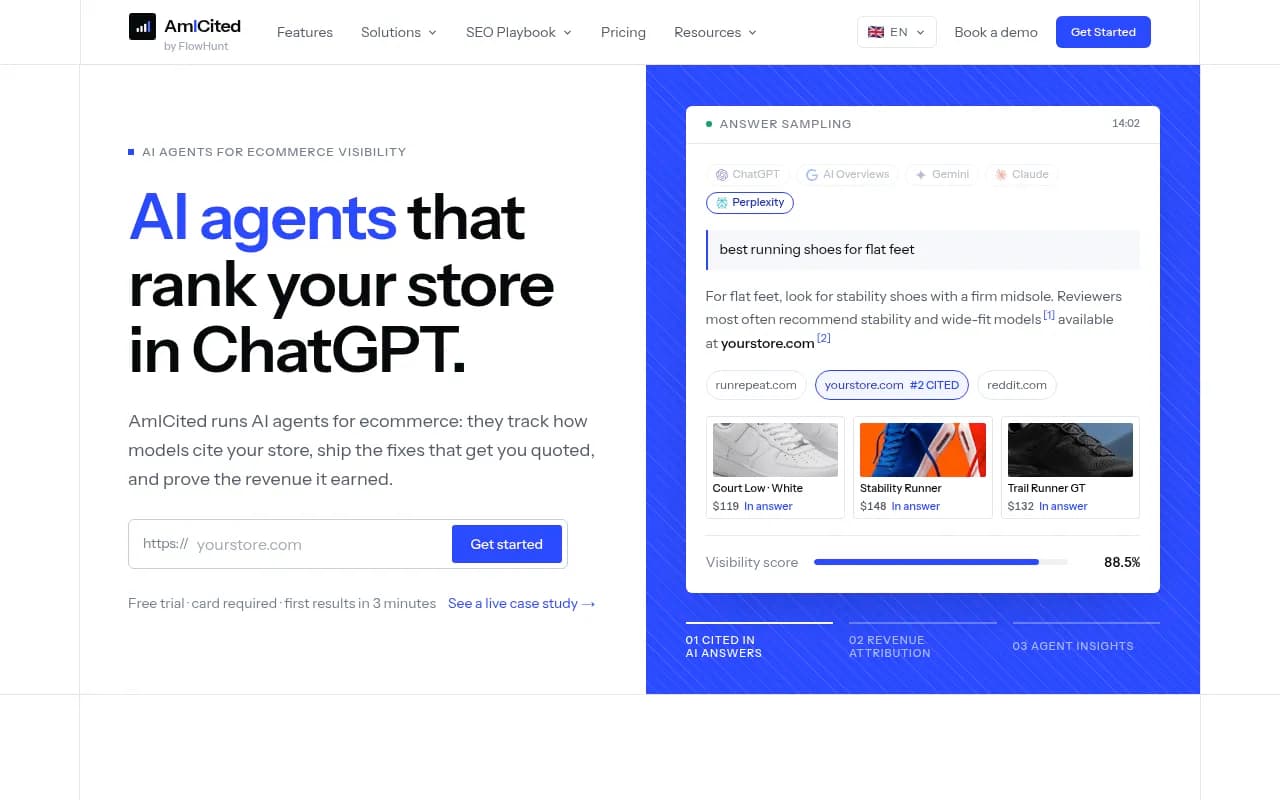
| Am I Cited | SKU-level citations, revenue attribution | Mid-market with published pricing | Published flat pricing | Verify engine coverage |
| Ranketta | Product-level AI visibility | Catalog-focused ecommerce | Check vendor | Less independent coverage |
| Brandlight | Agentic purchase positioning | Enterprise retailers | Custom | Enterprise-oriented |
Promptwatch: tracking plus the fix
Promptwatch is the option I would look at first if you want more than a scoreboard. It tracks ChatGPT Shopping carousels and Amazon Alexa product results, lets you upload your catalog to follow your own products, and alerts you when competitors appear in shopping results instead of you. It also runs Ads Radar, which shows which advertisers bid on your prompts, their ad copy and landing pages. Given the ads data above, that matters.

The difference from most trackers is what happens after you find a gap. IP-verified AI crawler logs show whether GPTBot or OAI-SearchBot can read your product pages. Visitor analytics tie AI-referred sessions to conversions. The Content Agent and Action Board then turn gaps into work. Crisp reported 2x higher conversion rates from AI traffic compared with traditional channels using this loop.
Trade-offs: the Content Agent and Shopping Insights sit on the Business plan ($579/mo), not the $95 Essential plan. Agency plans leave out both. Check promptwatch.com/pricing for current numbers.
Alhena: best if revenue attribution is the goal
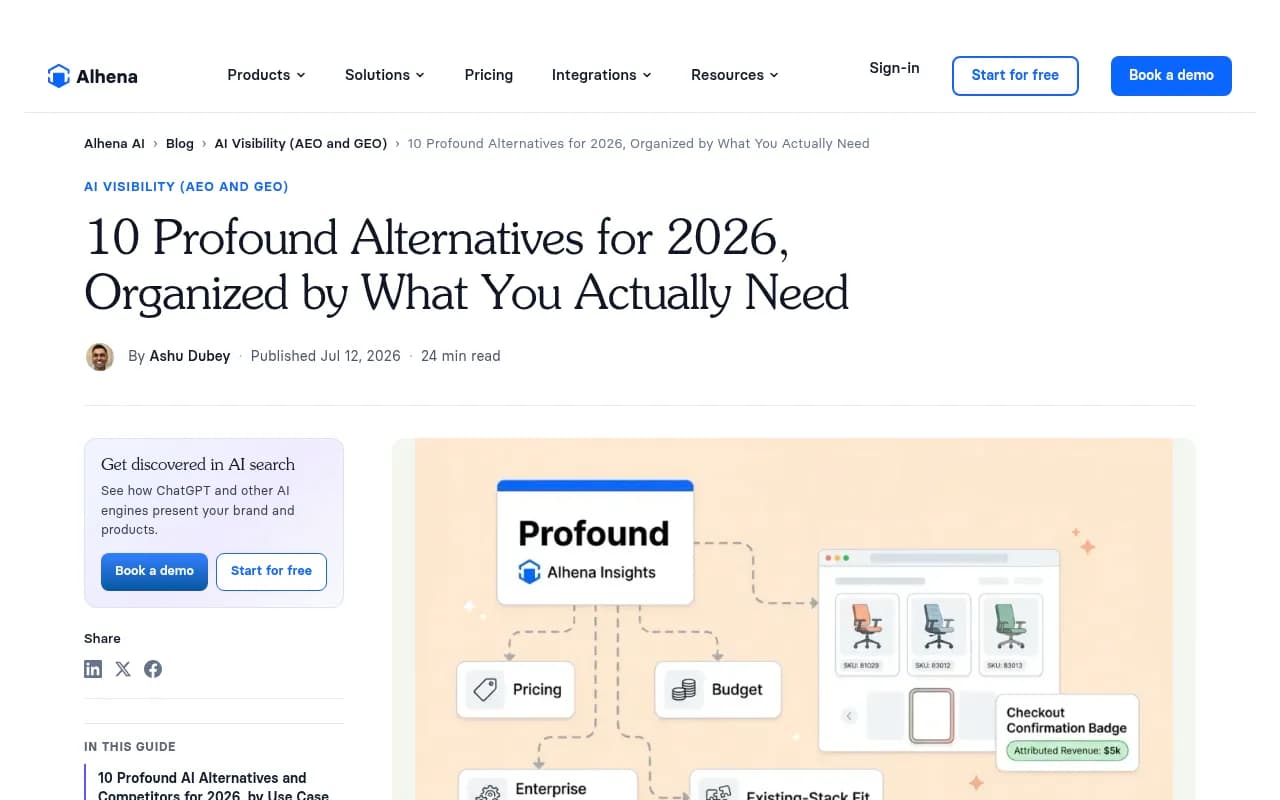
Alhena's AI Visibility product is built for online stores. It maps each AI product card to a SKU in your catalog, flags stale prices and invisible bestsellers, and, because Alhena also runs an on-site shopping assistant, it can join AI-referred sessions to checkout events. It covers ChatGPT, Google AI Overviews, Gemini, Perplexity and Claude, and syncs with Shopify, WooCommerce and Salesforce Commerce Cloud. Alhena lists plans at free, then $199, $499 and $999 a month billed annually.
Skip it if you are not a commerce brand, or if you need crawler log analysis. Note that the source for these claims is Alhena's own roundup, which ranks Alhena first for ecommerce, so read it as a vendor's view.
ShopMentions: the budget Shopify pick
ShopMentions is a Shopify-native app that pulls in your products and shows what is being said in ChatGPT, Perplexity, Gemini, Claude and AI Overviews, with per-product scorecards and competitor rankings. Answer Socrates calls it the closest match to Profound's shopping tracking at an app-store price, from a free trial up to about $29 a month. That is one author's opinion, and Answer Socrates sells a competing product, so test it yourself. It is not in our catalog, so there is no card here, and it only works on Shopify.
Peec AI and Am I Cited
Peec AI's pricing page lists SKU-level tracking as visibility, position and win rate per product, on top of brand-level metrics. It has unlimited seats, which suits agencies handling many stores.

Am I Cited takes the revenue angle: connect Shopify or WooCommerce and it ties AI-assisted sessions to orders, and its content generation drafts product pages and buying guides scored against the prompts you are losing. Its own roundup claims Profound offers neither at any price, which is a competitor claim worth checking against Profound's current feature set.
Other catalog options worth a look
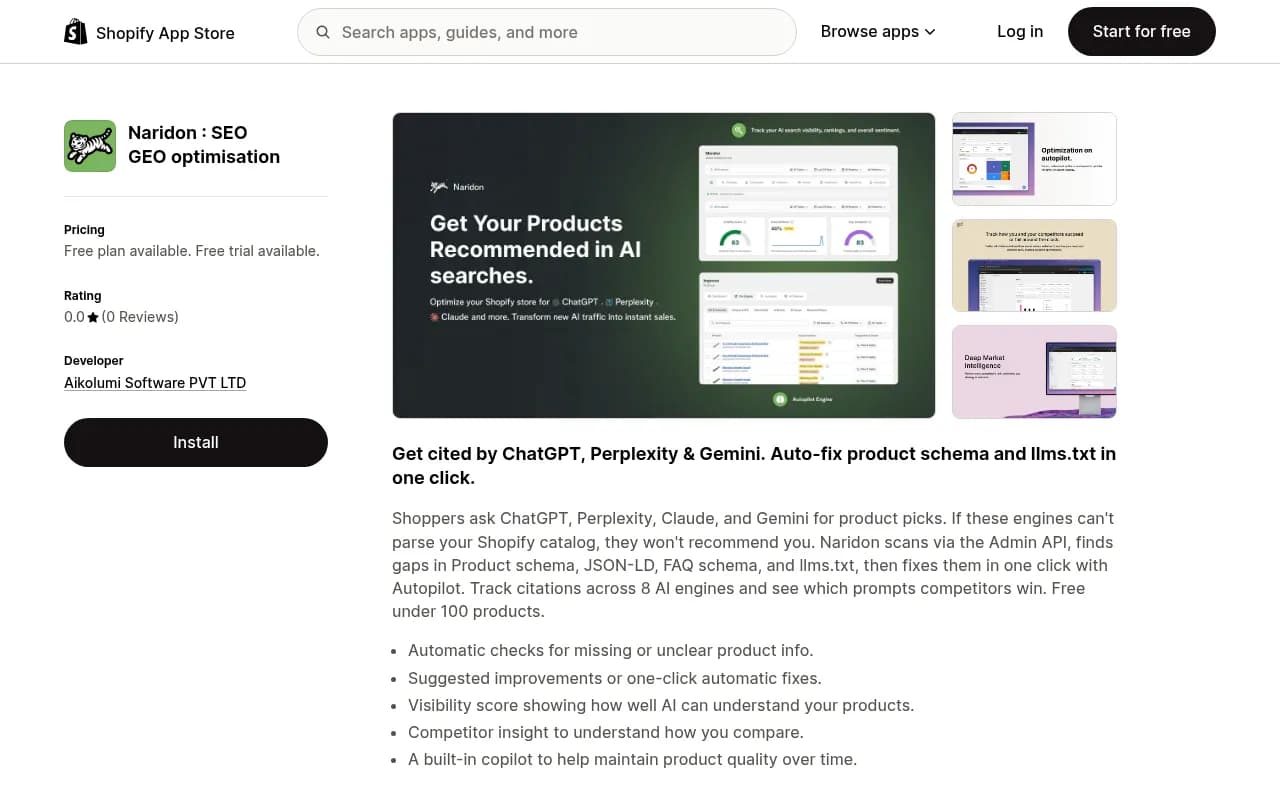
A few more tools in our catalog target ecommerce directly. Ranketta focuses on product-level AI visibility, Yotpo Discover covers catalogs and reviews, Naridon is a Shopify-native monitor, and Azoma and Bluefish target agentic commerce for AI shopping agents. Brandlight positions for the moment AI agents make purchase decisions on a shopper's behalf.
Yotpo Discover


If you already pay for an SEO suite, Semrush and Ahrefs Brand Radar add AI tracking cheaply, but the prompt sets are fixed and shallow for shopping.

For more options, browse the GEO software directory at bestgeosoftware.com.
How to choose
- Decide whether you need SKU tracking or brand tracking. If your catalog is big, you need SKU tracking. If you sell three products, brand-level tracking may be enough.
- Check the platform. ShopMentions requires Shopify. Alhena and Am I Cited connect to Shopify and WooCommerce.
- Decide whether attribution or action matters more. Alhena and Am I Cited lean on order attribution. Promptwatch leans on crawler logs, traffic and content workflows.
- Look at real-UI data. Shopping cards and ads appear in the consumer interface, and API outputs can differ. Ask each vendor how they capture responses.
- Run the tool on 20 or so commercial prompts for two weeks. Because card frequency moves in steps, a single day tells you little.
Fix the basics regardless of tool
Promptwatch's shopping data recommends complete Product schema markup, accurate prices and availability, and a clean merchant feed. Add crawler access to that list: if OAI-SearchBot hits errors on your product pages, no tracker will fix it. Check your robots.txt and CDN rules first. Then track which commercial prompts return cards and who fills them.
Treat ChatGPT shopping like early Google Shopping. Traffic is modest today, but the brands that build product visibility first will be hardest to displace.
Verdict
For a large retailer with budget, Profound is still the benchmark for SKU-level ChatGPT Shopping insight. For everyone else, start from your constraint. Shopify and tight budget: ShopMentions. Orders and revenue attribution: Alhena or Am I Cited. Agency with many stores: Peec AI. Want tracking, crawler data, ads visibility and a way to ship the fixes: Promptwatch. Whichever you pick, verify pricing on the vendor's page, because several of these numbers come from third-party roundups written by competing vendors.