Search Visibility Review 2026
Search Visibility tracks how ChatGPT, Claude, Gemini, and 9+ AI models mention your brand, comparing share of voice against competitors with a free starting tier.

Key takeaways
- Search Visibility is a brand-mention tracker that checks whether ChatGPT, Claude, Gemini, Perplexity, DeepSeek, Grok, Mistral, Llama, and Qwen mention your brand, with a 14-day free trial that doesn't ask for a credit card.
- It's monitoring-only. It lacks the content gap analysis, AI crawler logs, visitor analytics, and automated content generation that Promptwatch includes, so you'll know you're invisible but not why, and the tool won't help you fix it.
- Good fit: solo founders and small marketing teams who want a first, cheap answer to "do AI models mention us at all?"
- Skip it if you need to tie AI visibility to actual traffic and revenue, or if you run client sites and need white-label reporting.
- No public pricing, no named customers, and no third-party reviews. Most AI visibility trackers land between $79 and $149 per month, so expect that neighborhood, but you'll have to start a trial to learn the actual cost.

What Search Visibility does
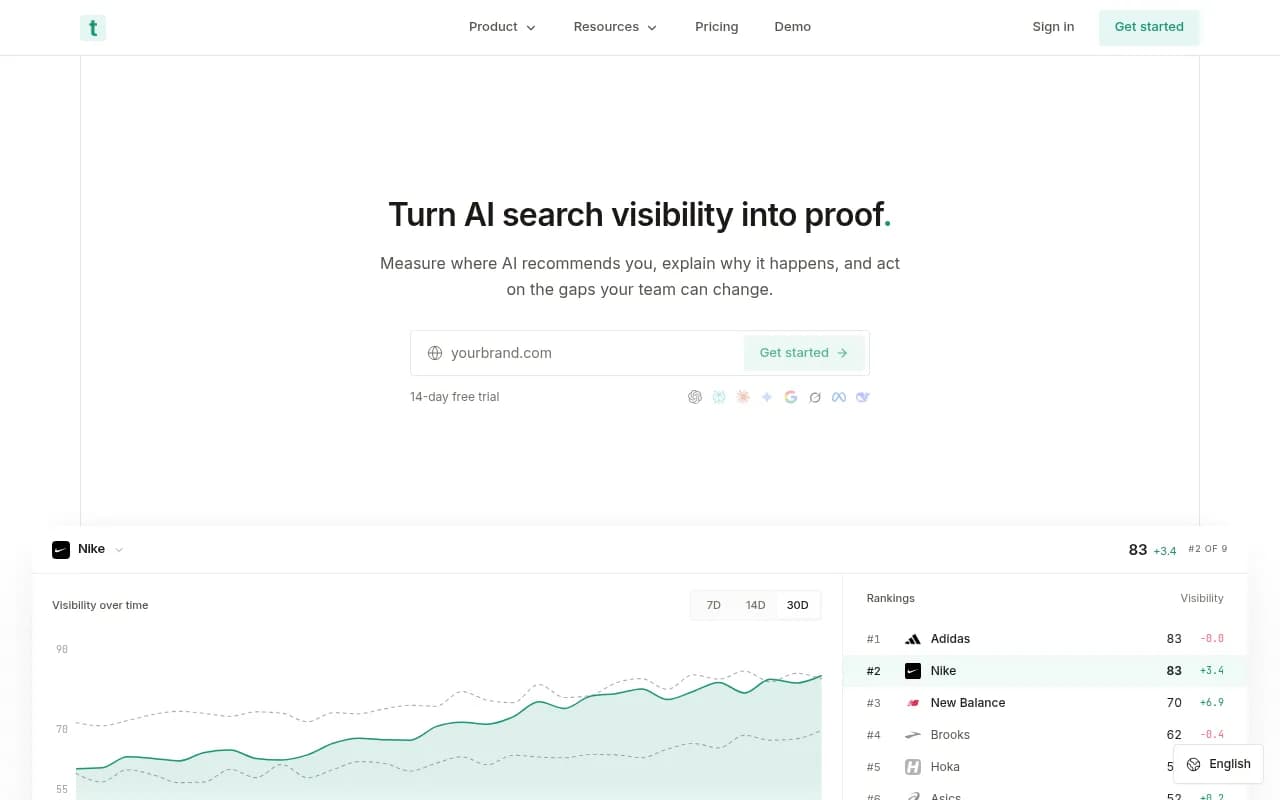
The workflow is four steps and the product doesn't pretend otherwise. You enter your brand name, website URL, and target keywords. The tool generates a set of Smart Prompts, its AI-written test questions, runs them across nine-plus models, and shows a dashboard with visibility scores, mention counts, rankings, and competitor comparisons.
The model list is the strongest card it plays. ChatGPT, Claude, Gemini, Perplexity, DeepSeek, Grok, Mistral, Llama, and Qwen is broader coverage than some more expensive trackers offer, and the team recently added Qwen along with Share of AI Voice tracking. If your audience skews toward markets where Qwen matters, that's a real differentiator. One small oddity: the hero copy says "9+ models" while the stats bar says "8+," which tells you the marketing is moving faster than the product copy. Not a dealbreaker, just a sign of a small team shipping quickly.
What works
Smart Prompts is the feature I'd point a beginner to first. Most trackers hand you an empty prompt box and wish you luck. Search Visibility generates test prompts from your brand and keywords, which protects you from the most common mistake in this category: tracking questions nobody actually asks.
Source tracking is the most actionable thing here. The tool shows which sources AI models cite when they mention you or your competitors, and the practical fix for weak visibility is usually "get cited by the sources the model already trusts." The implementation is shallow next to what mature platforms do, Promptwatch classifies every citation into 22 content types and 20 source types and tracks ramp-up and decay per cited page, but the core idea is present and useful.
Sentiment analysis and historical trends round out the package. You can see whether models describe you positively and whether that's improving over time. The trend charts are the reason to keep the tool running past week one, because single snapshots age fast in this space. Competitor share of voice per model is there too, which is table stakes but works. There's also a demo video on the site and a beginner-friendly blog, including a 2026 AI search optimization guide, which suggests the people behind it know the space.
Where it falls short
The tool stops at "was I mentioned?" That question is where it begins and ends. There's no content gap analysis to show which prompts you're losing and why, no content briefs, no writing agent, no CMS publishing. When you find a visibility hole, the product's answer is a blog post, not a workflow.
There are no crawler logs. Search Visibility can't tell you whether ChatGPTBot or ClaudeBot has ever visited your site, which pages they read, or whether they hit errors. That diagnostic layer is what explains why visibility scores move, and without it you're guessing at causes. Promptwatch logs 400+ crawlers in real time and connects the crawl-to-citation path for each page.
Mentions are not revenue, and the tool can't bridge that gap. There's no visitor analytics, so you can't see whether AI-driven users actually land on your site or convert. For a CMO building a budget case, that's a hard stop.
Reddit and YouTube, two of the most-cited source types in AI answers, get no dedicated tracking. ChatGPT shopping results, increasingly a commercial channel, are absent too. Smart Prompts come with no volume or difficulty data, so you can end up optimizing for prompts with no real demand. Query fan-outs, page-level citation tracking, prompt volumes: none of it is here.
The public evidence is thin. The site claims an "average 40% increase in AI mentions within 90 days" with no methodology, no case studies, and no named customers. I couldn't find a G2 profile or any third-party reviews. Pricing isn't published; you start a trial first and learn the cost after. None of this means the product is bad, but you're asked to take a fair amount on faith.
Strengths and limitations
Strengths:
- Nine-plus model coverage including Qwen, DeepSeek, and Grok
- 14-day free trial with no credit card
- Smart Prompts lower the entry barrier for beginners
- Source tracking, sentiment, trends, and competitor share of voice included
- Fast setup, genuinely usable in an afternoon
Limitations, compared with a full-stack platform like Promptwatch:
- No content gap analysis or answer-gap reporting
- No AI content generation, briefs, or CMS publishing to Webflow, Framer, or WordPress
- No AI crawler logs or agent analytics
- No visitor analytics or AI traffic attribution
- No Reddit or YouTube citation tracking
- No ChatGPT Shopping or Ads Radar
- No prompt volume or difficulty scoring, no query fan-outs
- No page-level citation lifecycle tracking
- No agency features: white-label dashboards, client portals, scheduled PDF reports
- No documented API, Slack integration, or Looker Studio connector
Who it's for
A solo founder or a two-person marketing team that has never checked AI visibility and wants a cheap first look will get value here. The tool answers "do AI models know we exist?" competently, and the free trial makes finding out painless.
It's a poor fit for SEO agencies managing multiple client sites (no white-label or client portal), for e-commerce brands (no shopping-result tracking), and for anyone who needs to report AI search as a revenue channel rather than a vanity metric. The missing analytics layer will bite within a month of serious use.
Bottom line
Search Visibility is a decent, narrow instrument. It tells you whether AI models mention you, how often, next to whom, and with what sentiment, and for a first look at AI visibility that's a reasonable way to spend a free trial.
But the category has moved past mention-counting. If you want a platform that explains why you're invisible, shows which pages and sources drive citations, measures the traffic AI actually sends, and then closes the loop by planning, writing, and publishing optimized content for you, Promptwatch is the stronger choice. It covers the chat models Search Visibility tracks plus Google AI Overviews, AI Mode, and AI coding assistants, adds crawler logs and visitor analytics that Search Visibility doesn't have at any price, and backs it with 1,840+ customers and a 4.7/5 G2 rating. Get your quick read here if the trial is free; do the actual optimization work somewhere that can act on the data.
Tags:
Frequently asked questions
What does Search Visibility do?
How much does Search Visibility cost?
Which AI models does Search Visibility track?
Is Search Visibility free?
How does Search Visibility compare to Promptwatch?
Who should use Search Visibility?
Does Search Visibility have a free trial?
What are the main limitations of Search Visibility?
Similar and alternative tools to Search Visibility